1. Introduction
The exhaust pipe has been the centre of automotive emissions engineering since the first catalytic converters. Successive standards forced down carbon monoxide, hydrocarbons, nitrogen oxides and particulate matter, and the particulate filter, now fitted to diesel and many petrol engines, removes the great majority of solid exhaust particles. Electrification completes the process by removing the engine. It would be easy to conclude that vehicle particle emissions are a problem with an end date.
They are not. A moving vehicle also produces particles by abrasion: brake pads against discs, tyres against the road, and the road surface itself, together with dust that traffic lifts back into the air. Reviews of these non-exhaust sources have for some years pointed out that their share of traffic-related particulate matter rises as exhaust emissions fall (Thorpe and Harrison, 2008; Amato et al., 2014), and source apportionment at roadside sites supports this (Pant and Harrison, 2013). National and international bodies now describe non-exhaust emissions as the larger part of primary particulate matter from road transport in countries with modern fleets (Air Quality Expert Group, 2019; OECD, 2020).
This Perspective takes a position on what follows from that. Its claim is that brake and tyre wear will outlast the tailpipe as a problem for engineers and regulators, and that the two are not equally tractable: brake wear can be reduced substantially by technology already in production, while tyre wear is bound to the function of the tyre and will persist.
2. The Argument
The case can be made in four steps: wear is intrinsic to how vehicles are controlled, the trend in vehicle design is unfavourable, the particles are chemically consequential, and the means of measuring and regulating them are immature.
2.1. Wear is intrinsic to grip
Exhaust particles were a by-product. Combustion can in principle be made clean, and where it cannot, the gas stream passes through a pipe in which a filter can be placed. Wear particles are different in kind. A tyre transmits every driving, braking and cornering force through a contact patch the size of a hand, and it does so by deforming and slipping against a rough surface. Material loss is the price of grip. The particles leave from an open, rotating surface into free air and onto the road, with no duct in which to intercept them. A friction brake converts kinetic energy to heat by rubbing, and the debris includes a fine fraction generated at high interface temperatures (Garg et al., 2000; Sanders et al., 2003).
2.2. Vehicles are becoming heavier
Tyre wear grows with the forces the tyre must carry, and those grow with mass and with the torque applied. The market has moved toward larger vehicles for years, and battery electric vehicles are heavier than their combustion counterparts because of the battery. Timmers and Achten (2016) argued on this basis that electric vehicles would bring little or no reduction in total particulate emissions, since added tyre and road wear and resuspension would offset the exhaust removed. Beddows and Harrison (2021) examined the dependence of non-exhaust emission factors on vehicle mass and reached a more qualified conclusion, in which the outcome depends on how much regenerative braking is used. The direction of the mass effect on tyres is not in dispute.
2.3. The particles are chemically consequential
Brake debris is rich in iron and, depending on the pad formulation, in copper, barium, antimony and other metals (Grigoratos and Martini, 2015). Toxicological studies of such particles, summarised in the same review, point to oxidative stress as a plausible mechanism of harm, although the body of evidence is still small. Tyre tread is a compound of natural and synthetic rubber, fillers, oils and protective additives, and the particles collected on roads are mixtures of tread and mineral material from the pavement (Kreider et al., 2010). Tyre wear is counted among the largest sources of microplastics released to the environment (Kole et al., 2017).
The clearest warning came from an unexpected direction. Tian et al. (2021) traced the recurrent deaths of coho salmon in urban streams of the Pacific Northwest to a quinone formed when a common tyre antiozonant, 6PPD, reacts with ozone. The compound was toxic at very low concentrations and had not previously been identified. Whatever its wider significance proves to be, the episode shows that the chemistry of tyre wear in the environment is not fully known, and that harm may arise in water and not only in air (Wagner et al., 2018).
2.4. Measurement and regulation are immature
Exhaust emissions are measured by standard procedures refined over decades. For wear particles the equivalent infrastructure is only now being built. A laboratory procedure for brake particle emissions from light-duty vehicles has been agreed at United Nations level (UNECE, 2023), and the Euro 7 regulation introduces limits on brake particle emissions and provides for limits on tyre abrasion (European Parliament and Council, 2024). Tyre abrasion is harder to standardise than brake emissions, because the result depends on the road surface, the temperature, the route and the driver, and because what matters environmentally is both the airborne fraction and the far larger mass that falls to the ground. Table 1 compares the particle sources on these points.
| Source | Principal constituents | Effect of electrification | State of regulation |
|---|---|---|---|
| Exhaust | Soot, organic compounds, ash | Eliminated | Mature limits and test methods |
| Brake wear | Iron and other metals, binder residues | Much reduced by regenerative braking | Limits introduced; test procedure agreed |
| Tyre wear | Rubber polymer, fillers, additives | Unchanged or increased with mass and torque | Abrasion limits in preparation |
| Road surface wear | Mineral aggregate, bitumen | Unchanged or increased with mass | None specific to vehicles |
| Resuspended dust | Mixture of deposited material | Unchanged | Managed through road cleaning |
3. Counter-Arguments
Three objections deserve a direct answer. The first is that regenerative braking solves the brake problem. To a large degree it does. An electric or hybrid vehicle recovers much of its kinetic energy through the motor, and its friction brakes are used far less. This is why the thesis here distinguishes the two sources: brake wear is on a path to substantial reduction, helped by harder disc coatings and by the new limits. But friction brakes remain on every vehicle for emergency stops and for holding, and the combustion fleet will be in use for decades. The objection weakens the claim for brakes without touching it for tyres.
The second objection is that wear particles are mostly coarse, settle quickly and are less harmful than combustion aerosol. The premise is partly right. Much of the mass of tyre debris is in particles too large to remain airborne, and estimates of the airborne share vary widely (Baensch-Baltruschat et al., 2020). The evidence on health effects of non-exhaust particles is also thinner than for exhaust, and honest reviews say so (Amato et al., 2014). Yet the conclusion does not follow. Coarse particles that leave the air enter soil, drains and rivers, where the concern is ecological. And an uncertain hazard attached to a source that every vehicle carries is a reason to study it, not to discount it.
The third objection is that regulation has arrived, so the problem is in hand. Limits on brake emissions and tyre abrasion are a real change. They resemble, however, the earliest exhaust standards more than the latest: the test methods are new, the limits are a first step, and replacement tyres and pads, which make up most of what is fitted over the life of a vehicle, are harder to police than original equipment. The history of exhaust regulation suggests a long sequence of revisions lies ahead.
4. Implications
If the argument holds, the response cannot be modelled on the exhaust filter. No single device can be bolted on. The measures available act at different points between the cause of wear and the place where particles end up, and Figure 1 arranges them in that order.
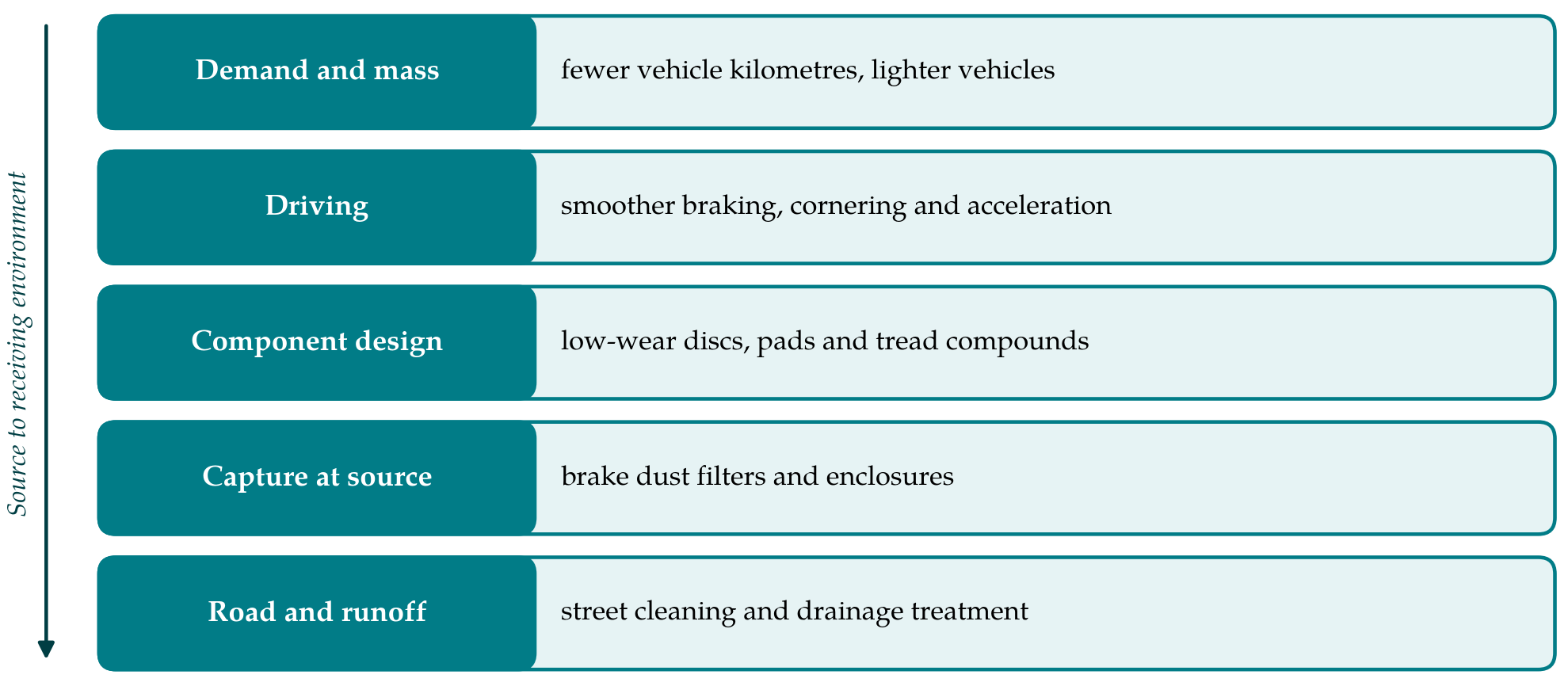
The upper layers are the most effective and the least popular. Fewer vehicle kilometres and lighter vehicles reduce every wear source at once, yet they run against the commercial trend. Driving style has a strong influence on tyre and brake wear, and driver assistance systems that smooth acceleration and anticipate stops could deliver part of that benefit without relying on behaviour. Component design is where engineers have most freedom: tread compounds that wear more slowly without sacrificing wet grip, substitutes for additives with harmful transformation products, coated discs and low-metal pads.
The lower layers accept that particles will be produced and try to intercept them. Devices that collect brake dust at the caliper have been demonstrated, and the enclosed geometry of a brake makes this feasible in a way it is not for a tyre. For tyre debris the practical point of capture is the road: street sweeping, gully pots, and treatment of runoff through sedimentation and filtration before it reaches watercourses. That places part of the responsibility with highway and water authorities, outside the vehicle type-approval system altogether, and it implies cooperation between institutions that have had little reason to work together.
For research, the priority is measurement that connects the laboratory to the road: tyre abrasion tests whose ranking of products holds in real use, markers that allow tyre material to be quantified in air, water and sediment, and toxicological work on realistic particle mixtures. For the automotive engineering community the implication is a change of habit. Emissions have been the business of powertrain departments. They are becoming the business of chassis, brake and tyre engineers.
5. Conclusion
Exhaust particles are being engineered out of road transport. Wear particles are not, because they arise from the friction by which vehicles are driven, steered and stopped. Brake wear can be cut sharply by regenerative braking and better materials, and regulation has begun to require it. Tyre wear is tied to grip and to vehicle mass, has no point of capture on the vehicle, and carries chemical hazards that are still being discovered. It is therefore likely to remain on the agenda long after the tailpipe has gone, and it calls for a layered response in which vehicle design, materials chemistry and road drainage each have a part.
Conflict of interest
To be declared by the author(s) before publication.
Funding
To be declared by the author(s) before publication.