1. Introduction
Early childhood caries is defined as the presence of one or more decayed, missing or filled tooth surfaces in any primary tooth of a child under six years of age. It is among the most common chronic conditions of childhood, and its burden falls unevenly: within every country studied, prevalence and severity are greatest among children from poorer families (Tinanoff et al., 2019). Untreated lesions cause pain, infection, disturbed sleep and eating, and absence from school. The Bangkok Declaration of the International Association of Paediatric Dentistry called for approaches that reach children where they live and that do not depend on specialist services (Pitts et al., 2019).
Restoring carious primary teeth in a three-year-old demands cooperation that many young children cannot give. Where treatment is available at all, it frequently involves sedation or general anaesthesia, with the attendant cost and risk. In low-income settings, and in underserved districts of wealthy countries, the practical alternative has been no treatment. Minimal intervention dentistry has sought methods that control the disease process with little or no removal of tooth tissue (Frencken et al., 2012). Silver diamine fluoride belongs to that tradition, and it has attracted attention because it is inexpensive, quick to apply and needs no equipment beyond a microbrush.
This review considers the use of silver diamine fluoride to arrest cavitated lesions in preschool children in community settings, meaning schools, nurseries, primary care clinics and outreach programmes as distinct from the dental surgery.
2. Scope and Approach
The article is a narrative review of the published literature. It relies on the randomised trials conducted in primary teeth, on systematic reviews and an umbrella review, and on the clinical guidelines issued by professional bodies. It does not report a new search with counts of records, and it offers no pooled estimate of its own. Trials in permanent teeth and in older adults are mentioned only where they bear on safety. Statements about effectiveness are worded to reflect the conclusions of the reviews cited and not any single trial.
3. Chemistry and Mode of Action
Silver diamine fluoride is an alkaline, colourless solution in which silver ions are stabilised by ammonia. The 38% formulation used in most trials contains about 44,800 parts per million of fluoride, roughly twice the concentration of sodium fluoride varnish. It was developed in Japan, where it has been in clinical use since the early 1970s (Yamaga et al., 1972). In the United States it was cleared in 2014 as a treatment for dentine hypersensitivity, and its use for caries arrest there is off-label.
Its action is usually explained under three headings (Mei et al., 2018). Silver ions are bactericidal and disrupt the cariogenic biofilm. Fluoride promotes remineralisation, and the treated surface becomes harder and richer in mineral. The solution also inhibits the proteolytic enzymes, including matrix metalloproteinases and cysteine cathepsins, that break down dentine collagen once it has been demineralised. The clinical sign of arrest is a lesion that is hard to gentle probing and dark brown or black. The colour comes from silver compounds precipitated in the carious tissue and is permanent (Rosenblatt et al., 2009).
4. Evidence of Effectiveness
The clinical evidence comes largely from community-based trials, which makes it unusually relevant to the question asked here. Table 1 lists the trials most often cited.
| Trial | Setting and children | Comparison | Principal conclusion |
|---|---|---|---|
| Chu et al., 2002 | Kindergartens, southern China | Annual 38% SDF versus quarterly fluoride varnish | SDF arrested more dentine lesions in anterior primary teeth |
| Llodra et al., 2005 | Schoolchildren, Cuba | Six-monthly 38% SDF versus no treatment | Fewer new lesions and more arrest over 36 months |
| Yee et al., 2009 | Schoolchildren, Nepal | Single application of 38% or 12% SDF versus none | One application of 38% arrested caries; 12% was weaker |
| Zhi et al., 2012 | Kindergartens, southern China | Annual SDF, six-monthly SDF, annual glass ionomer | Six-monthly application raised the arrest rate |
| Fung et al., 2018 | Kindergartens, Hong Kong | 12% versus 38%; annual versus six-monthly | 38% applied six-monthly performed best |
| Milgrom et al., 2018 | Preschool programmes, United States | 38% SDF versus placebo, short term | More lesions arrested; no rise in resistance genes detected |
The trials differ in age group, lesion type and follow-up, but they point the same way. Systematic reviews restricted to children have concluded that 38% silver diamine fluoride arrests a clear majority of treated dentine lesions in primary teeth, and that it is more effective for this purpose than fluoride varnish or the other non-restorative agents with which it has been compared (Duangthip et al., 2015; Gao et al., 2016). A network meta-analysis prepared for the American Dental Association reached a similar conclusion (Urquhart et al., 2019), and an umbrella review of existing reviews found their conclusions to be consistent while noting that many of the underlying trials carried some risk of bias (Seifo et al., 2019).
Two questions of regimen are reasonably settled. The 38% solution is more effective than the 12% solution, and application twice a year is more effective than once a year (Yee et al., 2009; Zhi et al., 2012; Fung et al., 2018). The guideline of the American Dental Association accordingly gives priority to 38% silver diamine fluoride applied twice yearly for cavitated coronal lesions in primary teeth (Slayton et al., 2018), and the American Academy of Pediatric Dentistry supports its use as part of a wider caries management plan (Crystal et al., 2017). In 2021 the World Health Organization added the product to its Model List of Essential Medicines (WHO, 2021).
Some limits should be stated plainly. Arrest is not universal, and lesions in posterior teeth, on surfaces that trap plaque and in children with poor oral hygiene respond less well than exposed anterior lesions. Arrested lesions can reactivate if the conditions that caused them persist. The trials measure lesion hardness, and fewer report outcomes that matter directly to the child, such as pain, infection or quality of life. Whether a child treated with silver diamine fluoride at three reaches the age of tooth exfoliation with fewer episodes of toothache than an untreated child is plausible but less firmly documented than the arrest of lesions.
5. Safety
Decades of use have produced no signal of serious harm. Reported adverse effects are local and transient: a metallic taste, temporary whitening or irritation of gingiva touched by the solution, and brown staining of skin that fades as the epidermis is shed. Because the fluoride concentration is high, the quantity applied is kept very small, in practice a drop on a microbrush for several teeth. A pharmacokinetic study in adults found that serum fluoride and silver after a single topical application stayed well below levels of toxicological concern (Vasquez et al., 2012). Comparable measurements in very young children are scarce, and manufacturers and guidelines advise limits on the amount used at one visit, which programmes should follow.
Accepted contraindications are allergy to silver and the presence of ulcerative gingivitis or stomatitis. The agent is not a treatment for teeth with signs or symptoms of pulpal involvement, such as spontaneous pain, swelling or a sinus tract. Screening for those signs without radiographs is one of the real difficulties of community use and is taken up below.
6. Staining and Acceptance
The black colour of arrested lesions is the chief drawback, and it is the reason the agent was long ignored in wealthy countries. Parents' views depend on where the tooth is and on what the alternative would be. In a survey of parents in the United States, staining of posterior teeth was widely accepted and staining of anterior teeth much less so, but acceptance of anterior staining rose when the alternative presented was treatment under sedation or general anaesthesia (Crystal et al., 2017). Informed consent therefore needs photographs of treated teeth, and the protocol developed at the University of California, San Francisco builds this into the consent form (Horst et al., 2016).
Two techniques are used to lessen the cosmetic problem. Potassium iodide applied immediately after the fluoride solution reduces staining in the short term, although its effect on arrest and on long-term colour is uncertain. Alternatively, arrested lesions can be covered with glass ionomer cement, with or without hand excavation in the manner of atraumatic restorative treatment. Neither removes the need for a frank conversation with the family before the first application.
7. Delivery in Community Settings
The features that make silver diamine fluoride attractive to programme planners are practical. It needs no electricity, suction or dental chair; application takes a few minutes; and the material cost per child is low. Several of the trials in Table 1 were carried out in kindergartens and schools with portable equipment, so effectiveness under field conditions has been demonstrated directly and not inferred from clinic studies. Figure 1 sets out the stages of a community programme and the obstacle most often met at each.
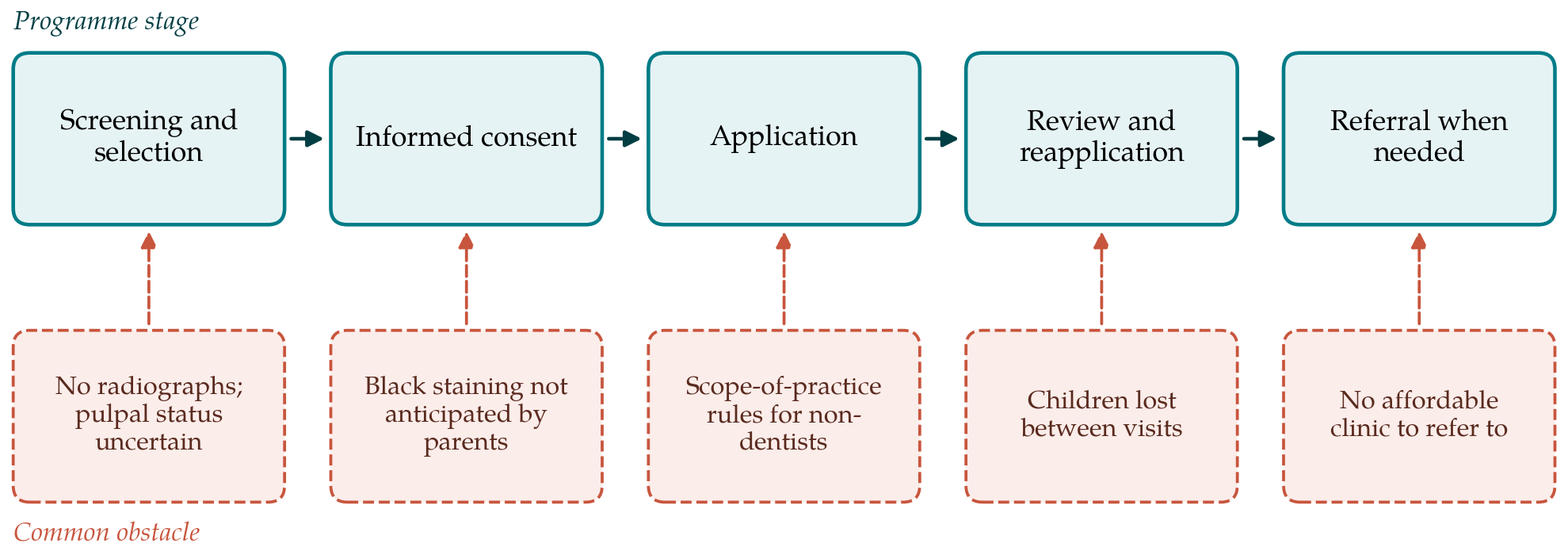
Selection of teeth is the first problem. In a school hall there are no radiographs, and the examiner must judge pulpal status from history and appearance. Programmes generally exclude teeth with pain, swelling or mobility and refer those children. Some asymptomatic teeth with pulpal involvement will be treated unknowingly, which is one reason follow-up matters.
Workforce is the second. The technique is simple enough to be taught to dental hygienists, dental therapists, nurses and community health workers, and school-based programmes have used such staff. A large school-based randomised trial in New York City compared silver diamine fluoride with sealants and atraumatic restorations and reported that the simpler regimen was not inferior for caries control (Ruff et al., 2023). Whether non-dentists may apply the agent is a matter of national or state regulation, and in many jurisdictions the law lags behind the evidence.
Continuity is the third. A single application gives less protection than a repeated one, so a programme has to find the same children again after six months. Linking applications to fixed points in the school or immunisation calendar helps. So does integration with other measures: supervised brushing with fluoride toothpaste, dietary advice, and, for multi-surface lesions in primary molars, preformed metal crowns placed by the Hall technique, which also avoids drilling and local anaesthetic (Innes et al., 2007). Silver diamine fluoride addresses existing lesions. It does not change the sugar exposure that produced them.
8. Gaps in the Evidence
Several questions remain open. Most trials follow children for two to three years, and outcomes at exfoliation are seldom reported. Child-centred outcomes, including pain, sepsis, school attendance and oral health-related quality of life, are under-measured. Economic evaluations exist, but few are based on programme-scale data from low-income settings where the case for the agent is strongest. Evidence on delivery by non-dental personnel is growing but still limited to a small number of health systems. The interaction with potassium iodide, the durability of glass ionomer placed over treated dentine, and the best management of lesions that fail to arrest all need better trials.
There is also a question of equity that evidence alone cannot settle. A treatment that leaves black teeth may come to be offered mainly to poor children, while others receive tooth-coloured restorations. Advocates reply that the realistic comparison for these children is untreated disease. Both points are fair. Programmes can answer the concern by offering restoration over arrested lesions where resources allow and by ensuring that consent is informed and freely given.
9. Conclusion
The published evidence supports 38% silver diamine fluoride, applied twice a year, as an effective and safe means of arresting cavitated lesions in primary teeth, and much of that evidence was gathered in the community settings where the need is greatest. Its limitations are equally clear: permanent black staining, incomplete arrest, no restoration of form, and reliance on repeat visits. Used with honest consent, a referral route for teeth beyond its scope and continued prevention, it offers a way of controlling disease in children who would otherwise go without care. The priorities for research are long-term and child-centred outcomes, delivery by a wider workforce, and cost at scale.
Conflict of interest
To be declared by the author(s) before publication.
Funding
To be declared by the author(s) before publication.