1. Introduction
Oral diseases are among the most prevalent conditions in the world, and most of them are preventable or treatable at an early stage. The World Health Organization estimates that they affect close to 3.5 billion people (WHO, 2022). Two papers in the Lancet in 2019 described how dentistry has remained apart from the rest of health care, organised around private operative treatment and poorly matched to the pattern of need (Peres et al., 2019; Watt et al., 2019). Rural populations feel this mismatch sharply. Disease is common, dentists are few, and the journey to a clinic may cost a day's work.
Teledentistry applies telecommunications to this problem. In its simplest form a locally based worker photographs the mouth and sends the images with a history to a dentist elsewhere, who replies with an assessment and a plan. The idea is decades old (Jampani et al., 2011). For most of that time it remained a pilot activity. Then, when routine dental care was suspended in 2020, remote consultation became for a period the only form of dental contact available (Ghai, 2020). Regulators relaxed rules, payers reimbursed remote consultations, and clinicians who had never used the method learned it quickly.
Much of that provision has since been withdrawn or allowed to lapse. This Perspective argues that for rural services this is a mistake, and that teledentistry should be established as a permanent part of how rural oral health care is organised.
2. A Structural Shortage
The case begins with the nature of the rural problem. Tudor Hart (1971) observed that the availability of good medical care tends to vary inversely with the need for it in the population served. Dentistry is a clear instance. Dentists establish practices where patients can pay and where professional and family life is convenient, and that is seldom a remote district. Analyses of rural oral health in the United States describe the same combination repeatedly: fewer providers per head, longer travel, lower rates of insurance, less fluoridated water and more untreated disease (Skillman et al., 2010).
Recruitment incentives, rural training placements and mobile clinics all help at the margin, but none has closed the gap, and each depends on moving scarce clinicians physically to places they do not stay. A service that lets one dentist's diagnostic and planning time be used across many sites, without travel, addresses the shortage at its root. That is the structural reason to treat teledentistry as infrastructure and not as a stopgap.
3. What Remote Dentistry Can Do
Teledentistry is not one thing. Table 1 distinguishes the main modes and what each is suited to. The distinction matters because objections that apply to one mode are often raised against all of them.
| Mode | How it works | Suited to | Not suited to |
|---|---|---|---|
| Store-and-forward | Images and records sent for later review by a dentist | Screening, triage, treatment planning | Urgent decisions |
| Real-time video | Live consultation between patient, local worker and dentist | History, advice, urgent triage, follow-up | Fine visual detail |
| Specialist consultation | Local dentist sends a case to a distant specialist | Oral medicine, orthodontic and surgical opinion | Replacing biopsy or imaging |
| Remote supervision | Dentist oversees allied personnel working in the community | Prevention and simple interim care | Complex operative work |
| Remote monitoring | Patient-captured images reviewed at intervals | Post-operative and orthodontic review | Initial diagnosis |
The published evidence is uneven in quality but reasonably consistent in direction. Systematic reviews have found that remote assessment from intraoral images agrees well enough with clinical examination to be used for screening and triage (Alabdullah and Daniel, 2018; Estai et al., 2016). In preschool children, examination by intraoral camera reviewed at a distance was comparable to visual examination for detecting caries (Kopycka-Kedzierawski and Billings, 2013). Reviews of clinical outcomes, use and costs report benefits in access and reduced travel, while noting that few studies are randomised and that economic evaluation is thin (Daniel et al., 2013; Mariño and Ghanim, 2013; Estai et al., 2018).
The most developed rural application combines remote assessment with local delivery. In the virtual dental home model described in California, dental hygienists and assistants based in schools, nursing homes and community centres collect radiographs, photographs and charting, a dentist reviews the records remotely, and the local team then provides prevention and interim restorations under that dentist's direction (Glassman et al., 2012). People who need operative care are referred. People who do not, often a substantial share, are looked after where they are. This is what makes teledentistry more than a referral filter (Daniel and Kumar, 2014).
4. Why Permanence Matters
A service that exists only under emergency rules or project grants cannot do the things that make it valuable. Staff are not trained for a programme that may end next year. Clinics do not buy intraoral cameras or reorganise appointment books for a payment code that may be withdrawn. Patients do not come to trust a route into care that appears and disappears. A qualitative synthesis of clinicians' experience identified uncertainty over funding and regulation, more than technology, as what holds adoption back (Irving et al., 2018), and an analysis of barriers in dentistry reached a similar view (Estai et al., 2016).
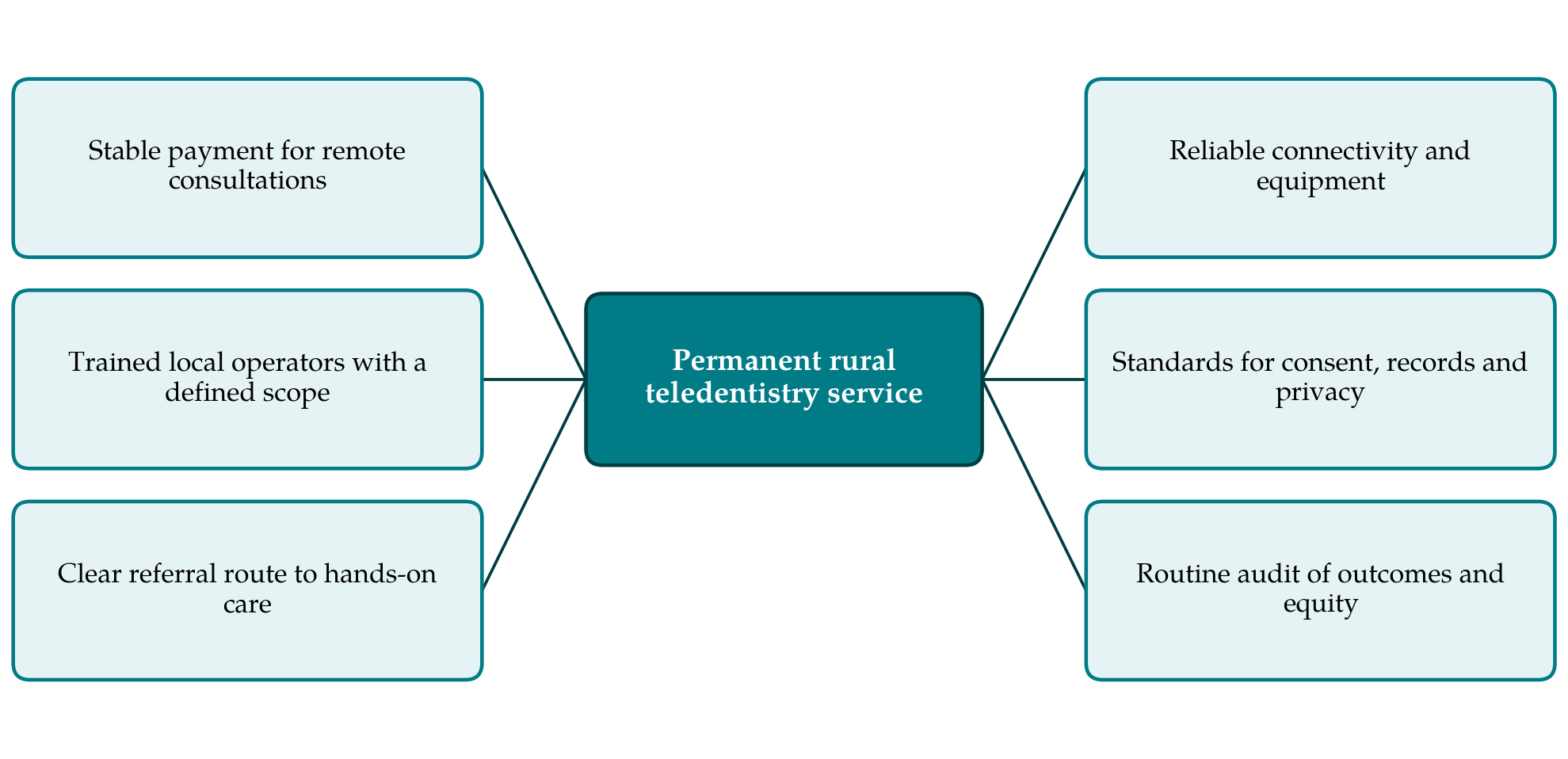
Permanence also changes what can be learned. Short pilots produce short evaluations, usually of diagnostic agreement or satisfaction. Questions that matter for policy, such as whether disease levels fall, whether emergency attendances decline and whether costs are offset, can only be answered by services that run for years. Figure 1 summarises the conditions that a permanent service has to meet.
There is an international mandate for moving in this direction. The World Health Organization's guideline on digital interventions recommends client-to-provider telemedicine as a complement to face-to-face services under stated conditions (WHO, 2019), and its global oral health report calls for the integration of oral health into primary care and universal health coverage (WHO, 2022). The experience of the pandemic showed how much of oral health care is essential and how poorly conventional delivery protects access to it.
5. Objections Considered
The first objection is that a remote examination is inferior. For some purposes it is. Images do not allow probing, percussion or palpation, and proximal caries cannot be judged without radiographs. The answer is to be specific about the task. For deciding who needs to be seen, how urgently and by whom, the evidence cited above supports remote assessment. For definitive diagnosis of a doubtful lesion it does not, and a permanent service should say so in its protocols. The proper comparison in a rural district is also seldom an in-person examination by a dentist next week. It is often no examination at all.
The second objection concerns connectivity. Rural areas have the weakest broadband, and a service built on live video will fail where it is most needed. This is a real constraint, and it argues for store-and-forward designs, which tolerate slow and intermittent connections, as the default mode. It also argues for treating connectivity at health facilities as part of health infrastructure. It is not a reason to abandon the approach.
The third objection is that dentistry is procedural and no camera can place a restoration. That is true and less decisive than it sounds. A large part of what rural populations need is assessment, prevention, advice, prescriptions where indicated and early non-operative management, and allied personnel working under remote supervision can provide much of it. Travel is then reserved for those who need a dentist's hands, and they arrive with a diagnosis and a plan.
The fourth objection is the most serious. Teledentistry could become a cheaper substitute offered to rural and poor communities while others continue to see a dentist in person, hardening the inequality it was meant to reduce. The risk is genuine. It is met by design: a guaranteed and funded referral route, published standards for what must be seen in person, and audit of whether referred patients actually receive treatment. Remote assessment is one part of a pathway, and the pathway has to be judged as a whole.
6. Implications for Policy and Practice
If the argument is accepted, several things follow. Payers, public and private, would need to reimburse remote assessment and supervision at rates that cover their cost, on a standing basis. Regulators would need to define what hygienists, therapists and community health workers may do under remote supervision, and to settle questions of licensure when dentist and patient are in different jurisdictions. Health services would need to set standards for image quality, consent, record-keeping and data protection. Dental and allied education would need to include remote assessment as an ordinary clinical skill.
Evaluation should be built in from the start. Services should record not only how many consultations take place but what happens afterwards: the share of patients managed locally, the time from referral to treatment, and whether those outcomes differ by income, ethnicity or distance. These are measures of whether the service is doing what it is for. Where they show that it is not, the service should be changed, and permanence should never mean exemption from scrutiny.
7. Conclusion
The shortage of dental care in rural areas is long-standing and built into how the profession is distributed. Teledentistry does not remove the need for dentists, clinics or prevention at population level. It allows scarce expertise to reach further, lets a good deal of care happen close to home, and directs travel to those who need it. The evidence is strong enough to support its routine use for screening, triage, planning and supervised local care, and incomplete enough to require that permanent services be evaluated as they run. Treating it as an emergency measure to be switched off wastes what was learned. Rural oral health services should keep it, fund it and hold it to account.
Conflict of interest
To be declared by the author(s) before publication.
Funding
To be declared by the author(s) before publication.