1. Introduction
Menopause is defined retrospectively, twelve months after the final menstrual period. The transition that leads to it is staged by the criteria of the Stages of Reproductive Aging Workshop and typically begins in the mid to late forties (Harlow et al., 2012). Most women are in paid work at that age. In earlier generations fewer were, and those who were often left the labour force sooner, so the meeting of menopause and employment on its present scale is comparatively new. Occupational health services, and the policies that guide them, were designed around a workforce in which this question rarely arose.
The argument of this Perspective is simple. Menopause affects work and work affects the experience of menopause, the measures that help are mostly inexpensive and familiar from other areas of occupational health, and the subject therefore belongs in occupational health policy instead of being left to individual goodwill. The sections that follow set out the grounds for that claim, examine the objections to it, and describe what proportionate policy would contain.
2. Symptoms That Follow Women to Work
Hot flushes and night sweats are the characteristic symptoms of the transition. Data from the Study of Women's Health Across the Nation showed that frequent vasomotor symptoms commonly persist for many years, longer than clinicians had assumed, and longest in women whose symptoms begin before the final period (Avis et al., 2015). Sleep disturbance, fatigue, low mood, anxiety, joint pain, and difficulty with memory and concentration are also frequently reported, and their physiology and prevalence have been reviewed in detail (Monteleone et al., 2018). Experience varies widely. Some women notice little; for others the symptoms are severe and prolonged.
Research on work has grown steadily. A Dutch study found that women with more severe menopausal symptoms had lower scores on the Work Ability Index, a widely used measure of perceived capacity to do one's job (Geukes et al., 2012). A survey of employees in the United Kingdom reported that many women felt their performance had been affected, that most had not disclosed their menopausal status to a manager, and that workplace temperature and ventilation were common difficulties (Griffiths et al., 2013). A government-commissioned evidence review concluded that the transition can have negative effects on economic participation for some women, while noting that the quality of the evidence was uneven (Brewis et al., 2017).
The relationship runs in both directions. Work outcomes in midlife women are associated with job stress and with the physical working environment as well as with symptoms themselves (Hardy et al., 2018). That finding matters for policy, because it locates part of the problem in conditions that an employer controls.
3. Why This Is an Occupational Health Matter
Occupational health concerns itself with the fit between workers and work, and with preventing work from damaging health. Menopause meets both tests. Hot workplaces, synthetic uniforms, restricted access to drinking water or toilets, and inflexible shift patterns are ordinary occupational exposures that interact with a predictable physiological state. The demand-control model of job strain, which holds that high demands combined with low decision latitude produce strain, offers a ready framework: a woman who can open a window, adjust her hours or step away briefly has more control over a symptomatic episode than one who cannot (Karasek, 1979).
Professional bodies have reached the same conclusion. The European Menopause and Andropause Society issued recommendations on working conditions for menopausal women (Griffiths et al., 2016) and later a global consensus statement calling on employers, managers, health professionals and policymakers to treat menopause as a workplace matter (Rees et al., 2021). In the United Kingdom, a parliamentary committee examined the issue and recommended action by government and employers (Women and Equalities Committee, 2022), and the national standards body has published guidance on menstruation, menstrual health and menopause at work (BSI, 2023). Existing law is also relevant. General duties to assess and control risks to health at work apply to all workers, and equality legislation such as the Equality Act 2010 protects against discrimination on grounds including age, sex and disability (UK Parliament, 2010). What has been missing is explicit guidance that connects these duties to menopause.
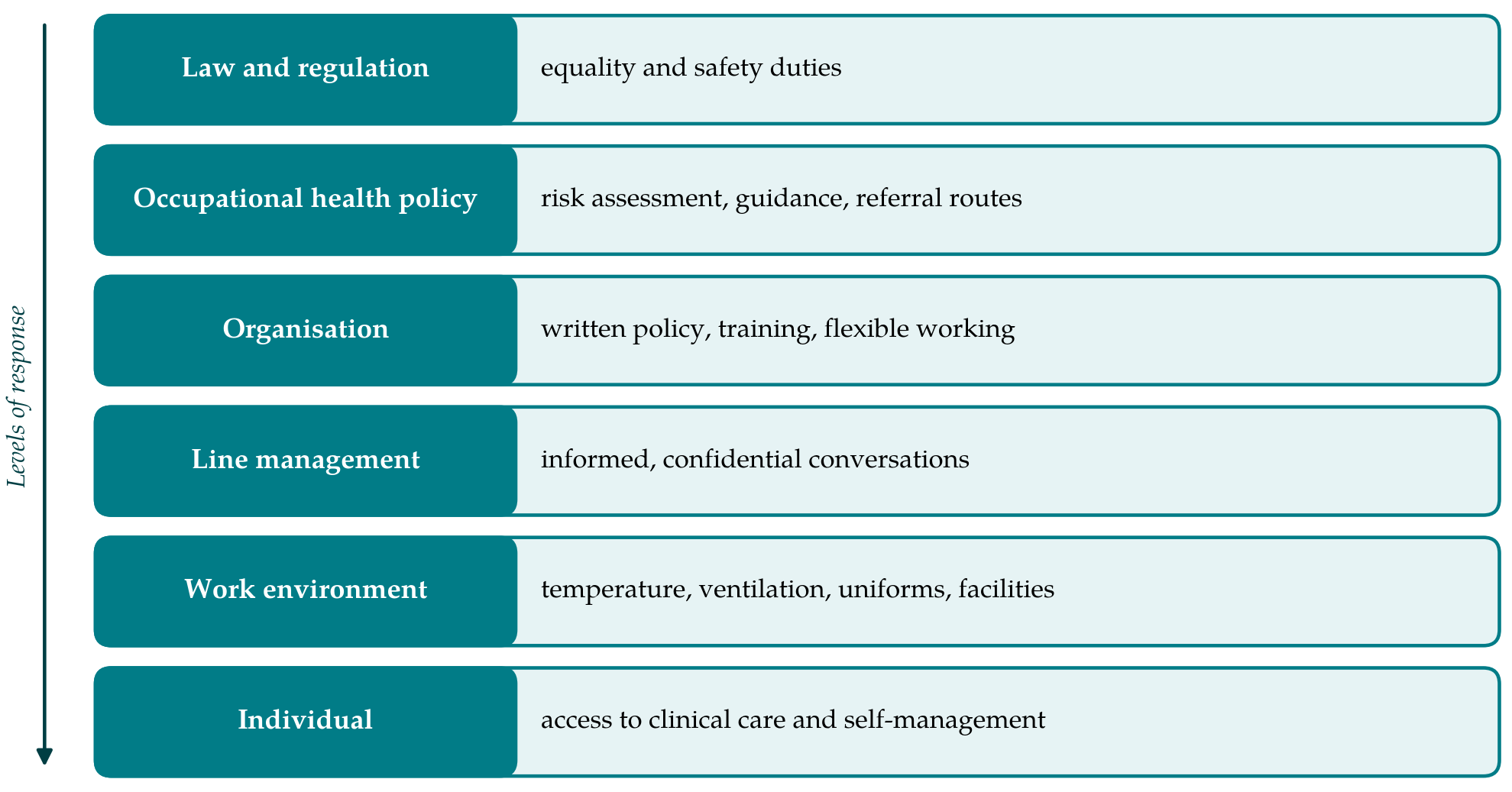
Research on what women themselves want points in a consistent direction. Qualitative work with working women found that they sought awareness among managers, the ability to talk about the subject without embarrassment, flexibility, and practical changes to the environment, and did not ask for special treatment (Hardy et al., 2017). Jack et al. (2016) summarised the measures open to employers under similar headings. Figure 1 arranges the possible responses by the level at which they operate, and Table 1 sets common difficulties beside the adjustments that the guidance documents describe.
| Reported difficulty | Workplace factor that aggravates it | Adjustment described in guidance |
|---|---|---|
| Hot flushes | High temperature, poor ventilation, heavy uniforms | Fans, control of temperature, breathable clothing Griffiths et al., 2016 |
| Poor sleep and fatigue | Early starts, night shifts, long hours | Flexible hours and shift changes Rees et al., 2021 |
| Heavy or irregular bleeding | Limited access to toilets and breaks | Ready access to facilities and rest breaks BSI, 2023 |
| Lapses in concentration | Time pressure, noise, frequent interruption | Review of workload and quieter work areas |
| Low mood or anxiety | Unsupportive management, fear of disclosure | Manager training, confidential conversations Hardy et al., 2017 |
| Untreated symptoms | No time or route to seek care | Time for appointments, occupational health referral Jack et al., 2016 |
4. Who Is Left Out of the Present Arrangement
Where support exists today it tends to reflect the initiative of individual employers, and it is concentrated in large organisations with human resources departments and staff networks. Women in insecure, low-paid or physically demanding jobs are the least likely to have a sympathetic policy to call on and the least able to alter their own conditions. They may also face symptoms earlier or more abruptly, for instance after surgery or cancer treatment that brings on menopause before the usual age. Transgender and non-binary workers who experience menopause can find that policies written only in terms of older women do not reach them. A matter left to voluntary action is therefore distributed unequally, and the correction of unequal protection is one of the ordinary purposes of occupational health policy. Framing guidance around working conditions, and making it available to every employer, would extend the benefit beyond those who are already best served.
5. Objections Considered
Three objections deserve a serious answer.
5.1. The evidence is thin
It is. Most studies are cross-sectional surveys with self-selected respondents and self-reported outcomes, and a narrative review of the field found that few have evaluated interventions (Verdonk et al., 2022). Women with troublesome symptoms are more likely to answer a survey about menopause, so prevalence figures drawn from such surveys overstate the average experience. It is not established that workplace menopause policies improve retention, attendance or wellbeing. This weakness should be acknowledged plainly. It does not, however, justify inaction. The adjustments in question are low in cost and risk, they rest on general principles of occupational hygiene that need no menopause-specific trial, and occupational health has never required randomised evidence before recommending that a hot workplace be ventilated. The right response to thin evidence is to act proportionately and evaluate.
5.2. Policy may medicalise or stigmatise
A second objection is that naming menopause in workplace policy turns a normal life stage into a medical problem and gives employers a reason to see older women as less capable. The concern is well founded in history, and scholars of work and organisation have warned that the manner in which menopause is discussed can reinforce gendered ageism (Atkinson et al., 2021). Yet silence has not protected women. It has left those with symptoms to manage alone, to reduce their hours, or to leave. The answer lies in how policy is framed. It should describe menopause as a normal transition with variable effects, avoid any presumption that a woman of a certain age is symptomatic, make disclosure voluntary, and focus on working conditions that benefit many employees.
5.3. Small employers cannot afford it
The third objection concerns burden. Large organisations can write policies, train managers and employ occupational physicians; a business with ten staff cannot. This is a reason for national occupational health policy to take up the issue, not a reason for leaving it alone. Model policies, short guidance for managers and access to shared occupational health advice are exactly the kind of support that public bodies provide for other workplace health matters. The measures themselves, a desk fan, a change of shift, an informed conversation, cost little.
6. What Proportionate Policy Would Contain
Four elements recur in the consensus documents and seem sufficient as a starting point (Rees et al., 2021; BSI, 2023). The first is inclusion of menopause in routine workplace risk assessment, with attention to temperature, ventilation, uniforms, facilities and working time. The second is information and training, so that managers know what the transition can involve and how to respond when an employee raises it. The third is flexibility in hours, location and duties where the work allows, offered without requiring a medical label. The fourth is a clear route to clinical advice. Effective treatments exist, and clinical guidelines describe them (NICE, 2015); occupational health should point women towards their own clinicians and should not attempt to prescribe or to favour any particular treatment.
Two further points apply to policymakers. Guidance should reach sectors where women have least control over their conditions, such as retail, care work, manufacturing and hospitality, since most published research has involved office and professional staff. And any national initiative should include funded evaluation with comparison groups and objective outcomes, so that the next review of the field has more than surveys to rely on.
7. Implications for Occupational Health Practice
For practitioners the change asked for is modest. Occupational physicians and nurses already take histories that touch on sleep, mood and concentration, and already advise on fitness for work and on adjustments. Asking about menopausal symptoms where they may be relevant, in the same matter-of-fact way as any other health question, would bring a common contributor into view. Training curricula for occupational health professionals give the subject little space at present, and professional bodies could correct that without waiting for legislation. Practitioners are also well placed to gather the evidence that is lacking, since they see workers across many job types and can record which adjustments were offered and what followed.
8. Conclusion
Menopause is a predictable stage in the working lives of half the workforce. For a sizeable minority it brings symptoms that interact with ordinary features of work, and the adjustments that help are modest. Occupational health policy has the concepts and the instruments to address it and has been slow to use them. The evidence is imperfect and the risk of stigma is real, but both are arguments for careful design and honest evaluation. Neither is a reason to continue treating the matter as private.
Conflict of interest
To be declared by the author(s) before publication.
Funding
To be declared by the author(s) before publication.