1. Introduction
There is an oddity at the centre of gout care. The cause of the disease is known, a cheap oral drug removes that cause, and a blood test shows whether it has done so. Yet in an article whose title has become a standing reproach, Doherty et al. (2012) asked why this curable disease is so seldom cured. National data from the United Kingdom gave the question numbers: the prevalence of gout was rising, only a minority of patients were prescribed urate-lowering therapy, and that proportion had not improved over many years (Kuo et al., 2015).
Most people with gout never see a rheumatologist. They are diagnosed and treated by a general practitioner, often during a flare, in an appointment of a few minutes. Any account of why urate goals are missed must therefore be an account of primary care. This article offers one. Its claim is that the shortfall is produced mainly by the way care is organised and by how the disease is understood, and only secondarily by the choices of individual patients or doctors.
2. The Case for a Target
The rationale is physicochemical. Monosodium urate becomes less soluble as temperature falls, and at body temperature its saturation point lies a little under 7 mg/dL (Loeb, 1972). Above that concentration crystals can form in and around joints; below it, existing deposits slowly dissolve. Flares, tophi and joint damage all follow from the crystal burden (Dalbeth et al., 2021). A treatment strategy that lowers urate far enough for long enough should therefore abolish the disease, and the lower the level, the faster the deposits clear.
Rheumatology guidance is built on that reasoning. Table 1 sets out the positions of the main guideline bodies. The American College of Rheumatology strongly recommends a treat-to-target strategy with dose titration guided by serial urate measurement (FitzGerald et al., 2020). EULAR sets the same threshold, with a lower one for severe disease until crystals have cleared (Richette et al., 2017), and the British guideline asks for the lower level from the outset (Hui et al., 2017).
| Body and year | Serum urate target | Position on titration to target |
|---|---|---|
| American College of Rheumatology (FitzGerald et al., 2020) | Below 6 mg/dL | Strongly recommended, with serial urate measurement |
| EULAR (Richette et al., 2017) | Below 6 mg/dL; below 5 mg/dL in severe gout | Recommended; maintain lifelong |
| British Society for Rheumatology (Hui et al., 2017) | Below 300 μmol/L (5 mg/dL) | Recommended; target may be relaxed later |
| American College of Physicians (Qaseem et al., 2017) | None endorsed | Evidence judged insufficient to recommend monitoring |
3. How the Goal Is Lost in Primary Care
If the principle is this clear, the failure must lie in its execution. Four features of everyday practice, taken together, account for most of it.
3.1. An acute illness in a system built for episodes
Gout presents as an emergency. The patient arrives in pain, receives an anti-inflammatory drug, improves within days and has no reason to return until the next attack. The consultation in which long-term treatment ought to be discussed is the one in which neither party has attention to spare for it. Qualitative work in general practice found that patients and practitioners alike tended to see gout as a series of attacks, brought on by diet and drink, and not as a chronic crystal deposition disease, and that practitioners were often reluctant to offer lifelong medication for what they regarded as an intermittent and partly self-inflicted complaint (Spencer et al., 2012). A disease understood in that way does not generate follow-up appointments.
3.2. The dose that never changes
Allopurinol is usually started at a low dose, which is correct, since the starting dose is related to the risk of hypersensitivity (Stamp et al., 2012). The error is that it stays there. For decades prescribers were taught to cap the maintenance dose according to creatinine clearance, following guidance intended to prevent severe toxicity in renal impairment (Hande et al., 1984). A later randomised trial showed that raising the dose above that cap, in steps and with monitoring, brought most patients to target without an excess of serious adverse events (Stamp et al., 2017). The older rule persists in habit and in some formularies, and it offers a ready reason to leave a subtherapeutic dose untouched.
3.3. Flares that punish the right decision
Lowering urate mobilises crystals, and flares become more frequent in the first months of treatment before they decline. Guidelines advise starting low, increasing gradually and giving anti-inflammatory prophylaxis during this period (FitzGerald et al., 2020). Where none of this is explained, the patient draws the natural conclusion that the new tablet has made matters worse and stops it. Adherence to urate-lowering therapy is poor by the standards of other long-term treatments (Scheepers et al., 2018), and this experience is one of the chief reasons.
3.4. Nobody owns the number
Blood pressure and glycated haemoglobin have registers, recall systems and, in some countries, payment attached to them. Serum urate generally has none of these. It is not measured after treatment starts unless someone remembers to request it, and a result above target prompts no automatic action. The failure to intensify treatment when a measurable goal has not been met was named clinical inertia in the context of diabetes, hypertension and lipids (Phillips et al., 2001). Gout is perhaps its purest example, because here the practice system does not even present the unmet goal to the clinician.
4. Counter-Arguments
The view taken here is open to three objections, and each deserves a fair hearing.
The first is that the target itself is unproven. The American College of Physicians concluded that evidence was insufficient to say whether treating to a urate target improves outcomes compared with adjusting treatment according to symptoms (Qaseem et al., 2017). The point is methodologically correct in a narrow sense: at the time, no trial had randomised patients to the two strategies with flares as the outcome. Rheumatology bodies replied that the biology, the consistent relation between achieved urate and clinical outcomes, and the weight of indirect evidence justified the target (Dalbeth et al., 2017). For a general practitioner the result was two authoritative documents pointing in different directions, and the one requiring less work was always likely to prevail.
The second objection is that patients do not want lifelong tablets and will not take them. The evidence does not support this as a fixed fact. In a proof-of-concept study, patients who were given a full explanation of gout and involved in decisions accepted treatment and nearly all reached the target (Rees et al., 2013). Reluctance appears to depend heavily on what patients have been told.
The third is safety. Allopurinol hypersensitivity is rare but can be fatal, and the cardiovascular safety of the alternative xanthine oxidase inhibitor, febuxostat, has been debated. These concerns call for care in choosing and starting a drug, and they are the reason for a low starting dose and gradual escalation. They are not a reason to leave a patient on a dose that exposes them to the risks of treatment without its benefit.
5. What Works, and What Follows
The strongest evidence that the problem is one of organisation comes from trials that changed the organisation and nothing else. In a randomised trial in the United Kingdom, care led by research nurses who educated patients, involved them in decisions and titrated therapy to target brought the large majority of patients to the urate goal at two years, against a minority under usual general practitioner care, with fewer flares, less tophaceous disease and favourable cost-effectiveness (Doherty et al., 2018). A site-randomised trial in the United States reported better adherence and target attainment with a pharmacist-led programme than with usual care (Mikuls et al., 2019). The drugs were the same in both arms of each trial. What differed was that a named person explained the disease, checked the urate and adjusted the dose. Figure 1 shows the loop that these models put into practice.
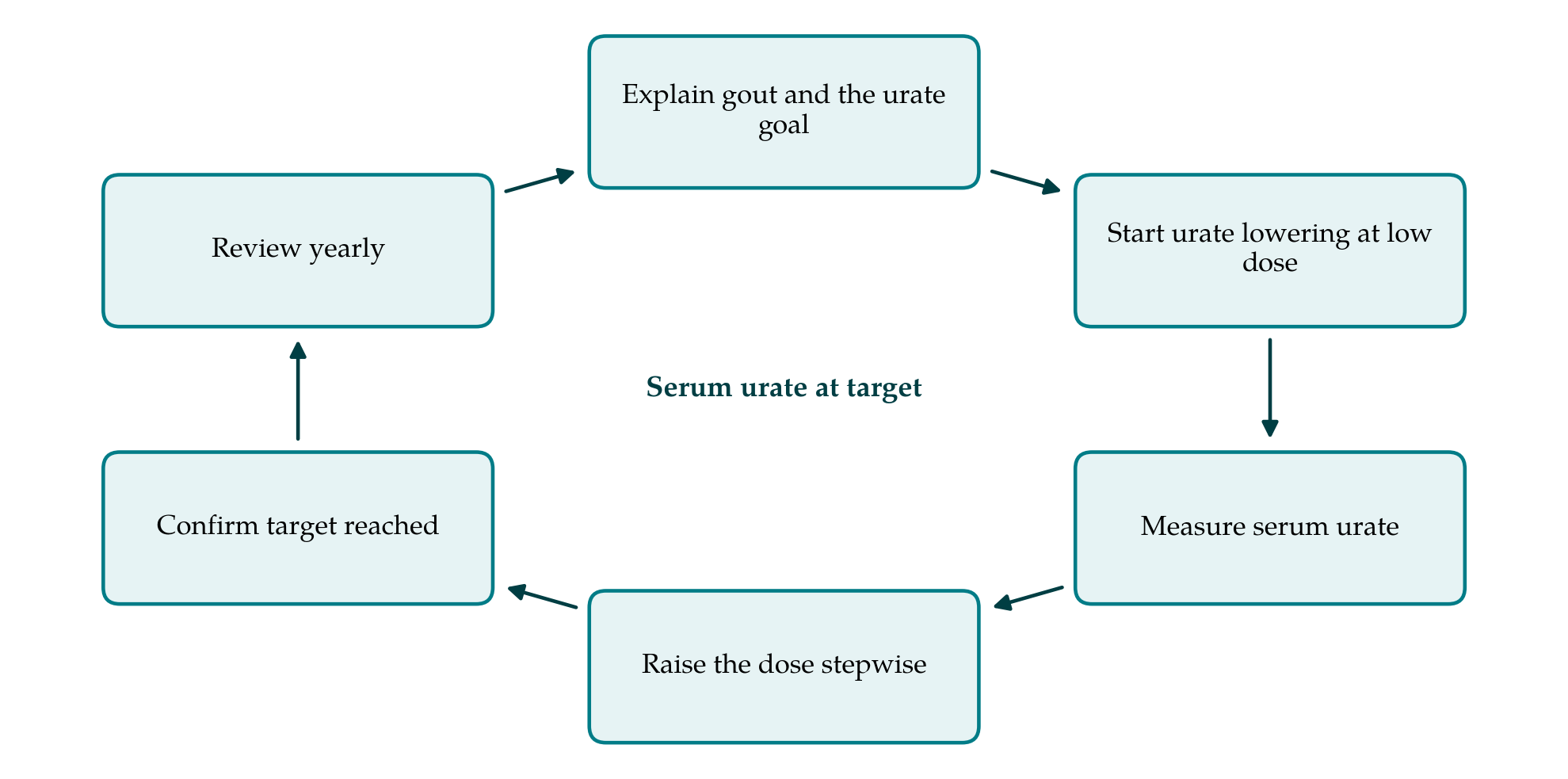
Three implications follow for primary care. Responsibility for titration should be assigned, and it need not be to a doctor; practice nurses and pharmacists already manage hypertension and anticoagulation by protocol. Serum urate should be treated as a monitored quantity, with a register of patients on urate-lowering therapy and a recall when no recent value is on file. And the first conversation about gout should be moved out of the flare consultation into a planned visit at which the cause of the disease, the purpose of the tablets and the likelihood of early flares can be explained properly.
None of this demands new science. It does demand that health systems regard gout as they regard other long-term conditions with a measurable target. Whether models proven in trials can be sustained in routine practice, with ordinary staffing and competing demands, is still to be demonstrated, and evaluations of implementation at scale would be more useful now than further comparisons of drugs.
6. Conclusion
Urate goals are rarely reached in primary care because the conditions for reaching them are absent: the disease is framed as episodic, the dose is fixed at its starting level, early flares go unexplained, the number is nobody's task, and guideline disagreement has excused all of this. Where those conditions have been supplied, by nurses or pharmacists working to a simple protocol, most patients have reached the target and their gout has receded. The remedy lies less in persuading individual clinicians than in giving serum urate the same standing in practice systems as blood pressure.
Conflict of interest
To be declared by the author(s) before publication.
Funding
To be declared by the author(s) before publication.