1. Introduction
Rutting, the accumulation of permanent deformation in the wheel paths, is one of the distresses that asphalt mixture design is expected to control. It arises from densification under traffic and, more seriously, from shear flow of the mixture at high pavement temperatures, and it is governed by the stiffness of the binder, the internal friction of the aggregate skeleton and the volumetric condition of the layer (Roberts et al., 1996). The Superpave system built its high-temperature binder grade and its aggregate and compaction requirements largely around this distress (Kennedy et al., 1994).
Two developments of the past decades have complicated the picture. Warm mix asphalt (WMA) covers a family of technologies that allow mixtures to be produced and compacted at temperatures some tens of degrees Celsius below those of conventional hot mix asphalt (HMA), with savings in fuel and emissions and better working conditions at the paver (D'Angelo et al., 2008; Rubio et al., 2012). Reclaimed asphalt pavement (RAP), the material milled from old surfaces, has meanwhile moved from a minor ingredient to a major one, and contents of a quarter of the mixture or more, usually described as high, are now a practical aim (Copeland, 2011; West et al., 2013).
The two are natural partners. The stiff binder in RAP makes a mixture harder to compact, and WMA additives ease compaction; the lower temperatures of WMA in turn reduce the further ageing of an already aged binder. Mallick et al. (2008) proposed exactly this pairing as a route to very high reclaimed contents. For rutting, however, the combination raises a question with no obvious answer in advance, since one component softens the mixture and the other stiffens it. This review sets out what the published evidence says about the balance.
2. Scope and Approach
This is a narrative review of the published literature: agency and cooperative research reports, journal articles, and the test standards against which rutting is judged. It is selective and makes no claim to have catalogued every study. Sources were chosen because they are widely cited, because they report on plant-produced material or pavements in service, or because they explain a mechanism. The review is confined to dense-graded mixtures for flexible pavements and to rutting that originates in the asphalt layers. Fatigue and low-temperature cracking are discussed only where the steps taken to control them bear on permanent deformation. No new test data are reported.
3. How Each Technology Acts on Permanent Deformation
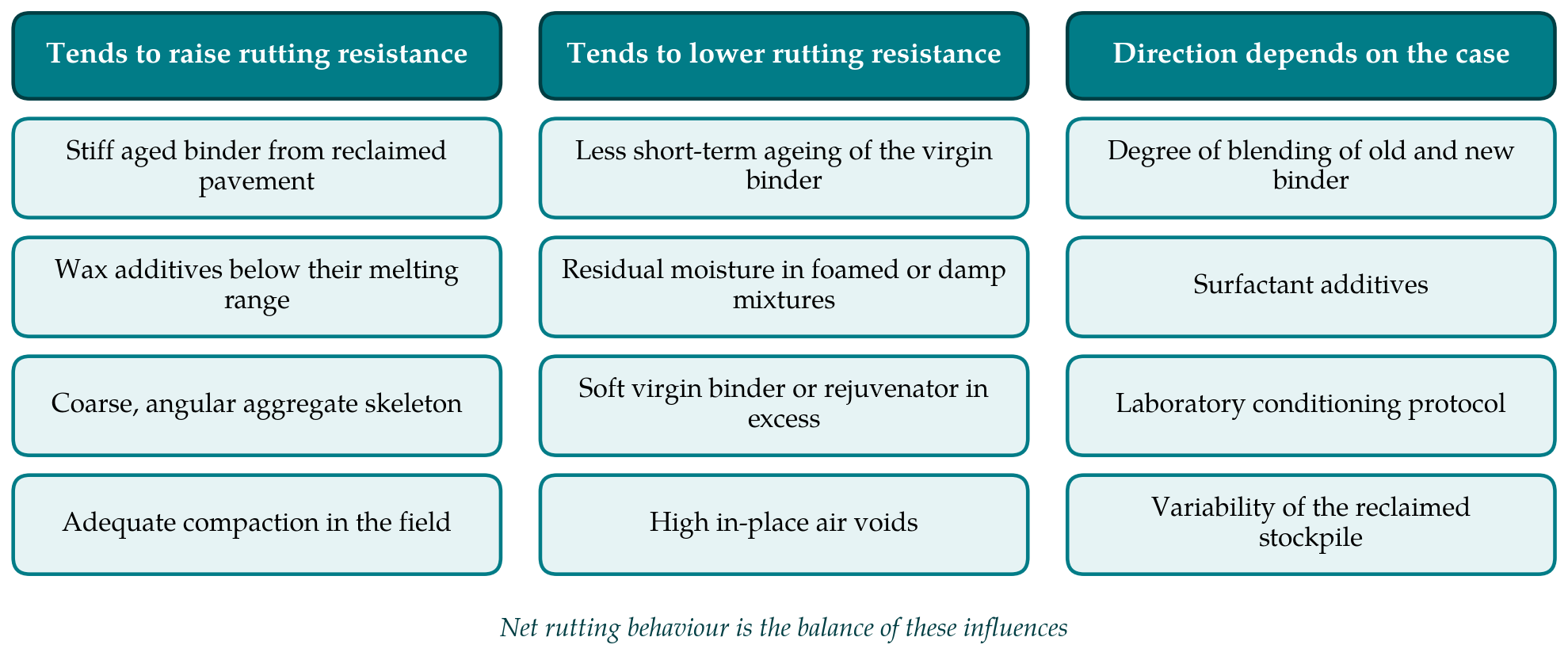
Figure 1 groups the influences discussed in this section according to the direction in which they push rutting resistance. The grouping is a summary of the literature reviewed here and not a ranking of their size.
3.1. Warm mix technologies
WMA technologies are conventionally sorted into organic additives, chemical additives and foaming processes (Rubio et al., 2012). Organic additives are waxes, of which the Fischer-Tropsch wax is the best known. They lower binder viscosity above their melting range and crystallise on cooling, so that at service temperatures the binder is stiffer than the base bitumen; Hurley and Prowell (2005) found no penalty in rutting for mixtures made with such a wax. Chemical additives are surfactant packages that improve coating and lubrication at the binder-aggregate interface with little change in binder grade. Foaming, by water injection or by water-bearing zeolites, expands the binder temporarily and leaves no additive behind, though some moisture may remain.
What all three share is a lower production temperature, and with it less of the oxidation and loss of volatiles that a binder normally undergoes in the mixing drum and during haulage. Since conventional specifications assume that short-term ageing, a warm mixture leaves the plant with a softer binder than its grade implies. This is the origin of the early concern about rutting, and of the related concern about moisture damage where aggregates are dried less thoroughly (Bonaquist, 2011).
3.2. Reclaimed binder and the question of blending
The binder in RAP has been oxidised through years of service, and its high-temperature stiffness is well above that of fresh bitumen. Whatever fraction of it becomes active in the new mixture raises resistance to rutting, a point on which reviews of RAP are agreed (Al-Qadi et al., 2007; Copeland, 2011). The practical guidance that grew out of the Superpave work reflects this: at low contents no change of virgin binder is needed, and at higher contents a softer grade or a blending chart is used to hold the combined binder near the target (McDaniel and Anderson, 2001).
How much of the aged binder is mobilised is less certain. At one extreme the RAP behaves as a coated aggregate, the so-called black rock; at the other the old and new binders blend completely. Laboratory work indicates that reality lies between the two, with only part of the aged film mingling with the new binder (Huang et al., 2005; Bowers et al., 2014). Lower mixing temperatures might be expected to reduce mobilisation further. For rutting the consequence is benign, because unblended stiff RAP particles still contribute to the skeleton, but it means that the effective binder is not what a blending chart predicts, and that the softer virgin binder coating the particles may dominate early behaviour.
4. Laboratory Measures of Rutting Resistance
Conclusions about rutting depend on the test used to draw them. Table 1 lists the methods that appear most often in the literature on WMA with RAP. Loaded-wheel tests dominate. The Hamburg device tracks a steel wheel over specimens submerged in heated water, so that it responds to moisture damage as well as to plastic flow (AASHTO, 2019); the Asphalt Pavement Analyzer loads the specimen through a pressurised hose (Kandhal and Cooley, 2003); and the European wheel-tracking standard defines small and large devices with tests in air or water (CEN, 2020).
| Method | What is measured | Point to note for WMA with RAP |
|---|---|---|
| Hamburg wheel tracking (AASHTO, 2019) | Rut depth under a steel wheel on submerged specimens | Combines plastic flow with stripping; sensitive to residual moisture |
| Asphalt Pavement Analyzer (Kandhal and Cooley, 2003) | Rut depth under a loaded pressurised hose | Usually run dry; ranks mixtures by binder stiffness |
| European wheel tracking (CEN, 2020) | Rut depth and wheel-tracking slope | Device size and conditioning medium differ between countries |
| Flow number (Witczak et al., 2002) | Load cycles to the onset of tertiary flow | Acceptance limits for WMA set lower than for HMA |
| Dynamic modulus (Witczak et al., 2002) | Stiffness over temperature and frequency | Shows stiffening by RAP; not a direct rutting test |
| Multiple stress creep recovery (D'Angelo et al., 2007) | Non-recoverable creep compliance of the binder | Needs recovered or blended binder; blending assumption matters |
Among the tests on cylindrical specimens, the flow number, which counts repeated load cycles until tertiary flow begins, was put forward together with the dynamic modulus as a simple performance test to accompany volumetric design (Witczak et al., 2002). At binder level, the multiple stress creep recovery test replaced the earlier Superpave rutting parameter because non-recoverable compliance tracks mixture rutting more closely, particularly for modified binders (D'Angelo et al., 2007).
Specimen conditioning matters as much as the test. Laboratory mixtures are aged briefly in an oven to imitate plant production, and if a warm mixture is conditioned at its own lower temperature it will test softer than a hot mixture conditioned at a higher one. The mix design procedure developed for WMA in the United States conditions loose mixture at the planned compaction temperature and, in recognition of the reduced ageing, accepts lower flow numbers for WMA than for HMA at the same traffic level (Bonaquist, 2011). Results from laboratory-mixed and plant-mixed specimens, and from reheated plant material, are therefore not interchangeable, a point demonstrated for high-RAP mixtures by Mogawer et al. (2012).
5. What Laboratory and Plant Studies Report
The earliest laboratory studies of the combination were concerned with feasibility. Mallick et al. (2008) produced mixtures with a very high reclaimed content at reduced temperatures using a wax additive and a soft virgin binder, and related work extended the idea to mixtures made almost wholly from reclaimed material. These studies established that WMA additives can offset the stiffness that otherwise makes high-RAP mixtures hard to compact, and that the resulting specimens were not deficient in stiffness.
Work aimed directly at permanent deformation followed. Zhao et al. (2012) tested foamed warm mixtures across a range of reclaimed contents and reported that rutting resistance improved as the content rose, and a companion comparison of warm and hot mixtures reached a similar conclusion, with the warm mixtures benefiting more from the added RAP because they started from a softer condition (Zhao et al., 2013). The same research group reported that the moisture susceptibility of foamed mixtures, a recurrent worry with that process, was not made worse by higher reclaimed contents (Shu et al., 2012). The general pattern across the laboratory literature is that the softening attributable to WMA is real but small, and that a moderate proportion of RAP is enough to cancel it.
Studies of plant-produced mixtures qualify this without overturning it. Mogawer et al. (2012) examined high-RAP mixtures from several plants and found that stiffness and cracking behaviour depended on production variables such as discharge temperature and storage time, which control how far the binders blend and age. Reviews of very high reclaimed contents make the same observation and treat rutting as the property least at risk, with cracking and consistency of the reclaimed stockpile as the binding constraints (Zaumanis and Mallick, 2015; Zaumanis et al., 2014).
6. Evidence From Pavements in Service
Laboratory rankings need confirming in the field, where rutting accumulates under real traffic and temperature. The broadest evidence for WMA comes from a cooperative study in the United States that monitored warm and hot sections built side by side on in-service roads, many of them containing RAP. It found rutting in the warm sections to be minor and not materially different from that in the companion hot sections, even where the warm mixtures were initially somewhat less stiff (West et al., 2014). European experience summarised for an earlier scanning tour pointed the same way (D'Angelo et al., 2008).
For high reclaimed contents specifically, field documentation is thinner, and much of it concerns hot mixtures. The national study of high-RAP mix design nevertheless reported good rutting performance wherever such mixtures had been placed and directed its recommendations towards cracking and materials management instead (West et al., 2013). Taken with the WMA field record, this supports the laboratory finding, though sections that combine WMA with reclaimed contents well above a quarter of the mixture, monitored over many years and in hot climates, remain few in the published record.
7. Gaps and Directions for Further Work
Three matters stand out as unresolved. The first is blending at reduced temperature. Methods for quantifying mobilisation of the aged binder exist (Bowers et al., 2014), but they have been applied mostly to hot mixtures, and the dependence on WMA technology, mixing time and silo storage is not well mapped. Without that knowledge the virgin binder grade for a warm, high-RAP mixture is chosen on an assumption.
The second is the interaction with measures taken against cracking. Softer virgin binders, rejuvenating agents and higher binder contents are the usual responses to the brittleness that RAP brings (Zaumanis et al., 2014). Each of them reduces high-temperature stiffness, and in a warm mixture they act on a binder that is already less aged. The comfortable rutting margin reported in the literature was mostly observed in mixtures that had not been softened in this way, so balanced mix design, in which a rutting test and a cracking test are both satisfied, is the proper setting for future evaluations.
The third is the representativeness of laboratory conditioning and the scarcity of long-term field data. Agreement is needed on how warm mixtures containing RAP should be aged before testing, and monitored sections in demanding climates and under heavy slow traffic would show whether the early softness of WMA has any lasting effect. The environmental case for the combination assumes durability equal to that of hot mixtures, which gives the question more than technical interest.
8. Conclusion
The published evidence gives little support to the fear that warm mix asphalt with high proportions of reclaimed pavement is prone to rutting. The reduced ageing of the virgin binder at lower production temperatures does soften the mixture, but the stiff reclaimed binder and, with wax additives, the additive itself compensate, and laboratory, plant and field studies agree that resistance to permanent deformation is generally equal to that of hot mixtures. The reservations are about what lies behind that result: an uncertain degree of binder blending, test outcomes that shift with conditioning, and the likelihood that softening agents added for the sake of cracking resistance will use up the margin. Design practice for these mixtures should therefore check rutting and cracking together and should not assume either from the reclaimed content alone.
Conflict of interest
To be declared by the author(s) before publication.
Funding
To be declared by the author(s) before publication.