1. Introduction
Most cropland in Ethiopia, Kenya, Tanzania and Uganda is rainfed, and most of it is worked by households that plant a hectare or two of maize, sorghum, teff or beans and carry the whole weather risk of the season themselves. A failed rainy season lowers the harvest of every farm in a district at once, which is exactly the kind of shock that village-level sharing arrangements handle badly. Households respond before the season as well as after it. They hold back on purchased inputs, spread plantings across safer crops and keep savings in livestock, and in doing so they give up expected income for the sake of a tolerable worst case (Morduch, 1995).
Conventional crop insurance has never served such farmers at scale. Assessing losses plot by plot is too costly for small sums insured, and moral hazard and adverse selection are hard to control. Index insurance was designed to avoid both problems. The contract pays when an independently measured index, such as cumulative rainfall at a station or a satellite measure of vegetation, crosses an agreed threshold, so no farm visit is required and the farmer cannot influence the payout (Barnett and Mahul, 2007; Miranda and Farrin, 2012). The price of that simplicity is basis risk: the index and the loss on a given plot are imperfectly correlated.
Two decades of pilots have made East Africa one of the main testing grounds for the idea. This review brings together what the published literature says about two linked questions. The first is uptake: which smallholders buy index cover, and what holds the others back. The second is whether insured farmers invest more in inputs, which is the outcome that would justify public support for the product.
2. Scope and Approach
This is a narrative review of the published literature. It draws on peer-reviewed studies of index insurance among crop and livestock producers in East Africa and, where the regional evidence is thin, on well-known studies from West Africa, southern Africa, India and China that test the same mechanisms. Review articles and institutional assessments were used to place individual studies in context (Hazell et al., 2010; Carter et al., 2017; Cole and Xiong, 2017). No formal search protocol was applied and no quantitative synthesis is attempted. The aim is to state what the evidence supports, where studies disagree and where the conclusions rest on a small number of settings.
3. Why Uninsured Risk Suppresses Input Use
The argument that risk depresses investment is older than index insurance. In a classic study of Indian villages, Rosenzweig and Binswanger (1993) showed that poorer households in riskier environments held asset portfolios that were less sensitive to rainfall and less profitable, while wealthier households, better able to absorb a bad year, did not make the same sacrifice. For Ethiopia, Dercon and Christiaensen (2011) found that the prospect of low consumption after a harvest failure discouraged fertiliser use, so that the possibility of drought reduced input demand in years when the rains turned out well too. Fertiliser bought on credit is a particular hazard, because the debt remains when the crop does not.
Risk is not the only candidate explanation for low input use, and the review literature is clear that it should not be treated as one. In western Kenya, Duflo et al. (2011) attributed part of the under-use of fertiliser to procrastination and the difficulty of saving harvest income until the next planting. Returns to improved seed and fertiliser also differ from farm to farm with soil and rainfall, and for some households the cost of reaching an input supplier is high. Insurance can only raise investment where exposure to weather is the binding constraint. Where the constraint is liquidity, distance or low returns, an insured farmer has no more reason to buy inputs than an uninsured one.
4. Index Insurance Products in East Africa
The products offered in the region differ in the index used, the scale at which it is measured and the channel through which cover is sold. Table 1 summarises the main designs. Crop schemes in Kenya have sold rainfall-indexed cover alongside seed and fertiliser through agro-dealers and mobile enrolment. In northern Ethiopia, cover has been offered through a public works arrangement in which farmers with little cash can pay the premium with labour. For pastoralists in northern Kenya and southern Ethiopia, index-based livestock insurance uses satellite vegetation readings to predict area-average herd mortality (Chantarat et al., 2013).
| Design | Index and trigger | Usual delivery channel | Main limitation |
|---|---|---|---|
| Rainfall station index | Cumulative rainfall at a gauge, by crop growth phase | Sold with seed or through cooperatives | Basis risk grows with distance from the gauge |
| Satellite rainfall estimate | Estimated rainfall for the grid cell of the farm | Agro-dealers and mobile enrolment | Estimate can differ from rain on the plot |
| Vegetation index | Forage condition against its historical norm | Pastoral livestock cover Chantarat et al., 2013 | Tracks area drought, not the loss of one herd |
| Area-yield index | Average measured yield of a defined zone | Group or cooperative policies | Needs trusted yield data; payout is slow |
| Multiscale cover | Area index plus a local audit trigger Elabed et al., 2013 | Producer organisations | Higher administrative cost |
| Meso-level cover | Any of the above, held by a lender or aggregator | Loan portfolios and input credit | Farmer may never see the payout directly |
Two features of this history matter for reading the evidence. Most schemes have depended on donor or government subsidy, either of the premium or of the cost of design and distribution, and few have been observed for long under commercial conditions (Hazell et al., 2010). In addition, the product that a farmer is offered is seldom insurance alone. It arrives with a seed pack, a loan, a training session or a labour scheme, so that what studies measure is frequently the effect of a bundle.
5. What Determines Uptake
The most consistent finding in the literature is that voluntary demand for index insurance at prices that cover its cost is low, in East Africa as elsewhere (Carter et al., 2017; Cole and Xiong, 2017). Four groups of explanations have been tested.
5.1. Price and cash at planting
Demand is sensitive to price. Field experiments in India that varied the premium at random found that purchases rose steeply with discounts, yet many households declined cover offered well below its actuarial cost (Cole et al., 2013). Timing matters as much as the level. The premium falls due at planting, when cash is scarcest and competes with seed and labour. In a study with contract sugarcane growers in Kenya, allowing the premium to be deducted from harvest revenue instead of paid in advance raised uptake sharply (Casaburi and Willis, 2018). The labour-for-premium arrangement used in northern Ethiopia addresses the same constraint by a different route.
5.2. Basis risk and contract quality
Basis risk changes the nature of the product. A farmer who pays the premium, loses the crop and receives nothing is worse off than if no cover had been bought, so the contract can deepen the worst outcome it was meant to soften. Clarke (2016) showed that under these conditions a rational, strongly risk-averse buyer may want little or no index cover, which reverses the usual expectation about who insures. Farmers also appear to dislike the layered uncertainty of an index contract in its own right (Elabed and Carter, 2015). Measurement in northern Kenya confirmed the practical weight of the problem: households holding index-based livestock insurance remained exposed to a large share of their mortality risk, much of it specific to the household and therefore beyond the reach of any area index (Jensen et al., 2016).
5.3. Trust, understanding and experience
An index contract asks a farmer to pay now for a promise from a distant institution, defined by a measurement the farmer cannot observe. Endorsement by a trusted local agent raised purchases in India (Cole et al., 2013), and most pilots now include sessions that explain the contract before it is sold. Among Ethiopian households, willingness to pay was higher for the better educated, the wealthier and those already inclined to try new technologies, which suggests that index insurance diffuses like an innovation and not like a safety net (Hill et al., 2013). Stated willingness to pay has also proved a poor guide to actual purchase among Ethiopian cooperative members (McIntosh et al., 2013).
5.4. Informal risk sharing
Index cover and informal arrangements can work together. Funeral societies and kin networks are well placed to share idiosyncratic losses among members but cannot absorb a drought that strikes them all. An index payout covers the common shock and leaves the group to redistribute among members whose losses the index missed. In Ethiopia, training the leaders of funeral societies in how groups might share basis risk raised demand for rainfall cover (Dercon et al., 2014). The implication for design is that selling to existing groups may raise the value of an imperfect index to each member.
6. Does Insurance Change Input Investment
The case for subsidising index insurance rests less on the payouts than on what farmers do before the season once they hold cover. Figure 1 sets out the chain of reasoning and the point at which each link can fail. The strongest single piece of evidence comes from northern Ghana, where farmers given rainfall insurance spent more on cultivation and shifted towards riskier production choices, while farmers given cash alone changed their behaviour much less (Karlan et al., 2014). The result indicates that uninsured risk, more than lack of capital, was holding investment back in that setting.
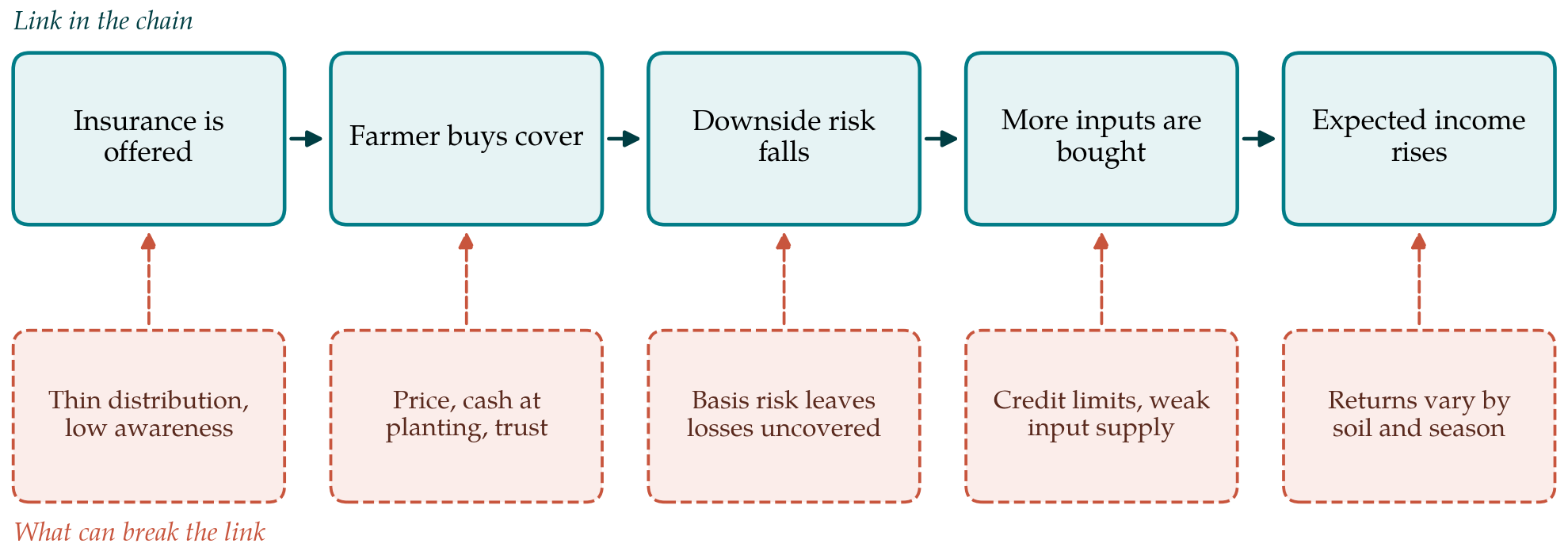
Evidence from East Africa is thinner and more varied in method. A study of maize farmers in Kenya associated uptake of rainfall-indexed cover with greater fertiliser use and higher yields (Sibiko and Qaim, 2020), although purchase was voluntary and those who bought may differ from those who did not in ways that are hard to remove statistically. For pastoralists, insured households in northern Kenya were less likely to sell animals or cut meals after a severe drought, an effect on coping that protects productive assets even though it is not an input decision (Janzen and Carter, 2019).
Not all findings point the same way. In Malawi, maize and groundnut farmers offered a loan with compulsory rainfall insurance took it up less often than those offered the loan alone (Giné and Yang, 2009). The authors' interpretation was that limited liability already insured borrowers against default in a bad year, so the premium bought little. The finding is a reminder that an insurance offer interacts with whatever implicit protection a household has, and that adding cover to credit does not automatically make the credit more attractive.
A sceptical reading of the whole enterprise deserves attention. Binswanger-Mkhize (2012) argued that better-off farmers have cheaper ways of managing risk through savings, diversification and off-farm income, while the poorest cannot afford the premium, leaving a narrow middle group as the natural market. On that view, the investment responses seen in experiments with free or heavily discounted cover say little about what an unsubsidised market would deliver.
7. Design and Delivery Responses
Much recent work treats low demand as a signal about product quality. If basis risk is the main deterrent, the remedy is a better index: denser measurement, satellite data validated against yields, contracts written at more than one scale, or a second trigger that allows a local audit when the area index fails (Elabed et al., 2013). Carter et al. (2017) argue that minimum quality standards are needed, since a contract that pays poorly in bad years can leave a farmer worse off than no contract.
Delivery has moved in a parallel direction. Selling cover to individuals is expensive, and groups offer both a cheaper channel and a means of sharing residual risk. Insurance held by a lender, a cooperative or an input supplier removes the purchase decision from the farmer altogether and can lower the cost of credit, though it weakens the link between cover and the farmer's own planting decision. Where premiums are subsidised as a matter of policy, the literature's advice is that the subsidy should be justified by investment or welfare gains that have been measured, and that poverty-trap arguments for support apply most strongly to households close to an asset threshold (Barnett et al., 2008).
8. Gaps and Future Work
Three gaps stand out. First, the investment evidence for East African crop farmers is largely drawn from single seasons and subsidised offers. Whether farmers keep buying cover and keep investing after a season in which they lost a crop and received no payout is the test that matters for a durable market, and it has rarely been observed. Second, few studies separate the effect of insurance from the effect of the inputs, credit or advice bundled with it. Designs that vary the components independently would show which element farmers respond to.
Third, the distribution of benefits is poorly documented. If uptake is concentrated among wealthier and better-educated households, as willingness-to-pay studies suggest, average effects may hide the absence of any change among the farmers whom the product was meant to reach. Work on women farmers, on tenants and on households with very small plots is especially scarce. Longer panels, attention to what happens after unpaid losses and routine reporting of basis risk alongside uptake would make the next round of evidence more useful to those deciding whether to fund such schemes.
9. Conclusion
The literature supports a qualified answer to both questions. Smallholders in East Africa do not, for the most part, buy weather index insurance at its full cost, and the reasons are intelligible: the contract is imperfect, the premium is due at the worst moment and the seller is not yet trusted. Where farmers do hold cover, studies generally find that they invest more, which is consistent with the long-standing view that uninsured weather risk suppresses input use. The second finding depends heavily on subsidised settings, and it cannot yet be said how far it would survive commercial pricing or a run of seasons with unpaid losses. Better contracts, payment timed to the harvest and delivery through groups are the most promising directions on present evidence.
Conflict of interest
To be declared by the author(s) before publication.
Funding
To be declared by the author(s) before publication.