1. Introduction
Village chickens are kept by a large share of rural households in Africa and Asia. They cost little, scavenge most of their feed, and provide meat, eggs, cash and gifts, often under the control of women (Kitalyi, 1998; Alders and Pym, 2009). Newcastle disease is the main constraint on them. Where the virus is endemic, outbreaks can kill most of the susceptible birds in a village within a few weeks, and they tend to return with a regularity that keepers come to expect (Awan et al., 1994; Alexander et al., 2004).
Recurrence is often accepted as a fact of the season. From the standpoint of disease control it is a finding that needs explaining. Either the virus persisted locally between outbreaks, or it was brought in again, and in both cases something in the way birds, people and materials move allowed it. Veterinary services that respond to backyard outbreaks rarely have a structured way of finding out what that was. The guidance available to them describes what good biosecurity looks like (FAO, 2008) but not how to work backwards from an outbreak to the specific lapse.
This article proposes such a method. It is written for a district veterinary officer or animal health worker with limited laboratory support, and it concerns a cluster of households whose flocks mix. The protocol has not been tested in the field; it is offered as a design to be tried and improved.
2. Background
The design draws on what is known about the virus, about village poultry keeping, and about investigating outbreaks in general.
2.1. The virus and its routes of spread
Newcastle disease is caused by virulent strains of avian paramyxovirus type 1, classified as Avian orthoavulavirus 1. Virulence is defined for international purposes by the intracerebral pathogenicity index or by the amino acid sequence at the cleavage site of the fusion protein (WOAH, 2023). Infected birds shed virus in respiratory secretions and faeces. Spread between flocks takes place through movement of live birds, contaminated people, equipment, feed and water, and poultry products and offal; the virus survives for long periods in carcasses and faeces, particularly in cool conditions (Alexander, 2000; Alexander, 2001). Wild and feral birds, pigeons among them, can carry virulent strains (Brown and Bevins, 2017).
Vaccination complicates the picture. Thermotolerant and conventional vaccines protect birds against disease and death, but vaccinated birds can still be infected and shed virulent virus (Dimitrov et al., 2017). A partly vaccinated village can therefore keep virus circulating without obvious mortality. Strains are grouped into genotypes on the basis of the fusion gene, and sequence comparison can indicate whether two outbreaks are likely to share a source (Miller et al., 2010).
2.2. Why outbreaks recur in village flocks
Village flocks are small, of mixed age and often mixed species, unconfined by day and loosely housed at night. Chicks hatch all year, so susceptible birds are always being added. Birds move between households as gifts, loans and purchases, and through live bird markets and itinerant traders. When disease appears, keepers commonly sell or slaughter birds that look sick, which disperses virus along the trading chain (Alders and Spradbrow, 2001; Alexander et al., 2004). A systematic review of biosecurity for backyard poultry found few measures whose feasibility or effect had been properly evaluated in such settings (Conan et al., 2012), which is a reason to find out what fails locally before prescribing remedies.
2.3. Outbreak investigation and network thinking
The steps of a field investigation are long established: verify the diagnosis, define a case, find cases, describe them by time, place and unit, form and test hypotheses, and act (Gregg, 2008; Thrusfield, 2007). Network analysis adds a way of describing who is connected to whom and which units link otherwise separate groups (Martínez-López et al., 2009); it has been applied to poultry trade through live bird markets (Fournié et al., 2013). The study of accidents contributes a distinction between the immediate unsafe act and the conditions that made it likely (Reason, 1997), which is useful when the aim is to prevent repetition and not to assign blame.
3. Design Principles
Four principles shaped the protocol. The unit is the network, because a household cannot protect a scavenging flock on its own. Recurrence is examined directly, by comparing the present outbreak with what keepers and records say about earlier ones. Lapses are sought along defined pathways, so that the enquiry is the same from one village to the next. And the output is a short list of actions that keepers have agreed are possible, since advice that assumes fencing, footbaths and all-in all-out management will not be followed where birds scavenge.
4. The Proposed Protocol
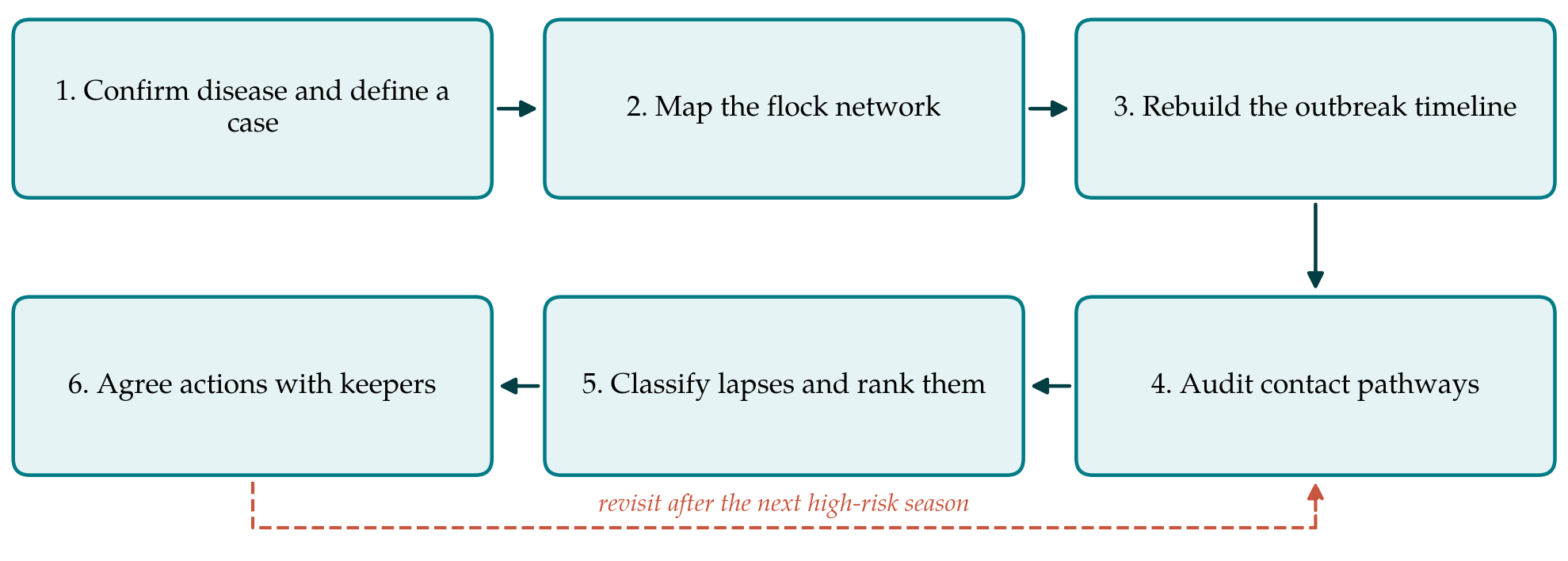
The protocol has six stages, shown in sequence in Figure 1. Table 1 lists the information collected at each stage and the record it should leave. The stages are described in turn below.
| Stage | Information gathered | Record kept |
|---|---|---|
| 1. Confirm and define | Clinical and post-mortem signs; samples for laboratory confirmation | Laboratory result; written case definition |
| 2. Map the network | Households, shared ground, bird exchanges, traders, markets, vaccinators | Sketch map and list of links |
| 3. Rebuild the timeline | First deaths per household; arrivals and sales; earlier outbreaks | Dated event line for each outbreak |
| 4. Audit pathways | Each route by which virus could enter or spread | Completed pathway checklist |
| 5. Classify lapses | Immediate acts and the conditions behind them | Ranked list with supporting evidence |
| 6. Agree actions | Measures keepers consider feasible; who will do what | Action list and date of return visit |
4.1. Stage 1: Confirm the disease and define a case
Sudden high mortality in village chickens has several causes, highly pathogenic avian influenza and fowl cholera among them, and an investigation built on a wrong diagnosis is wasted. Samples should be taken from freshly dead and sick birds and submitted for the tests set out in the international manual, normally detection of viral RNA or virus isolation (WOAH, 2023). While results are awaited, a working case definition is agreed at flock level, for example a household in the cluster with deaths accompanied by respiratory or nervous signs or green diarrhoea within the outbreak period. If isolates from an earlier outbreak in the area exist, sequence comparison should be requested.
4.2. Stage 2: Map the network
With two or three keepers, the investigator draws a sketch map of the cluster: households that keep poultry, where birds scavenge and drink, where they roost, and where carcasses and offal are thrown. Links are then added. These include households that exchange or lend birds, the markets where birds are bought and sold, the traders who call, neighbours who share a cockerel, and people who move between flocks, such as vaccinators and those who buy eggs. The map need not be to scale. Its purpose is to show which households and which outside contacts connect the rest.
4.3. Stage 3: Reconstruct the timeline
Each affected household is asked when the first bird fell sick or died, and what had happened in the preceding two to three weeks, a period chosen to cover the usual incubation period with a margin: birds bought, received or returned unsold from market, visits by traders, a ceremony, a neighbour's losses. Events are placed on a single line of dates. The same is done from memory, and from any veterinary records, for the previous one or two outbreaks. Comparing the lines shows whether outbreaks begin in the same household or follow the same kind of event.
4.4. Stage 4: Audit the contact pathways
Stage 4 is the core of the protocol. The investigator works through a fixed list of pathways and records, for each, what is actually done in the cluster. The list covers introduction of live birds and whether they are kept apart on arrival; return of unsold birds from market; contact with traders, their cages and vehicles; shared scavenging and water; contact with ducks, pigeons and wild birds; disposal of dead birds, offal and feathers; sale or slaughter of sick birds; movement of people and equipment between flocks; and vaccination, including who was vaccinated, when, with what vaccine and how it was stored. The pathways correspond to the routes of spread described for the virus (Alexander, 2000) and to the segregation, cleaning and disinfection headings of standard biosecurity guidance (FAO, 2008).
4.5. Stage 5: Classify and rank the lapses
Each departure from good practice found in Stage 4 is written down and classified. An immediate lapse is an act close in time to the outbreak, such as adding market birds to the flock without separation. An underlying condition is what made that act ordinary: no spare coop, no source of vaccine, a need for cash that forces the sale of sick birds. Lapses are then ranked by two judgements, namely how well the lapse fits the timeline and network of this outbreak, and whether it was also present before earlier ones. A lapse that scores on both is a likely cause of recurrence. The ranking is a reasoned judgement and should be recorded as such.
4.6. Stage 6: Agree corrective actions
Findings are taken back to a meeting of keepers. For the two or three highest ranked lapses the group is asked what could be done with what they have. Measures with a record of use in village settings include regular vaccination with a thermotolerant vaccine organised through community vaccinators, keeping new and returned birds apart for a period, burying or burning dead birds, and agreeing not to sell birds from a sick flock (Alders and Spradbrow, 2001). A return visit is fixed for after the next season of risk, when the pathway checklist is repeated.
5. Fitting the Protocol to Field Conditions
The protocol is meant to be completed in two or three visits by one or two people. It relies on recall, which fades and bends, so dates should be anchored to market days, festivals and rainfall, and accounts from several households compared. Keepers may be reluctant to admit selling sick birds; questions are better put about what people in the village generally do. Where laboratory confirmation is not available, the investigation can proceed on clinical grounds, but the report must say so. Outbreaks of Newcastle disease are notifiable in most countries, and the investigation should run alongside official reporting and never delay it (WOAH, 2023).
6. Limitations and What Remains to Be Shown
No part of this protocol has been validated. Its central assumption, that recurrence in a cluster can be traced to a small number of identifiable lapses, may not hold where virus is so widespread that reintroduction is continuous by many routes. The ranking in Stage 5 is subjective, and two investigators might rank the same findings differently; agreement between investigators is the first thing a pilot should measure. The protocol cannot by itself distinguish local persistence from reintroduction without sequence data, which will often be lacking. Finally, identifying a lapse does not show that correcting it prevents the next outbreak. That would require following clusters that used the protocol and comparable clusters that did not over several seasons, a study that has yet to be designed.
7. Conclusion
Recurrent Newcastle disease in backyard flocks is usually treated as a matter for vaccination alone. The protocol proposed here adds a structured enquiry into how the virus reached, or remained in, a network of households, and turns the answer into actions that keepers have agreed to take. It uses skills and materials that a district animal health service already has. Whether it reduces recurrence is unknown, and field trials, beginning with tests of its repeatability, are the necessary next step.
Conflict of interest
To be declared by the author(s) before publication.
Funding
To be declared by the author(s) before publication.