1. Introduction
Wet processing is the stage of textile manufacture with the heaviest environmental burden, and dyeing is its most visible part. Cotton is dyed mainly with reactive dyes, which form a covalent bond with cellulose under alkaline conditions. The chemistry gives bright, fast shades, but it requires large quantities of electrolyte to drive the dye onto the fibre, a share of the dye hydrolyses and never fixes, and repeated hot rinses are needed to remove it (Khatri et al., 2015). The outcome is a coloured, saline effluent that is expensive to treat and that has damaged rivers and groundwater in several dyeing regions (Kant, 2012).
Much of this dyeing is done in clusters: geographic concentrations of small and medium firms, each with a handful of dyeing machines, drawing on the same aquifer or river and often discharging to a common effluent treatment plant. When regulators tighten discharge limits, in some regions to the point of requiring zero liquid discharge, the whole cluster faces the same cost at the same time. Suppliers and development agencies then promote waterless dyeing as a way out.
The difficulty is that a cluster of medium-sized firms cannot afford to choose wrongly, and the term waterless is applied loosely. This article proposes a framework for making the choice in an orderly way. It is a methodological proposal built from published sources. No cluster was studied for it, and it has not yet been applied in practice.
2. Background
Two matters need to be clear before a procedure can be designed: what waterless dyeing can mean for cotton in particular, and why the cluster, and not the single firm, is the right unit of decision.
2.1. What waterless means for cotton
The best known waterless process replaces water with carbon dioxide above its critical point of 31.1 °C and 7.38 MPa. In that state carbon dioxide dissolves non-polar disperse dyes and swells polyester, so that dyeing proceeds without water, salt or drying, and the gas is recycled (Saus et al., 1993; Bach et al., 2002). The process is used industrially for polyester. Cotton is another matter. Cellulose is polar and is not swollen by carbon dioxide, and disperse dyes have no affinity for it. Research has pursued reactive disperse dyes that can bond to cellulose from the supercritical medium, chemical modification of the fibre, and polar co-solvents, with encouraging laboratory results but without an established industrial process (Fernandez Cid et al., 2005; van der Kraan et al., 2007; Banchero, 2013). High-pressure vessels also carry a capital cost of a different order from that of an atmospheric dyeing machine (Bach et al., 2002).
For cotton, the routes that reduce water substantially today are low-water and not strictly waterless. Cold pad-batch dyeing applies concentrated dye liquor by padding and fixes it at ambient temperature without salt. Foam and spray application replace most of the water in the liquor with air and lower the wet pick-up of the fabric. Cationic pretreatment of cotton allows reactive dyeing without electrolyte and with less wash-off (Khatri et al., 2015; Hasanbeigi and Price, 2015). The European reference document on best available techniques lists low liquor ratio machinery and optimised rinsing among the measures already proven at scale (European Commission, 2003). Table 1 compares the main routes.
| Route | Principle | Fit with cotton | Main constraint for a cluster |
|---|---|---|---|
| Supercritical carbon dioxide | Dye dissolved in dense carbon dioxide; no water or drying | Poor with existing dyes; research stage (Banchero, 2013) | Capital cost; pressure equipment skills |
| Cold pad-batch | Padding with concentrated liquor; fixation at room temperature | Good for woven and some knitted cotton | Needs open-width preparation and batching space |
| Foam application | Air replaces most of the water in the liquor | Established for finishing; dyeing more demanding | Levelness and penetration on heavy fabric |
| Spray application | Metered liquor sprayed onto moving fabric | Promising for open-width goods | Limited shade depth; new machinery |
| Cationised cotton | Fibre modified to attract anionic dye without salt | Chemically effective | Extra pretreatment step; reagent handling |
| Low liquor ratio exhaust | Same chemistry in less water | Fully compatible | Saves water but not salt per unit of dye fixed |
2.2. Why the cluster is the unit of decision
Firms in a cluster gain from proximity through shared suppliers, labour and knowledge (Porter, 1998), and research on clusters in developing economies adds that deliberate joint action, which Schmitz and Nadvi (1999) call collective efficiency, lets small firms do what none could do alone. A common effluent treatment plant is an example. Clean technology raises the same logic. Studies of manufacturing plants in developing countries find that regulatory pressure drives adoption, and that lack of capital, information and technical capacity holds it back (Luken and Van Rompaey, 2008). Each barrier is easier to address collectively.
Diffusion research supplies the remaining concepts. Rogers (2003) identifies five attributes that govern how quickly an innovation spreads: relative advantage, compatibility with existing practice, complexity, trialability and observability. A pressure dyeing plant scores badly on the last four for a small cotton dyer. A shared pilot can supply the trial and the observation that individual firms cannot arrange for themselves.
3. The Proposed Framework
The framework has five stages, carried out by a working group formed by the cluster association with technical support from a textile institute or university department.
3.1. Stage 1: Establish the baseline
The cluster first needs to know what it uses. For a representative set of member dyehouses, the working group records water intake, salt, alkali, dye and auxiliary consumption, steam and electricity, and effluent volume and quality, each expressed per kilogram of fabric dyed and broken down by process step and by shade depth. The reference document on best available techniques gives a structure for such an inventory (European Commission, 2003). The baseline shows where water actually goes. In reactive dyeing a large share is used in rinsing and soaping after dyeing, a fact that shapes the choice of remedy.
3.2. Stage 2: Screen the technologies
Each candidate route is then assessed against criteria agreed in advance: the reduction in water, salt and effluent load it offers relative to the baseline; its technical readiness for cotton in the fabric forms the cluster processes; capital and operating cost; the skills and maintenance it demands; and its effect on shade range, fastness and reproducibility as required by buyers. Because the criteria are of different kinds and members will weigh them differently, the screening is suited to a simple multi-criteria method in which weights are set openly and the sensitivity of the ranking to those weights is examined (Belton and Stewart, 2002). Figure 1 shows the intended output: each option placed by its benefit and its readiness, and assigned to one of four courses of action.
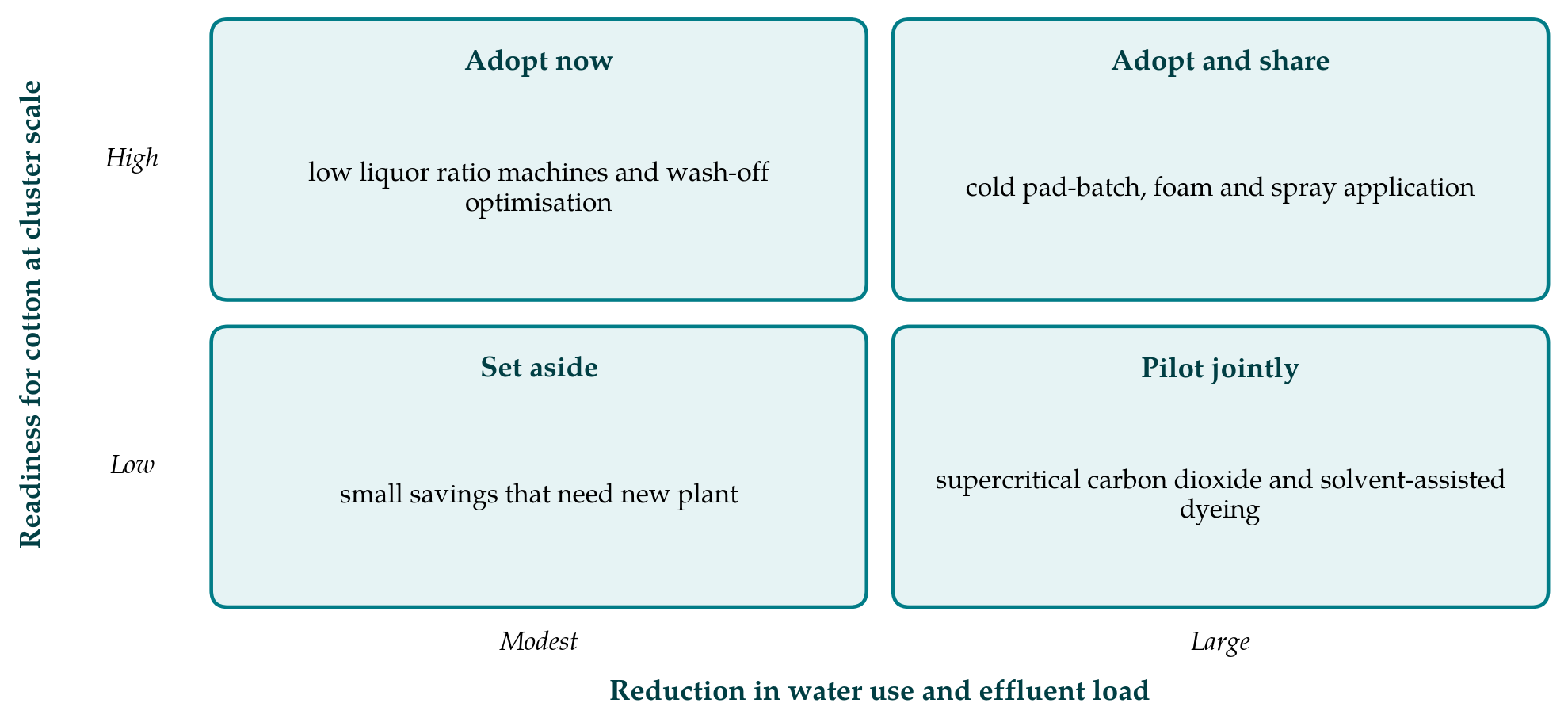
The quadrant labels in Figure 1 are illustrative placements based on the published state of each technology, and a cluster would revise them from its own baseline. The essential point of the matrix is that options with large benefits and low readiness are not rejected. They are assigned to joint piloting, where the risk is shared.
3.3. Stage 3: Run a shared pilot
Options in the pilot quadrant are tested on a single installation owned or leased by the association and open to all members, who bring their own fabrics and shades. The arrangement follows the reasoning of strategic niche management, which holds that an unproven technology needs a protected space in which users can learn about it before it meets full commercial competition (Kemp et al., 1998). The pilot protocol is fixed beforehand: which fabrics and shades, how many repeats, which colour fastness and levelness tests, and which resource flows are metered. Members must be able to see the results, including the failures.
3.4. Stage 4: Evaluate
Pilot data are evaluated on three counts. Technical performance is judged against the buyers' specifications that members already work to. Environmental performance is assessed by life cycle assessment in accordance with the international standards (ISO, 2006a; ISO, 2006b), with the system boundary drawn widely enough to include the electricity for compression or the reagents for fibre modification, so that a saving in water is not bought with an unexamined burden elsewhere. Economic performance is assessed over the life of the equipment and includes the avoided cost of effluent treatment, which in a cluster under strict discharge rules may be the largest single item (Holkar et al., 2016).
3.5. Stage 5: Roll out in steps
Adoption then proceeds in the order the screening suggests. Measures that are ready and cheap are taken up by individual firms at once. Measures that are ready but require new machinery, such as pad-batch ranges, may be better provided as a shared service, with one facility dyeing on commission for several members. High-pressure or otherwise novel plant is added only if the pilot supports it, and then preferably as a common facility. Financing follows the same division: firm-level loans for the first group, and collective borrowing or public co-funding, justified by the reduced load on the common treatment plant, for the others.
4. Fitting the Framework to a Medium-Scale Cluster
Three practical conditions affect how the framework is used. Product mix comes first. A cluster that dyes knitted cotton in rope form on jet machines is poorly placed to use open-width pad processes without changing its preparation, whereas a woven cluster can adopt them readily. The second is governance. Shared pilots and shared service facilities depend on trust over scheduling, recipes and customer confidentiality, and the association needs rules for these before equipment is ordered. The third is the buyer. Export dyers work to restricted substance lists and shade tolerances set by brands, and a new process is adoptable only if the buyer accepts its output, so buyers should be brought into the pilot stage and not presented with its results afterwards.
The framework also guards against a common error, which is to treat the most novel technology as the most valuable. For many cotton clusters the largest and quickest reductions are likely to come from unglamorous measures: lower liquor ratios, better right-first-time rates, optimised wash-off and salt recovery. A framework that begins from a measured baseline makes that visible.
5. Limitations and What Remains to Be Shown
The framework has not been applied, and its usefulness is unproven. Its stages are assembled from literatures that were developed separately, and whether they combine well in a real cluster can only be learned by trying. Three questions deserve particular attention in a first application. One is whether member firms will share baseline data that reveal their costs. Another is whether a shared pilot produces results that members accept as valid for their own conditions. The third is whether the screening criteria and weights, once set, survive contact with supplier marketing and subsidy offers that favour particular equipment.
The technical picture will also move. Dye chemistry for supercritical processing of cellulose is an active research area (Banchero, 2013), and a route that belongs in the pilot quadrant today may be ready sooner than expected, or may never be. The framework is intended to be re-run as evidence changes and should not be treated as a single decision.
6. Conclusion
A medium-scale cotton cluster under pressure to cut water use and effluent has more options than the label waterless dyeing suggests, and fewer truly waterless ones that are ready for cotton. The framework proposed here asks the cluster to measure first, to screen low-water and waterless routes against cotton-specific criteria, to share the risk of piloting what is promising but unproven, to evaluate with life cycle and cost methods, and to roll out in steps with collective arrangements where scale requires them. It remains a proposal, and the natural next step is its application and critical reporting in a working cluster.
Conflict of interest
To be declared by the author(s) before publication.
Funding
To be declared by the author(s) before publication.