1. Introduction
Selling by live video is older than the smartphone. Television shopping channels paired a presenter, a demonstration and a countdown clock decades ago. What livestream shopping changes is the direction of communication and the distance to the till. Viewers type questions and receive answers within seconds, they see what others in the audience are saying and buying, and they can pay without leaving the stream. In Southeast Asia the format is offered by regional marketplaces such as Shopee and Lazada, by TikTok Shop, and informally by sellers who broadcast on Facebook and take orders through comments and private messages.
The region is a natural setting for the question this review addresses. Its internet users are young and reach the internet mainly through mobile phones, and industry reporting identifies e-commerce as the largest part of a growing digital economy (Google et al., 2023). Young adults are of particular interest because they are heavy users of short video and social media, often have limited and irregular incomes, and are still forming habits of spending and saving. A sales format that encourages purchases made on the spot therefore raises questions of both commercial and consumer-welfare interest.
This article reviews the published literature on livestream shopping and impulse purchase intention and considers how far it speaks to young consumers in Southeast Asia. It reports no new data. Its aim is to set out what is reasonably well supported, what is assumed, and what has not yet been studied.
2. Scope and Approach
The review is narrative. It draws on three bodies of work judged most relevant to the question: the consumer research literature on impulse buying, the information systems literature on online impulse buying and website cues, and the more recent literature on live streaming commerce. Sources were selected for their influence on later work and for their bearing on the mechanisms through which a live broadcast might prompt an unplanned purchase. No claim of exhaustive coverage is made, and effect sizes are not pooled. Studies of Southeast Asian sellers and shoppers are highlighted where they exist, and the frequent reliance on evidence from China, where the format matured first, is treated as a limitation in its own right.
A point of terminology should be settled first. Most of the studies discussed measure the urge to buy impulsively or a stated intention to do so, and few observe purchases. This review keeps urge, intention and behaviour apart, because the distance between intention and behaviour is well documented in social psychology (Sheeran, 2002) and is likely to matter for an act that is by definition unplanned.
3. Impulse Buying Before the Livestream
Impulse buying has been studied for more than half a century. Stern (1962) distinguished pure impulse purchases from those prompted by a reminder, by a suggestion, or by a plan to take advantage of offers found in the shop, a classification that already recognised the retailer's hand in the unplanned purchase. Rook (1987) gave the modern definition: a sudden, often powerful and persistent urge to buy something immediately, experienced with emotional conflict and little regard for consequences. Later work treated the tendency to buy on impulse as a stable consumer trait and showed that acting on it depends on whether the buyer judges the purchase appropriate in the situation (Rook and Fisher, 1995).
Two further findings from this period remain central. Beatty and Ferrell (1998) modelled the precursors of the impulse purchase and placed positive affect, the time and money available, and the felt urge between browsing and buying. The self-control literature added the other side of the ledger: impulse purchases occur when desire is strong and also when the capacity to resist is low (Baumeister, 2002), and people whose self-regulatory resources have been depleted by a prior task spend more on impulse (Vohs and Faber, 2007). A late-evening broadcast watched at the end of a working day fits that description uncomfortably well.
When retailing moved online, researchers asked whether website design could play the part of the shop floor. Experimental work showed that both the task-relevant quality of a site and its mood-relevant cues affect the urge to buy impulsively (Parboteeah et al., 2009), and that website quality interacts with the shopper's own impulsiveness (Wells et al., 2011). Survey work linked merchandise attractiveness, enjoyment and the store's style of communication to impulse buying through positive emotion (Verhagen and van Dolen, 2011). A literature analysis by Chan et al. (2017) organised this body of research around the stimulus-organism-response framework, which livestream studies later adopted almost without modification.
4. What the Livestream Adds
A livestream differs from a product page in several respects that matter for impulse buying, summarised in Table 1. None is wholly new, but their combination in one continuous experience is.
| Feature | Proposed route to impulse buying | Representative sources |
|---|---|---|
| Real-time interaction with the host | Questions are answered at once, which lowers uncertainty and delay | Wongkitrungrueng and Assarut, 2020; Sun et al., 2019 |
| Streamer attractiveness and fit | Liking and credibility transfer from the host to the product | Xu et al., 2020; Park and Lin, 2020 |
| Para-social relationship | Felt familiarity with the host makes buying feel like support for a friend | Horton and Wohl, 1956; Xu et al., 2020 |
| Visible audience activity | Comments and orders from other viewers act as social proof | Cialdini, 2009; Sun et al., 2019 |
| Time-limited prices and stock counts | Scarcity raises perceived value and urgency | Cialdini, 2009 |
| Checkout inside the stream | Shortens the interval in which second thoughts can arise | Baumeister, 2002 |
Interaction is the feature most often credited with the format's commercial success. In a study of Thai shoppers who bought from sellers on Facebook Live, Wongkitrungrueng and Assarut (2020) related the utilitarian, hedonic and symbolic value of live streaming to trust in the product and the seller and, through trust, to engagement. A companion study of the sellers themselves described distinct sales approaches, from transaction-centred to relationship-centred broadcasting (Wongkitrungrueng et al., 2020). These two papers are among the few from Southeast Asia that are widely cited, and they concern trust and engagement more than impulse buying as such.
The host matters independently of the interaction. Viewers watch streams for enjoyment as well as for product information, and hedonic motives are tied more closely to an interest in the streamer than in the goods (Cai et al., 2018). In commerce streams, the attractiveness of the streamer and para-social interaction with them have been associated with arousal and with impulsive consumption (Xu et al., 2020), and the fit between an internet celebrity and the product endorsed shapes attitudes toward the broadcast (Park and Lin, 2020).
Scarcity and social proof are standard instruments of persuasion (Cialdini, 2009) and livestreams apply both continuously. A price holds only while the broadcast lasts, a counter shows remaining stock, and each order placed by another viewer scrolls past in the chat. The checkout sits inside the stream, so the interval between wanting and paying, in which a shopper might reconsider, is reduced to a few taps. The older literature would predict exactly this combination to be effective: high arousal, a salient norm that buying is what people here do, and little time for deliberation.
5. Theoretical Lenses
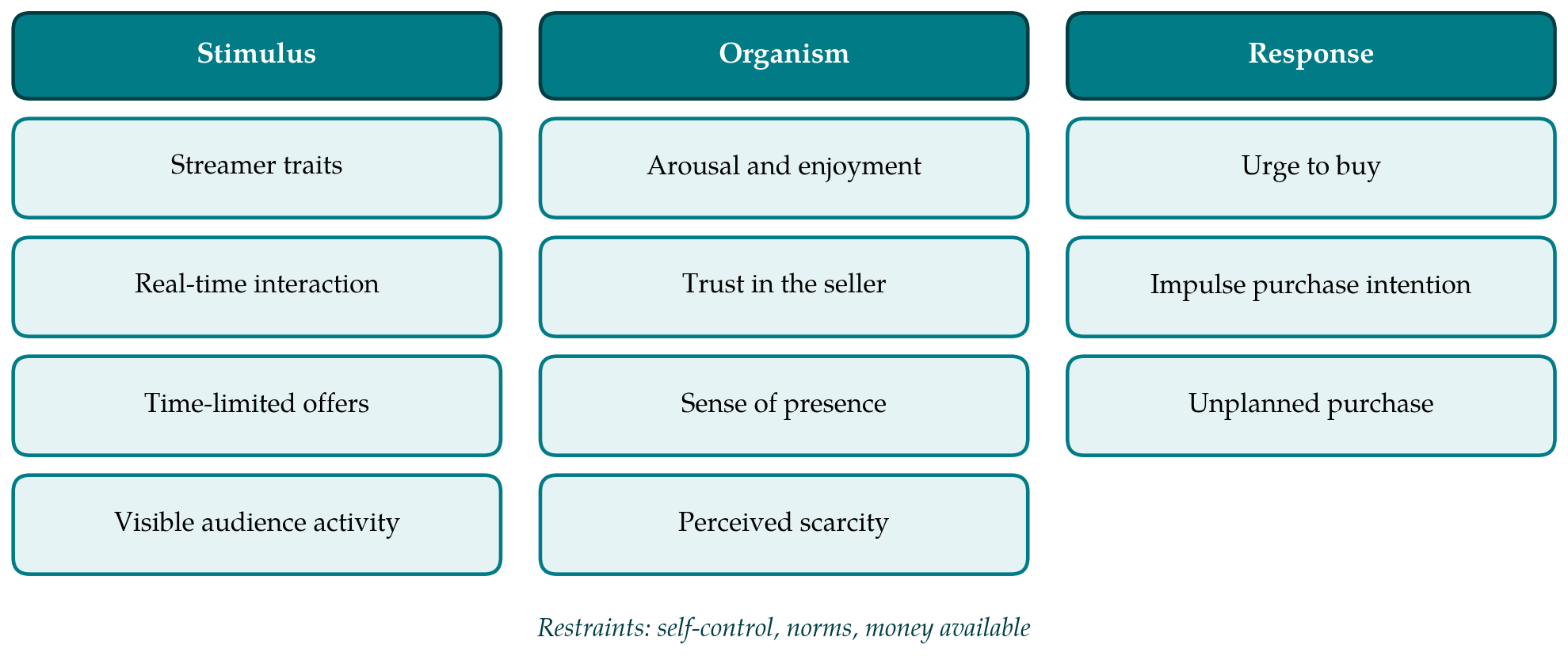
Three frameworks dominate. The first is the stimulus-organism-response model taken from environmental psychology (Mehrabian and Russell, 1974), in which features of an environment produce internal states that in turn produce approach or avoidance. Figure 1 shows the version that recurs in livestream studies. Stimuli are features of the stream and the streamer, the organism is represented by affective and cognitive states such as arousal, enjoyment, trust and perceived scarcity, and the response is the urge or intention to buy.
The second lens is affordance theory. Sun et al. (2019) argued that live streaming affords visibility of the product, a channel through which viewers can voice their reactions, and guidance while shopping, and that these affordances raise purchase intention by way of immersion and a sense of presence. The third is para-social interaction, a concept introduced for television audiences by Horton and Wohl (1956) to describe the illusion of a face-to-face relationship with a performer. A streamer who greets viewers by their usernames and answers their questions strengthens that illusion considerably.
The frameworks are complementary more than competing, and their shared weakness is permissiveness. Almost any feature can be entered as a stimulus and almost any feeling as an organism state, so the models are easy to confirm and hard to refute. Few studies test rival explanations against each other, for instance whether scarcity cues work through arousal or through a reasoned judgement that the discount is real. Fewer still include the restraining variables that the earlier literature treats as essential: normative evaluation, self-control and available money. Reviews of social commerce research had already remarked on the fragmentation of constructs in the field (Zhang and Benyoucef, 2016).
6. The Southeast Asian Setting and Young Consumers
Whether these findings carry over to Southeast Asia is not settled. The region is not one market. It spans high-income Singapore and lower-middle-income economies, several major religions, and languages that divide audiences by country. Some shared features are relevant all the same. Selling through social media and chat applications was established before marketplace apps introduced their own live features, so that many shoppers first met livestream selling as an extension of a personal relationship with a small seller. Cash on delivery and e-wallets are widely used alongside cards, which changes what a one-tap checkout means and when payment is felt.
Culture may also alter the link between trait and act. In a study that included respondents from Singapore and Malaysia, Kacen and Lee (2002) found that the relationship between trait impulsiveness and impulse buying was weaker in collectivist than in individualist cultures, which they attributed to the greater weight given to group norms and emotional restraint. Southeast Asian societies are commonly described as collectivist in this sense, though they differ among themselves. A livestream complicates the prediction, because the visible audience may itself supply a group norm that favours buying. Whether collectivism restrains or amplifies impulse purchase in this format is an open and testable question.
Regulation is part of the setting. In 2023 Indonesia barred social media platforms from processing sales transactions directly, which led TikTok to suspend its shop there before returning through a partnership with the marketplace Tokopedia. The episode showed that governments in the region regard the fusion of entertainment and checkout as a matter for policy, in that case mainly out of concern for small domestic traders. Consumer-protection questions specific to young buyers, such as cooling-off rights for purchases made during a broadcast or the disclosure of paid endorsement by hosts, have received less attention in the research literature.
For young consumers the available evidence is indirect. Student and young-adult samples are common in the surveys, largely for convenience, so the literature describes this group better than it describes older shoppers. What it lacks is comparison across age groups and attention to the circumstances that make youth relevant. Limited income raises the cost of an unplanned purchase. Instalment and deferred-payment options at checkout may soften the moment of payment. Heavy use of short-video applications means that a shopping stream can appear in the feed uninvited, so that exposure itself is unplanned. None of these conditions is yet well represented in published models.
7. Limits of the Evidence
The methodological profile of the field is narrow. The typical study is a cross-sectional online survey of people who have watched or bought from a livestream, analysed with structural equation modelling. Predictors and outcomes are reported by the same person at the same sitting, a design known to inflate associations through common method variance (Podsakoff et al., 2003). Respondents are asked to recall a recent stream and rate their urge to buy, which measures a memory of a feeling. Samples are self-selected, and people who never buy from streams, or who have stopped, are absent.
The outcome variable deserves particular scrutiny. Intention is a concept from models of reasoned action, in which behaviour follows from a deliberate plan (Ajzen, 1991). Impulse buying is defined by the absence of such a plan. An item that asks whether the respondent intends to buy impulsively in future streams therefore captures something closer to self-knowledge of a tendency than a forecast of behaviour, and the general gap between intentions and actions (Sheeran, 2002) is likely to be wide here. Platform log data, field experiments with sellers, and diary or experience-sampling designs would each address part of the problem, and each is rare in the published work.
8. Gaps and Directions for Research
Four gaps follow from this assessment. The first is behavioural evidence: studies that observe orders, cancellations and returns, ideally through collaboration with platforms or sellers. Returns and cancellations are of special interest because they are the visible trace of regret, and cash-on-delivery markets allow a buyer to refuse a parcel at the door. The second is causal identification of specific features. Countdown timers, stock counters and pinned discount vouchers can be switched on and off, which makes them suitable for experiments in a way that streamer charisma is not.
The third gap is regional. Comparative work across Southeast Asian countries, using common instruments and local languages, would show whether models developed in China hold where platforms, payment habits and seller types differ. Studies of informal sellers on social media, following the Thai examples, are as relevant as studies of marketplace apps. The fourth gap concerns welfare. Research has asked what makes viewers buy. It has rarely asked what happens afterwards to satisfaction, to budgets, or to debt among young buyers who use deferred payment. Answering those questions requires longitudinal designs and measures of restraint as well as of desire.
9. Conclusion
The literature offers a coherent account of why livestream shopping should encourage impulse buying. The format gathers the classic precursors, namely arousal, social proof, scarcity and a short path to payment, and adds a host with whom viewers feel a relationship. Survey studies consistently associate these features with the urge and the stated intention to buy. The account is plausible and theoretically grounded, yet it is supported mainly by self-reported intention measured at one point in time, and much of it comes from outside Southeast Asia.
For young consumers in the region, the fair summary is that the mechanisms are well described and the consequences are not. Research that observes behaviour, tests individual design features, compares countries, and follows buyers after the purchase would turn a persuasive model into dependable knowledge, and would give regulators and platforms a firmer basis for deciding which features of the format need rules.
Conflict of interest
To be declared by the author(s) before publication.
Funding
To be declared by the author(s) before publication.