1. Introduction
Nepal is among the most linguistically diverse countries of its size. The national census of 2011 recorded 123 languages spoken as mother tongues (Central Bureau of Statistics, 2012), from four language families, and Nepali is the first language of fewer than half the population. A child in a hill or Tarai village may therefore enter the first grade speaking Tamang, Magar, Tharu, Maithili, Limbu or one of many smaller languages, and meet a teacher and a textbook that use another.
The case for beginning school in a language the child understands has been made for seventy years, since the expert meeting convened by UNESCO (1953), and Nepal's own law now reflects it. The constitution adopted in 2015 gives every community the right to education in its mother tongue (Government of Nepal, 2015), and the School Sector Development Plan commits the system to using children's languages in the early grades (Ministry of Education, 2016). Practice has moved the other way. Ethnographic work in Nepali schools has documented how local-language policies are displaced by the prestige of Nepali and by parental demand for English (Phyak, 2013; Sah and Li, 2018).
Published accounts of multilingual education in Nepal mostly describe either national policy or what happened in particular pilot schools. What a head teacher or a ward education officer lacks is an ordered account of the decisions involved. This article offers one. It sets out a stepwise planning procedure for a rural primary school with children from more than one language community. No application of the procedure is reported, and the article describes no actual school.
2. Background
Three bodies of knowledge inform the design: research on learning through a first language, the record of earlier efforts in Nepal, and the study of how language policy is carried out in schools.
2.1. Learning through the first language
The theoretical foundation is the interdependence hypothesis of Cummins (1979): literacy and academic concepts developed in one language are available to a second, provided the first has been developed far enough. The practical consequence is that time spent on the mother tongue is not taken from the second language. Longitudinal comparison of programme types in the United States found that children who received longer first-language instruction did better in English in the long run than those moved early into English only (Thomas and Collier, 2002). A review of African experience reached the same conclusion about early exit, judging that a switch of medium after two or three years is too soon for most children (Alidou et al., 2006).
Evidence from settings closer to rural Nepal is consistent, with qualifications. The Lubuagan programme in the Philippines reported gains across subjects for children taught through their own language (Walter and Dekker, 2011). A randomised trial in Kenya found that mother-tongue instruction improved reading in the mother tongue while showing no added benefit for English or Kiswahili, and it drew attention to the practical obstacles of implementing the approach in ordinary schools (Piper et al., 2016). Reviews written for policy makers stress that results depend on materials, teacher language proficiency and the length of the programme (Benson, 2004).
2.2. Earlier experience in Nepal
A donor-supported multilingual education programme was piloted in a small number of schools across several districts in the late 2000s. Hough et al. (2009) describe its approach, which built teaching materials from the knowledge of community elders and treated indigenous knowledge as curriculum content. Critical studies of what followed are instructive. Phyak (2011) argued that planning for primary education remained shaped by a monolingual habit of mind and by elite preference, and his later ethnography showed teachers and parents in a multilingual school treating the local language as an obstacle to mobility (Phyak, 2013). The spread of English-medium instruction in community schools, sought by parents as a form of capital and often taught by teachers with limited English, has sharpened the difficulty (Sah and Li, 2018).
2.3. Policy as practised in schools
Language policy research describes implementation as layered. Ricento and Hornberger (1996) likened it to an onion, with legislation at the outside and the classroom teacher at the centre, and Hornberger and Johnson (2007) showed that local actors open or close the spaces that national policy leaves. For Nepal this means that the constitutional right is realised or lost in decisions taken by school management committees and local governments, which since federal restructuring hold responsibility for basic education. A planning procedure should therefore be addressed to that level.
3. The Proposed Procedure
The procedure has seven steps, to be worked through over the school year before mother-tongue teaching begins and repeated in lighter form each year afterwards. Figure 1 shows the sequence. Table 1 lists the decision made at each step, who is responsible for it and the record that should be kept. The steps are then described in turn.
| Step | Decision to be made | Who decides | Record kept |
|---|---|---|---|
| 1. Language mapping | Which languages are present, and who speaks them well enough to teach | Head teacher with class teachers | Language register by grade |
| 2. Language model | Which language or languages are used as medium, and in which grades | Parents and management committee | Minuted agreement |
| 3. Materials | Script, spelling conventions and the first set of reading materials | Language community and teachers | Orthography note, materials list |
| 4. Teachers | Who teaches which class, and what training and support they receive | Head teacher and local government | Staffing and training plan |
| 5. Transition | When Nepali and English are introduced as subjects and as media | Management committee | Grade-by-grade language timetable |
| 6. Assessment | In which language children are assessed in each subject | Teachers and head teacher | Assessment policy |
| 7. Review | What is kept, changed or dropped for the following year | All of the above | Annual review report |
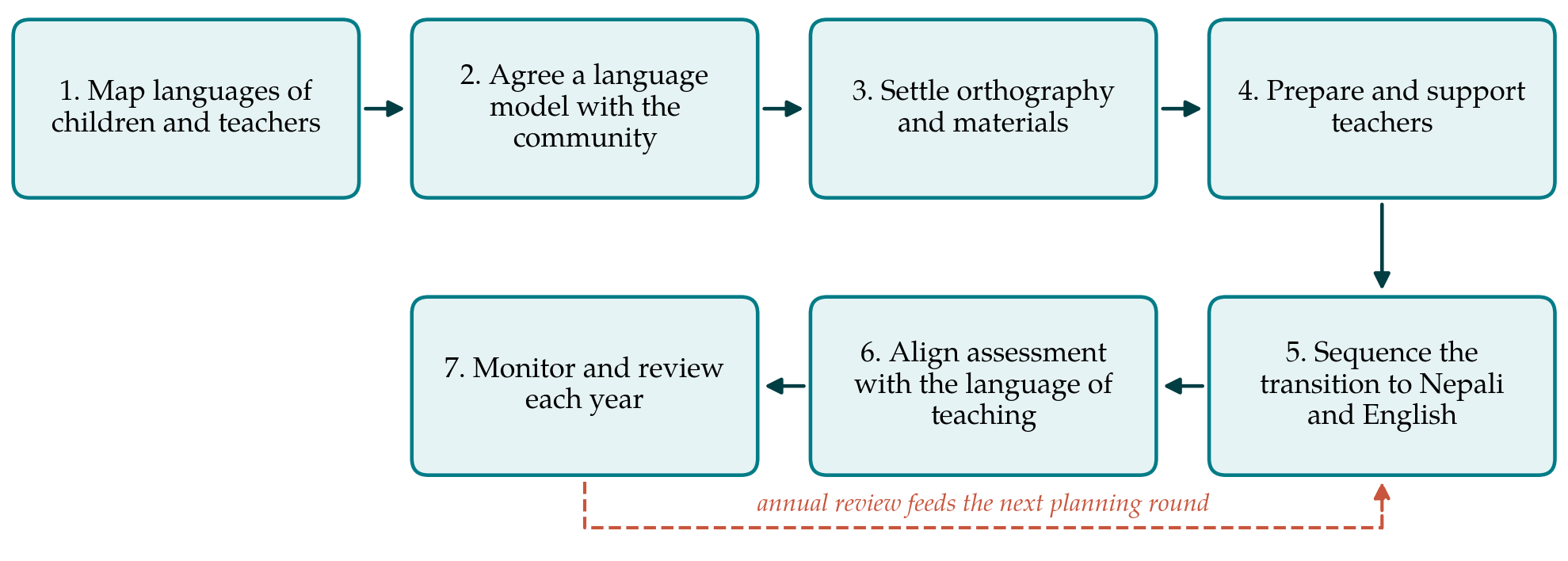
3.1. Step 1: Map the languages of children and teachers
Planning begins with facts that schools seldom record. For each child entering the early grades the school notes the language used at home, any other language the child understands, and how well the child follows spoken Nepali. For each teacher it notes the languages spoken and read. Ethnic surnames are an unreliable guide, since many families have shifted language, so the information should come from parents and from listening to the children. The result shows whether the school has one dominant local language, two or three sizeable groups, or many small ones, and each pattern leads to a different model.
3.2. Step 2: Agree a language model with the community
Parents who want English for their children are making a reasonable judgement about opportunity, and a plan imposed over their objection will not last. The school should present the options plainly at an open meeting, explain what research indicates about learning a second language on the foundation of the first, and ask what parents hope and fear. Where one language predominates, it can serve as the medium in the early grades. Where several are present, the workable choices include parallel groups for literacy, a multilingual classroom in which the teacher and classroom assistants move between languages, or the mother tongue as an oral medium alongside Nepali print. Flexible use of several languages in one lesson has a research base under the name of translanguaging (García and Li Wei, 2014). The agreement reached should be minuted.
3.3. Step 3: Settle orthography and materials
Some of Nepal's languages have established writing traditions and published primers. Others are written rarely or in competing conventions. The school should not invent a spelling system. Its task is to find out what the language community and the curriculum authorities already use, adopt it, and record the choice. Initial materials can be modest: an alphabet chart, a set of short graded stories, songs and oral texts collected locally and written down by teachers and elders, in the manner described by Hough et al. (2009). Quantity matters less at first than having something for every child to read in the language of the lesson.
3.4. Step 4: Prepare and support teachers
A teacher who speaks the children's language has not necessarily read or written it, and may have been trained to regard it as unsuitable for school. Preparation therefore has three parts: the teacher's own literacy in the language, methods for teaching initial reading in it, and methods for teaching Nepali and English as second languages instead of assuming them. Where no teacher speaks a language that many children use, the school and local government should consider recruiting a community member as a classroom assistant. Continuing support through visits and meetings with teachers from nearby schools is more useful than a single workshop.
3.5. Step 5: Sequence the transition to Nepali and English
The plan must show, grade by grade, which language carries which subject. The research reviewed above argues against an abrupt switch and against a very early one. A defensible sequence introduces Nepali orally from the first grade, adds Nepali literacy once reading in the mother tongue is under way, teaches English as a subject by methods suited to beginners, and keeps the mother tongue as a medium for as long as teachers and materials allow. Setting this out in a timetable answers the commonest parental objection, that children will be left without the national language.
3.6. Step 6: Align assessment with the language of teaching
Children taught mathematics in Tharu and tested on it in Nepali are being tested on Nepali. Classroom assessment in the early grades should use the language in which the subject was taught, and reading should be assessed in each language separately. The school needs to agree this with the local education office, since reporting formats usually assume a single language.
3.7. Step 7: Monitor and review each year
At the end of each year the head teacher, teachers and management committee should look at attendance, at how children are reading in each language, at what teachers found hard, and at what parents now think. The purpose is to adjust the model, the materials and the staffing before the next intake, and the review then feeds a lighter repetition of the first step.
4. Fitting the Procedure to Local Conditions
Rural schools in Nepal differ in ways that change how the steps apply. In a school with one teacher for several grades, parallel language groups are impossible and the multilingual classroom is the only realistic model. In a village where the mother tongue is itself giving way to Nepali among children, the mapping in the first step may show that a revitalisation aim, teaching the heritage language as a subject, fits better than using it as medium. Where a neighbouring private school advertises English medium, the community meeting in the second step carries more weight, and the school may need to show what children can do in all three languages. UNESCO (2016) treats teacher preparation and suitable materials as the conditions on which such programmes most depend, and both cost money that rural schools lack, so the procedure assumes a small budget and relies on local knowledge and on staff the school already has.
5. Limitations and What Remains to Be Shown
The procedure is a proposal. It has been reasoned from policy documents and published research and has not been tried in a school for this article, so nothing here shows that following the seven steps produces better learning or a more durable programme than proceeding without them. A trial would need to establish at least three things: that school communities can complete the steps with the time and support actually available to them; that agreement reached in the second step holds when English-medium alternatives are on offer; and that children's reading in the mother tongue and in Nepali develops as the research on other countries would predict.
Two limits lie beyond the reach of any school-level plan. Teacher deployment is decided elsewhere, and a school cannot keep a programme whose only speaker of the language is transferred. National examinations in the higher grades are set in Nepali and English, which gives parents a lasting reason to press for early transition. The procedure can make a school's choices more deliberate; it cannot remove those pressures.
6. Conclusion
The right to mother-tongue education in Nepal is established in law and remains uncommon in rural classrooms. This article has proposed a seven-step planning procedure through which a multilingual primary school and its community could decide how to use children's languages, record the decisions and revisit them yearly. Its emphasis falls on local agreement, on realistic use of existing teachers and on an explicit path to Nepali and English. Whether it works is a question for trial in schools, ideally by the teachers and local officials who would have to carry it out.
Conflict of interest
To be declared by the author(s) before publication.
Funding
To be declared by the author(s) before publication.