1. Introduction
A patient who receives intravenous chemotherapy cannot miss a dose without the clinic knowing. The appointment is kept or it is not, and the drug is given by a nurse and documented. A patient prescribed a tyrosine kinase inhibitor, an oral hormonal agent or capecitabine is in a different position. The prescription leaves the clinic, and what happens to it afterwards depends on a pharmacy counter, an insurer's rules, a household budget and daily habit. The oncologist usually learns little of this.
The past two decades have brought many oral agents into cancer care, some of them taken for years. They spare patients travel and venous access and are rightly valued for it. They have also joined two problems that used to be separate. One is adherence, long known to be imperfect for any long-term medication (Osterberg and Blaschke, 2005). The other is price. Where patients pay part of the cost of each prescription, an expensive drug taken every day turns price into a recurring personal expense. This Perspective examines what follows from that, and why it is so easily missed.
2. What Financial Toxicity Means
The phrase financial toxicity was introduced to make a point by analogy: the cost of cancer treatment harms patients in ways comparable to its physical side effects and deserves the same clinical attention (Zafar and Abernethy, 2013). A study of insured patients who had sought help with copayments found that many were cutting spending on food and clothing, drawing down savings, and altering their medication to save money (Zafar et al., 2013). Later work has separated three elements: the material burden of bills and lost income, the psychological distress that accompanies it, and the coping behaviors that people adopt in response (Altice et al., 2017). A patient-reported instrument, the Comprehensive Score for Financial Toxicity, was developed to measure the experience (de Souza et al., 2014).
The consequences can be severe. In one United States cancer registry linked to court records, people with cancer were considerably more likely to file for bankruptcy than people without it (Ramsey et al., 2013), and among patients with cancer those who filed had a higher risk of early death (Ramsey et al., 2016). These are observational associations and do not prove that financial ruin shortens life. They are nonetheless hard to dismiss, and one plausible link between the two is treatment that was not taken.
3. Why Oral Drugs Are Different
In many insurance systems, drugs given in a clinic and drugs dispensed by a pharmacy are covered under separate benefits with separate rules. In the United States the pharmacy benefit has commonly placed expensive oral agents on a specialty tier, where the patient pays a percentage of the price and not a fixed sum. The amount due can be large at the first prescription of the year and recurs monthly. In countries where cancer drugs are bought mainly out of pocket, the same arithmetic applies with less protection. A group of more than a hundred specialists in chronic myeloid leukemia drew attention to this in 2013, arguing that the prices of the very drugs that had transformed the disease were putting them beyond the reach of patients (Experts in Chronic Myeloid Leukemia, 2013).
The effect of the patient's share on behavior has been measured. Analyses of pharmacy claims found that the higher the amount a patient was asked to pay for a newly prescribed oral anticancer drug, the more likely the prescription was to be left uncollected (Streeter et al., 2011). Among insured patients with chronic myeloid leukemia, higher copayments for imatinib were associated with more discontinuation and more missed days of treatment (Dusetzina et al., 2014). In women taking aromatase inhibitors after breast cancer, higher copayments went with poorer persistence and adherence (Neugut et al., 2011).
These findings matter because adherence to oral therapy matters. In chronic myeloid leukemia, patients who took less of their prescribed imatinib were much less likely to reach the deep molecular responses that predict long-term control (Marin et al., 2010). Early discontinuation of adjuvant hormonal therapy is a recognized problem in breast cancer, and reviews of oral antineoplastic agents report rates of adherence that vary widely between studies and are often well below what clinicians assume (Greer et al., 2016).
4. The Argument: A Cause That Hides
The claim made here is that cost-related nonadherence to oral anticancer drugs is common, consequential and largely invisible, and that its invisibility is a product of how care is organized. Four features keep it out of sight.
The first is that nobody observes the dose. The second is that patients seldom volunteer the problem. People are reluctant to tell the doctor treating their cancer that they cannot afford what was prescribed; some fear being offered inferior treatment, and others feel ashamed. The third is that clinicians seldom ask. Many do not know what their patients pay, feel unqualified to discuss it, or regard it as outside the consultation. The fourth is that the behavior is easily taken for something else. A patient who stretches a month's supply over six weeks shows fewer side effects and, later, a disease that seems to have become resistant.
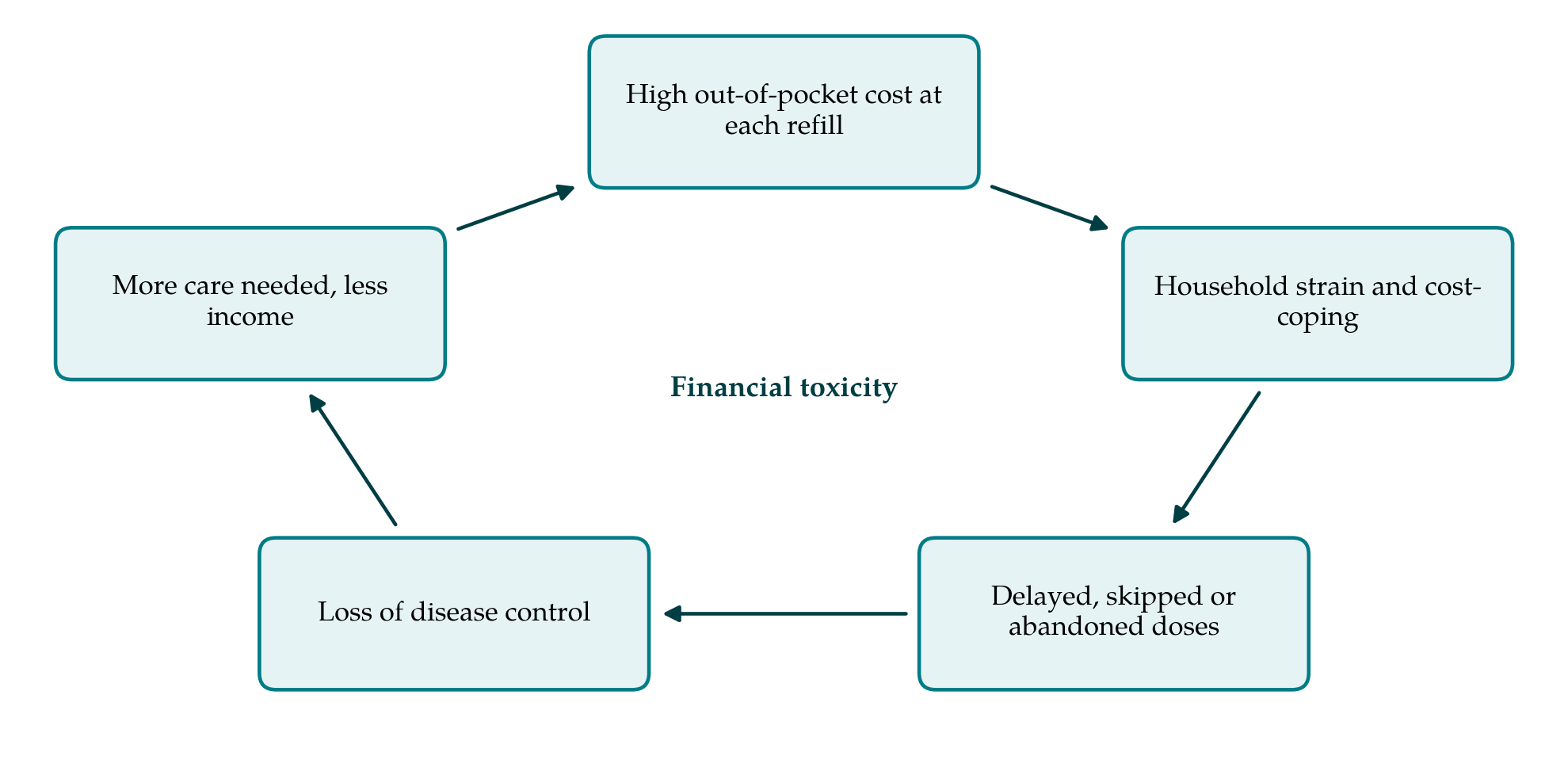
That last point deserves emphasis. When a tumor progresses on an oral agent, the usual inference is biological resistance, and the usual response is a change to another, often costlier, drug. If the true cause was underdosing for financial reasons, the change adds expense and solves nothing. Table 1 sets out the routes by which cost reaches behavior, how each appears in the clinic and what might be done. Figure 1 shows how the process can feed on itself.
| Route | How it presents in clinic | Possible response |
|---|---|---|
| Prescription never collected | Start of treatment later than recorded, or not at all | Contact after first prescription; pharmacy feedback |
| Delayed refills | Gaps between supplies; apparent loss of response | Check dispensing dates before changing therapy |
| Dose stretching or splitting | Fewer side effects than expected | Ask directly and without judgment |
| Trading against other needs | Other medicines stopped; missed visits | Screen for hardship; social work referral |
| Early discontinuation | Patient reports intolerance or reluctance | Explore cost alongside toxicity |
| Distress and avoidance | Anxiety, disengagement from follow-up | Financial navigation; psychological support |
5. Counter-Arguments
Three objections should be met. The first is that nonadherence has many causes, and cost is only one. This is true. The World Health Organization's framework lists factors related to the therapy, the condition, the patient, the health system and social and economic circumstances (World Health Organization, 2003). Side effects, complex schedules, low mood and forgetfulness all play a part with oral anticancer drugs (Greer et al., 2016). The argument here does not require cost to be the main cause. It requires only that cost be a cause that is modifiable and currently overlooked, and the claims-based studies support the first of these while routine practice illustrates the second.
The second objection is that the evidence is observational and comes largely from one country. Patients facing higher copayments may differ in other ways from those facing lower ones, and insurance arrangements elsewhere are different. The limitation is real. The direction of the association is consistent across drugs and datasets, however, and the mechanism needs no elaborate theory: people buy less of what costs them more. In systems with little insurance cover the effect is, if anything, likely to be stronger, though it is less well documented.
The third objection is that clinicians cannot change drug prices and should not be asked to manage what they cannot control. Price is indeed set elsewhere. Yet clinicians do control whether the subject is raised, whether a less costly equivalent is chosen where one exists, and whether help is sought early. Professional guidance has held for some years that discussion of cost is part of good oncological care (Meropol et al., 2009), and others have argued that out-of-pocket cost should be disclosed to patients as any side effect would be (Ubel et al., 2013).
6. Implications for Practice and Policy
If financial toxicity is treated as an adverse effect, the clinical response follows a familiar pattern: anticipate, ask, grade and manage. Anticipating means recognizing before the first prescription which patients are exposed, by reason of their insurance, income or the drug chosen. Asking can be as simple as a single routine question about difficulty paying for medicines, or a validated measure (de Souza et al., 2014). Managing draws on resources that many centers already have and use too late: pharmacists who can identify assistance schemes and generic or biosimilar alternatives, social workers and financial navigators (Carrera et al., 2018).
Before a patient is declared resistant to an oral agent, the dispensing record should be checked. This costs little and may prevent an unnecessary switch. Where pharmacies and clinics share information, a missed refill can prompt a call in the way a missed infusion does.
Policy sets the limits within which clinics work. Rules that cap what patients pay for prescription drugs in a year address the problem at its source. In the United States the Inflation Reduction Act of 2022 introduced such an annual limit on out-of-pocket spending for drugs covered under Medicare Part D (United States Congress, 2022). How far measures of this kind improve adherence to oral anticancer drugs is an empirical question that deserves study as they take effect. Research is also needed outside high-income countries, where the burden is probably greatest and the evidence thinnest, and on whether screening and navigation, which are widely recommended, change what patients actually take.
7. Conclusion
Oral anticancer drugs work only when taken, and for many patients taking them means paying for them month after month. The published evidence links higher out-of-pocket cost with prescriptions left uncollected, interrupted treatment and early stopping, and links poor adherence with worse control of disease. Because none of this happens in front of the clinician, it is seldom recognized for what it is. Asking about cost, checking refills before concluding that a drug has failed, and bringing financial help in early are modest steps. They treat the patient's ability to afford treatment as part of the treatment, which for oral therapy it is.
Conflict of interest
To be declared by the author(s) before publication.
Funding
To be declared by the author(s) before publication.