1. Introduction
Orthopaedic surgeons treat the consequences of osteoporosis every working day. A wrist fracture in a woman in her sixties, a vertebral compression fracture found on a chest radiograph, a proximal humeral fracture after a trip on a kerb, a hip fracture: each is repaired or immobilised with skill, and each is a statement about the strength of the skeleton that broke. The epidemiology is not in dispute. A prior fracture roughly doubles the risk of a further one, across fracture sites and independently of bone density (Klotzbuecher et al., 2000; Kanis et al., 2004), and the excess risk is concentrated in the period soon after the first event (Johansson et al., 2017). Fragility fractures, including those outside the hip, are also followed by increased mortality (Bliuc et al., 2009).
Against this background, the usual experience of a patient with a fragility fracture is that the bone is treated and the disease is not. Reviews of practice have documented for two decades that only a minority of such patients are investigated or treated for osteoporosis (Elliot-Gibson et al., 2004). In the United States, the proportion of patients receiving osteoporosis medication after a hip fracture was low at the start of this century and fell further over the following decade (Solomon et al., 2014), a trend that leading bone researchers described as a crisis (Khosla and Shane, 2016).
The fracture liaison service was designed to close this gap. This article takes the position stated in its title: the model works, it has been available for more than twenty years, and most orthopaedic departments still do not have one or have one that reaches only a fraction of eligible patients. It argues that the reasons are organisational and that the remedy lies largely within orthopaedics.
2. What a Fracture Liaison Service Is
A fracture liaison service is a coordinator-based system of secondary fracture prevention. In the model established in Glasgow, specialist nurses working to agreed protocols identified every patient aged fifty or over who presented with a new fracture, arranged assessment including bone densitometry where appropriate, and made treatment recommendations, with medical supervision in the background (McLellan et al., 2003). The essential element is a dedicated person whose job is to find the patients, as opposed to waiting for them to be referred. The same principle was applied within an orthopaedic unit in Toronto, where a coordinator based in the fracture clinic achieved high rates of diagnosis and treatment (Bogoch et al., 2006), and within a large managed care organisation in California, where orthopaedic surgeons led a programme that the authors associated with a substantial fall in hip fracture rates (Dell et al., 2008).
Not all services are equally intensive. A widely used classification distinguishes four types. In the most complete, the service identifies patients, investigates them and initiates treatment. In the next, it identifies and investigates but leaves prescribing to primary care. In the third, it identifies patients and alerts them and their doctor. In the least intensive, it only informs the patient. Table 1 summarises these models. The meta-analysis from which the classification comes found a clear gradient: the more of the pathway the service itself delivers, the higher the rates of bone density testing and treatment (Ganda et al., 2013).
| Model | What the service does | What is left to others | Reported effect on treatment rates |
|---|---|---|---|
| Type A | Identifies, investigates and starts treatment | Long-term prescribing and review | Highest |
| Type B | Identifies and investigates | Starting treatment (primary care) | Intermediate |
| Type C | Identifies; alerts patient and primary care doctor | Investigation and treatment | Lower |
| Type D | Gives the patient information only | Everything else | Little or none |
| No service | Fracture care only | Depends on individual initiative | Baseline care gap Elliot-Gibson et al., 2004 |
3. The Argument: A Problem of Ownership
The care gap persists because secondary prevention falls between specialties. The orthopaedic surgeon regards osteoporosis as a medical condition and assumes that the general practitioner will deal with it. The general practitioner receives a discharge letter describing a fracture and its fixation, with no mention of bone health, and reasonably concludes that the hospital has dealt with whatever needed attention. The patient, told that the fracture has healed, concludes that the problem is over. Each assumption is understandable, and the combined effect is that nobody acts. The systematic review that underpinned the international position on coordinator-based systems reached this conclusion directly: the absence of a clearly responsible party is the central cause of the gap (Marsh et al., 2011).
Education has been tried as the remedy and has largely failed. Guidelines, reminders to surgeons and letters to primary care correspond to the lower-intensity models in Table 1, and those models produce the smallest gains (Ganda et al., 2013). This is not surprising. A busy fracture clinic is organised around radiographs, casts and operative decisions, and a task that belongs to no one will be left undone however well its importance is understood. Figure 1 sets out the points along the pathway at which patients are typically lost.
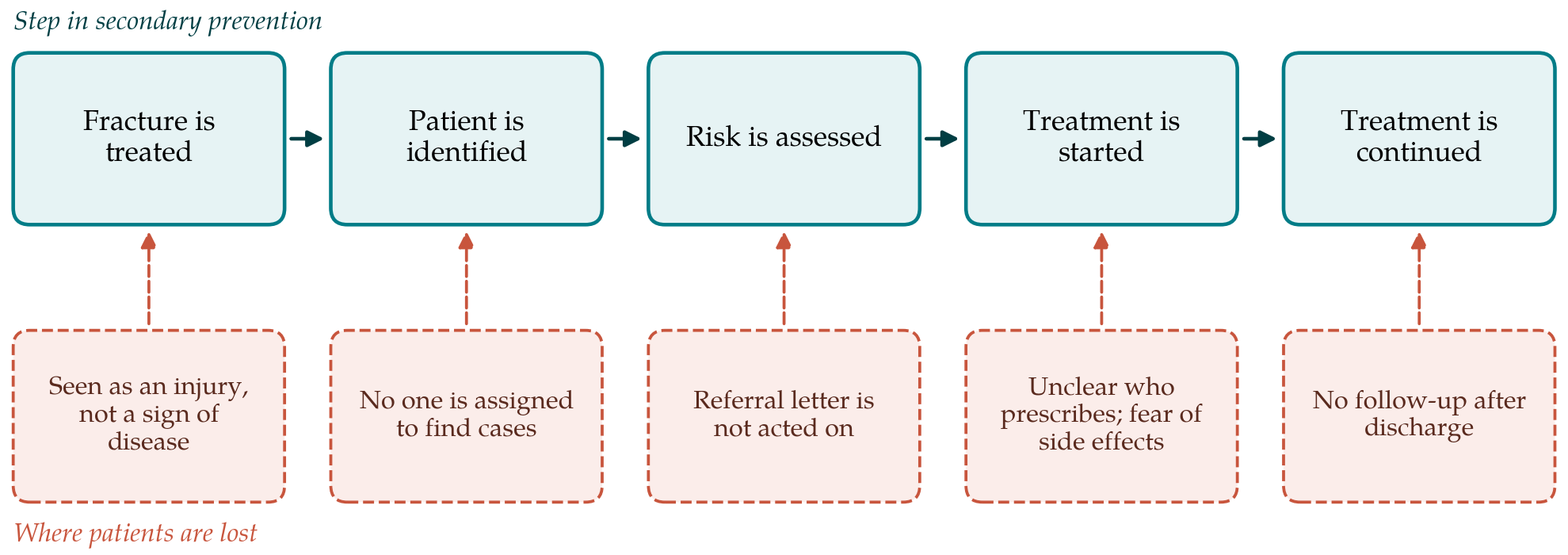
Orthopaedic departments are the natural owners of the first two steps. Every patient with a fragility fracture who comes to hospital attention passes through the emergency department, the fracture clinic or the trauma ward; no other service sees them all. A task force of the American Society for Bone and Mineral Research made the case for systematic secondary prevention under the phrase that the first fracture should be the last (Eisman et al., 2012), and the International Osteoporosis Foundation's Capture the Fracture programme published a Best Practice Framework with standards against which any service can be benchmarked (Åkesson et al., 2013). A multistakeholder coalition has since issued consensus clinical recommendations for the care of people aged sixty-five and over with a hip or vertebral fracture (Conley et al., 2020). The standards exist. What is lacking is their adoption as part of routine orthopaedic work.
4. Objections Considered
The first objection is cost. A coordinator is a salaried post, and bone densitometry and drugs are not free. The economic evaluation of the Glasgow service, based on eight years of data, concluded that the service was cost-effective and indeed cost-saving for the health system, because fractures prevented are expensive fractures (McLellan et al., 2011). The difficulty in practice is that the cost falls on one budget, often the orthopaedic or outpatient budget, while the savings accrue elsewhere and later. That is a reason to make the case at the level of the hospital or the payer. It is not a reason to conclude that the service is unaffordable.
The second objection concerns the strength of the evidence. Most studies of fracture liaison services measure process: rates of assessment, treatment initiation and adherence. The evidence that they reduce refracture and mortality comes mainly from observational comparisons, which a meta-analysis found to favour the services but which are open to confounding (Wu et al., 2018). This limitation should be acknowledged. It should also be put in proportion. The drugs that a service initiates have been shown in randomised trials to reduce fractures, and a service is a delivery mechanism for treatment of proven efficacy. Demanding randomised proof that reliable delivery of an effective treatment improves outcomes sets a standard that few organisational measures in surgery have been asked to meet.
A third objection is that concern about rare adverse effects of antiresorptive drugs, notably atypical femoral fracture and osteonecrosis of the jaw, has made patients and clinicians reluctant. The concern is real and has contributed to falling treatment rates (Khosla and Shane, 2016). For patients who have already sustained a fragility fracture, however, the balance of benefit and harm strongly favours treatment, and explaining that balance to an anxious patient is exactly the kind of unhurried conversation that a liaison nurse can have and a fracture clinic cannot.
The last objection is one of remit: that this is not orthopaedic work. No one proposes that surgeons should manage osteoporosis in the long term. The proposal is narrower. The department that treats the fracture should ensure that the patient is identified and enters a pathway, in the same way that it ensures a patient receives thromboprophylaxis without the surgeon personally administering it. A global call to action endorsed by orthopaedic, geriatric and osteoporosis organisations states this expectation in plain terms (Dreinhöfer et al., 2018).
5. Implications for Orthopaedic Departments
Several practical consequences follow. Each department should have a named clinical lead for secondary fracture prevention and should know what proportion of its patients aged fifty or over with a new fracture are assessed for bone health; a department that cannot state this figure has not begun. Identification should be systematic and independent of the treating surgeon's memory, drawing on fracture clinic lists, ward admissions and radiology reports, with particular attention to vertebral fractures, which are the type most often missed. Where resources allow only a modest start, the evidence on service models suggests concentrating them on a coordinator who identifies and investigates, since a service that merely sends letters achieves little (Ganda et al., 2013).
Integration matters as much as initiation. For hip fracture, orthogeriatric co-management already provides a setting in which bone health assessment and falls assessment can be completed before discharge. For the larger number of patients with non-hip fractures who are never admitted, the fracture clinic is the only point of contact, and the liaison service has to be built into its workflow. Follow-up to check that treatment was started and is being taken is part of the model, because treatment that lapses within months prevents nothing. Finally, departments should measure themselves against the published framework (Åkesson et al., 2013) and report the results, as they do for surgical site infection or time to theatre.
Training has a part to play. Orthopaedic curricula give extensive attention to the fixation of osteoporotic bone and little to the disease that weakened it. A trainee who has worked in a department where every fragility fracture triggers an assessment will regard that as normal practice, and will expect it in the departments they later lead.
6. Conclusion
The case for fracture liaison services has been settled for some time on the points that matter for a decision: fragility fractures predict further fractures, treatment reduces them, most patients do not receive it, and a coordinator-based service corrects this at acceptable cost. The services remain underused because the task of secondary prevention has no natural owner, and orthopaedic departments, which see every one of these patients, have not claimed it. They are the group best placed to do so. The fracture should be regarded as incompletely treated until the patient's risk of the next one has been assessed and addressed.
Conflict of interest
To be declared by the author(s) before publication.
Funding
To be declared by the author(s) before publication.