1. Introduction
Spraying from unmanned aircraft is older than the present enthusiasm suggests. Remotely piloted helicopters were introduced for rice protection in Japan in the late 1980s and became a standard service there, and the electric multirotor machines that followed spread through China, South Korea and Southeast Asia during the 2010s (He et al., 2017). The early engineering papers in English described spray systems built for small single-rotor unmanned helicopters, and showed that acceptable deposition could be obtained from them (Huang et al., 2009; Giles and Billing, 2015). At that time a widely read review of small unmanned aircraft in precision agriculture was still concerned almost wholly with remote sensing (Zhang and Kovacs, 2012). Spraying has since become a principal use in its own right.
Variable-rate spraying adds a further ambition. Instead of a uniform dose over a field, the aircraft adjusts its output to a prescription map or to a sensor reading, so that less product is used where pest pressure or canopy density is low. A drone is in some respects well suited to the task: it already flies a programmed path under satellite positioning, its pumps are electric and easily modulated, and it can treat a small patch without trampling the crop. In other respects it is poorly suited. The tank is small, the spray must therefore be concentrated and finely atomised, and fine droplets released into a rotor wake a few metres above the crop are exposed to drift.
This review considers the three issues named in its title in turn and asks how each bears on variable-rate work. It is written for agricultural engineers and for those drafting operating rules, and it concentrates on multirotor aircraft, which now dominate the fleet.
2. Scope and Approach
The article is a narrative review of the published literature: peer-reviewed studies of spray systems, deposition and drift from unmanned aircraft, the standards that define droplet size classes and drift measurement, and the principal legal instruments in the European Union, the United States and India. No systematic search protocol was followed and no pooled estimate is offered. Field studies of drone spraying differ so much in aircraft, nozzle, crop, sampler and weather that their numerical results cannot be averaged, and they are described here in qualitative terms. The synthesis of the Organisation for Economic Co-operation and Development, which reached the same view of the data, is used as a point of reference throughout (OECD, 2021).
3. Atomisers and Flow Control
Whatever the aircraft, the spray is formed by a nozzle, and the size of the droplets it forms governs almost everything that follows. Large droplets fall quickly and resist the wind but give poor coverage at low volumes; small droplets cover well and penetrate foliage but evaporate and drift. Droplets smaller than about 100 to 150 μm in diameter are conventionally treated as the drift-prone fraction (Hewitt, 2000; Matthews et al., 2014).
A spray is never of one size. It is described by its volume median diameter, the droplet diameter below which half of the sprayed volume lies, together with a measure of spread, and two sprays with the same median can differ greatly in the share of their volume carried by drift-prone fines. For a drone the matter is sharpened by the low application volumes in use. Fewer litres per hectare must be divided into enough droplets to cover the target, which pushes the operator towards finer sprays than a ground sprayer would use on the same crop.
3.1. Nozzle types and droplet spectra
Three families of atomiser are fitted to spraying drones. Hydraulic flat-fan and hollow-cone tips are inherited from ground sprayers; their droplet size depends on orifice size and pressure, with smaller orifices and higher pressures giving finer sprays (Nuyttens et al., 2007). Air-induction versions of the flat fan draw air into the liquid and produce coarser, air-filled droplets intended to reduce drift. Rotary or centrifugal atomisers, now common on larger machines, fling liquid from a spinning disc or cage; droplet size is set mainly by rotational speed and is largely independent of flow rate, which gives a comparatively narrow spectrum of the kind sought in controlled droplet application (Matthews et al., 2014).
Droplet spectra are reported against reference nozzles so that results from different laboratories can be compared. The scheme of the American Society of Agricultural and Biological Engineers assigns a spray to a category from very fine to ultra coarse (ASABE, 2009), and an international standard now provides an equivalent classification (ISO, 2018). Table 1 summarises the atomiser options against the criteria that matter for variable-rate use. A weakness of the literature is that many drone studies give the nozzle model but no measured spectrum, and spectra measured in still air may not hold beneath a rotor.
| Atomiser | How droplet size is set | Drift tendency | Rate control |
|---|---|---|---|
| Standard flat fan | Orifice size and pressure (Nuyttens et al., 2007) | Higher with small tips at high pressure | Pressure change alters droplet size and fan angle |
| Hollow cone | Orifice size and pressure | High; fine spectrum | As flat fan |
| Air-induction flat fan | Air inclusion gives coarse droplets | Lower | Narrow working pressure range; coverage falls at low volume |
| Pulse-width-modu lated flat fan | Fixed pressure and tip | As the tip fitted | Duty cycle varies flow at constant pressure (Giles and Comino, 1990) |
| Rotary atomiser | Disc speed, largely independent of flow | Adjustable in flight | Pump speed varies flow; size held by disc speed |
| Electrostatic nozzle | As the base nozzle, with charged droplets | Unclear from field evidence | As the base nozzle (Law, 2001) |
3.2. Varying the rate without changing the spray
A conventional sprayer changes its output by changing pressure, and with a hydraulic tip a change of pressure also changes droplet size and spray angle. For variable-rate work this coupling is a defect: the spray quality on which the label and the drift assessment rest shifts every time the rate does. Two remedies are available. Pulse-width modulation, in which a solenoid valve opens and closes the nozzle many times a second and the proportion of open time sets the flow, was shown long ago to vary output over a wide range with little change in droplet size (Giles and Comino, 1990), and it featured in early unmanned helicopter systems (Huang et al., 2009). The rotary atomiser offers the same independence by separating the pump, which sets flow, from the disc motor, which sets droplet size.
The control problem does not end at the nozzle. The aircraft must know where it is, how fast it is moving and what the prescription requires, and the liquid system must respond before the target has passed. Automatic systems that link flow to ground speed and position have been demonstrated (Xue et al., 2016). The logical extension, in which wind measured at the field corrects the flight line while the job is in progress, remains a research topic. Electrostatic charging has been proposed as a way to improve deposition at low volumes; the principle is well established for ground equipment (Law, 2001), but evidence for a consistent benefit on drones is limited.
4. Deposition and Drift
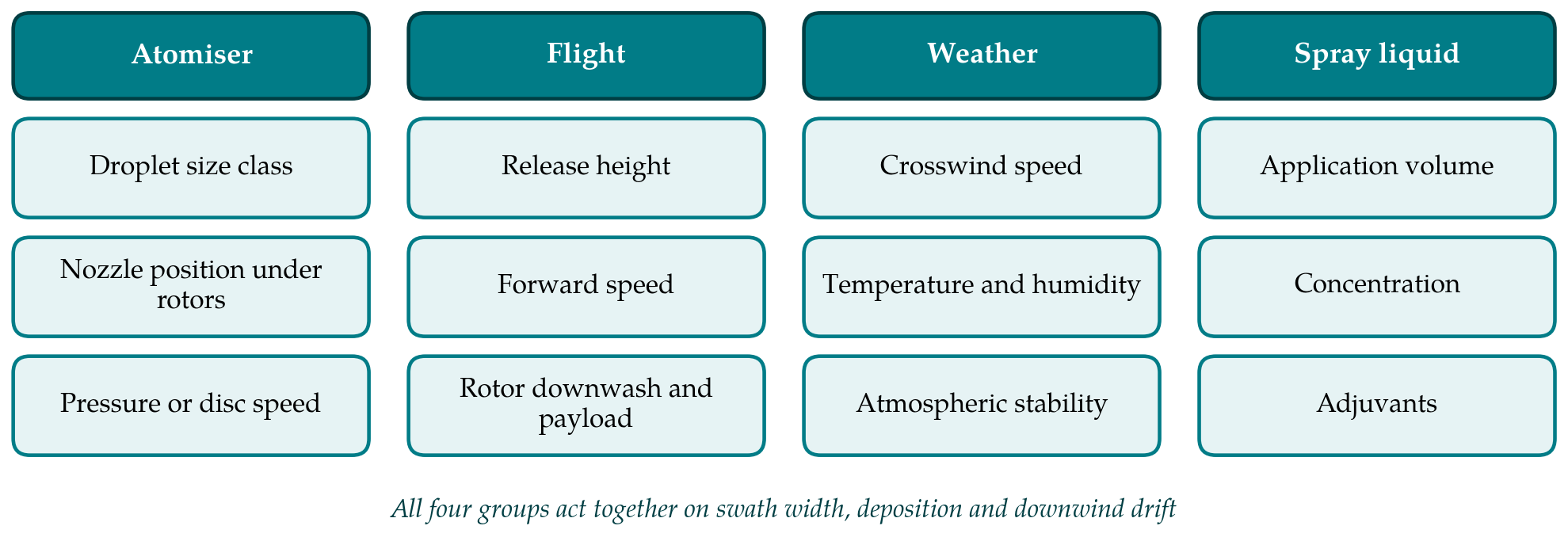
Spray drift is the movement of droplets through the air to any place other than the target at the time of application. For a drone it results from the interplay of the four groups of factors shown in Figure 1, and the feature that distinguishes it from other sprayers is the rotor wake.
4.1. The rotor wake
Every rotorcraft supports its weight by driving air downwards, and the downwash carries droplets into the canopy. A study in rice that used a small single-rotor unmanned helicopter found that deposition within the crop and the control of planthoppers both depended on flight height and speed, which is consistent with a strong influence of the downwash (Qin et al., 2016). On a multirotor several smaller rotors interact with one another and with the airframe, and the wake is less orderly. It complicates matters most in forward flight. As speed rises the wake tilts backwards and rolls up into trailing vortices, and droplets entrained in them can be lifted and held aloft. Measurements on multirotor sprayers show that spray pattern and effective swath change with release height and ground speed (Martin et al., 2019). Because the downwash scales with the weight of the aircraft, the pattern also changes as the tank empties, which is an awkward property for a machine expected to deliver a prescribed dose.
4.2. Nozzle choice, volume and weather
Field comparisons agree on the direction of the main effects, if not their size. Coarser sprays and lower flight speeds reduce the drift potential of herbicide applications but at some cost in coverage (Hunter et al., 2020). Higher application volumes improve deposition and biological effect in wheat, yet they shorten the area covered per flight, and very low volumes with fine sprays give less reliable control (Wang et al., 2019). Crosswind is the dominant weather variable. Downwind deposits rise with wind speed in the trials collated for regulators, which is why any buffer distance has to be tied to a stated wind (OECD, 2021). Temperature and humidity act through evaporation, which shrinks droplets in flight and matters more for the finely atomised, low-volume sprays that small tanks impose (Matthews et al., 2014).
4.3. Measuring and modelling drift
The reference method for field measurement of drift is an international standard that prescribes the layout of ground and airborne collectors, the tracer, and the weather records to be kept (ISO, 2005). It was written for boom and orchard sprayers, and its application to a small aircraft whose swath and height vary raises practical questions that authors have resolved in different ways. This is one reason why published drone drift curves are difficult to compare.
Regulatory assessment of aerial application has long relied on mechanistic models. AgDRIFT and its parent code AGDISP follow droplets released into the wake of a fixed-wing aircraft or helicopter and predict deposition downwind (Teske et al., 2002). Work to extend this approach to multirotors has coupled the droplet model to a rotorcraft wake code (Teske et al., 2018), but validation data remain sparse. The synthesis prepared for regulators concluded that the available trials were too few and too varied to support a general drift curve for unmanned aircraft (OECD, 2021).
5. Regulatory Hurdles
An operator who wishes to spray from a drone must satisfy at least three sets of rules, none of them drafted with variable-rate drone application in mind: aviation law, pesticide use law, and the conditions on the product label.
5.1. Aviation rules
In the European Union, unmanned aircraft operations are divided into open, specific and certified categories, and an operation that involves dropping material or carries a heavy payload generally falls into the specific category, which requires an authorisation based on a risk assessment (European Commission, 2019). In the United States, the rule for small unmanned aircraft covers machines below 55 pounds, and dispensing an economic poison additionally brings the operator under the long-standing rules for agricultural aircraft operations, with heavier spray drones needing exemptions (Federal Aviation Administration, 2016). India liberalised its framework with rules that classify drones by weight and zone the airspace (Ministry of Civil Aviation, 2021). The common thread is that payload mass, flight beyond visual line of sight and the operation of several aircraft by one pilot, each of which matters for the economics of spraying, are the points at which permissions become harder to obtain.
5.2. Pesticide law and labels
Pesticide law is often the tighter constraint. The European directive on sustainable use prohibits aerial spraying and allows it only by derogation where there is no viable alternative or a clear advantage for health and the environment (European Parliament and Council, 2009). Since a drone is an aircraft, the prohibition applies to it, however different its drift behaviour may be from a manned aeroplane. Elsewhere the difficulty lies in the label. A product is authorised for stated crops, doses, water volumes and application methods on the strength of residue, efficacy and exposure data generated with conventional equipment. Drone application at very low volumes and high concentrations may fall outside those conditions, and operator exposure during frequent mixing and loading of concentrated spray has scarcely been studied (OECD, 2021).
Variable-rate application raises a question that labels do not yet answer. A prescription that lowers the dose in part of a field is easily accommodated, since labels set maxima. A system that changes droplet size or volume on the move is harder to place, because drift mitigation measures such as buffer zones are tied to a declared spray quality. Atomisers that hold droplet size constant while varying flow therefore have a regulatory as well as an agronomic advantage.
6. Gaps and Future Work
Four gaps stand out. The first is test method: agreed procedures for measuring swath, deposition and drift from multirotors, including a requirement to report measured droplet spectra, weather and payload, would make studies comparable and usable by regulators. The second is the wake: droplet size measurements and model validation under real rotor flow, across the range of aircraft sizes now sold. The third is biological: the efficacy and crop safety of low-volume, concentrated applications for the main product groups, which decides whether drift-reducing coarse sprays are acceptable in practice. The fourth concerns variable-rate control itself, where the accuracy with which the delivered dose follows the prescription, given latency in sensing, pumping and droplet transit, has seldom been verified on the ground.
7. Conclusion
The components needed for variable-rate spraying from drones exist. Pulse-width-modulated nozzles and rotary atomisers can vary flow while holding droplet size, and flight controllers can follow a prescription. What lags is knowledge of where the spray goes once it leaves the nozzle and enters the rotor wake, and a regulatory framework able to use that knowledge. Aviation rules restrict the payloads and modes of operation that make spraying economic, pesticide law in some jurisdictions treats the drone as a conventional aircraft, and labels rarely provide for it. Progress on all three depends on the same thing: standardised, well-reported measurements of deposition and drift.
Conflict of interest
To be declared by the author(s) before publication.
Funding
To be declared by the author(s) before publication.