1. Introduction
A community struck by a natural disaster loses more than buildings. It loses people, livelihoods, landmarks and the assumption that the ground and the weather can be relied on. Religious communities are frequently among the first to respond, with shelter, food and visits, and their gathered worship becomes one of the few settings in which the loss can be spoken about in public. What is said there matters. Worship that moves at once to thanksgiving for survival can leave those who have lost the most with the impression that their grief is a failure of faith.
The Psalter contains a large body of prayer written for such times. Laments or complaints, individual and communal, form the largest single group among the psalms: prayers in which the speaker tells God what has gone wrong, asks why, and demands help. Brueggemann (1986) argued that the disappearance of these psalms from the regular worship of many churches was a costly loss, because a community that may only praise has no legitimate way of raising questions of justice with God. Since then a substantial literature has called for the recovery of lament in preaching, liturgy and pastoral care (Billman and Migliore, 1999; Brown and Miller, 2005).
That literature explains why lament should be recovered. It says less about how a particular congregation, some months after a disaster, might go about it. This article proposes a procedure for that purpose. It is addressed to clergy and lay leaders, and it is offered as a design to be tried and assessed. No application of it is reported here.
2. Background
Three bodies of work inform the design: the study of the form and theology of the lament psalms, theological reflection on trauma, and guidance on psychosocial support after emergencies.
2.1. The form and theology of lament
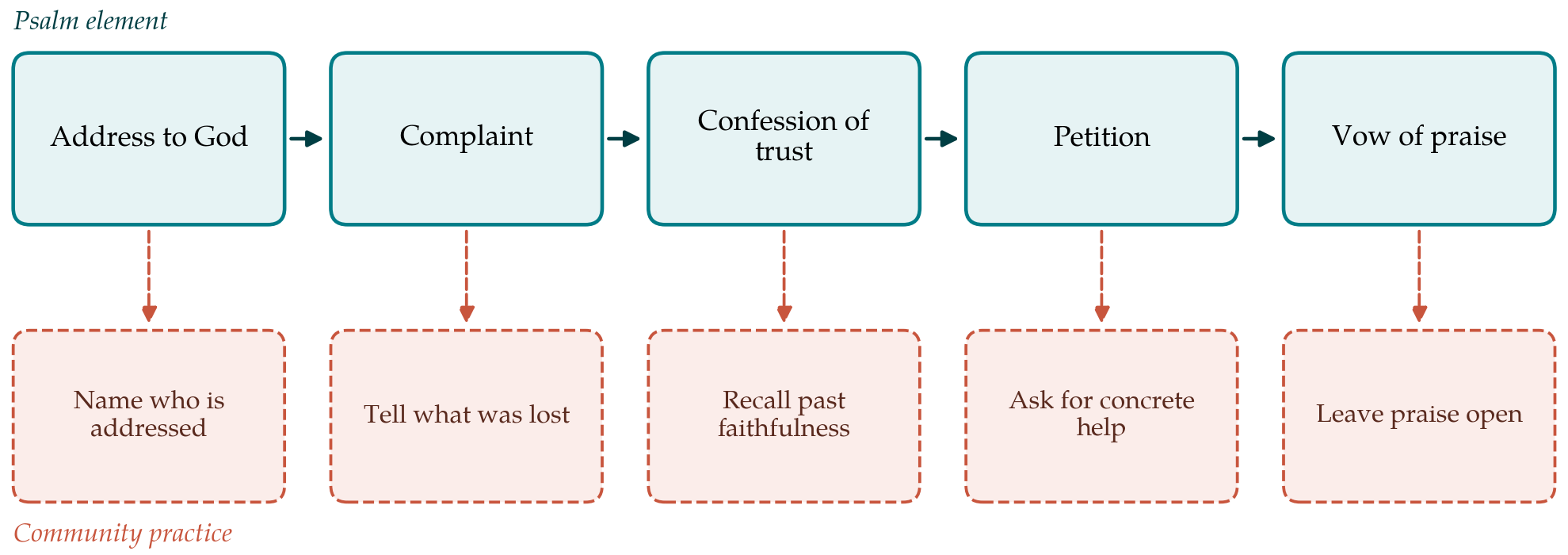
Form criticism, beginning with Gunkel, classified the psalms by type and setting and identified the complaint of the individual and the complaint of the people as distinct genres with recurring parts (Gunkel and Begrich, 1998). Westermann (1981) described the typical sequence as address, complaint, confession of trust, petition and vow of praise, and observed that the complaint itself has three subjects: God, the one who suffers and the enemy. He regarded lament and praise as the two poles of biblical prayer, each incomplete without the other. Miller (1994) showed how closely the form follows ordinary human speech to someone who is able to help.
Brueggemann (1984) offered a scheme that has been widely used in pastoral settings. He grouped the psalms as psalms of orientation, disorientation and new orientation, and presented the laments as the speech proper to disorientation, when the settled world has collapsed. The scheme can suggest a smooth passage from one state to the next, and later study has complicated that picture. Villanueva (2008) showed that the change of mood in the laments does not always run from complaint to praise; some psalms move back from confidence into distress, and Psalm 88 ends in darkness with no turn at all.
2.2. Trauma and the refusal of quick resolution
Clinical writing on trauma has stressed that recovery cannot be hurried. Herman (1992) described it in three stages, the establishment of safety, remembrance and mourning, and reconnection with ordinary life, and insisted that the second cannot begin until the first is secure. Theologians have drawn on this work to question forms of proclamation that pass too rapidly from death to resurrection. Rambo (2010) develops a theology of remaining, in which witness to what persists after an overwhelming event is itself a work of the Spirit. O'Connor (2002) reads the book of Lamentations, in which God does not speak, as a text that honours suffering by declining to explain it. Swinton (2007) treats lament as one of a set of practices by which a congregation resists evil without first having to account for it.
2.3. Psychosocial support and its relation to worship
Guidance for humanitarian work treats communal religious practice as a resource and also as something that outsiders should not manipulate. The guidelines of the Inter-Agency Standing Committee on mental health and psychosocial support in emergencies include the facilitation of conditions for appropriate communal cultural, spiritual and religious healing practices among their recommended actions (IASC, 2007). A widely cited consensus statement identifies five elements that intervention after mass trauma should promote: a sense of safety, calming, a sense of self-efficacy and community efficacy, connectedness and hope (Hobfoll et al., 2007). Research on religious coping has found that turning to faith under stress can take forms that help and forms that are associated with greater distress, and that struggle with God is common (Pargament, 1997). Lament can be understood as a disciplined form in which such struggle is expressed within the relationship and not as a departure from it.
3. The Proposed Procedure
The procedure has six steps, intended to be spread over several months and led by people who belong to the community or are trusted by it. Its overall shape follows the account of practical theological interpretation given by Osmer (2008), which moves from describing a situation, through interpreting it and bringing normative sources to bear, to a considered response. Table 1 lists the steps with the task each sets for facilitators and the safeguard each requires.
| Step | What facilitators do | Safeguard |
|---|---|---|
| 1. Listen first | Hear how members describe the event and their losses before choosing texts | No one is pressed to speak |
| 2. Choose psalms | Select communal and individual laments that fit what was heard | Avoid texts that invite blame of victims |
| 3. Read whole | Read each psalm in full, including complaint against God | Do not omit or soften hard verses |
| 4. Compose | Help the group write its own lament on the biblical pattern | Participation is voluntary at every stage |
| 5. Hold with care | Link the practice to practical aid and to referral routes | Lament never replaces professional help |
| 6. Return | Revisit the psalms and the composed lament at later dates | Praise is offered, never required |
3.1. Step 1: Listen before selecting a text
The first task is descriptive. Before any psalm is chosen, those leading the process should learn how people in the community speak about what happened: what they call the event, whom or what they hold responsible, what they miss, what they fear. This can be done through ordinary pastoral visiting and through small gatherings. The purpose is to prevent the imposition of a text that answers a question nobody is asking. It also reveals differences within the community, since those who lost relatives, those who lost property and those who were spared will not speak alike.
3.2. Step 2: Choose psalms suited to the situation
The communal laments, among them Psalms 44, 74, 79 and 80, speak in the first person plural about public catastrophe and are the nearest biblical analogue to a community's loss. Psalm 44 is especially apt after a natural disaster because it protests that the calamity was not deserved. Individual laments such as Psalms 13, 22 and 77 serve those whose grief is personal, and Psalm 88 gives words to people who can see no improvement. Psalms in which the complaint is tied to confession of sin should be used with great caution, because disasters readily attract the suggestion that the victims brought them on themselves. Psalms that call down harm on enemies raise separate difficulties and are not needed here.
3.3. Step 3: Read the psalm whole
Lectionaries and hymn books often abbreviate the laments, keeping the expressions of trust and dropping the accusations. The procedure asks that each chosen psalm be read in full and slowly, with time allowed after the complaint. The theological ground is that these words are canonical prayer. They give the congregation permission, on the authority of scripture, to say to God that God has been absent or has not acted. Facilitators should not rush to explain the complaint or to answer it. Figure 1 sets the five recurring elements of the psalm beside the practice each suggests for the community.
3.4. Step 4: Compose a communal lament
Once the form is familiar, the group is invited to write a lament of its own that follows it. The use of the psalm form as a structure for the expression of grief was proposed for pastoral counselling by Capps (1981), and the present procedure extends it to a community. The address names the God to whom the community speaks. The complaint records what was lost, in concrete terms and in the community's own words. The confession of trust recalls occasions in the community's history when help came. The petition asks for specific things. The final element, the vow of praise, is deliberately left open: the group may write it, may write that it cannot yet do so, or may leave a blank.
3.5. Step 5: Hold lament together with practical and psychosocial care
Lament is prayer and not treatment. It should run alongside the material work of recovery and never in place of it, and gatherings should be arranged so that they support the conditions named in the consensus on mass trauma, beginning with safety and calm. Facilitators need to know in advance where to refer people whose distress is severe or persistent, and should say plainly that seeking such help is consistent with faith. The petitions of the composed lament can be connected to action: a request for housing or for fair treatment by authorities, once spoken before God, is also an agenda for advocacy. Katongole (2017) has argued, with reference to communities affected by violence in East Africa, that lament of this kind is a source of social agency and not of passivity.
3.6. Step 6: Return over time
Grief after a disaster does not follow the calendar of relief operations. The procedure therefore provides for return: the composed lament and the psalms that shaped it are used again at intervals, for instance at the anniversary of the event and when reconstruction reaches a visible stage. On each occasion the community may revise what it wrote. Some will find that they can now add words of praise. Others will not, and the example of Psalm 88 shows that scripture has room for them. The measure of the practice is whether people remain able to pray truthfully together, not whether they arrive at thanksgiving by a set date.
4. Fitting the Procedure to Local Settings
The procedure will need adjustment to tradition and circumstance. Churches with a fixed liturgy may place the psalms within existing services of evening prayer or commemoration, while congregations with freer worship may set aside separate gatherings. Where a community is religiously mixed, the Psalter is shared scripture for Jews and Christians, but a common act of lament should be planned jointly and not assumed. Translation matters: the psalms should be read in the language in which people grieve, and composed laments may draw on local forms of mourning song. Leaders who were themselves affected by the disaster should not carry the process alone, and an experienced colleague from outside can share the work without taking it over.
5. Limitations and What Remains to Be Shown
This article sets out a procedure and does not test it. Its rationale rests on biblical scholarship, theological argument and general guidance on psychosocial support, none of which demonstrates that this particular sequence helps the people who take part. Several things would need to be learned. One is acceptability: whether congregations find full readings of the laments bearable soon after a disaster, and how long an interval is wise. Another is safety: whether communal recollection of loss distresses some participants in ways that facilitators without clinical training cannot manage. A third is whether any benefit is attributable to lament specifically or to the gathering and mutual attention that accompany it.
These questions call for careful qualitative study conducted with affected communities and with their consent, and for collaboration between pastoral leaders and mental health professionals. There are also theological limits. The procedure assumes a community that prays the Psalms as its own scripture, and it offers no account of why disasters occur. That silence is intended, since the laments themselves question God without supplying an explanation, but some communities will want more than the procedure provides.
6. Conclusion
The lament psalms give communities a form of speech in which loss, protest and trust can be held together before God. The six-step procedure proposed here aims to make that form usable in the months after a natural disaster: it begins with listening, lets the biblical text be heard in full, invites the community to speak in its own words, ties prayer to practical care and allows for return. It remains a proposal, and its value can be judged only when communities and those who serve them have tried it and reported honestly on what they found.
Conflict of interest
To be declared by the author(s) before publication.
Funding
To be declared by the author(s) before publication.