1. Introduction
Recurrent sore throat is one of the commonest reasons for a child to be brought repeatedly to a family doctor, and one of the commonest reasons for parents to ask about alternatives to antibiotics and surgery. Homeopathic practitioners often respond with what they call constitutional prescribing: a single remedy chosen to match the child's general characteristics, susceptibilities and temperament, given between episodes with the stated aim of reducing their frequency. Where this is offered alongside ordinary medical care, and not in place of it, the practice is described as adjunctive.
Reports of individual children who had fewer episodes after such treatment are easy to find and difficult to weigh. The condition itself is the main obstacle. Most children with frequent throat infections have fewer as they grow older, whatever is done. A report that begins when episodes are at their peak and ends two years later will usually describe improvement, and the improvement will usually be credited to whatever was being tried at the time.
The purpose of this article is to propose a way of preparing a two-year case report in this area that is as informative as a single case can be, and candid about what it cannot show. The framework is a proposal. It has not been applied to a case in this article and has not been validated. No patient is described here.
2. Background
Three bodies of published work shape the design: the clinical criteria and natural history of recurrent tonsillitis, the evidence on homeopathy for childhood respiratory infection, and the standards for writing case reports.
2.1. Frequency criteria and natural history
The most widely used definition of severe recurrent throat infection comes from the Pittsburgh tonsillectomy trial of Paradise et al. (1984): seven or more episodes in the preceding year, five or more in each of the preceding two years, or three or more in each of the preceding three years, with each episode documented in a clinical record and marked by fever, cervical lymphadenopathy, tonsillar exudate or a positive test for group A streptococcus. Current American guidance uses the same thresholds and recommends watchful waiting for children who fall below them (Mitchell et al., 2019). Scottish guidance takes a similar position on indications for surgery (SIGN, 2010).
The reason for caution about surgery is the same reason for caution about case reports. A Cochrane review found that tonsillectomy gave a modest reduction in sore throat episodes in the year after operation compared with non-surgical management, and that many children who were not operated on improved spontaneously (Burton et al., 2014). Children enter treatment at a time of unusually frequent illness, so some decline would be expected through regression to the mean alone (Barnett et al., 2005).
2.2. Homeopathy in childhood respiratory infection
The controlled evidence does not support a preventive effect. A systematic review of randomised trials of homeopathy for childhood and adolescent ailments concluded that the evidence was not convincing enough to recommend it for any condition (Altunç et al., 2007). A Cochrane review of homeopathic products for preventing and treating acute respiratory tract infections in children found no consistent benefit over placebo and judged much of the evidence to be of low quality (Hawke et al., 2018). A meta-analysis of individualised prescribing across conditions found few trials that could be regarded as reliable (Mathie et al., 2014). A case report in this field therefore starts from a low prior probability that the remedy is active.
2.3. Standards for case reports
The CARE guideline sets out the items a clinical case report should contain, including a timeline, the diagnostic assessment, the intervention, follow-up and outcomes, and the patient's perspective (Gagnier et al., 2013), and an accompanying document explains each item with examples (Riley et al., 2017). A supplement for homeopathic cases, HOM-CASE, adds items on the type of homeopathy, the medicine and its potency, the rationale for selection and the assessment of possible causal attribution (van Haselen, 2016). Case reports have a recognised place in medicine, chiefly in describing the unexpected and in generating hypotheses; they are not a means of establishing that a treatment works (Vandenbroucke, 2001).
3. The Proposed Framework
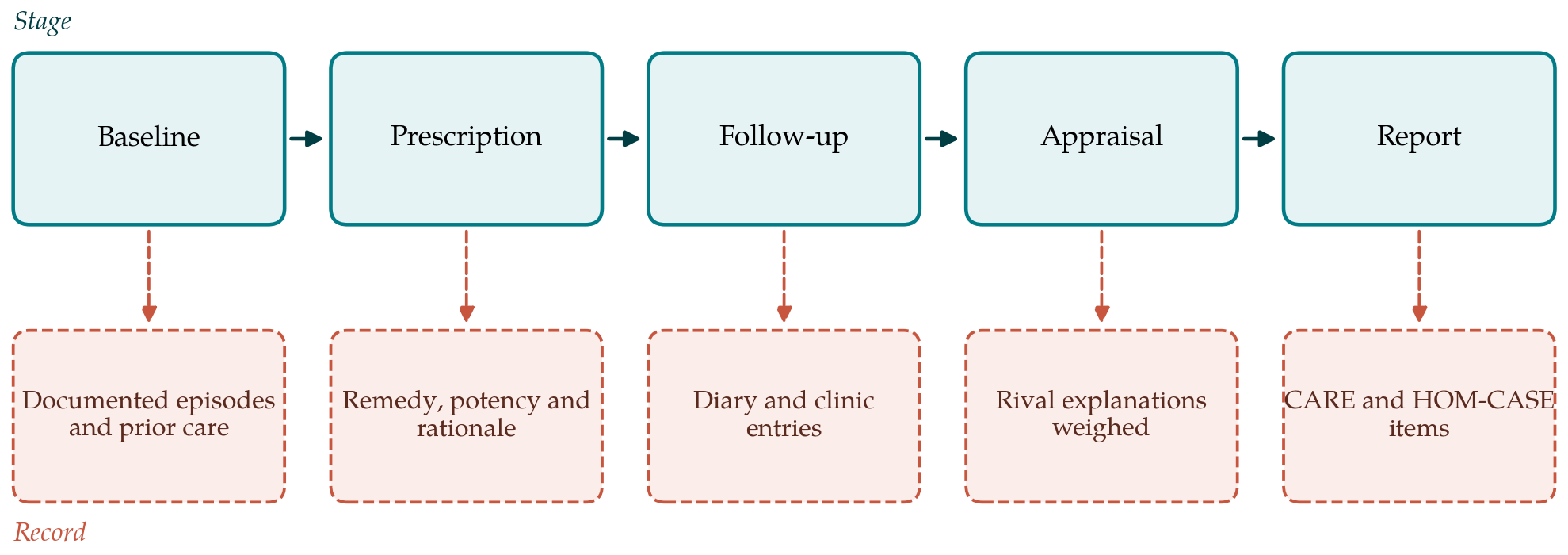
The framework has five stages, each tied to a record that must exist before the report is written. Figure 1 shows the stages and their records, and Table 1 lists what should be documented at each stage and the weakness that the documentation is meant to address.
| Stage | What to document | Weakness addressed |
|---|---|---|
| 1. Baseline | Dated, clinician-confirmed episodes for two to three years; tests and treatment for each | Recall bias; unclear severity |
| 2. Prescription | Remedy, manufacturer, potency, schedule, rationale; all concurrent care | Unrepeatable intervention; hidden co-interventions |
| 3. Follow-up | Pre-set outcomes at fixed intervals; diary kept apart from clinic records | Selective reporting; outcome switching |
| 4. Appraisal | Each rival explanation considered and the evidence for it | Unsupported causal claims |
| 5. Report | CARE and HOM-CASE checklists; consent and assent; timeline figure | Incomplete or unverifiable reporting |
| All stages | Red-flag checks, referrals made, adverse events | Unsafe delay of effective care |
3.1. Stage 1: a documented baseline
The report should begin from the medical record and not from parental recollection. For each episode in the two or three years before the first homeopathic prescription, the clinician preparing the report should extract the date, the findings on examination, whether a throat swab or rapid antigen test was done, and what was prescribed. Episodes that were never seen by a clinician should be listed separately and labelled as undocumented. The baseline can then be set against the Paradise thresholds, and the reader can see whether the child's illness was severe, moderate or within the ordinary range for age. Clinical scoring of individual episodes, for instance with the McIsaac modification of the Centor score (McIsaac et al., 1998), helps to distinguish probable streptococcal infection from viral sore throat, a distinction on which the Infectious Diseases Society of America guideline places great weight (Shulman et al., 2012).
3.2. Stage 2: the prescription and concurrent care
The homeopathic intervention should be described so that another practitioner could understand exactly what was given: the remedy by its full name, the manufacturer, the potency and scale, the form, the schedule and every later change, together with the features of the child on which the choice rested. The practitioner's training and the length and number of consultations belong here too. Equal care is owed to everything else the child received. Antibiotic courses, analgesics, referrals to an ear, nose and throat service, changes in nursery or school attendance, exposure to tobacco smoke at home and vaccination history can all bear on the frequency of infection, and omitting them invites the reader to assume that nothing else changed.
3.3. Stage 3: prospective follow-up with fixed outcomes
Outcomes should be chosen and written down at the first consultation. The primary outcome should be the number of clinician-documented episodes per year, defined as at baseline. Secondary outcomes can include antibiotic courses, days absent from school or childcare, and a validated quality-of-life measure such as the Pediatric Quality of Life Inventory (Varni et al., 2001). A parent-held diary is useful for capturing milder episodes, but entries should be kept distinct from clinic-confirmed ones. Follow-up contacts should be scheduled at fixed intervals over the two years and not only when the child is unwell, so that periods of good health are recorded as carefully as periods of illness.
3.4. Stage 4: appraising causation
Before drafting, the author should set out the explanations that compete with a remedy effect and say what the record shows about each. The list is short and predictable: natural remission with age, regression to the mean from a peak year, the effect of concurrent conventional treatment, changes in exposure such as leaving a nursery, and more lenient counting of episodes once treatment has begun. Structured causality tools can discipline this step. The algorithm of Naranjo et al. (1981) was devised for adverse drug reactions and scores features such as timing, response to withdrawal and re-challenge, and alternative causes; HOM-CASE asks authors of homeopathic reports to make a comparable assessment explicit (van Haselen, 2016). In a remitting childhood illness most of these criteria cannot be met, and the honest result will usually be that causation is possible but unproven.
Formal single-patient trials, in which treatment and placebo periods alternate under blind conditions, were developed for stable chronic symptoms that return when treatment stops (Guyatt et al., 1986). They suit an episodic condition with a falling background rate poorly, and the framework does not pretend to offer an equivalent.
3.5. Stage 5: writing the report
The manuscript should follow the CARE checklist item by item, with the HOM-CASE items added, and should include a timeline figure that shows every documented episode before and after the first prescription on the same scale. The title and abstract should describe the case as adjunctive and should not use words such as cure or successful treatment. Written consent from a parent or guardian, and the child's assent where age allows, are required for publication, in keeping with the principles of the Declaration of Helsinki (World Medical Association, 2013).
4. Safety Rules That Run Through Every Stage
Adjunctive means that nothing effective is withheld. The framework assumes that each acute episode is assessed in the ordinary way and that antibiotics are given when a clinician judges them indicated, for example in confirmed streptococcal pharyngitis as the guideline recommends (Shulman et al., 2012). It assumes that the family has been told the thresholds at which referral for a surgical opinion is appropriate, and that features such as difficulty swallowing saliva, trismus, a unilateral swelling, or snoring with pauses in breathing prompt same-day medical review. A report prepared under the framework should state that these arrangements were in place and should record any occasion on which they were used. It should also record, without minimising, any episode in which care was delayed.
5. Limitations and What Remains to Be Shown
The framework improves the transparency of a case report. It does not change what a case report is. A single child followed for two years, however carefully, provides no comparison, and the expected course of the illness is improvement. A flawless report under this framework would still be compatible with the remedy having done nothing, and the controlled evidence summarised above makes that the more probable reading. Authors should say so in the discussion, plainly.
Whether the framework is workable in ordinary practice is untested. Retrieving two or three years of primary care records may be difficult where a family has moved or used several services. Diary keeping over two years is demanding. It also remains to be shown that reports written this way are judged more useful by readers and editors than conventional ones. These are questions that a small audit of submitted reports could begin to answer.
6. Conclusion
Case reports on constitutional prescribing in recurrent childhood tonsillitis will continue to be written. The framework proposed here asks their authors to document the baseline from records, to describe both the remedy and the conventional care in full, to fix outcomes in advance, to weigh the ordinary explanations for improvement, and to keep the child's safety ahead of the report. Its chief merit may be that it makes the limits of the single case visible to writer and reader alike.
Conflict of interest
To be declared by the author(s) before publication.
Funding
To be declared by the author(s) before publication.