1. Introduction
Indian indentured migration began in Mauritius in 1834, reached British Guiana in 1838 and Trinidad in 1845, and was brought to an end during and just after the First World War. The labourers signed, or were said to have signed, an agreement that bound them to an estate for a term of years. The word for that agreement, shortened in Bhojpuri mouths to girmit, gave the migrants one of their names. The crossing itself gave another: jahaji, the shipmate. Both words now appear in the titles of novels, memoirs and critical studies written by the descendants of those who made the voyage.
For most of the twentieth century this history was a minor presence in the literatures of the places it had shaped. Caribbean writing was read chiefly through the Middle Passage and creolisation, Mauritian writing through the French colonial inheritance. V. S. Naipaul's A House for Mr Biswas, published in 1961, placed a Hindu family of estate origin at the centre of a major novel, but the sea voyage that brought the family to Trinidad lies outside its frame. From the 1970s onward, and with increasing frequency after 1990, novelists began to write the voyage and the estate directly, and a critical literature formed to interpret what they were doing.
This article reviews that critical literature. Its interest lies in how scholars have described the memory of indenture as oceanic, that is, as carried by the sea crossing and by connections between distant shores, and in how well the available concepts serve two bodies of fiction that are seldom read together.
2. Scope and Approach
The review is narrative in kind. It draws on monographs, edited collections and journal articles in English and French that the field treats as its reference points, together with the novels those studies discuss. It makes no claim to exhaustive coverage and reports no search protocol. Fiction from Fiji, South Africa and Suriname is mentioned only where critics have used it for comparison, and poetry is left aside except for Torabully, whose verse is the origin of a concept that criticism of the novel has adopted. The term contemporary is taken broadly to mean writing published from the 1970s to the present.
3. Historical Scholarship and the Limits of the Archive
Literary readings of indenture lean on a small number of historical studies. Tinker (1974) took a phrase from the colonial record for his title and argued that the system reproduced many features of the slavery it replaced: recruitment by deception, penal sanctions for breach of contract, and estates that confined their workers. Later historians qualified that picture. Carter (1995) showed how Indians in Mauritius moved out of contract into roles as overseers and small proprietors, and her edition of letters, petitions and depositions gave critics access to the migrants' own recorded words (Carter, 1996). Historians of the Caribbean have added that the figure of the Indian labourer was defined by planters, abolitionists and officials long before any labourer was heard.
The record has particular gaps where women are concerned. Reddock (1985) demonstrated that many women travelled to Trinidad alone and that the shortage of women on the estates exposed them to control and violence from several directions. Bahadur (2013) followed a single ancestor through ship lists and emigration passes to British Guiana and made the thinness of that trail part of her subject. These studies matter to literary criticism because the novelists face the same documents. A ship's register gives a name, a caste label, a village and a bodily mark. What the person thought is nowhere written down, and fiction is one of the few means of proposing an answer.
4. Three Critical Vocabularies
Three sets of terms dominate the criticism. Table 1 summarises them with one further concept that critics have borrowed from a neighbouring field.
| Concept | Principal source | What it offers | Recognised limit |
|---|---|---|---|
| Kala pani | Mehta, 2004 | Reads the crossing as loss of caste and as release, especially for women | Rests on a Hindu taboo that not all migrants shared |
| Girmit ideology | Mishra, 2007 | Explains the nostalgia and grievance of the old plantation diaspora | Built on Fiji; fits Creole societies less closely |
| Coolitude | Torabully and Carter, 2002 | Makes the voyage, not India, the ground of identity | Risks blurring indenture into a general hybridity |
| Oceanic turn | Gilroy, 1993; Hofmeyr, 2007 | Links Atlantic and Indian Ocean histories of unfree labour | Atlantic models can overwrite Indian Ocean particulars |
| Postmemory | Hirsch, 1997 | Describes memory inherited by generations born after the event | Framed for a different history and a shorter interval |
4.1. Kala pani and the girmit diaspora
The Hindi phrase kala pani, dark or black water, names the prohibition on sea travel that upper caste Hindus were held to observe. To cross was to lose caste. Mishra (2007) made the crossing the founding trauma of what he called the old Indian diaspora, the plantation communities whose imagination was formed by a broken promise and an impossible return. Mehta (2004) turned the same term toward women. For the widows, deserted wives and unmarried women who boarded the ships, she argued, the loss of caste could also be an opening, and Indo-Caribbean women writers have recovered that doubleness. Pirbhai (2009) extended the comparison to novels from Africa and the Pacific and proposed that indenture has generated its own narrative conventions.
4.2. Coolitude
Khal Torabully, a Mauritian poet, coined coolitude in the early 1990s by analogy with négritude and in deliberate distinction from it. The term takes the insult coolie and attaches it to the voyage. Identity in this account begins in the hold of the ship, where caste, region and religion were mixed, and it remains open to the other peoples of the island. The fullest statement in English is the volume Torabully prepared with the historian Marina Carter (Torabully and Carter, 2002). Bragard (2008) used the concept to read Caribbean and Indian Ocean texts side by side, and hers remains the main book-length comparison of the two regions. Critics sympathetic to the idea have still asked whether its emphasis on encounter understates the communal separations that persisted on land, a point Prabhu (2007) makes about celebrations of hybridity in Mauritius more generally.
4.3. The oceanic turn
Gilroy (1993) proposed the ship in motion as the unit of analysis for Black Atlantic culture, and scholars of indenture were quick to see the relevance. Hofmeyr (2007) set out what an Indian Ocean counterpart would need to account for: older trading worlds, several empires, and forms of bondage that do not map neatly onto Atlantic slavery. DeLoughrey (2007) brought Caribbean and Pacific writing together through the image of the tide. Lowe (2015) placed the Asian contract labourer at the hinge between slavery and free labour in liberal thought. Together these studies moved indenture from the margin of national literary histories to a place within a connected history of the sea.
5. Criticism of Indo-Caribbean Fiction
Early critical attention went to the estate and the village. Harold Sonny Ladoo's No Pain Like This Body (Ladoo, 1972), set among rice growers in the early twentieth century, was read as an unsparing correction to pastoral images of the East Indian peasant. David Dabydeen's The Counting House (Dabydeen, 1996) took the story back to recruitment in India and to a Guianese plantation, and critics noted its insistence on placing indentured Indians and formerly enslaved Africans in the same yard, with all the rivalry and intimacy that implied.
Women's fiction changed the questions. In The Swinging Bridge (Espinet, 2003) a researcher living in Canada pieces together the life of a great-grandmother who crossed as a young widow and whose songs the family had suppressed. In Peggy Mohan's Jahajin (Mohan, 2007) a linguist records an old woman's Bhojpuri account of the voyage. Both novels make the act of research part of the plot, and critics following Mehta have read them as arguments about who holds memory: the respectable family that edits its past, or the women whose songs survive in spite of it. Shani Mootoo's Cereus Blooms at Night, first published in 1996, has drawn a different line of comment, on sexuality and on the mission schooling that reshaped Indian families.
6. Criticism of Mauritian Fiction
Mauritian fiction on indenture is written in several languages, and the criticism is divided accordingly. Abhimanyu Unnuth's Hindi novel Lal Pasina (Unnuth, 1977) is the foundational estate narrative, yet it is discussed far more in Hindi-language scholarship than in work on the island's francophone writing. Eisenlohr (2006), an anthropologist, explains part of the background: Hindi functions in Mauritius as an ancestral language that marks a community, while Bhojpuri and Creole carry everyday life. A novel's language is therefore already a statement about memory before its story begins.
In French, Ananda Devi's Le Voile de Draupadi (Devi, 1993) has been read for the pressure that inherited ritual places on a woman of a later generation. Nathacha Appanah's Les Rochers de Poudre d'Or (Appanah, 2003) narrates recruitment, depot, voyage and arrival through several travellers and has become the text most often set beside Caribbean voyage novels. Barlen Pyamootoo's Bénarès, which appeared in 1999, takes its title from a Mauritian village named after the Indian city and treats the doubled place name with a restraint that critics have found telling. Ravi (2007) reads such works as mappings of an island divided by ethnic territory.
7. Recurring Concerns Across the Two Oceans
Read together, the two critical literatures circle four concerns, which Figure 1 arranges as branches of a single inquiry: the crossing, the plantation, the descendant and the language.
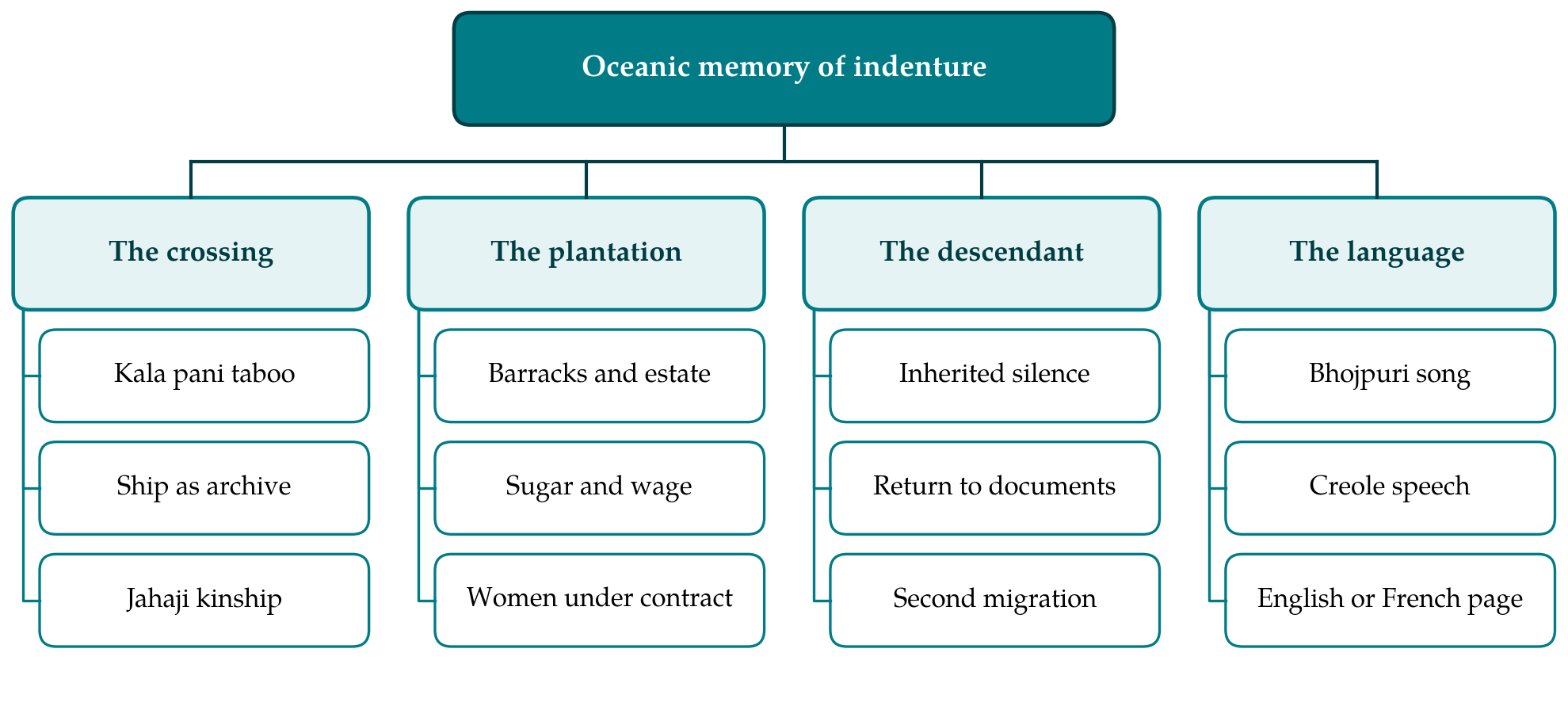
The ship receives the most attention. Critics describe it as a space where old identities were suspended and a shipboard kinship formed, and they often cite Amitav Ghosh's Sea of Poppies of 2008, a novel by an Indian author about a vessel bound for Mauritius, as the most widely read version of that idea. The estate is treated as the place where the promise of the contract was tested against the barracks and the cane field. The researching descendant, usually a woman and often living in a second diaspora in Canada or Europe, has become a convention in its own right. Language is the concern on which the regions differ most. Caribbean novelists write in English and must translate or gloss Bhojpuri; Mauritian novelists choose among French, Hindi, English and Creole, and each choice addresses a different readership.
A fifth matter runs beneath these: the relation between indenture and slavery. Some novels and some critics treat the two as successive chapters of one plantation history. Others stress that indenture had a term, a wage and a return passage, however poorly honoured, and warn against a comparison that flatters neither group. The better criticism holds both points and attends to how a given novel stages contact between the descendants of the two systems.
8. Gaps and Directions for Further Work
Several limits of the field are plain. Comparison across the Atlantic and Indian Oceans is still rare and depends heavily on one concept, coolitude, and one monograph. Language barriers explain much of this: few critics read English, French and Hindi with equal ease, and the Mauritian novels in question are not all available in translation. Work in Bhojpuri and Creole, including song and oral narrative, enters the criticism mainly as a source for novels and seldom as literature in its own right.
There are also conceptual imbalances. The kala pani framework rests on a Hindu prohibition, although the ships carried Muslims and Christians as well, and labourers from the south of India whose relation to caste rules differed. Models taken from trauma studies and from the historiography of Atlantic slavery are applied with too little adjustment. Readers of this fiction would benefit from closer exchange with historians of the Indian Ocean, from attention to publishing and translation as conditions of what is remembered, and from studies that begin with Mauritius and look west, reversing the usual direction of comparison.
9. Conclusion
Criticism of indenture fiction has given the field a workable set of terms and a canon of novels in which the sea voyage is the central event. Its strongest contribution has been to show how fiction fills, and comments on, an archive that recorded bodies and withheld voices. Its weaker side is geographical and linguistic: the Caribbean and Mauritian traditions are more often named together than read together, and the Indian-language writing of Mauritius waits for the attention its position deserves. A comparative practice equal to the shared history will need translators as much as theorists.
Conflict of interest
To be declared by the author(s) before publication.
Funding
To be declared by the author(s) before publication.