1. Introduction
The programmable nucleases arrived with an implicit promise: if a disease is caused by a known mutation, the mutation can be corrected. The chemistry has largely delivered on that promise. Cas9 and its relatives cut where they are directed (Jinek et al., 2012), base editors install transitions without a double-strand break (Komor et al., 2016), and prime editors write short defined sequences (Anzalone et al., 2019). What stands between those molecules and a treatment is the problem of getting them into the right cells in a living person.
The problem is harder than it is for a conventional drug for two reasons. The cargo is large: a Cas9 messenger RNA is several kilobases, a base editor larger still, and a ribonucleoprotein complex is a protein of some 150 kilodaltons bound to a guide RNA. And the exposure wanted is unusual. Most medicines are designed for sustained presence. An editor should act once and then be cleared, since the edit persists while the editor adds only risk (Doudna, 2020).
Those two facts explain why delivery, rather than nuclease design, now sets the pace. This article reviews the vehicles in clinical use and in development, considers what each is suited to, and looks at the carriers that may extend editing beyond the tissues currently reachable.
2. Scope and Approach
This is a narrative review. It draws on the primary reports of clinical editing studies, on the foundational pharmacology of lipid nanoparticles and adeno-associated virus vectors, and on reviews that summarise each platform. No systematic search was performed and no screening counts are reported. Delivery to plants and to microbial systems is outside the scope, as is the large literature on electroporation of cultured cells, which is mentioned only where it supports a point about ex vivo therapy.
3. What the Cargo Demands
An editor can be supplied in three forms, and the choice shapes everything downstream. Plasmid DNA is cheap and stable but must cross the nuclear envelope, risks integration, and gives expression that persists for days. Messenger RNA needs only to reach the cytoplasm, is translated within hours and is degraded within a day or two, which matches the exposure an editor should have; the chemistry of modified nucleosides and capping that made mRNA therapeutics practical is now mature (Pardi et al., 2018). A preassembled ribonucleoprotein acts immediately and disappears fastest of all, and lipid-mediated delivery of editor protein was demonstrated early in the development of the field (Zuris et al., 2015). Table 1 sets out the three formats against the vehicles that can carry them.
| Cargo format | Usual vehicle | Duration of editor exposure | Main limitation |
|---|---|---|---|
| Plasmid DNA | Viral vector or electroporation | Days to indefinite | Risk of integration and prolonged activity |
| Messenger RNA | Lipid nanoparticle | Hours to about two days | Reaches liver readily, other tissues poorly |
| Ribonucleoprotein | Electroporation, lipids, virus-like particles | Hours | Manufacture and stability of the protein |
| Viral genome | Adeno-associated virus | Months to years | Packaging limit and pre-existing immunity (Mingozzi and High, 2013) |
| Lentiviral genome | Integrating lentivirus | Permanent in the transduced cell | Integration, chiefly used ex vivo (Naldini, 2015) |
A fourth consideration cuts across the three. Editing performed outside the body avoids the delivery problem almost entirely: cells are collected, electroporated with a ribonucleoprotein at an efficiency unattainable in vivo, checked, and returned. The constraint becomes the cell type, since only tissues that can be harvested and re-engrafted qualify.
4. Lipid Nanoparticles
A lipid nanoparticle is not a liposome. It is a dense particle of ionisable cationic lipid, phospholipid, cholesterol and a polyethylene glycol lipid, assembled by rapid mixing of an ethanolic lipid phase with an acidic aqueous phase containing the nucleic acid. The ionisable lipid is the active ingredient of the formulation: positively charged at low pH so that it binds the cargo during assembly, near neutral in blood so that the particle is not acutely toxic, and protonated again in the acidifying endosome, where it destabilises the membrane and releases the cargo. The systematic design of such lipids was the advance that made nucleic acid delivery practical (Semple et al., 2010).
Particles of this kind accumulate in the liver, because apolipoprotein E adsorbs to them in circulation and directs them to hepatocytes through the low-density lipoprotein receptor. That tropism was exploited first for small interfering RNA, in the treatment of hereditary transthyretin amyloidosis (Adams et al., 2018), and the regulatory and manufacturing path established there (Akinc et al., 2019) was what allowed an editing programme to follow quickly.
The clearest demonstration is the in vivo knockout of the transthyretin gene in the liver using Cas9 messenger RNA and a guide RNA in a lipid nanoparticle, reported with durable reduction of the circulating protein (Gillmore et al., 2021). Work in non-human primates had shown shortly before that a base editor delivered the same way could disable PCSK9 and lower low-density lipoprotein cholesterol durably from a single infusion (Musunuru et al., 2021; Rothgangl et al., 2021). The attraction of the platform is that it is a chemical product rather than a biological one, that the exposure is brief, and that a second dose is possible because the particle provokes no neutralising response of the kind a viral capsid does.
Its weakness is the same as its strength. Reaching tissues other than liver means overcoming the protein corona that sends the particle there. Adding a fifth, charged lipid shifts the biodistribution of the particle towards lung or spleen in a predictable way, an approach described as selective organ targeting (Cheng et al., 2020), and antibody conjugation offers a second route. Neither has yet carried an editor through a clinical programme.
5. Viral Vectors
Adeno-associated virus is a small, non-enveloped, non-pathogenic parvovirus whose recombinant form persists mainly as an episome in non-dividing cells. Its serotypes and engineered capsids give access to liver, muscle, retina and central nervous system, and it has become the standard vehicle for in vivo gene transfer (Wang et al., 2019). Approved products exist, including a systemic treatment for spinal muscular atrophy (Mendell et al., 2017), and a subretinal editing therapy for an inherited retinal dystrophy brought the vector together with a nuclease (Maeder et al., 2019).
Three features make it an awkward partner for editing. The packaging limit is about five kilobases, which Cas9 with its promoter and guide barely fits and which a base or prime editor exceeds, forcing split constructs delivered on two vectors. Expression continues for months or years, so the nuclease keeps working long after the edit is made, and self-limiting designs are an active area of work. And immunity is widespread: many adults carry neutralising antibodies to common serotypes and are excluded from treatment, while cellular responses to the capsid can destroy transduced cells (Mingozzi and High, 2013). Integrating lentiviral vectors avoid the size limit but integrate, which is acceptable in an ex vivo product subject to release testing and much less so in vivo (Naldini, 2015).
Capsid engineering is the main route around the first and third of these. Directed evolution and rational design of the capsid surface have produced variants with altered tropism and reduced recognition by circulating antibodies, and the retinal editing programme shows what a well matched serotype and a contained compartment can achieve together (Maeder et al., 2019). An enclosed site such as the eye also limits systemic exposure, which is why ocular indications reached the clinic before systemic ones. For a tissue that must be reached through the bloodstream, dose requirements rise steeply and with them the manufacturing burden and the likelihood of an immune response, so the advantages of the vector are least available precisely where delivery is hardest.
6. The Ex Vivo Route
Where the target cell can be removed, the delivery problem becomes a manufacturing one. Autologous haematopoietic stem cells edited at the BCL11A erythroid enhancer to raise fetal haemoglobin have been used in sickle cell disease and beta thalassaemia, with the editing performed by electroporation of a ribonucleoprotein before reinfusion (Frangoul et al., 2021). T cells follow the same logic, and early studies of multiplex-edited T cells established that the approach is feasible and that edited cells persist (Stadtmauer et al., 2020; Lu et al., 2020). The cost of this route is conditioning, apheresis and bespoke manufacture for each recipient, which is why in vivo editing of haematopoietic cells is a major goal.
7. What Comes Next
Three directions are worth watching, and Figure 1 places them beside the established platforms. The first is the virus-like particle, a capsid assembled without a viral genome that carries editor protein and guide RNA as a packaged ribonucleoprotein. Engineered versions of such particles deliver base editors to several tissues in animals and combine the tropism of a virus with the brief exposure of a protein cargo (Banskota et al., 2022).
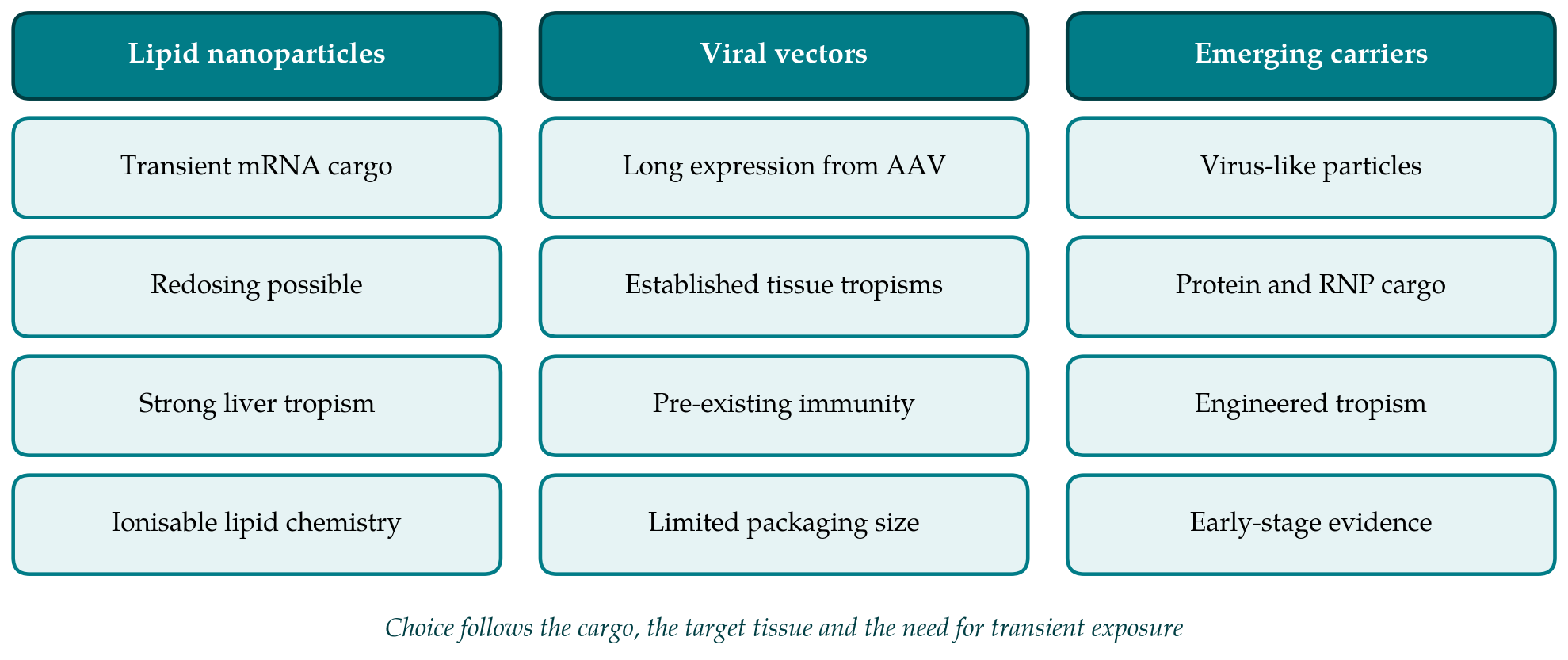
The second is the redirection of lipid nanoparticles away from the liver, whether by altering the lipid composition (Cheng et al., 2020) or by displaying a targeting ligand. Delivery to haematopoietic stem cells in the marrow would remove the need for conditioning and transplantation in the haemoglobinopathies, and delivery to lung epithelium would open cystic fibrosis to in vivo correction.
The third is the reduction of the cargo itself. Compact nucleases from smaller bacterial systems, and editors built on them, ease both the packaging limit of adeno-associated virus and the manufacturing burden of messenger RNA. Making the editor smaller is a less glamorous route than making the vehicle cleverer, and it may prove the more productive one.
8. Obstacles That Remain
Immunogenicity applies to all platforms. Cas9 is a bacterial protein and many people have been exposed to the organisms it comes from, so pre-existing cellular immunity is plausible wherever the protein persists. Repeat dosing of lipid nanoparticles raises the separate question of responses to the polyethylene glycol component. Manufacture is a second obstacle: viral vector production at clinical scale remains a bottleneck, while lipid nanoparticle manufacture is comparatively straightforward, a difference that will shape which platform scales.
Cost and access deserve mention. Approved gene therapies are among the most expensive medicines ever priced, and an autologous ex vivo product carries a cost structure that will not fall far with volume. A manufactured, off-the-shelf in vivo editor is the only version of this technology with a plausible route to the populations where the diseases it addresses are most common, and that argument, as much as any scientific one, favours continued work on non-viral delivery.
9. Conclusion
There is no general-purpose vehicle for a genome editor and there is unlikely to be one. Lipid nanoparticles suit a liver target, a transient cargo and the possibility of redosing. Adeno-associated virus suits tissues that nanoparticles cannot reach and accepts the penalties of limited capacity and persistent expression. Ex vivo editing sidesteps delivery altogether at the price of manufacture. The useful question is not which platform will win but which combination of cargo, carrier and tissue solves a given clinical problem, and the carriers now in development, particularly protein-carrying particles and retargeted lipid formulations, are best read as attempts to widen the set of problems for which an answer exists.
Conflict of interest
To be declared by the author(s) before publication.
Funding
To be declared by the author(s) before publication.