1. Introduction
Norway's decision in the early 2000s to require that each gender hold at least 40 per cent of the seats on the boards of public limited companies turned board composition into an instrument of public policy. The idea travelled. Several European states legislated quotas of their own, and a second wave of rules, usually more modest, appeared in emerging markets: a statutory requirement of at least one woman director in India, a code target in Malaysia, and listing requirements of various kinds elsewhere. The comparative literature explains the spread by reference to welfare institutions, political coalitions and earlier equality initiatives more than to evidence about firm outcomes (Terjesen et al., 2015).
Most research on these rules asks whether they change firm value or the careers of women. A narrower question has received less attention. Boards do their monitoring through committees, and the audit committee is the one on which regulators rely most heavily, since it oversees financial reporting, internal control and the external auditor. Its usefulness depends on the independence of its members. A rule that changes who sits on the board may change who sits on the committee, and it may do so in either direction: by bringing in outsiders with no ties to management, or by adding directors who are independent in name and loyal in fact.
The second possibility matters most in emerging markets. There the typical listed firm has a controlling owner, usually a family or the state, and the main governance conflict runs between that owner and minority investors and not between dispersed shareholders and professional managers (Young et al., 2008; Claessens and Yurtoglu, 2013). This review brings together what is known about gender rules, audit committees and concentrated ownership in order to assess how far the literature answers the question and where it falls short.
2. Scope and Approach
This is a narrative review of the published literature. It draws on the main studies of board gender quotas, the accounting literature on audit committee composition and the governance literature on emerging markets, together with the legal instruments themselves. No claim is made to an exhaustive or systematic search, and no pooled estimate is offered. Studies were selected because they are widely cited, because they supply the theoretical arguments on which later work depends, or because they illustrate a design problem. The term emerging market is used loosely for economies with developing capital markets and concentrated ownership. The review reports what the cited authors found and does not present new data.
3. Gender Rules and Their Design
Rules on board gender composition differ in what they demand and in how they bind, and these differences shape any effect on committees. Table 1 sets out the main types. The Norwegian statute stands at one end: a numerical quota backed by the ultimate sanction of dissolution, which produced full compliance within a few years. At the other end are disclosure requirements that ask a company only to state its policy. Between them lie minimum-seat mandates and code targets that operate on a comply-or-explain basis.
| Type of rule | How it binds | Example | Bearing on the audit committee |
|---|---|---|---|
| Statutory quota | Fixed share of seats, with legal sanctions | Norway, 40 per cent for public limited companies | Many new directors, so committee seats are likely to change hands |
| Minimum-seat mandate | At least one woman on the board | India, Companies Act 2013 (Government of India, 2013) | One appointee, who may or may not be placed on the committee |
| Independent-seat mandate | At least one independent woman director | India, largest listed entities (SEBI, 2015) | Adds a director eligible to count towards committee independence |
| Code target | Comply or explain | Malaysia, 30 per cent target (Securities Commission Malaysia, 2021) | Depends on investor pressure and on the quality of explanations |
| Disclosure rule | Report policy and numbers | Diversity statements in annual reports | Indirect, through reputation only |
The Indian case shows why design matters for the present question. The Companies Act 2013 requires prescribed classes of company to have at least one woman director, without saying that she must be independent (Government of India, 2013). The same statute and the listing regulations require an audit committee on which independent directors predominate; under the listing regulations two-thirds of the members must be independent (SEBI, 2015). A woman director who is a relative of the promoter satisfies the first rule and contributes nothing to the second. The securities regulator later required the largest listed entities to have at least one independent woman director, a change that links the gender rule to the pool from which committee members are drawn.
Malaysia took the code route. Its corporate governance code recommends that women make up at least 30 per cent of the board and leaves departures to be explained (Securities Commission Malaysia, 2021). A target of this kind works only as far as someone reads the explanations and acts on them, which in a market of controlled companies cannot be assumed.
4. Channels From Board Seats to Committee Independence
Three steps separate a gender rule from a more independent audit committee, and Figure 1 arranges the possibilities at each. The first is the identity of the appointee. A firm may recruit an outsider, promote or co-opt someone tied to the controlling owner, or turn to one of a small group of women who already hold several directorships. The second is committee assignment: the appointee may be placed on the audit committee, or kept on the main board. The third is conduct, since a seat creates an opportunity to monitor and not a guarantee that monitoring will occur.
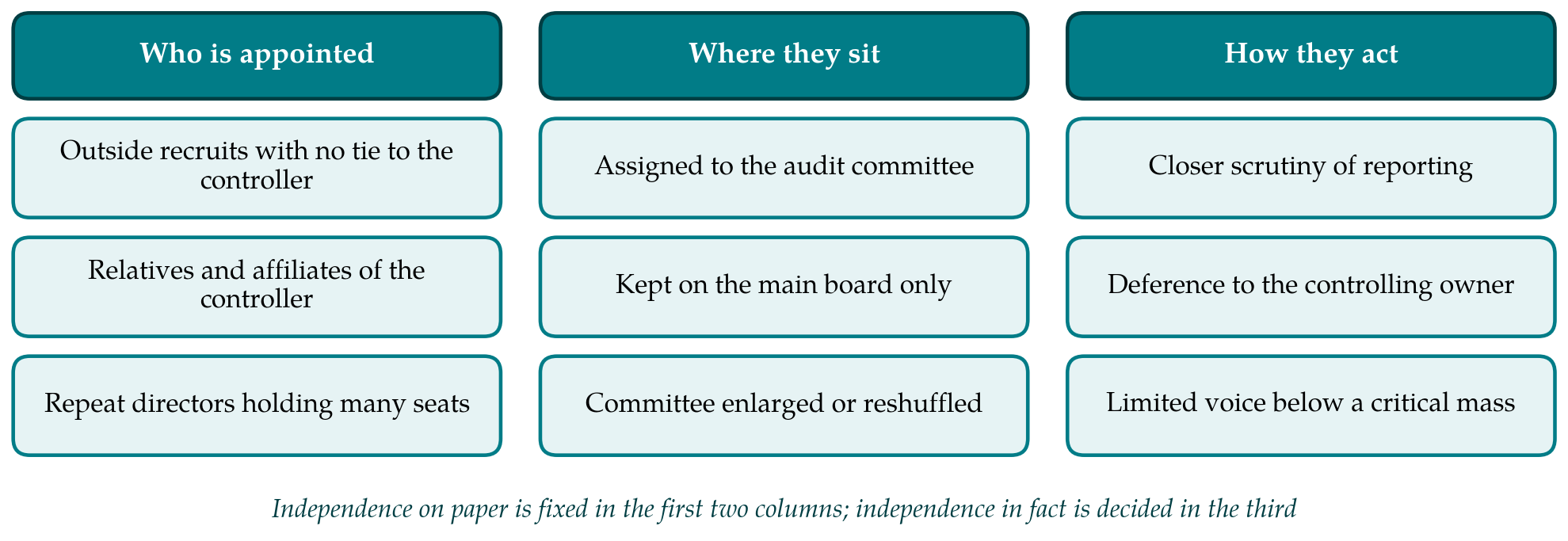
Agency theory supplies the reason for caring about the committee at all. Where ownership is separated from control, decision management and decision control need to be held by different people, and outside directors are the device through which control is exercised (Fama and Jensen, 1983). The accounting literature gave this argument empirical content. Klein (2002) found that abnormal accruals were lower where the audit committee and the board were more independent, and Carcello and Neal (2000) showed that auditors of distressed companies were less likely to issue a going-concern report when affiliated directors made up more of the committee.
Resource dependence theory points to a different function of directors: they bring knowledge, contacts and legitimacy that the firm needs from its environment (Pfeffer and Salancik, 1978). On this view a rule that widens the pool of candidates may improve a committee simply by adding skills, such as accounting or legal training, that were absent. The theory of tokenism qualifies both accounts. Kanter (1977) argued that members of a small minority in a group are treated as representatives of a category and find it hard to be heard, and later work on boards suggests that influence grows once there are about three women at the table (Torchia et al., 2011). A mandate satisfied by one appointment may therefore change the composition of a committee without changing its deliberations.
5. Evidence From Developed Markets
The study most often cited on gender and monitoring is that of Adams and Ferreira (2009), who examined United States firms. They reported that women directors had better attendance records than men, that they were more likely to be assigned to monitoring committees, the audit committee among them, and that chief executive turnover was more sensitive to performance in firms with more diverse boards. They also found that the average effect of diversity on firm performance was negative, a result they attributed to over-monitoring in firms that were already well governed. The appointments they studied were voluntary.
Related work links women directors to the quality of reported numbers. Firms with women on the board have been found to show higher earnings quality (Srinidhi et al., 2011). A meta-analysis by Post and Byron (2015) concluded that female board representation is positively related to accounting returns and to the board's monitoring and strategy activities, and that the relationships are stronger in countries with better shareholder protection. That last finding is a warning against carrying results across institutional settings. Most of this evidence, in addition, is correlational.
Mandated appointments are a separate matter, and the Norwegian evidence remains contested. Ahern and Dittmar (2012) reported a fall in firm value and younger, less experienced boards after the quota; Eckbo et al. (2022) re-examined the question and found valuation effects that were statistically insignificant. Bertrand et al. (2019) found that the women appointed were better qualified than their predecessors but that benefits did not spread to women lower in the firms. Two findings bear directly on committees. Some firms changed their legal form and so left the scope of the law (Bøhren and Staubo, 2014), and a small group of women accumulated many seats (Seierstad and Opsahl, 2011). A director who serves on many boards may be formally independent on each and short of time for all.
6. The Emerging Market Setting
The studies above come from markets where the audit committee is meant to check managers on behalf of dispersed owners. In most emerging markets the party to be checked is the controlling shareholder. The cross-country evidence that concentrated control is the norm outside a few common-law economies is long established (La Porta et al., 1999), and its implication for independent directors has been stated plainly by Bebchuk and Hamdani (2017): where the controller can appoint and remove every director, those directors have weak incentives to resist transactions that favour the controller, whatever their formal status. Definitions of independence that look only for ties to management miss this.
Board independence can still matter in such firms. Cross-country work finds that firms with a dominant shareholder are valued more highly when more of the board is independent, especially where legal protection is weak (Dahya et al., 2008), and a study of Korea found that governance, and board independence in particular, predicted market value (Black et al., 2006). The literature therefore supports two statements at once. Independent directors in controlled firms are structurally weak, and firms that appoint more of them, or are compelled to, appear to be treated better by investors.
Gender rules enter this setting with an ambiguous effect. In a family-controlled firm the cheapest way to meet a one-seat mandate is to appoint a female relative of the controlling family, an outcome that commentary on the Indian rule anticipated and that the later independent-seat requirement was designed to limit. Where the appointee is a real outsider, the mandate may do what independence rules alone have not: it forces a search beyond the controller's usual circle, because the pool of women already connected to the firm is small. Whether the net effect on the audit committee is positive depends on which of these responses predominates, and on whether the newcomer is given a committee seat. The published literature does not settle the point.
7. Measurement and Identification Problems
Three difficulties explain why direct evidence is thin. The first is measurement. Audit committee independence is usually recorded as the share of members classified as independent in company filings, a formal measure that takes the firm's own classification on trust. Substantive independence, meaning the willingness to challenge, cannot be read from a filing. Researchers approximate it through family and business ties, tenure, the number of other seats held, or outcomes such as restatements and audit qualifications, and each proxy is disputed.
The second is endogeneity. Boards are chosen by the people they are meant to supervise, and their composition responds to the firm's circumstances, so an association between composition and outcomes does not show which caused which (Hermalin and Weisbach, 2003). A mandate looks like an escape from this problem, since it changes boards for reasons outside the firm. In emerging markets the escape is partial. Mandates often arrive in the same reform as new independence rules, new audit requirements or a new companies statute, which makes the separate effect of the gender rule hard to isolate. The third difficulty is avoidance. Firms may enlarge the board, reclassify directors or leave the regulated category, as the Norwegian experience showed, and each response changes the comparison group.
8. Gaps and Directions for Future Work
The clearest gap is descriptive. Before effects can be estimated, the field needs to know who was appointed under emerging market mandates, how they are related to controlling owners, and which committee seats they received. Company filings contain most of this information, though assembling it by hand is slow. A second need is for measures of independence that suit controlled firms, built on ties to the controller and on the handling of related-party transactions, which is where an audit committee in such a firm earns its keep.
Design opportunities exist. Rules that apply above a size threshold, or that were phased in by market capitalisation, allow comparison of firms just inside and just outside their reach. The move from a one-seat mandate to an independent-seat mandate separates the effect of gender from that of independence within a single jurisdiction. Qualitative work on how audit committees deliberate in controlled firms, and on whether new members change those deliberations, would complement the archival studies. Comparative research across jurisdictions with statutory, listing-rule and code-based approaches would show whether the form of the rule matters as much as theory suggests.
9. Conclusion
The literature gives good reasons to expect that gender rules can affect audit committees and little direct evidence of what they do in emerging markets. Work on developed markets associates women directors with committee service and with reporting quality, though mostly for voluntary appointments. Work on emerging markets shows that formal independence means less where one shareholder controls the board, and that mandates can be met with affiliated appointees. Read together, the two bodies of research imply that the effect of a gender rule on audit committee independence turns on its design: whether it requires independence as well as gender, and whether it reaches the committee as well as the board. Establishing the size and direction of the effect is work that remains to be done.
Conflict of interest
To be declared by the author(s) before publication.
Funding
To be declared by the author(s) before publication.