1. Introduction
Guduchi is among the most widely used drugs of Ayurveda, valued as a rasayana and prescribed in fevers, metabolic disorders and convalescence. The official part is the stem (Government of India, 1990). Its chemistry is dominated by clerodane diterpenoids, protoberberine and aporphine alkaloids such as berberine, palmatine and magnoflorine, glycosides, sesquiterpenoids and immunologically active polysaccharides (Singh et al., 2003). Phenolic compounds, flavonoids among them, are also reported in stem extracts, though this fraction has been characterised less thoroughly than the alkaloids and diterpenoids. Antioxidant activity is one of the properties most often attributed to the drug in experimental work (Upadhyay et al., 2010).
Collectors, manufacturers and students regularly raise the matter of season. If stems harvested at different times of year differ in flavonoid content and antioxidant capacity, the time of collection becomes a quality parameter. Comparisons across the three broad Indian seasons of summer, monsoon and winter are simple to set up with a spectrophotometer. This note does not report such a comparison. It considers what one would need to look like for its conclusions to hold.
2. Why Season Might Matter
There are sound biological reasons to expect some seasonal change. Flavonoids are products of the phenylpropanoid pathway, and their synthesis is induced by ultraviolet and high visible irradiance, drought, low temperature, nutrient limitation and wounding (Winkel-Shirley, 2002). In the plant they serve as screening pigments and as antioxidants located where reactive oxygen species are generated (Agati et al., 2012). T. cordifolia is a deciduous climber. It sheds its leaves in the dry season, flowers while leafless, and puts out new foliage with the rains. During the leafless period the green stem is the photosynthetic organ and is exposed to full light, while in the monsoon it is shaded by its own canopy and grows rapidly. A stem might plausibly carry more photoprotective phenolics in one phase than in the other.
The stem is also a storage organ. Starch accumulates in it, and reserves are drawn on at flowering and at leaf flush. The dry matter against which phenolics are expressed therefore changes over the year. A concentration that falls in the monsoon may reflect dilution by new, water-rich growth and not reduced synthesis, which is a further reason to determine moisture content and to match stem pieces by age.
The classical pharmacy also treats time of collection as significant. The Caraka Samhita advises gathering different plant parts in different seasons and assigns branches and leaves to the rains and spring (Sharma, 1981). That guidance was framed in terms of potency as the tradition understood it and not in terms of any chemical class, so it supplies a hypothesis and not a finding about flavonoids.
3. What the Assays Measure
Most seasonal comparisons rely on a small set of colorimetric assays, summarised in Table 1. None of them measures "flavonoids" or "antioxidant activity" in a direct sense. The aluminium chloride method depends on complex formation with particular hydroxyl and keto groups, and Chang et al. (2002) showed that it responds well to flavones and flavonols and poorly to flavanones, so the figure obtained depends on which subclasses are present and on the standard used for calibration. The Folin-Ciocalteu reagent is reduced by phenols generally and by other reducing substances such as ascorbic acid and some sugars (Singleton and Rossi, 1965).
| Assay | Principle | Point to keep in mind |
|---|---|---|
| Aluminium chloride total flavonoids (Chang et al., 2002) | Coloured complex with flavonoid hydroxyl and keto groups | Response differs by subclass; result depends on the standard |
| Folin-Ciocalteu total phenolics (Singleton and Rossi, 1965) | Reduction of the reagent in alkaline solution | Not specific to phenols; other reducing agents respond |
| DPPH (Brand-Williams et al., 1995) | Decolorisation of a stable organic radical | Slow reactions; coloured extracts can interfere |
| ABTS (Re et al., 1999) | Decolorisation of a preformed radical cation | Works in aqueous and organic media; radical is not physiological |
| FRAP (Benzie and Strain, 1996) | Reduction of a ferric complex at acid pH | Measures reducing power only |
The radical scavenging and reducing assays have their own chemistry. DPPH and ABTS use synthetic radicals that do not occur in living systems, and FRAP measures the capacity to reduce ferric iron at low pH. Prior et al. (2005) reviewed these methods and concluded that no single assay reflects total antioxidant capacity, that results from different assays are not interchangeable, and that several should be used together. For guduchi there is a particular complication. The stem contains alkaloids and other non-flavonoid constituents that may contribute to the readings, so a seasonal shift in a colorimetric value need not reflect a shift in flavonoids at all. Only a chromatographic profile with identified peaks can show which compounds changed. Liquid chromatography with diode-array detection, or thin-layer chromatography with a reagent selective for flavonoids, separates the individual phenolics, and comparison with authentic standards such as rutin and quercetin allows named compounds to be followed from one season to the next.
4. Designing an Interpretable Three-Season Comparison
Figure 1 groups the factors that can produce a difference between samples collected at different times of year. Season is only one of them. The simplest design, in which stems are bought or gathered from whatever plants are convenient on three occasions, confounds season with every other factor in the figure.
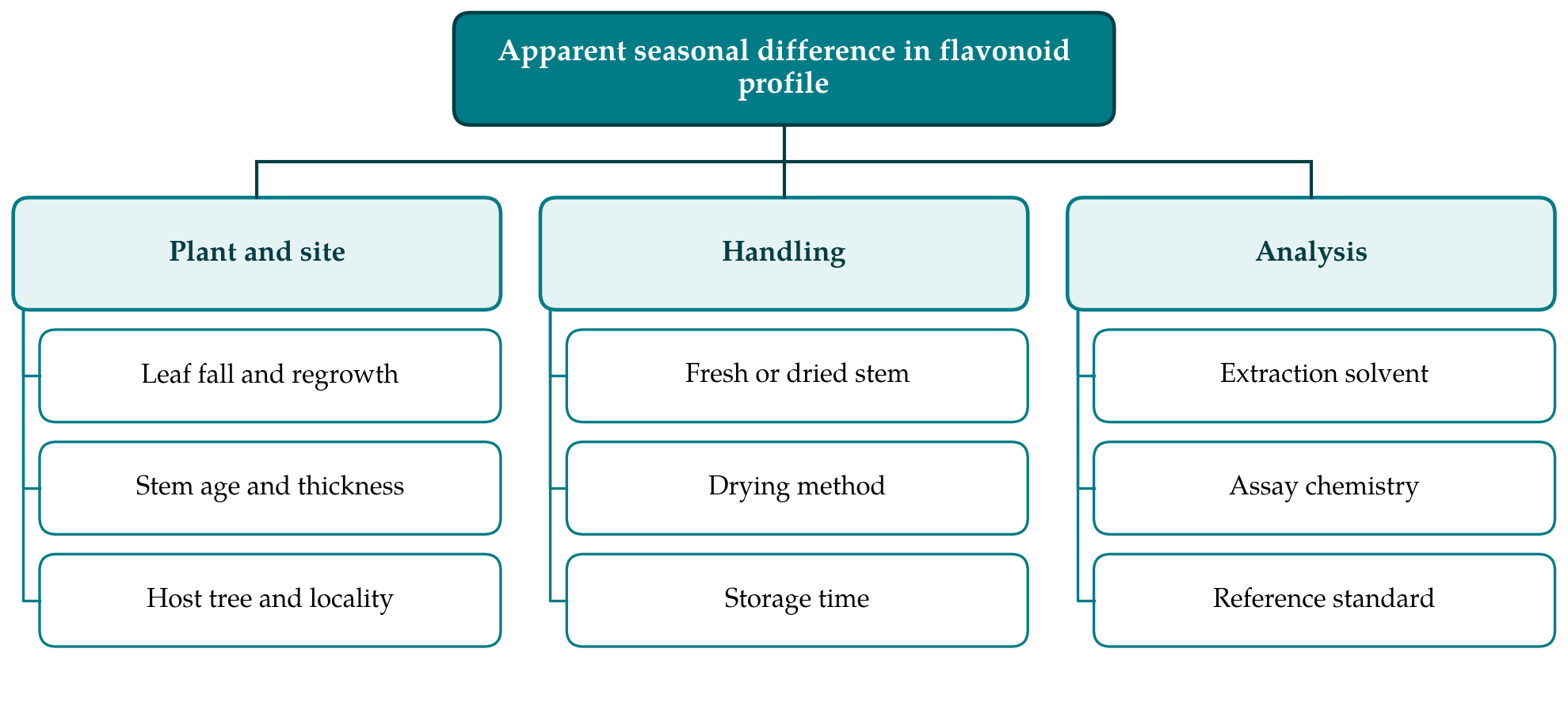
Plant-to-plant variation comes first. Wild climbers differ genetically, grow on different host trees and stand in different light and soil. Traditional opinion holds that guduchi growing on neem is superior, which, whatever its basis, is a reminder that the host should be recorded. A sound comparison marks a set of individual plants, authenticates them with a voucher specimen, and returns to the same plants in each season, so that each plant serves as its own control. Stem pieces should be matched for diameter and position, since a thin green shoot and a thick corky stem are different tissues.
Handling comes next. Guduchi is used both fresh and dried in practice, and phenolic compounds can be oxidised or lost during slow drying. Monsoon humidity lengthens drying times, so a batch collected in the rains may differ from a summer batch because of how it dried. Drying all samples under the same controlled conditions, or extracting fresh material and expressing results on a dry-weight basis from a parallel moisture determination, removes this artefact. Storing early samples for months so that all can be analysed together introduces a storage effect; analysing each on collection introduces day-to-day analytical drift. Either route can work if it is acknowledged and controlled with a retained reference extract run on every occasion.
Analysis is the third group. The extraction solvent determines which compounds are recovered, and aqueous, hydroalcoholic and methanolic extracts of the same stem will rank differently. A comparison should fix one solvent that reflects the intended use, use two or more antioxidant assays of different mechanism, and state the calibration standard and units. Replication must be at the level of plants, not repeated readings of one extract, and a single year cannot separate a seasonal pattern from the weather of that year. The collection site, date, weather and plant condition should be documented for every sample.
Two matters of reporting deserve the same care. "Summer", "monsoon" and "winter" mean different months and different weather in Kerala, Gujarat and the Himalayan foothills, and the onset of the rains shifts from year to year. Each collection should therefore be reported by date and place, with the temperature, rainfall and day length of the preceding weeks taken from the nearest meteorological station, and with a note of whether the plant was leafless, in flower or in full leaf. Results should be expressed per unit dry weight in equivalents of a named standard, and the variation between plants within a season should be shown beside the difference between seasons. A seasonal difference smaller than the spread among plants collected on the same day has little practical meaning for a collector, whatever a significance test may say.
5. Conclusion
A seasonal effect on the flavonoid content and antioxidant capacity of guduchi stem is biologically plausible and practically relevant, but it is harder to demonstrate than the ease of the assays suggests. Total flavonoid and radical scavenging values are method-dependent indices, and differences between collection dates can arise from the plants sampled, the drying of the material and the conduct of the analysis as readily as from the season itself. Comparisons that follow the same authenticated plants through the year, standardise handling, combine several assays with a chromatographic profile and extend over more than one year would allow a recommendation on time of collection to rest on firm ground.
Conflict of interest
To be declared by the author(s) before publication.
Funding
To be declared by the author(s) before publication.