1. Introduction
The finding that fibres resembling those of clothing were present in shoreline sediments, and that a single garment could release large numbers of them in one wash, turned domestic laundering into a recognised source of microplastic pollution (Browne et al., 2011). A decade of laboratory work has followed, and it has produced figures that are difficult to reconcile with one another.
The difficulty is methodological. Studies have used different machines, load sizes, detergents, filter pore sizes and units, and have reported results as numbers of fibres, as mass, per garment, per kilogram or per wash (Henry et al., 2019). Comparison of knitted fabrics is harder still, because the way a knit is cut and seamed for testing can release more loose fibre than the fabric surface does.
This article proposes a procedure for one defined purpose: measuring the mass and, secondarily, the number and length of fibre fragments released from knitted fabrics during cycles in a domestic front-loading washing machine. The procedure is assembled from published methods and from existing standards. It is put forward as a proposal, and it has not been tested in the laboratory for this article.
2. Background
Two bodies of work inform the design: the experimental studies that identified what controls shedding, and the standard test methods published since.
2.1. What the experimental literature has established
Early studies showed that fabric type and washing conditions both matter. Napper and Thompson (2016) compared polyester, acrylic and polyester-cotton garments and found differences between fibre types and effects of detergent and conditioner. Hartline et al. (2016) recovered more fibre mass from top-loading than from front-loading machines and more from aged garments than from new ones. Pirc et al. (2016) followed fleece through repeated washes and observed that release fell over the first cycles before levelling off. A single wash of a new specimen therefore measures something different from the tenth wash of the same specimen.
Mechanistic work has since narrowed the list of influential variables. Hernandez et al. (2017) reported that the presence of detergent increased release from polyester fabrics while temperature and cycle duration had less effect than expected. Kelly et al. (2019) identified the ratio of water volume to fabric as a controlling factor, which explains why gentle programmes that use more water can release more fibre than normal ones. Cai et al. (2020), working with a range of polyester textiles, showed that the cut edges of specimens were a major source of the fibres collected and that the method of cutting changed the result. Construction and yarn type also matter: fleece and other brushed knits shed more than tightly constructed fabrics, and cellulosic fabrics can release as much fibre as synthetics or more (Zambrano et al., 2019).
2.2. Standard methods and what they leave open
Two standard methods are now available. The AATCC method for fibre fragment release (AATCC, 2021) and the first part of the ISO series on microplastics from textile sources (ISO, 2023) both agitate small specimens in sealed canisters, in apparatus of the kind long used for testing colour fastness to laundering, and determine the mass of material retained on a filter. A closely related procedure was developed and examined for reliability by Tiffin et al. (2022). These methods are well suited to ranking fabrics under identical conditions. They do not reproduce the liquor ratio, mechanical action, rinsing or spinning of a household machine, and they are not intended to. Studies that washed whole garments in domestic machines (De Falco et al., 2019) answer the realism question but have each used their own arrangements for capturing the effluent.
3. The Proposed Procedure
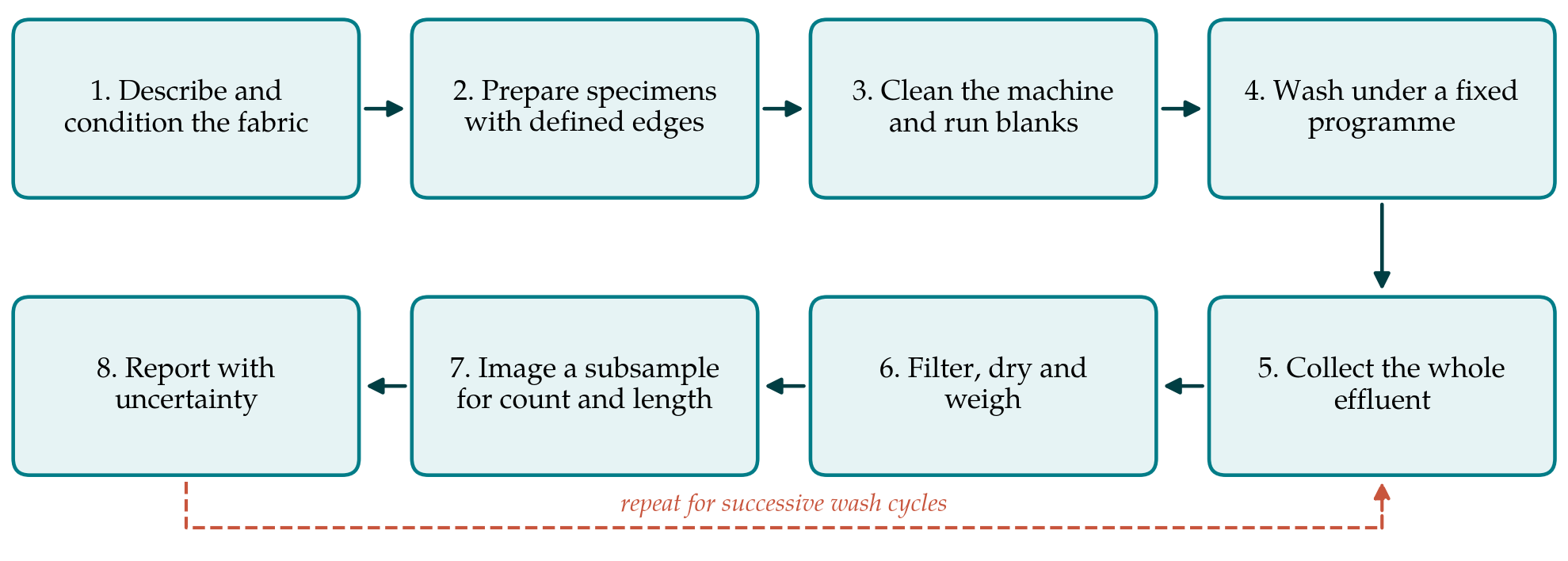
The procedure keeps the gravimetric principle of the standards and transfers it to a domestic machine operated according to the international standard for washing in textile testing (ISO, 2021). Its eight steps are shown in Figure 1. Table 1 lists the sources of variation that the literature has identified and the way each is controlled or recorded.
| Source of variation | Why it matters | Treatment in the procedure |
|---|---|---|
| Cut edges | Raw edges release fibre unrelated to the fabric face (Cai et al., 2020) | Edges hemmed or sealed; edge treatment reported |
| Water-to-fabric ratio | More water per unit of fabric increases release (Kelly et al., 2019) | Fixed load mass and programme; water intake measured |
| Detergent | Presence and type change release (Hernandez et al., 2017) | Reference detergent at a stated dose, or none; stated either way |
| Wash number | Release falls over early cycles (Pirc et al., 2016) | Successive cycles measured and reported separately |
| Carry-over in the machine | Fibres from earlier loads lodge in sump, hose and seal | Cleaning cycles and a blank before each series |
| Filter pore size | Coarser filters pass short fragments | Pore size fixed and reported |
| Airborne and reagent fibres | Contaminate filters during handling (Hidalgo-Ruz et al., 2012) | Covered vessels, filtered water for rinsing, procedural blanks |
3.1. Describing and conditioning the fabric
A shedding figure is only interpretable alongside a description of what was washed. The report should give fibre composition, whether the yarn is staple or filament, yarn count and twist where known, the knit structure in standard terminology (single jersey, rib, interlock, fleece and so on), mass per unit area, stitch density, and any mechanical finishing such as brushing or shearing (Spencer, 2001). Fabric is conditioned and weighed in the standard atmosphere for textile testing (ISO, 2005) so that the dry mass of each specimen is known before washing.
3.2. Preparing specimens
Knits unravel and curl at cut edges, and a raw edge exposes every loop it crosses. Because edges can dominate the result (Cai et al., 2020), the procedure fixes the edge treatment and reports it. The proposed default is a rectangular specimen of stated dimensions whose edges are turned twice and sewn with a filament thread of a contrasting polymer or colour, so that thread fragments can be recognised. Where the fabric is thermoplastic, edges sealed by laser or ultrasonic cutting are an acceptable alternative. Enough specimens are prepared to make up the load mass with no ballast, since ballast fabric sheds fibre of its own.
3.3. Cleaning the machine and running blanks
A domestic machine retains fibre in its sump, drain hose and door seal. Before each series the empty machine is run through the test programme until the mass collected from a cycle is stable and small relative to the release expected from the specimens. The last of these empty cycles is recorded as the machine blank. A separate procedural blank, in which clean water is taken through the filtration and drying steps alone, separates contamination arising in the laboratory from carry-over in the machine.
3.4. Washing under a fixed programme
The load is washed in a front-loading reference machine of the type described in the washing standard, on a stated programme with a stated temperature, load mass and spin speed (ISO, 2021). The procedure does not prescribe one programme, because the appropriate one depends on the care label of the fabric, but it requires that the volume of water taken in is measured, since this determines the water-to-fabric ratio. Detergent is either omitted or added as a reference detergent at a recorded dose. Powder detergents containing insoluble builders add solids to the filter, so a liquid or a fully soluble formulation is preferred where detergent is used.
3.5. Collecting and filtering the effluent
The drain hose is led to a clean, covered vessel large enough to hold the entire discharge of the wash and all rinses. Capturing the whole effluent avoids the sampling error that arises when a small aliquot is taken from a liquid in which fibres settle, float or cling to walls. The collected liquid is passed through a filter of stated material and pore size. For large volumes a two-stage arrangement is practical: a coarse woven mesh that retains the bulk of the fibre, followed by a fine membrane or glass-fibre filter for the remainder, in the manner of the cascade filtration used by De Falco et al. (2019). The vessel and hose are rinsed with filtered water and the rinsings pass through the same filters.
3.6. Determining mass, count and length
Filters are dried to constant mass and weighed before and after use on a balance whose resolution is suited to the small masses involved, following the practice of the standard gravimetric methods (ISO, 2023; AATCC, 2021). Mass is the primary result because it is traceable and does not depend on an operator's judgement. Count and length are obtained as secondary results from a subsample: a known fraction of the filter area is imaged under a stereomicroscope and the fibres are measured with image analysis software. Visual identification has known error rates, especially for short and pale fibres (Hidalgo-Ruz et al., 2012), so the counting rule, the minimum length recorded and the area fraction examined are stated.
3.7. Repeating and reporting
The same specimens are washed for a defined series of consecutive cycles, with the effluent of each cycle collected and analysed separately, and the whole series is repeated on fresh specimens. The result for each cycle is expressed as milligrams of fibre per kilogram of conditioned fabric, after subtraction of the machine blank, and the mean and spread across replicate series are given. An uncertainty statement prepared along the lines of the international guide (JCGM, 2008) should combine the contributions of weighing, the blank and replicate variation. Detergent residue retained on the filter is checked by filtering a detergent solution of the same concentration without fabric.
4. Fitting the Procedure to Knitted Fabrics
Several features of knits call for particular care. Weft knits stretch and distort when wet, so specimen dimensions are recorded before and after the series. Fleece and brushed fabrics carry loose fibre from finishing that is released in the first cycles, which is a real emission from a new garment but says little about steady-state behaviour; reporting each cycle separately allows a reader to distinguish the two. Blends of cotton and polyester shed both fibres, and the mass result cannot apportion them. Where apportionment matters, the retained material can be analysed by selective dissolution or by spectroscopic identification of a subsample, and the report should say which was done.
The procedure is also meant to sit alongside the canister standards and not to replace them. A laboratory that runs both on the same fabrics can learn how well the accelerated ranking predicts behaviour in a real machine, which is the question that matters to a brand or a regulator choosing between materials.
5. Limitations and What Remains to Be Shown
The procedure is a proposal and has not been validated for this article. Before it could be adopted, four things would need to be demonstrated. The first is recovery: a known mass of reference fibre introduced into the empty machine should be retrieved on the filters to an acceptable and stated degree. The second is repeatability within a laboratory across replicate series. The third is reproducibility between laboratories and between machines of the same type, which is unlikely to be as good as for the sealed canister methods. The fourth is the adequacy of the hemmed-edge default, since stitching itself perforates the fabric and might add or suppress release.
Other limits are inherent. The method measures what leaves the machine in the effluent and not what is emitted to air during tumble drying or wear. It reports mass above a stated pore size and is blind to smaller fragments. A front-loading reference machine does not represent top-loading machines, which earlier work found to release more (Hartline et al., 2016). Results should be presented with these boundaries stated.
6. Conclusion
Shedding measurements on knitted fabrics have suffered from uncontrolled edges, unmeasured water volumes, partial sampling of effluent and incomparable units. The eight-step procedure proposed here addresses each of these with a specific control drawn from published evidence, and it keeps the gravimetric endpoint of the existing standards so that results can be set beside them. Whether it delivers acceptable recovery and repeatability in a working laboratory is the next question, and it is one that a modest interlaboratory exercise could answer.
Conflict of interest
To be declared by the author(s) before publication.
Funding
To be declared by the author(s) before publication.