1. Introduction
Most people who die in building fires are overcome by smoke before heat reaches them, and the gases responsible are well known: carbon monoxide and hydrogen cyanide, which cause asphyxia, and irritants such as hydrogen chloride and acrolein, which impede escape (Purser and McAllister, 2016). The quantity of each gas produced depends on what is burning and on how it burns. A material containing nitrogen can release hydrogen cyanide, a halogenated one can release acid gases, and almost any organic material yields far more carbon monoxide when it burns with too little air.
External wall insulation has brought large quantities of combustible polymer onto the outside of buildings. Rigid polyisocyanurate and polyurethane foams, phenolic foam and expanded or extruded polystyrene compete with stone wool and glass wool, which contain only a small proportion of organic binder. Under the European system these products are classified by flame spread, heat release, smoke opacity and flaming droplets (CEN, 2018). Smoke toxicity is not assessed. A comparison of insulation materials by Stec and Hull (2011) found large differences in toxic product yield between the mineral fibre products and the foams, and the highest toxicity from the nitrogen-containing foams under-ventilated. Later work on facade products supported that ranking (McKenna et al., 2019).
A specifier who wishes to take smoke toxicity into account therefore has to commission tests, and there is no agreed procedure for facade insulation in particular. This article proposes one. It is a protocol built from current international standards, written so that a competent fire laboratory could follow it and so that results from different laboratories could be compared. It reports no measurements, and it has not yet been validated in use.
2. Background: Why the Fire Condition Must Be Controlled
The central difficulty of bench-scale toxicity testing is that product yields are not properties of the material alone. They vary with temperature and, above all, with ventilation. The governing parameter is the equivalence ratio φ, the actual fuel-to-air ratio divided by the stoichiometric ratio. Below about one the fire has excess air and combustion is relatively complete. Above one it is fuel-rich, and yields of carbon monoxide, hydrogen cyanide and organic irritants rise steeply (Pitts, 1995). Stec et al. (2008) showed this dependence for a range of common polymers in the tube furnace. International guidance accordingly classifies fires into stages, from non-flaming oxidative pyrolysis through well-ventilated flaming to under-ventilated flaming, and asks that toxicity data be tied to a stage (ISO, 2011).
Most bench-scale apparatus cannot hold a chosen stage. In their critical analysis of the available methods, Hull and Paul (2007) concluded that open apparatus such as the cone calorimeter represents well-ventilated burning only, and that closed-box methods such as the smoke density chamber (ISO, 2017) pass through an undefined sequence of conditions as the oxygen in the box is consumed. Earlier work in the United States had reached a related conclusion about the need to match the test to post-flashover conditions, which account for most fire deaths (Babrauskas et al., 1991; Gann et al., 1994). The steady-state tube furnace was developed to meet this need: the specimen is fed at a constant rate into a furnace through which air flows at a constant rate, so that φ is fixed by the operator and maintained throughout the run (ISO, 2016).
3. The Proposed Protocol
The protocol has seven steps. Table 1 lists them with the output of each, and the paragraphs that follow give the reasoning.
| Step | Action | Output |
|---|---|---|
| 1. Characterise the product | Record composition, density, facings and elemental analysis | Product description and stoichiometric air requirement |
| 2. Prepare specimens | Cut strips of the core material and condition them | Specimens of known mass per unit length |
| 3. Select fire stages | Fix furnace temperature and equivalence ratio for each stage | Test matrix |
| 4. Run the furnace | Feed the specimen at constant rate until steady state is held | Steady-state period and mass loss |
| 5. Analyse the effluent | Measure oxygen, carbon oxides, asphyxiants and irritants | Concentration records for each gas |
| 6. Check and calculate | Verify equivalence ratio and carbon balance; compute yields | Yield of each gas per mass of material |
| 7. Express toxic potency | Convert yields to a fractional effective dose at a stated loading | Potency value and contributing gases |
3.1. Step 1: Characterise the product
The product is described as supplied: the generic polymer, the declared density and thickness, any facings such as aluminium foil or glass tissue, and any flame retardant declared by the manufacturer. Elemental analysis for carbon, hydrogen, nitrogen, sulphur, chlorine, bromine, fluorine and phosphorus is obtained. It serves two purposes. It indicates which gases must be looked for, and it gives the stoichiometric air requirement from which the equivalence ratio is calculated. For products with a large inert fraction, such as mineral wool, the organic content should be determined, since yields expressed per unit mass of product and per unit mass of combustible will differ widely.
3.2. Step 2: Prepare the specimens
The tube furnace takes the specimen as a strip laid along a silica boat. Strips of the core material are cut to give the linear mass loading required for the intended feed rate. Low-density foams need a larger cross-section than dense materials, and the dimensions used should be reported. Facings are tested with the core in the proportion in which they occur in the product, unless the purpose is to study the core alone, and the choice is stated. Specimens are conditioned to constant mass in a standard laboratory atmosphere before weighing.
3.3. Step 3: Select the fire stages
Four conditions defined in the tube furnace standard are used, as shown in Figure 1: oxidative pyrolysis without
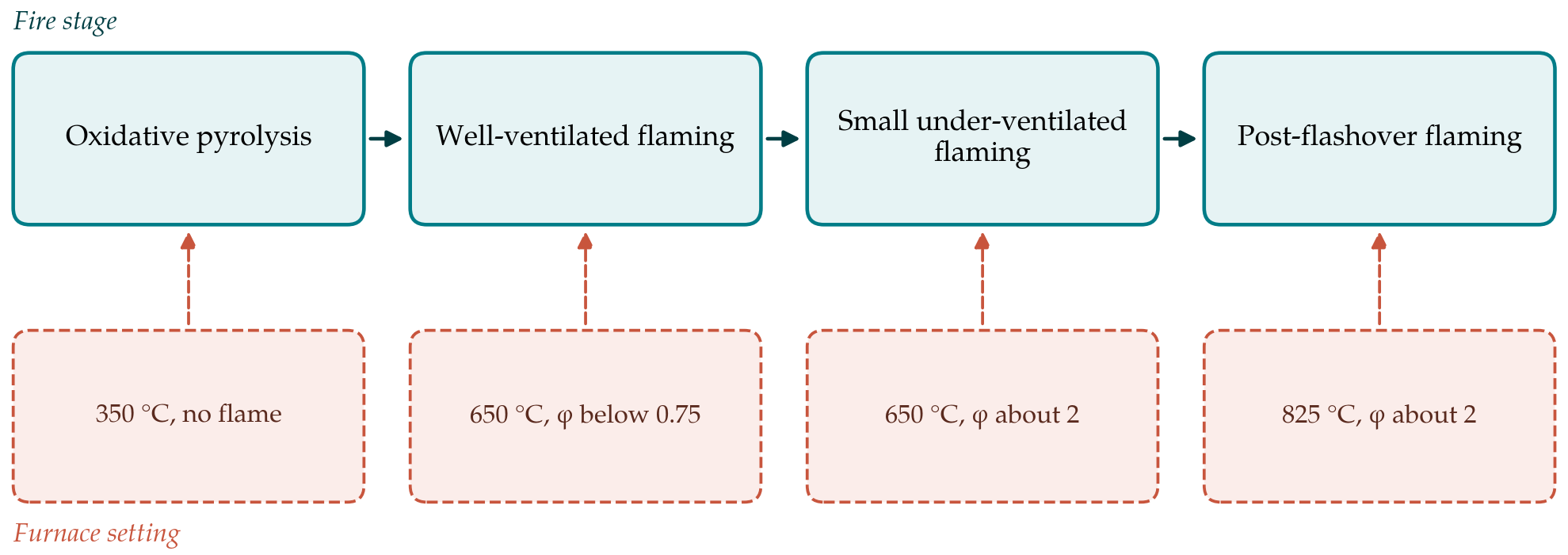
flame,
well-ventilated
flaming,
small
under-ventilated
flaming,
and
post-flashover under-ventilated flaming (ISO, 2016). For facade insulation none should be omitted. Insulation enclosed in a cavity may smoulder or pyrolyse without flame when heated from one side. Burning on the exposed face of a facade is well ventilated. Smoke that enters the building from a cavity or through a window opening above a fully developed room fire is the product of under-ventilated combustion. The under-ventilated conditions usually give the highest toxic potency and are the ones most often left out of routine testing.
Some materials will not flame steadily at the prescribed temperature for a well-ventilated or a small under-ventilated fire. The standard permits the temperature to be raised until steady flaming is obtained, and where this is done the temperature used must be reported. A material that cannot be made to flame at all under a given condition is reported as such, which is itself a relevant finding.
3.4. Step 4: Run the furnace
The boat is driven into the furnace at a constant rate while primary air flows through the tube. The effluent passes into a mixing chamber, where it is diluted with secondary air to a fixed total flow before sampling. The run continues until the concentrations of oxygen and carbon dioxide have been steady for a period long enough to allow all sampling to be completed. At least two runs are made at each condition, and a third if the two disagree appreciably. The residue is weighed so that the mass loss rate during the steady period can be calculated.
3.5. Step 5: Analyse the effluent
Oxygen, carbon dioxide and carbon monoxide are measured continuously with dedicated analysers. The other gases are measured by Fourier transform infrared spectroscopy with a heated sampling line and cell, following the international guidance for that technique (ISO, 2015a). The analytes are chosen from the elemental analysis in Step 1. Hydrogen cyanide and nitrogen oxides are measured for any product containing nitrogen, which includes polyisocyanurate, polyurethane and the binders of some mineral wools. Hydrogen chloride, hydrogen bromide and hydrogen fluoride are measured where the corresponding halogen is present, sulphur dioxide where sulphur is present, and acrolein and formaldehyde for all organic materials. Because acid gases are readily lost on surfaces and in soot filters, and because hydrogen cyanide is the analyte on which the result most often turns, it is recommended that these be confirmed by an independent wet-chemical method on at least one run per condition.
3.6. Step 6: Apply quality checks and calculate yields
Two checks are applied before a run is accepted. The first is the equivalence ratio. The value set from the feed rate and the air flow is compared with the value calculated afterwards from the measured mass loss rate, and with the oxygen depletion observed. The second is a carbon balance: the carbon recovered as carbon dioxide, carbon monoxide, measured hydrocarbons and soot is compared with the carbon lost from the specimen. A poor balance indicates leakage, incomplete sampling or unsteady burning. Yields are then calculated for each gas as mass produced per unit mass of specimen lost during the steady period. Yields per unit mass of specimen charged are reported as well, because for charring and inert-filled products the two differ and both are needed in hazard calculations.
3.7. Step 7: Express the toxic potency
Yields are converted into a single measure by the fractional effective dose method. For lethality, the concentration of each gas that would result from dispersing the effluent of a stated mass of material in a stated volume is divided by its lethal concentration for a thirty-minute exposure, and the fractions are summed with the corrections that the standard prescribes for carbon dioxide and oxygen depletion (ISO, 2015b). The mass loading at which the sum reaches one is an estimate of the lethal toxic potency of the material under that fire condition. Since escape is prevented by incapacitation long before death, the protocol also requires the asphyxiant dose and the irritant concentration fractions to be computed by the tenability method (ISO, 2012). The report states which gases contribute most to each index.
4. Reporting and Interpretation
A test report under the protocol contains the product description and elemental analysis, specimen dimensions and loading, the furnace temperature and the set and achieved equivalence ratio for each run, the steady-state concentrations, the results of the carbon balance, the yields on both mass bases, and the potency indices with their main contributors. Results for different fire stages are not averaged. A material is described by its set of values, and comparisons between materials are made stage by stage.
Toxic potency is a property of the effluent per unit mass burned. The hazard in a building depends also on how much mass burns and how fast, and here the materials differ again: a product that chars and loses little mass may present less hazard than one of lower potency that is consumed entirely. The potency values from this protocol are therefore inputs to a hazard assessment, to be combined with mass loss data from tests of the facade system. They are not a ranking of products for use as a pass or fail criterion.
5. Limitations and What Remains to Be Shown
The protocol is proposed and untested as a whole, although each of its parts rests on a published standard. Before it could be adopted in specifications, its repeatability within a laboratory and its reproducibility between laboratories would have to be established for the materials in question. Low-density foams that shrink away from the heat, intumescent or strongly charring products such as phenolic foam, and foil-faced specimens all present practical difficulties in achieving steady burning, and these are the materials the protocol is meant for.
The relation between bench and full scale also needs confirmation. Published comparisons support the tube furnace as a reasonable representation of large-scale product yields for a number of polymers (Hull and Paul, 2007), but data for insulation burning inside a ventilated cavity are lacking, and the equivalence ratio that prevails there is not well known. The decomposition chemistry of polyurethane and polyisocyanurate foams is complex, with hydrogen cyanide yields sensitive to temperature as well as ventilation (McKenna and Hull, 2016), so conclusions should not be extended beyond the conditions tested. Finally, the lethal concentration values used in the calculation derive from animal experiments and carry their own uncertainty, as the standards acknowledge.
6. Conclusion
The smoke toxicity of facade insulation is not regulated in the European reaction-to-fire system, and published comparisons indicate that the differences between products are large. A defined procedure is needed if those differences are to be measured consistently. The protocol proposed here uses the steady-state tube furnace to reproduce four fire stages at controlled equivalence ratio, specifies the gas analysis and the checks that make a run acceptable, and converts yields to fractional effective doses by standard calculations. It remains to be validated by inter-laboratory work and by comparison with larger tests of facade systems, and it is offered as a basis for that work.
Conflict of interest
To be declared by the author(s) before publication.
Funding
To be declared by the author(s) before publication.