1. Introduction
The public-key algorithms used to establish session keys today, Diffie-Hellman over finite fields and elliptic curves, depend on the hardness of the discrete logarithm problem. Shor (1997) showed that a sufficiently large quantum computer would solve that problem in polynomial time. No such machine exists yet, but recorded traffic can be stored and decrypted later, and the time needed to replace deployed cryptography is long. Mosca (2018) put the point as an inequality: if the period for which data must stay secret plus the time needed to migrate exceeds the time until a capable quantum computer appears, action is already overdue. Sensor networks score badly on that test. Nodes are installed for many years and are seldom updated once in the field.
Replacements are available. After a public evaluation, the United States National Institute of Standards and Technology standardised ML-KEM, a key-encapsulation mechanism derived from CRYSTALS-Kyber (Bos et al., 2018; NIST, 2024). The question for sensor networks is what adopting it costs on hardware and radios chosen for frugality. This communication sets out where the overhead arises, using published parameters and standards, and reports no new measurements.
2. The Constraints of Sensor Platforms
The Internet Engineering Task Force classifies constrained nodes by memory. A class 1 device has on the order of 10 kibibytes of data memory and 100 kibibytes of code memory, and a class 2 device roughly five times the data memory (Bormann et al., 2014). Radios conforming to IEEE 802.15.4 carry at most 127 bytes in a physical-layer frame (IEEE, 2020), and after link-layer and adaptation headers a good deal less is left for the application. Larger datagrams are split by the 6LoWPAN adaptation layer into fragments, and in its original form the loss of any one fragment causes the whole datagram to be discarded (Montenegro et al., 2007).
Energy is the binding resource. Early work on public-key cryptography for sensor nodes established that elliptic-curve methods were affordable on 8-bit microcontrollers where RSA was not, and that the energy of a handshake has to include the radio as well as the processor (Wander et al., 2005). Elliptic-curve key exchange suits the radio very well, since a public value of 32 bytes on a modern curve occupies part of one frame.
3. Where the Overhead Arises
Post-quantum schemes change the proportions of the handshake more than its total computational cost. Figure 1 separates the overhead into three components, which are discussed in turn.
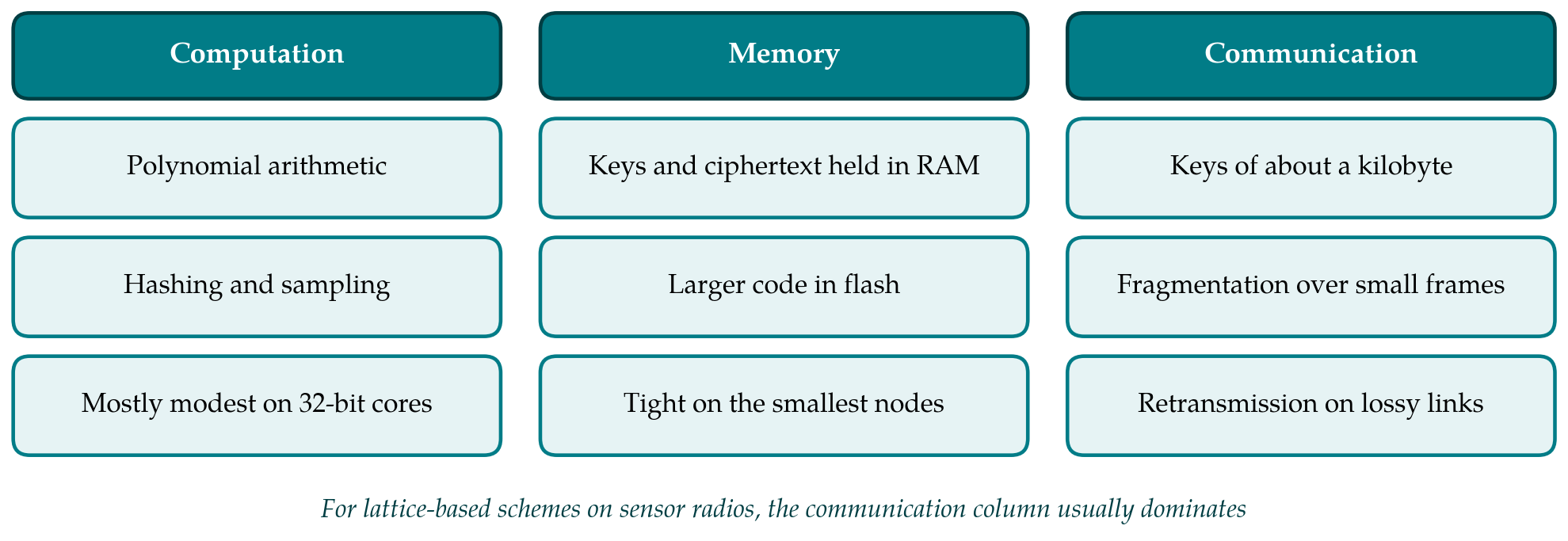
Computation is the smallest concern. ML-KEM works with polynomials whose coefficients are small integers, multiplied by a number-theoretic transform, plus hashing with SHA-3 functions. Benchmarking of the candidate schemes on the ARM Cortex-M4 showed lattice-based encapsulation mechanisms to be among the fastest in the field, with running times of the same order as an elliptic-curve scalar multiplication on comparable hardware (Kannwischer et al., 2019). On 8-bit and 16-bit microcontrollers the picture is less favourable and less well documented.
Memory comes next. Keys and ciphertexts of around a kilobyte must be held in RAM while they are processed, along with intermediate polynomials, and the code is larger than a compact elliptic-curve library. On a class 2 device this is comfortable. On a class 1 device that also runs a network stack it competes with packet buffers, and care in implementation matters.
Communication dominates. Table 1 gives the sizes fixed by the standards. The smallest ML-KEM parameter set has an encapsulation key of 800 bytes and a ciphertext of 768 bytes, against 32 bytes each way for X25519. Neither message fits in an 802.15.4 frame, and each needs at least seven frames before any header is counted. Every fragment costs transmit and receive energy, lengthens the time the radio is awake, and on a lossy multi-hop path adds to the probability that the datagram must be sent again in full.
| Scheme | Public or encapsulation key | Response or ciphertext | Remark |
|---|---|---|---|
| X25519 | 32 bytes | 32 bytes | Elliptic curve; not quantum resistant |
| ML-KEM-512 | 800 bytes | 768 bytes | Lattice based; lowest security category of NIST (2024) |
| ML-KEM-768 | 1184 bytes | 1088 bytes | Lattice based; middle parameter set |
| ML-KEM-1024 | 1568 bytes | 1568 bytes | Lattice based; highest parameter set |
| Code-based KEMs | Very large | Very small | Key too large to send over sensor links; could be pre-installed |
The other families of post-quantum scheme do not offer an easy way out. Code-based mechanisms of the McEliece type have short ciphertexts but public keys far too large to transmit over such links, and hash-based constructions provide signatures, not key exchange (Bernstein and Lange, 2017). Isogeny-based key exchange once looked ideal for sensor networks because its keys were small, until the SIDH construction was broken by a classical attack (Castryck and Decru, 2023). That episode is a reminder that compactness and confidence do not always arrive together.
4. Options for Reducing the Burden
Several mitigations follow from the analysis. The first is to perform key establishment less often: derive long-lived link or session keys from one exchange and refresh them by symmetric means, so that the fragmented handshake is paid for at commissioning and rarely afterwards. The second exploits the asymmetry of the mechanism. In a star or tree topology the mains-powered gateway can generate the key pair and the node can encapsulate, which spares the node key generation and decapsulation, though it must still receive the key and send the ciphertext.
Third, during the transition a hybrid exchange that combines an elliptic-curve secret with an ML-KEM secret protects against failure of either, at the cost of a little more data on top of an already fragmented message. Fourth, the protocol can be designed around fragments. Lightweight exchanges for constrained networks such as EDHOC were specified with elliptic curves and message sizes that fit a few frames (Selander et al., 2024). Carrying a lattice-based mechanism in such a protocol calls for block-wise transfer or fragment-level acknowledgement so that one lost frame does not void the exchange.
5. Open Questions
The reasoning above rests on sizes and published benchmarks, and it leaves questions that only measurement on deployed hardware can answer. The total energy of a complete post-quantum handshake on common sensor platforms, radio included, under realistic loss rates and duty cycling, is not well characterised in the open literature. Nor is the behaviour of multi-hop networks when many nodes rejoin at once after an outage and their fragmented handshakes contend for the channel. Implementations hardened against power and timing side channels, which matter for devices an adversary can handle, cost more than reference code, and the size of that penalty on small cores needs reporting. Finally, authentication is a separate problem: post-quantum signatures are larger still than the key encapsulation messages discussed here, and designs that avoid sending them deserve attention.
6. Conclusion
For low-power wireless sensor networks, the overhead of moving to standardised post-quantum key exchange lies mainly in the radio. Lattice-based encapsulation is computationally affordable on 32-bit microcontrollers, and its keys and ciphertexts are several times larger than the frames that carry them. Designs that establish keys rarely, give the heavier role to the gateway and tolerate fragment loss can contain the cost. How large that cost is in the field remains to be measured, and those measurements are the most useful next contribution.
Conflict of interest
To be declared by the author(s) before publication.
Funding
To be declared by the author(s) before publication.