1. Introduction
In the 1968 Boyer Lectures the anthropologist W. E. H. Stanner spoke of a great Australian silence, a habit of forgetting practised on a national scale that had left Aboriginal people out of the country's account of itself (Stanner, 1969). Poets had not been wholly silent. Judith Wright, raised on a pastoral property in New England, had written since the 1940s about the killings that cleared such land, and she returned to the subject in essays whose title names the inheritance without softening it (Wright, 1991). In Canada the long poem had been a vehicle of national story since the colonial period, and its modern practitioners had begun to ask what that story left out.
The word guilt is an awkward one for this material. It can name a legal fact, a collective responsibility or a private feeling, and critics have not always said which they mean. This review follows the usage of the scholarship it surveys and takes settler guilt to cover the range of responses, from unease to explicit self-accusation, with which non-Indigenous writers register their implication in dispossession. Narrative poetry is likewise taken broadly, to include the long poem, the verse novel, the documentary collage and the linked sequence that tells a story.
Australia and Canada invite comparison because their histories run in parallel: British settlement, federal constitutions, policies of child removal, late judicial recognition of prior title, and public inquiries followed by apology. Their critical traditions have nonetheless developed largely apart. One purpose of the review is to set them next to each other.
2. Approach of the Review
What follows is a narrative review of published criticism and theory, organised by period. The works discussed are those that the field itself cites most often or that changed its vocabulary; no systematic search was carried out and no count of sources is offered. Because much of the relevant theory was written about settler culture in general and only later applied to verse, the review reports both the general argument and its use by readers of poetry. Poems are cited by author and date in the running text, and the reference list is reserved for criticism, theory and a small number of primary works that mark a change in the field.
3. The 1990s: Ambivalence and the Second World
The first phase took its terms from postcolonial theory. Goldie (1989) compared the image of the Indigenous person across Canadian, Australian and New Zealand writing and argued that settler literatures pursue indigenisation: the wish to become native to a place by absorbing, in symbolic form, the people already there. Hodge and Mishra (1991) read Australian literature as organised around a legitimacy it could not secure, with the Aboriginal presence returning in displaced forms. Slemon (1990) proposed that settler writing belongs to a Second World, neither metropolitan nor colonised in the usual sense, and Lawson (1995) described the settler subject as placed between two sources of authority, the imperial centre and the Indigenous owner, and as mimicking both.
Read through these arguments, guilt appeared less as a moral position than as a symptom. Critics of Margaret Atwood's sequence The Journals of Susanna Moodie (Atwood, 1970) had long noted its divided speaker, at once invader and exile; the new vocabulary allowed that division to be read as the structure of settler consciousness. E. J. Pratt's epics Brébeuf and His Brethren (1940) and Towards the Last Spike (1952) were reread for the people their heroic narratives pushed to the edge. In Australia, Les Murray's The Buladelah-Taree Holiday Song Cycle, modelled on a translated Arnhem Land song cycle, became a test case. Some readers saw homage and a claim that rural settlers also belong to country; others saw the indigenising move that Goldie had described.
Studies of form developed alongside. Kamboureli (1991) defined the contemporary Canadian long poem as a genre that refuses the authority of epic, and later critics drew on her account when reading Robert Kroetsch's Seed Catalogue (1977), which asks how a poet grows on the prairie and answers with a list of absences, or Daphne Marlatt's Steveston (1974), a documentary poem of a Japanese Canadian fishing town. The emphasis of this decade, though, fell on the settler's doubleness. Its weakness, visible in retrospect, was that ambivalence could become a comfortable resting place. A subject described as torn is also a subject excused.
4. From Mabo to the Apologies: Haunting, Witness and Apology
Public events changed the questions. Figure 1 places the main critical interventions beside the legal and political dates that criticism in both countries came to treat as turning points.
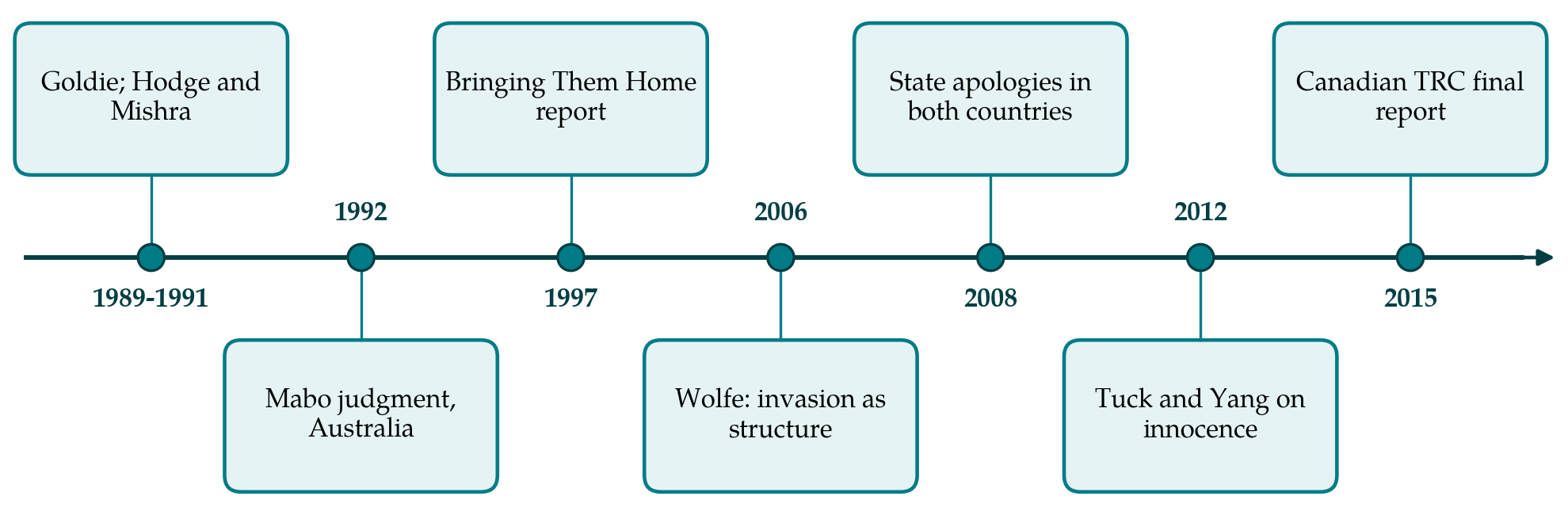
After the High Court of Australia recognised native title in the Mabo judgment of 1992, Gelder and Jacobs (1998) described a postcolonial uncanny, the condition of finding that one's place is also, and legitimately, someone else's. The image of haunting spread quickly through criticism of poetry, where ghosts, bones and unquiet ground were already common figures. Curthoys (1999) supplied a caution from history: white Australians, she argued, have preferred to tell their own past as a story of suffering and exile, and that preference makes acknowledgement of harm done to others harder. The same decade brought the dispute over so-called black armband history, in which guilt became a term of political abuse.
Critics now asked what a poem does with historical record. Laurie Duggan's The Ash Range (1987), assembled from the documents of Gippsland settlement, was praised for letting sources speak and questioned for the same restraint. Kinsella (2007), a poet writing as a critic, argued for a poisoned or radical pastoral that keeps ownership of land in view in every description of it. Mead (2008) treated Australian poetry as part of the public language in which questions of land and law are argued, and Huggan (2007) placed whiteness and racism at the centre of an account of the national literature.
In Canada the same period ran from the confrontation at Oka in 1990 through the Royal Commission on Aboriginal Peoples to the federal apology for residential schools in 2008 and the Truth and Reconciliation Commission that followed. Regan (2010) asked non-Indigenous Canadians to unsettle the settler within, treating discomfort as a condition of learning and not a debt to be discharged. Literary scholars took up the phrase. In both countries, criticism of this phase tended to value poems that bear witness and to describe reading itself as a form of listening. The risk was that apology would be taken for an ending.
5. Since 2006: Guilt Under Suspicion
The third phase begins with the argument of Wolfe (2006) that settler invasion is a structure and not an event. If dispossession continues, a poetry of remorse for the past addresses the wrong tense. Veracini (2010) catalogued the narrative forms by which settler societies disavow their founding violence, and the list reads in places like an inventory of the national long poem. Tuck and Yang (2012) named a set of settler moves to innocence, strategies that relieve feelings of guilt without returning land or power, and their essay became one of the most cited sources in the field. Ahmed (2004) had already argued that declarations of shame by white subjects can work to restore the good self-image of the one who declares.
Indigenous scholars set the terms more firmly still. Moreton-Robinson (2015) analysed the possessive logic by which the nation is assumed to belong to white people, a logic that expressions of regret leave untouched. Coulthard (2014) criticised the politics of recognition and reconciliation in Canada as a means of managing Indigenous claims. Among non-Indigenous writers, Maddison (2011) argued that guilt paralyses and should give way to responsibility, and Rothberg (2019) offered the category of the implicated subject for those who are neither perpetrators nor victims but who benefit from and help reproduce a wrong. Table 1 sets the three phases side by side.
| Phase | Leading question | Representative sources | How guilt is understood |
|---|---|---|---|
| Ambivalence, about 1989 to 1996 | How is the settler subject constituted? | Goldie, 1989; Lawson, 1995 | A symptom of a divided position |
| Haunting, about 1997 to 2010 | What returns, and how should a poem witness it? | Gelder and Jacobs, 1998; Regan, 2010 | A stage on the way to acknowledgement |
| Structure, from 2006 | Whom does remorse serve while dispossession continues? | Wolfe, 2006; Tuck and Yang, 2012 | A possible move to innocence |
| Indigenous critique | Who owns the story and the land? | Moreton-Robinson, 2015; Coulthard, 2014 | Beside the point without redress |
| Implication | What follows from benefiting without having acted? | Rothberg, 2019; Maddison, 2011 | Replaced by responsibility |
For readers of poetry the effect has been a change in what counts as a good poem on this subject. The confessional lyric of regret, once valued for its candour, is now often read as centred on the speaker. Poems that foreground their own position without asking for absolution, that work with documents, or that give up the claim to speak for country have attracted more approving comment. Fee (2015) reframed the Canadian tradition as a series of literary land claims, in which writing asserts or contests title, and that framing makes guilt a secondary matter beside the question of whose claim a poem advances.
6. Indigenous Narrative Poetry and the Position of the Critic
The most consequential change of the last two decades came from outside settler writing. Ali Cobby Eckermann's verse novel Ruby Moonlight (Eckermann, 2012) tells of a young Aboriginal woman who survives a massacre in colonial South Australia. Jordan Abel's The Place of Scraps (Abel, 2013) erases and rearranges an ethnographer's prose about Northwest Coast totem poles until the method of collecting stands exposed. Works of this kind narrate the same history from the other side and with other formal means, and criticism that once discussed settler conscience in isolation now has to read it in their company.
Indigenous poets had addressed settler readers long before this. Oodgeroo Noonuccal's We Are Going, published in 1964 under the name Kath Walker, was the first book of verse by an Aboriginal author, and Judith Wright was among its early supporters. Marilyn Dumont's A Really Good Brown Girl (1996) contains a verse letter to Canada's first prime minister that answers the railway epic from a Métis position. What is new is the readiness of criticism to treat such work as setting the terms of the conversation.
A second consequence concerns the critic. Much of the scholarship reviewed here was written by non-Indigenous academics, and the newer work asks them to state where they stand. That practice can harden into ritual, as Ahmed's argument predicts, but at its best it has made criticism more exact about what a reading of a poem can and cannot achieve. A reading interprets; it does not repair.
7. Gaps and Future Directions
Four gaps stand out. The first is comparison. Goldie's study remains one of the few books to treat the two national literatures together, and it predates most of the events and theory discussed above. Scholars cite the same theorists on both sides of the Pacific but rarely read each other's poets. The second is form. Accounts of guilt are usually thematic, and little has been written on how line, stanza, collage or the pacing of a verse novel distribute knowledge and blame. The verse novel, which has flourished in Australia since the 1990s, is a case in point: it borrows the plotting of prose fiction, and that changes how a reader is led toward knowledge of violence or spared it. The third is range: the same few poets recur, while regional, women's and migrant long poems that complicate the settler category are passed over. Migrant writers are settlers in law without being heirs to the founding violence in the same way, and the scholarship has no settled language for their position.
The fourth gap is the least discussed. Critics have a developed vocabulary for poems that confess and for poems that evade. They have less to say about poems that decline the emotion altogether and turn to practical solidarity, to treaty, or to the return of land as subject matter. If the argument of the third phase is right, such poems deserve more attention than those that dwell on the feeling.
8. Conclusion
Across three decades the scholarship has moved from describing settler guilt, to valuing it as witness, to doubting its use. Each phase answered the public history of its moment, and each left tools that remain serviceable: the analysis of ambivalence, the ethics of listening, and the test of whom a poem's remorse serves. The field would gain from bringing the Australian and Canadian conversations into sustained contact, from closer work on verse form, and from letting Indigenous narrative poetry set more of the questions that are put to settler texts.
Conflict of interest
To be declared by the author(s) before publication.
Funding
To be declared by the author(s) before publication.