1. Introduction
Diabetic ketoacidosis is taught as a triad of hyperglycaemia, ketonaemia and metabolic acidosis, and clinicians are primed to look for it when glucose is very high. The variant in which glucose is only mildly raised was described half a century ago in young people with insulin-treated diabetes (Munro et al., 1973) and remained a curiosity until sodium-glucose cotransporter 2 (SGLT2) inhibitors came into wide use. Reports then accumulated of ketoacidosis at unremarkable glucose concentrations in people taking these drugs, including people with type 2 diabetes (Peters et al., 2015). The most recent consensus on hyperglycaemic crises recognises the euglycaemic form explicitly and has relaxed the glucose criterion for diagnosis accordingly (Umpierrez et al., 2024).
Over the same period, very low carbohydrate and ketogenic diets have gained a place in the management of type 2 diabetes. Proponents argue that carbohydrate restriction addresses the central defect of the condition (Feinman et al., 2015), and consensus guidance now lists low and very low carbohydrate patterns among acceptable options while advising caution in particular groups, among them people taking SGLT2 inhibitors (Evert et al., 2019). Episodes of euglycaemic ketoacidosis in people following such diets have been described in case reports, most often in combination with an SGLT2 inhibitor. These reports differ greatly in the detail they give about the diet, the medicines and the search for other causes, so that a reader can seldom judge how much the diet itself contributed.
This article proposes a structured framework for assessing and writing up such an episode. It is a methodological proposal built from published diagnostic criteria, physiology and reporting standards. It presents no case, reports no data, and has not been validated. Its purpose is to make future reports comparable and more useful for judging cause.
2. Background
Three matters need to be clear before the framework is set out: the difference between nutritional ketosis and ketoacidosis, the reasons glucose may stay near normal, and the limits of what a single case can show.
2.1. Nutritional ketosis and ketoacidosis
Ketone bodies are a normal fuel. When carbohydrate intake is low and insulin concentrations fall, adipose tissue releases fatty acids, the liver converts part of them to acetoacetate and β-hydroxybutyrate, and the brain and muscle oxidise these in place of glucose (Laffel, 1999). In prolonged fasting, ketone concentrations rise over days to a plateau that is held in check by the small amount of insulin still secreted, and blood pH stays within the normal range (Cahill, 2006). The ketosis of a well-conducted very low carbohydrate diet is of this regulated kind. Ketoacidosis differs in degree and in control: insulin action is insufficient to restrain lipolysis and ketogenesis, counter-regulatory hormones are raised, ketone production outruns use, and buffering capacity is exhausted (Dhatariya et al., 2020). The distinction is made biochemically, by acid-base status, and not by the presence of ketones alone.
2.2. Why glucose may remain near normal
Glucose stays low in ketoacidosis when its supply is reduced or its loss increased. Reduced supply occurs with fasting, low carbohydrate intake, depleted hepatic glycogen, alcohol and pregnancy. Increased loss is the mechanism of SGLT2 inhibition, which maintains glycosuria independent of insulin. By lowering glucose these drugs also lower insulin secretion and raise glucagon, shifting metabolism toward ketogenesis, and they may reduce renal clearance of ketones (Taylor et al., 2015). Rosenstock and Ferrannini (2015) describe the result as predictable and list reduced carbohydrate intake, acute illness, surgery, dehydration, alcohol and reduction of insulin doses among the usual precipitants. A very low carbohydrate diet in a person taking an SGLT2 inhibitor therefore combines two influences that act in the same direction, and separating them in a given case requires careful documentation.
2.3. What a case report can and cannot show
Case reports are the usual first signal of a rare harm and have a legitimate place in the literature (Vandenbroucke, 2001). They cannot give a rate, and causal inference from a single episode is always provisional. Pharmacovigilance has developed tools for making that inference more disciplined, including the questionnaire of Naranjo et al. (1981) and the categorical scheme described by Edwards and Aronson (2000). Reporting standards have developed in parallel: the CARE guidelines specify what a case report should contain (Gagnier et al., 2014; Riley et al., 2017), and a short tool exists for appraising the quality of case reports and series (Murad et al., 2018). None of these was written with a dietary exposure in mind.
3. The Proposed Framework
The framework has seven steps, shown in sequence in Figure 1. Table 1 lists the minimum information each step should produce for the report. The order reflects clinical logic, and in practice the early steps overlap with emergency care, which follows local protocols and is outside the scope of this article.
| Step | Minimum information | Why it matters |
|---|---|---|
| 1. Confirm ketoacidosis | Glucose, pH, bicarbonate, anion gap, blood β-hydroxybutyrate and method | Shows that diagnostic criteria were met |
| 2. Characterise diet | Daily carbohydrate, energy intake, duration, supervision, recent change | Defines the exposure under suspicion |
| 3. Medicines and insulin | All glucose-lowering drugs, last doses, C-peptide, autoantibodies | Identifies drug effects and insulin deficiency |
| 4. Other precipitants | Infection, acute illness, surgery, alcohol, dehydration, pregnancy | Reveals competing triggers |
| 5. Other acidoses | Lactate, renal function, alcohol history, toxicology where indicated | Rules out alternative diagnoses |
| 6. Causality judgement | Timing, alternative causes, course after change, any re-exposure | Grades the contribution of diet |
| 7. Reporting | CARE checklist items, timeline, consent, follow-up | Makes the report usable by others |
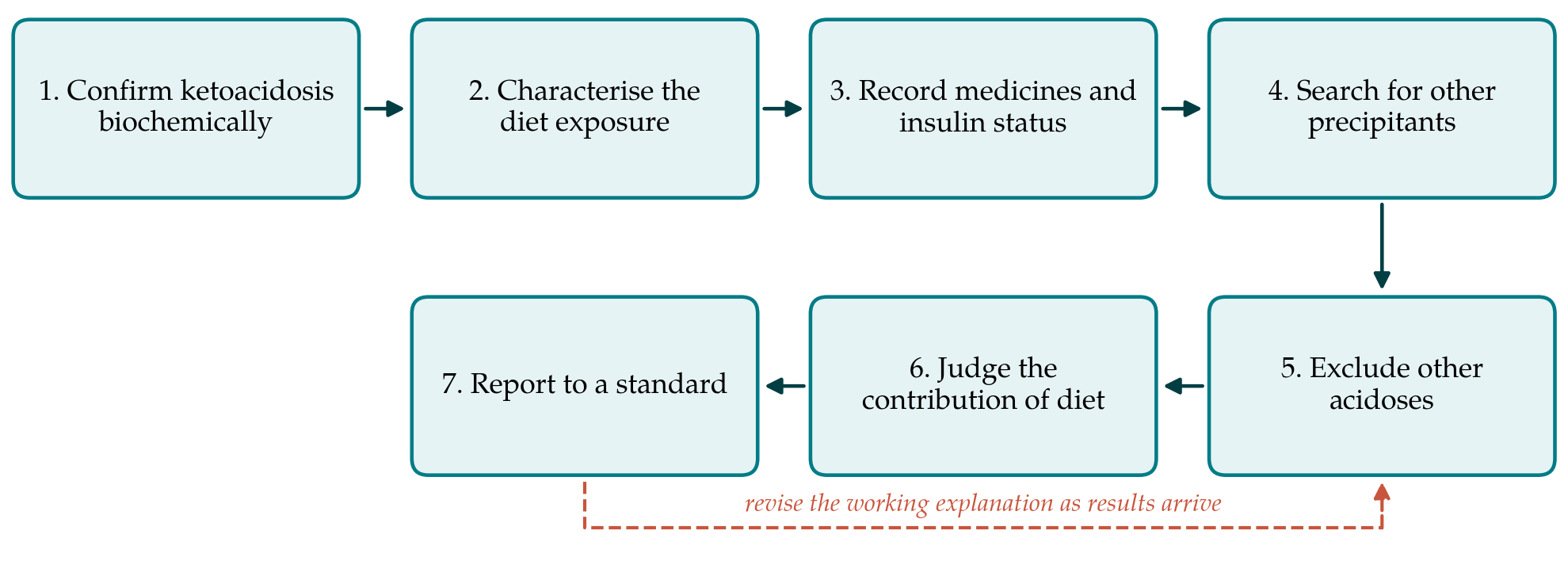
3.1. Step 1: Confirm ketoacidosis biochemically
The report should show that the episode met accepted criteria. The current consensus requires evidence of diabetes or of hyperglycaemia, ketonaemia with β-hydroxybutyrate of 3.0 mmol/L or more or marked ketonuria, and metabolic acidosis with pH below 7.3 or bicarbonate below 18 mmol/L (Umpierrez et al., 2024). Earlier criteria set the glucose threshold at 250 mg/dL (Kitabchi et al., 2009), and the term euglycaemic is conventionally applied below that value. Blood β-hydroxybutyrate is preferable to urine testing, which detects acetoacetate. The values at presentation, the method of ketone measurement and the anion gap should all be stated.
3.2. Step 2: Characterise the diet exposure
Diet is the exposure of interest and is usually the least well described element. Definitions vary; one widely cited scheme describes a very low carbohydrate ketogenic diet as 20 to 50 g of carbohydrate a day, or less than 10 per cent of energy (Feinman et al., 2015). The report should give the estimated daily carbohydrate intake and how it was estimated, total energy intake if known, the duration of the diet, whether it was supervised, and any recent change such as a further restriction, a period of fasting or reduced intake during illness. Recent weight loss and any home ketone readings before the episode are also informative.
3.3. Step 3: Record medicines and insulin status
Every glucose-lowering medicine should be listed with its dose and the time of the last dose, with particular attention to SGLT2 inhibitors and to recent reduction or omission of insulin. Because insulin deficiency is the central lesion of ketoacidosis, the report should state what is known of endogenous secretion. A proportion of adults labelled as having type 2 diabetes have slowly progressive autoimmune diabetes or pancreatic disease, and a measurement of C-peptide and islet autoantibodies, taken once the acute episode has resolved, helps to show whether the diagnosis was secure.
3.4. Step 4: Search for other precipitants
The recognised triggers of ketoacidosis should be sought and their presence or absence stated: infection, myocardial infarction and other acute illness, surgery, vomiting and dehydration, alcohol, pregnancy, and strenuous exertion (Kitabchi et al., 2009; Rosenstock and Ferrannini, 2015). A statement that no precipitant was identified carries weight only if the investigations that support it are named.
3.5. Step 5: Exclude other acidoses
A raised anion gap with ketones is not unique to diabetes. Alcoholic ketoacidosis, starvation ketosis with a superimposed acidosis, lactic acidosis, renal failure and ingestion of salicylate, methanol or ethylene glycol belong in the differential diagnosis (Dhatariya et al., 2020). The report should give lactate, renal function and the alcohol history at least, and say which further tests were done.
3.6. Step 6: Judge the contribution of the diet
Causality tools for adverse drug reactions ask a small number of questions that transfer readily to a dietary exposure: whether the event followed the exposure in a plausible time, whether it is a recognised or mechanistically plausible effect, whether other causes could explain it alone, whether it resolved when the exposure was changed, and whether it recurred on re-exposure (Naranjo et al., 1981). The framework proposes that authors answer each question explicitly for the diet and separately for any SGLT2 inhibitor, and then place the diet in one of the familiar categories of certain, probable, possible or unlikely (Edwards and Aronson, 2000). Where an SGLT2 inhibitor was being taken, or another precipitant was present, the diet can rarely be rated above possible or contributory, and the report should say so. Deliberate re-exposure to establish cause is not justified; information on what happened when carbohydrate restriction was later resumed, if the person chose to do so, should be reported when available. The general considerations set out by Hill (1965), particularly temporality and plausibility, provide a useful check on the reasoning.
3.7. Step 7: Report to a standard
The write-up should follow the CARE checklist, with a dated timeline that places dietary changes, medicine changes, symptoms and laboratory results on one axis (Riley et al., 2017). Informed consent, the perspective of the person concerned where they wish to give it, and the plan for diet and medicines after the episode complete the report. Negative findings belong in the text; their omission is the commonest reason a case report cannot be interpreted.
4. Fitting the Framework to Practice
Most of the information the framework asks for is collected in routine care, though not always recorded. The dietary history is the exception. In an emergency department it is rarely taken in quantitative form, and a retrospective estimate made days later is subject to recall error. A brief structured dietary recall as soon as the person is well enough, ideally by a dietitian, is the single addition most likely to improve the quality of a report. Timing also matters for C-peptide, which is suppressed during acute illness and is better measured after recovery. Units working with ketogenic diet programmes could adopt the table as a standing template so that information is gathered prospectively should an episode occur. The same structure would serve a case series or a registry, where consistent fields allow reports from different centres to be read side by side.
5. Limitations and What Remains to Be Shown
The framework is proposed and untested. It has not been applied to published reports to see how often each item is available, nor has agreement between assessors on the causality category been examined, and both exercises would be needed before it could be recommended as a standard. Causality instruments designed for drugs perform imperfectly even for drugs, and adapting them to a diet, an exposure that is continuous, self-reported and variable from day to day, adds uncertainty. The framework organises judgement and does not replace it.
Better reports will not answer the question of frequency. Whether very low carbohydrate diets raise the risk of ketoacidosis in type 2 diabetes in the absence of SGLT2 inhibitors, and by how much they raise it in their presence, can be settled only by cohort data with a known denominator. Nothing in this article should be read as guidance on treating ketoacidosis or on prescribing or withholding any diet or medicine; those decisions rest on current clinical guidelines and individual assessment.
6. Conclusion
Euglycaemic ketoacidosis in a person with type 2 diabetes on a very low carbohydrate diet nearly always has more than one possible cause. A report that confirms the diagnosis against current criteria, quantifies the diet, documents medicines and insulin reserve, names the precipitants and alternative diagnoses that were sought, and grades the contribution of the diet in explicit terms is far more useful than one that records only the association. The seven steps proposed here offer a way to produce such reports. Their usefulness has yet to be tested on real case material.
Conflict of interest
To be declared by the author(s) before publication.
Funding
To be declared by the author(s) before publication.