1. Introduction
Cracking is a normal condition of reinforced concrete. Design codes do not try to prevent it; they limit crack widths to values judged acceptable for durability and appearance (CEN, 2004). Cracks nevertheless provide a short path to the reinforcement for chloride, carbon dioxide and water, and the inspection and repair they call for are costly, especially where access is difficult. The idea that the material might seal its own cracks is therefore attractive, and it has grown from a curiosity into an organised field of research with its own state-of-the-art reports (de Rooij et al., 2013; De Belie et al., 2018).
Concrete already heals to some extent unaided. Narrow cracks in water-retaining structures have long been seen to close, and Edvardsen (1999) showed that precipitation of calcium carbonate in the crack is the main cause. This autogenous healing is limited to fine cracks and needs water. Engineered, or autonomous, healing aims to extend the range by placing a healing agent in the concrete in advance. The two approaches that have received most attention are bacteria that produce calcium carbonate and encapsulated chemical agents released by the crack itself.
This review considers both. Its subject is less the catalogue of systems, which earlier reviews cover thoroughly (Van Tittelboom and De Belie, 2013), than the question in its title: why results that look so favourable in the laboratory have led to so few applications, and what would have to change for that to be different.
2. Approach of the Review
The article is a narrative review based on the published literature: the reports of the RILEM technical committee and of the European SARCOS network, the primary papers that introduced the principal systems, and the published accounts of field and large-scale trials. No systematic search protocol was applied and no new experimental results are presented. The emphasis is on mechanisms and on the conditions under which reported performance was obtained, since it is those conditions that decide whether a result transfers to a structure.
3. Mechanisms
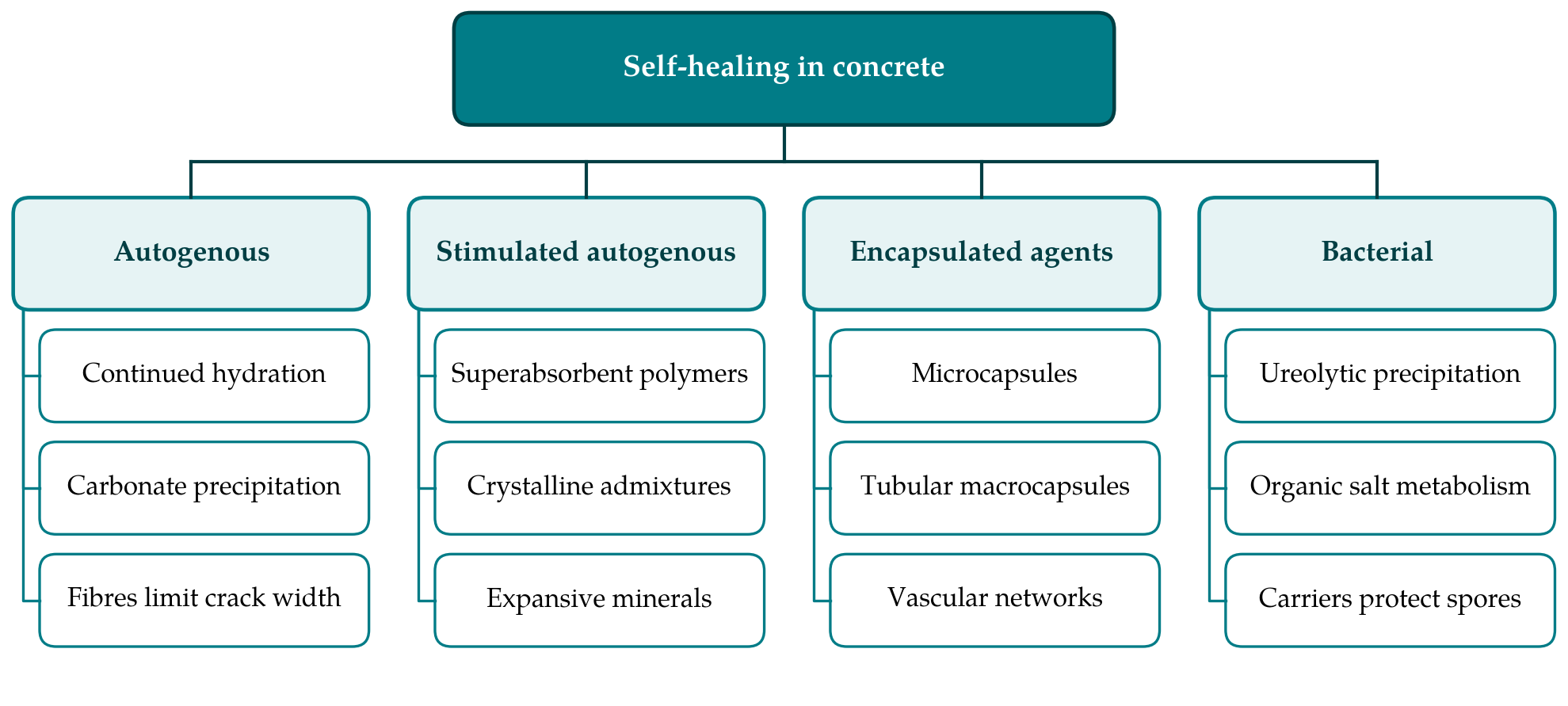
Figure 1 groups the healing routes found in the literature. Following the terminology of the RILEM committee, autogenous healing uses only constituents that the concrete would contain anyway, while autonomous healing depends on an engineered addition (de Rooij et al., 2013). Hearn (1998) drew the further distinction between self-sealing, in which flow through a crack is blocked, and healing in the sense of recovered mechanical properties. The distinction is easily lost and matters throughout what follows.
3.1. Autogenous healing and its stimulation
Two processes account for most autogenous healing: hydration of cement grains that had remained unreacted, and carbonation of dissolved calcium hydroxide to calcium carbonate at the crack mouth. Both need liquid water, and both are effective only when the crack is narrow. The practical route to exploiting them is therefore crack width control. In engineered cementitious composites, fibres hold cracks to widths of tens of micrometres, and Yang et al. (2009) showed that such cracks recover stiffness and transport resistance under repeated wetting and drying. Snoeck et al. (2014) combined microfibres with superabsorbent polymers, which swell to block the crack and then release water that sustains further hydration. In seawater the chemistry differs, with magnesium and carbonate from the water taking part in the precipitates (Palin et al., 2015).
3.2. Bacterial healing
Microbially induced carbonate precipitation was first applied to construction materials as a surface treatment for stone (De Muynck et al., 2010). Two metabolic pathways have been adapted for use inside concrete. In the ureolytic pathway, bacteria such as Sporosarcina pasteurii or Bacillus sphaericus hydrolyse urea, raising the carbonate concentration so that calcium carbonate precipitates on the cell walls (Van Tittelboom et al., 2010). The reaction is fast but produces ammonium as a by-product. In the second pathway, introduced by Jonkers et al. (2010), spores of alkali-tolerant Bacillus species are mixed into the concrete with an organic calcium salt such as calcium lactate. When a crack admits water and oxygen the spores germinate and oxidise the salt, and the carbon dioxide formed reacts with calcium to give carbonate.
The difficulty is survival. Spores added directly to the mix lose viability within months as the pores of the hydrating paste become smaller than the cells (Jonkers et al., 2010). Carriers were the answer: Wiktor and Jonkers (2011) loaded spores and nutrient into porous expanded clay particles and reported closure of cracks more than twice as wide as those that healed in control specimens, and Wang et al. (2014) used polymer microcapsules to protect the spores and obtained healing of substantially wider cracks than in specimens without bacteria.
3.3. Encapsulated chemical agents
The capsule concept came to concrete from two directions. Dry (1994) embedded hollow fibres filled with adhesive in cement matrices, and White et al. (2001) demonstrated autonomic healing in a polymer composite with microcapsules of monomer and a dispersed catalyst, a paper that set the pattern for much later work. In concrete the agents tried include polyurethane, epoxy, cyanoacrylate and methyl methacrylate among the polymers, and sodium silicate and other mineral precursors among the inorganic options. Van Tittelboom et al. (2011) used glass and ceramic tubes filled with polyurethane and recovered a good part of the original strength and stiffness as well as water tightness. Kanellopoulos et al. (2015) encapsulated mineral agents in glass, on the reasoning that mineral products are more compatible with the matrix than polymers.
Microcapsules can be dispersed in the mix like a fine aggregate but hold little agent each. Macrocapsules hold more and can seal wider cracks, but they must be placed by hand or protected, and they act only where they are. Vascular networks of embedded channels allow an agent to be supplied, and resupplied, from outside, at the price of making the element a small piece of plant.
4. What the Laboratory Has Shown
Table 1 compares the main approaches on the points that decide their usefulness. The laboratory record supports three statements with reasonable confidence. Engineered systems close cracks several times wider than autogenous healing manages. Closure restores water tightness to a large degree, which is the property most often measured. And polymer agents, though not mineral ones or bacterial carbonate, can restore a meaningful part of the mechanical capacity across the crack.
| Approach | Trigger and product | Main strength | Main obstacle in practice |
|---|---|---|---|
| Autogenous with crack width control Yang et al., 2009 | Water; hydration products and calcium carbonate | No added agent; repeatable | Only very fine cracks; fibre cost |
| Superabsorbent polymers Snoeck et al., 2014 | Water; swelling, then hydration | Simple to mix; immediate sealing | Voids left in matrix; needs wet cycles |
| Ureolytic bacteria Van Tittelboom et al., 2010 | Water and urea; calcium carbonate | Fast precipitation | Ammonium by-product; cell protection |
| Spores with organic salt Wiktor and Jonkers, 2011 | Water and oxygen; calcium carbonate | Long dormancy; benign products | Carrier lowers strength; oxygen limits depth |
| Microcapsules Wang et al., 2014 | Crack ruptures shell; polymer or mineral | Dispersed through the mix | Small payload; survival of mixing |
| Macrocapsules Van Tittelboom et al., 2011 | Crack breaks tube; polymer | Wider cracks; some strength regain | Manual placement; one use |
| Vascular networks Davies et al., 2018 | Crack opens channel; pumped agent | Refillable; repeatable | Complex to build and operate |
These statements come with conditions that are not always prominent in the reporting. Most specimens are small mortar prisms or cylinders cracked once at an early age, under a controlled opening, and then stored in water or in wet and dry cycles for some weeks. The crack is clean and static, and the healing period follows cracking immediately. Ferrara et al. (2018) reviewed the test methods in use and found wide variation in how cracks are made, how healing is conditioned and how its extent is expressed, which makes results from different groups hard to compare. Healing efficiency defined by closure of the crack mouth can be high while the interior of the crack remains open.
5. What Field and Large-Scale Trials Have Shown
Published trials at structural scale are few. Van Tittelboom et al. (2016) cast large beams containing encapsulated polyurethane or superabsorbent polymers and compared them under laboratory conditions; healing was obtained, but capsule placement and survival during casting required special measures that would not be routine on site. Wiktor and Jonkers (2015) applied a liquid bacteria-based repair system to the cracked deck of a parking garage and reported reduced leakage, an application of the biology as a repair product and not as an ingredient of new concrete.
The fullest account of healing systems built into a real structure is that of Davies et al. (2018), who describe wall panels cast on a highway construction site in Wales with microcapsules, bacteria in lightweight aggregate, shape memory polymer tendons and vascular networks, alone and in combination. The trial showed that each system could be incorporated with ordinary site plant, and it also showed how much preparation each needed and how difficult it is to load a full-scale element so as to produce cracks of the intended width. Observations over the months that followed were informative but short in comparison with a service life.
6. Why the Distance Persists
The reasons that laboratory success has not carried through fall into five groups, and they are better understood as properties of the systems than as accidents of the trials.
6.1. Survival and shelf life
A healing agent must survive mixing, placing and compaction, then remain potent for years until a crack arrives. Capsule shells strong enough for the mixer may be too strong to rupture when the crack crosses them; brittle shells that rupture reliably are easily broken beforehand. Polymer agents can cure slowly inside their capsules. Spores are remarkably durable, but their viability over decades in concrete has been inferred and not observed. Li and Herbert (2012) listed long shelf life among the criteria for a robust system, together with pervasiveness, quality, reliability, versatility and repeatability, and few engineered systems satisfy all six.
6.2. Moisture, oxygen and crack conditions
Bacterial and autogenous healing need liquid water, and the spore-based route needs oxygen as well, which restricts it to the region near the crack mouth. A structure that is dry for most of the year heals little. Real cracks also differ from laboratory ones: they open and close with temperature and load, they may be contaminated, and they may form decades after casting when unreacted cement is scarce. Healing of a moving crack is a much harder problem than healing of a static one, and it has been studied far less.
6.3. Single use and partial coverage
A capsule heals once. If the crack reopens, or a second crack forms nearby, the agent is spent. Only autogenous healing in fibre-controlled cracks and externally fed vascular systems are repeatable in any real sense. Dispersed agents also add cost to the whole volume of concrete in order to treat the small fraction that cracks, and placing them only where cracking is expected requires a confidence in crack prediction that designers seldom have.
6.4. Measuring the right thing
Crack closure seen under a microscope is the most common measure of healing and the least relevant to an owner. What matters is whether chloride ingress and corrosion at the crack are delayed, and whether the benefit lasts. No standard test method exists. The inter-laboratory study reported by Van Mullem et al. (2020), in which several laboratories tested the same macrocapsule concrete with common procedures, is a step toward one, and it revealed how much the method of forming and controlling the crack contributes to the scatter. Without agreed methods there can be no product standard, and without a product standard a designer has no basis for crediting self-healing in a durability calculation.
6.5. Cost
Self-healing additions cost more than the concrete they go into. For bacterial systems, Silva et al. (2015) identified the production of axenic spores and their encapsulation as the dominant costs and argued that non-sterile production from mixed cultures would be necessary for economic viability. The argument for accepting a higher initial price rests on avoided repair, which accrues decades later and to a party that is often not the one paying for construction. The life-cycle case therefore needs evidence of durable benefit of exactly the kind that the test methods do not yet deliver.
7. Where the Technology Is Closest to Practice
The obstacles do not weigh equally everywhere. They are lightest where cracks are narrow and predictable, water is reliably present and repair is expensive or disruptive: basements and tunnels below the water table, tanks and reservoirs, marine structures in the submerged and tidal zones. In such elements watertightness is the functional requirement, sealing and not strength regain is what is wanted, and the moisture that healing needs is guaranteed. Bacteria-based repair mortars and liquids, which treat existing cracks and so avoid the dormancy problem altogether, are a second realistic route. Structural elements in dry service that crack under variable load are the least promising case, and it would help the field if claims were framed accordingly.
8. Conclusion
Bacterial and encapsulated-agent concretes do what their developers say under the conditions in which they have been tested: they close cracks wider than concrete can close unaided and restore resistance to water flow. The step to practice has been slow because those conditions are narrower than a structure's life. Agents must lie dormant for years, cracks move, water is not always present, most systems act once, and the benefit is measured in ways that do not yet connect to service life. Progress now depends less on new healing agents than on standard test methods, on monitored structures followed for many years, and on matching each system to the exposure in which its mechanism can work.
Conflict of interest
To be declared by the author(s) before publication.
Funding
To be declared by the author(s) before publication.