1. Introduction
Boiling a liquid directly on the surface of an electronic device removes the stack of thermal interface materials, cold plates and heat sinks that stands between a chip and its coolant in conventional designs. The liquid has to be electrically insulating and chemically inert, which in practice has meant fluorinated compounds: perfluorocarbons such as FC-72 and, later, hydrofluoroethers and fluoroketones. Their boiling points sit conveniently below the junction temperature limits of silicon devices; FC-72 boils at about 56 °C at atmospheric pressure. The case for this kind of cooling at high heat flux has been set out several times (Mudawar, 2001; Bar-Cohen et al., 2006), and passive two-phase immersion of whole servers has been proposed on the same basis.
The difficulty is that the properties which make these liquids safe also make them poor at boiling. Their latent heat of vaporisation and thermal conductivity are a small fraction of the values for water, and their surface tension is several times lower. The consequences are a low critical heat flux and a reluctance to start boiling at all. Enhancement of the heated surface has therefore been studied for as long as the fluids have been used, and the resulting literature is large (Webb, 1981; Leong et al., 2017; Liang and Mudawar, 2019).
Laser texturing has attracted attention within that literature for practical reasons. A scanned laser beam can structure a copper heat spreader in a single maskless step, in air, over areas of industrial size. The texture is cut from the parent metal, so there is no sintered or sprayed layer to add interface resistance or to flake off into a sealed tank. This review asks what the published literature supports about the use of such surfaces with dielectric fluids, and where the support is thin.
2. Scope and Approach
The article is a narrative review of the published literature. It does not follow a formal search protocol and makes no claim to completeness. Three groups of sources were read against one another: classical and modern work on nucleate boiling and critical heat flux, with particular attention to highly wetting liquids; the laser processing literature on the formation of surface structures on metals; and boiling studies on laser-textured metals and on other engineered surfaces tested in dielectric fluids. Because the first and third groups overlap only partly with the specific pairing of laser-textured copper and a fluorinated liquid, some conclusions here are reasoned from adjacent evidence. Where that is so, the text says it.
3. Boiling Behaviour of Dielectric Fluids
The boiling curve first mapped by Nukiyama (1966), in work originally published in 1934, has the same shape for a fluorinated liquid as for water: natural convection, onset of nucleation, nucleate boiling and a critical heat flux beyond which a vapour film insulates the surface. What differs is where each transition falls and how the surface influences it. A standard account of the regimes is given by Dhir (1998).
3.1. Wetting, vapour trapping and incipience
Heterogeneous nucleation depends on gas or vapour trapped in surface cavities when liquid advances over the solid. Bankoff (1958) showed that trapping requires the contact angle to exceed the cavity mouth angle, and Hsu (1962) related the range of cavity sizes that can become active to the wall superheat and the thickness of the thermal boundary layer. Fluorinated liquids wet almost every engineering surface with a contact angle close to zero. Ordinary conical cavities flood, and only very small or re-entrant ones keep an embryo.
The visible result is the incipience excursion. The wall temperature climbs well above saturation in single-phase convection and then drops abruptly when boiling finally starts. Bar-Cohen and Simon (1988) analysed these excursions for dielectric liquids. For an electronic component the overshoot is a reliability concern in its own right, because it is a thermal shock applied at every start-up. An enhanced surface for these fluids is judged first on whether it removes the overshoot, and only then on how far it shifts the nucleate boiling curve.
3.2. Nucleate boiling and critical heat flux
In established nucleate boiling the correlation of Rohsenow (1952) carries the influence of the surface in an empirical coefficient specific to each liquid and surface pair, which amounts to an admission that, for a given fluid, the surface can move the curve by a large factor. The hydrodynamic theory of Zuber (1959) gives the critical heat flux on a large flat plate as proportional to the latent heat, the square root of vapour density, and the fourth root of the product of surface tension, gravity and the density difference. Every term apart from vapour density counts against a fluorinated liquid.
Zuber's expression contains no surface property, yet critical heat flux is known to depend on wettability and structure. Kandlikar (2001) introduced the contact angle through a force balance on a growing bubble. Later work on micro- and nanostructured surfaces related the gain in critical heat flux to roughness-amplified capillary forces (Chu et al., 2012) and to the rate at which the structure wicks liquid back to dry spots (Rahman et al., 2014). These models were developed largely with water, and they point to capillary liquid supply as the property that a texture should be designed to provide.
4. Laser Texturing of Copper
A pulsed laser removes material from a metal by melting, vaporisation and, at very short pulse durations, direct solid-to-vapour ablation. Chichkov et al. (1996) set out the difference between regimes: nanosecond pulses leave a melt pool that is expelled and resolidifies as rims and droplets, whereas femtosecond and picosecond pulses deposit energy faster than heat can diffuse and leave a much smaller heat-affected zone. Copper is a demanding material in both regimes because of its high reflectivity in the infrared and its high thermal conductivity.
Several kinds of structure can be produced, often superimposed. Near the ablation threshold, ultrashort pulses generate laser-induced periodic surface structures, ripples with a period close to or below the wavelength of the light (Bonse et al., 2012). At higher fluence and with many overlapping pulses, self-organised mounds and spikes several micrometres across grow, covered in nanoscale debris (Vorobyev and Guo, 2013). Scanning the beam along lines cuts grooves, and two crossed sets of lines leave arrays of pillars. Table 1 lists the main feature types with the role each would be expected to have in boiling a highly wetting liquid.
| Feature | How it forms | Expected role in boiling | Related source |
|---|---|---|---|
| Periodic ripples | Ultrashort pulses near the ablation threshold | Sub-micrometre roughness; cavities probably too open to hold vapour | Bonse et al., 2012 |
| Mounds and spikes | Ultrashort pulses, high fluence, many overlapping passes | Multi-scale cavities, large area gain, wicking | Kruse et al., 2015 |
| Rimmed microcavities | Nanosecond pulses with melt expulsion | Re-entrant sites able to retain vapour | Zupančič et al., 2017 |
| Grooves and channels | Line scanning in either regime | Fin effect; separate liquid inflow from vapour escape | Liter and Kaviany, 2001 |
| Pillar arrays | Two crossed sets of scan lines | Area gain comparable to etched pin fins | Honda et al., 2002 |
| Oxide nanostructure | Processing in air; redeposited debris | Alters wetting; adds thermal resistance; changes with time | Kietzig et al., 2009 |
Processing in air oxidises copper, and the chemistry of the fresh surface is not stable. Kietzig et al. (2009) showed that laser-structured metal alloys are hydrophilic immediately after irradiation and become hydrophobic over days as carbon-containing species accumulate from the atmosphere. For water the change is large enough to alter boiling behaviour. A fluorinated liquid wets both states, so the wettability drift matters less, but the oxide layer remains as a thermal resistance and as a possible source of particles.
5. Mechanisms by Which Laser Textures Can Enhance Boiling
The ways in which a laser-textured copper surface could improve boiling of a dielectric liquid can be grouped under three headings, with a fourth for the penalties. Figure 1 sets them out. The grouping follows the general review of surface modification by Liang and Mudawar (2019) and is applied here to features that a laser can make.
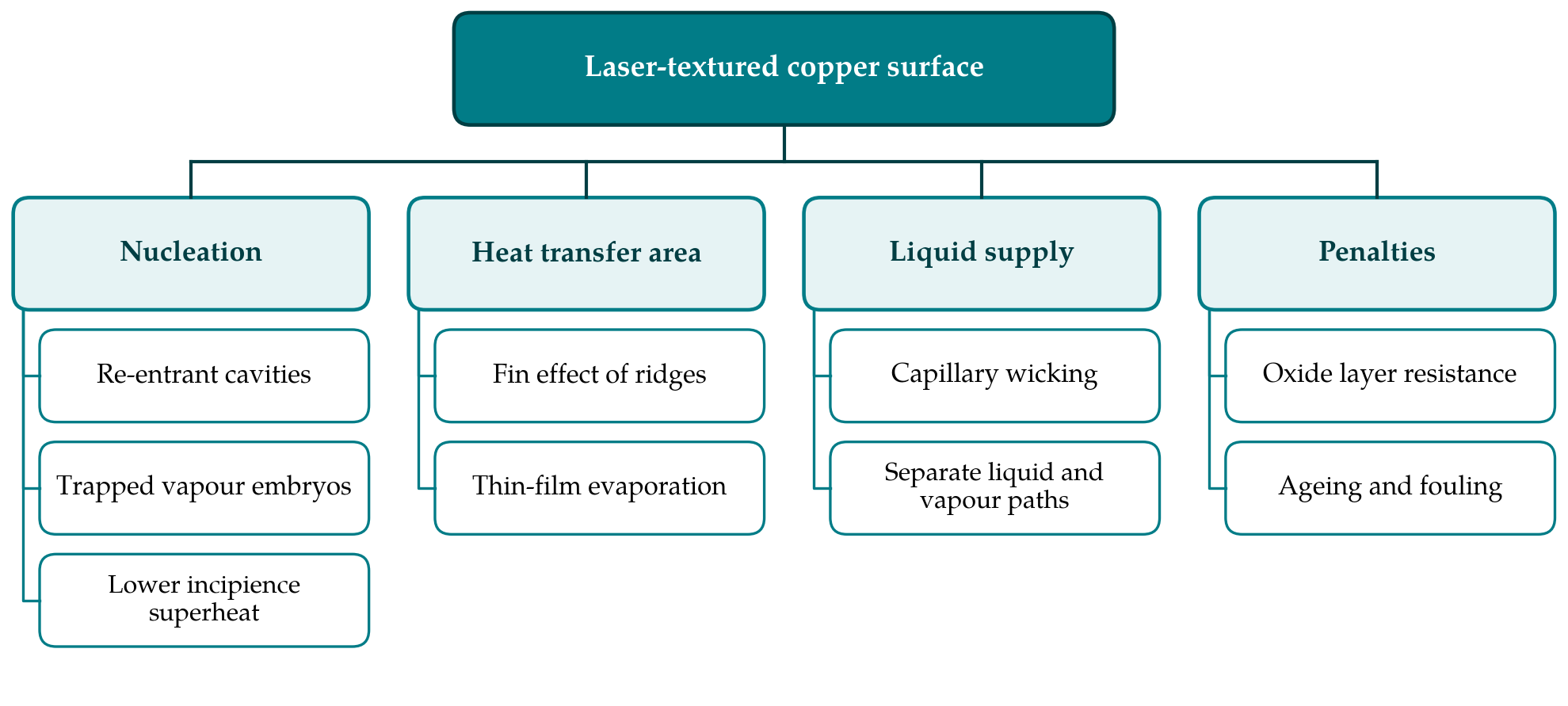
The first route is nucleation. Melt rims that partly close a cavity, and the gaps between resolidified droplets, are re-entrant shapes of the kind that the Bankoff criterion says can hold vapour even at near-zero contact angle. The commercial re-entrant tunnel surfaces surveyed by Webb (1981) work on the same principle. If a laser texture supplies a dense population of such sites in the size range that Hsu's analysis identifies as active, the incipience overshoot should shrink and the nucleate boiling curve should shift to lower superheat.
The second route is area. Grooves and pillars tens to hundreds of micrometres deep act as fins, and in a liquid of low thermal conductivity the fin efficiency of copper features remains high. The third is liquid supply. A network of fine channels draws liquid toward the heated base by capillarity while vapour leaves through wider gaps, the arrangement that Liter and Kaviany (2001) produced with modulated porous coatings. Low surface tension weakens the capillary pressure available, although the low viscosity of fluorinated liquids offsets part of the loss.
6. Evidence From Boiling Experiments
Published boiling tests on laser-processed metals have mostly used water. Kruse et al. (2015) reported higher critical heat flux and heat transfer coefficients on stainless steel covered with femtosecond-laser mound structures than on the polished metal, and Zupančič et al. (2017) used nanosecond texturing to produce steel surfaces with uniform and patterned wettability that altered nucleation behaviour. These studies establish that laser textures are robust enough to survive boiling and that they can act through both wettability and cavity geometry. They do not show what the same textures do in a liquid that floods cavities which water leaves dry.
The best guide to that question is the record of other structured surfaces in fluorinated liquids. Microporous coatings tested in saturated FC-72 by Chang and You (1997) lowered incipience superheat sharply and raised both the heat transfer coefficient and the critical heat flux, with a clear dependence on coating thickness relative to the superheated liquid layer. Honda et al. (2002) found that silicon chips with micro-pin-fins and submicron roughness outperformed smooth chips in FC-72, and El-Genk and Ali (2010) obtained comparable gains on electrochemically deposited copper microporous layers.
Read together, these results suggest which laser textures are worth pursuing. Features that resemble a microporous layer, with interconnected cavities of micrometre scale and a thickness of the order of the thermal boundary layer, have the strongest precedent. Open ripples of sub-micrometre period have the weakest, since they offer little that a fully wetting liquid cannot flood. Pillar arrays cut by crossed scans should behave like the etched pin fins already tested. These are inferences. The reviews of dielectric boiling by Leong et al. (2017) treat laser texturing briefly compared with coatings and machined structures, which reflects how recent the technique is in this application.
7. Gaps and Future Work
Four gaps stand out. The first is direct evidence: boiling curves for laser-textured copper in fluorinated liquids, measured with increasing and decreasing heat flux so that incipience behaviour is recorded, are needed for each of the feature types in Table 1. The second is durability. Immersion systems are sealed for years, and it is not known how laser-generated oxide and loosely attached debris behave over long boiling periods or whether they contaminate the liquid. The same concern applies to sintered and sprayed porous coatings.
The third gap is the fluid itself. Much of the existing enhanced-surface data was obtained with FC-72, and the perfluorinated compounds are being displaced by alternatives of lower global warming potential whose properties differ. Results will need to be re-established and, ideally, reported in a form that allows scaling between fluids. The fourth is reporting. Laser studies often describe a surface by its processing parameters alone. Without measured cavity size distributions, structure height and oxide thickness, results from different laboratories cannot be compared, and the link to nucleation theory cannot be tested. Uncertainty in heat flux and wall temperature should be stated alongside.
8. Conclusion
Laser texturing offers a way to build boiling enhancement into a copper surface without adding a separate layer, and the mechanisms by which it could help a dielectric liquid are those already established for porous and finned surfaces: retained vapour, extended area and capillary liquid supply. The published boiling evidence for laser-textured metals is encouraging but has been gathered mainly with water. For fluorinated liquids the case rests for now on analogy with microporous coatings and pin fins. Experiments that pair well-characterised laser textures with the current generation of dielectric fluids, and that follow the surfaces over long operating times, would settle whether the analogy holds.
Conflict of interest
To be declared by the author(s) before publication.
Funding
To be declared by the author(s) before publication.