1. Introduction
Cotton holds its ground for a long time. In the rainfed and partly irrigated vertisols of central and peninsular India, and in comparable systems elsewhere, the crop is sown with the first monsoon rains and the last picking may not be finished until midwinter. By then the window for a timely winter crop has closed, and the field commonly lies bare until the next rains. The system exports nitrogen in seed cotton, returns little organic matter where stalks are pulled for fuel or burnt, and depends heavily on purchased fertiliser.
Relay intercropping is one response. Chickpea (Cicer arietinum L.) is drilled or dibbled between the cotton rows while the cotton is still standing, usually after the main flush of bolls has opened, so that the pulse germinates on the last of the stored soil water and grows on after the cotton is removed. The appeal is obvious. A second crop is obtained without waiting for the field to be cleared, the soil is covered for longer, and the newcomer is a legume. Advisory material often adds that the chickpea leaves nitrogen behind in the soil for the next cotton crop.
That last statement deserves scrutiny. A grain legume adds nitrogen to a field only if the amount it fixes from the atmosphere exceeds the amount carried away in its grain, and for cool-season pulses the difference has been found to range from clearly positive to clearly negative (Evans et al., 2001). This article reviews what the published literature allows one to say about the nitrogen balance of a cotton system when chickpea is relayed into it, and where the evidence stops.
2. Scope and Approach
This is a narrative review of the published literature and makes no claim to an exhaustive search. Field studies that measure fixation in chickpea sown into standing cotton are few and scattered, and the argument here is therefore built from better-documented neighbouring work: studies of legumes grown in sequence with cotton, studies of fixation and nitrogen budgets in sole chickpea, and the experimental literature on nitrogen use in intercrops. Where a conclusion about the relay is an inference from these sources and not a direct observation, the text says so. The balance considered is the field-scale budget of inputs minus outputs over one full cotton-chickpea year, the form of budget whose assumptions and uncertainties are set out by Oenema et al. (2003).
3. The Relay as a Cropping System
Intercropping research distinguishes mixtures by how long the component crops overlap. In a relay the overlap is deliberately short: the second crop is established during the reproductive or ripening phase of the first, so that the two compete for only part of their lives (Willey, 1979; Vandermeer, 1989). The usual yardstick of success is the land equivalent ratio, the sum of the relative yields of the components against their sole crops (Mead and Willey, 1980). Reviews of annual intercrops report that ratios above one are common when the components differ in the timing of their demand for light, water and nutrients (Lithourgidis et al., 2011; Brooker et al., 2015).
Cotton has been studied most thoroughly as the relayed crop, not the standing one. In the wheat-cotton strip systems of northern China, cotton sown into wheat develops later and yields less lint than sole cotton, yet the land produces more in total (Zhang et al., 2007). The cotton-chickpea relay reverses the roles. Here the pulse is the understorey, emerging beneath an ageing canopy into a soil profile that the cotton has been drying for months and to which nitrogen fertiliser has been applied during the season. Each of these conditions bears on how much nitrogen the chickpea can fix.
4. Terms of the Nitrogen Balance
Figure 1 groups the flows that make up the balance. Fertiliser and fixation dominate the inputs, and the nitrogen removed in seed cotton and chickpea grain dominates the outputs in most seasons. Leaf fall, stalks, pulse residues and roots move nitrogen within the field and affect the balance only through the losses they cause or prevent. Adding chickpea alters three terms at once: it adds a fixation input, it adds a grain output, and by taking up mineral nitrogen in the months after cotton it may reduce what is lost from an otherwise bare soil.
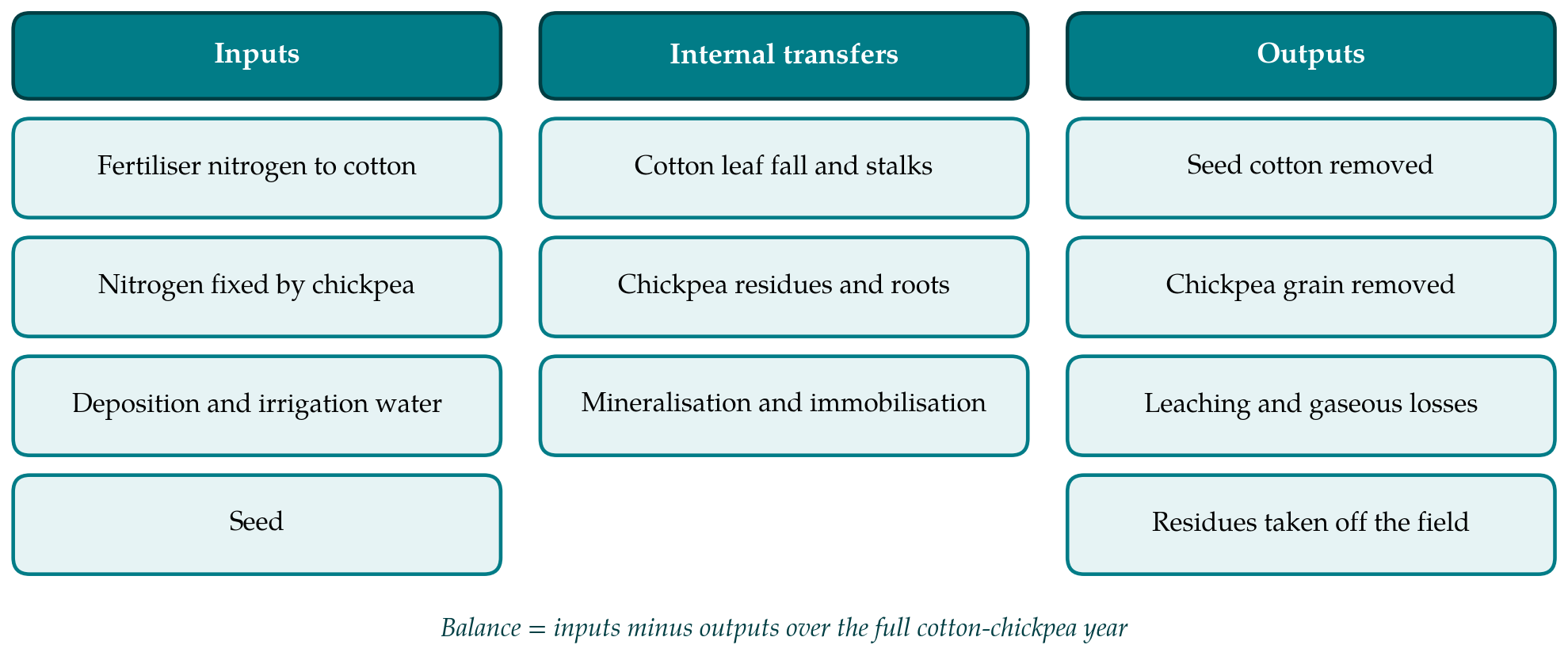
The contribution of the legume alone can be written simply. It is the nitrogen fixed in the whole plant, minus the nitrogen in harvested grain. Nitrogen fixed is the product of legume biomass, its nitrogen concentration and the proportion of that nitrogen derived from the atmosphere, and across many crops and sites the quantity fixed follows legume dry matter closely (Peoples et al., 2009). A relay that produces a thin chickpea stand cannot fix much, whatever the efficiency of its nodules, and one that draws most of its nitrogen from the soil is a net exporter.
5. Nitrogen Fixation by Chickpea Under Relay Conditions
Global syntheses rank chickpea below soybean and faba bean in the quantity of nitrogen it typically fixes, mainly because it is grown in dry environments where biomass is modest (Herridge et al., 2008). Three features of the relay situation deserve separate attention.
5.1. Soil nitrate and the proportion of nitrogen fixed
Nitrate in the root zone suppresses both nodule formation and nodule activity, an effect documented across legume species (Streeter, 1988). Chickpea is no exception. Australian work showed that the proportion of chickpea nitrogen derived from fixation falls steeply as soil nitrate at sowing rises, with prior fallow and applied fertiliser both lowering it (Doughton et al., 1993), and a survey of commercial crops found that many chickpea paddocks on nitrate-rich soils removed more nitrogen than they fixed (Schwenke et al., 1998). The state of the soil when the chickpea is sown is therefore the first thing to establish in a relay.
Two opposing arguments apply. Cotton is fertilised, often generously, and unused fertiliser nitrogen could depress fixation in the pulse. Against this, a deep-rooted cotton crop approaching maturity has usually drawn mineral nitrogen in the profile down to low levels, and intercropping studies show that competition from a non-legume for soil nitrogen pushes the companion legume toward greater reliance on fixation (Jensen, 1996; Hauggaard-Nielsen et al., 2001; Bedoussac et al., 2015). By this reasoning chickpea relayed into cotton might fix a higher proportion of its nitrogen than chickpea sown after a fallow. The inference is reasonable but, for this crop combination, largely untested.
5.2. Shade, sowing time and biomass
A high proportion of fixed nitrogen is of little value if the plant is small. Seedlings under standing cotton receive reduced light until the stalks are cut, and nodules depend on current photosynthate. The relay also changes the sowing date. Its purpose is to sow the pulse on time instead of late, and timely sowing generally lengthens the vegetative period and raises biomass. Whether the gain from an earlier start outweighs the cost of early shading and a drier seedbed depends on cotton row spacing, the degree of defoliation at sowing and the water left in the profile, and it will differ between rainfed and irrigated fields.
5.3. Rhizobia and soil constraints
Chickpea nodulates with a narrow group of Mesorhizobium strains, and where the crop is new to a field, inoculation is commonly needed for effective nodulation (Giller, 2001). Many cotton soils have no history of chickpea. Phosphorus deficiency, salinity and high soil temperature at sowing limit fixation further, and each is plausible in the surface soil beneath late-season cotton. These factors do not change the structure of the balance, but they explain why fixation measured on research stations may overstate what farmers obtain.
6. From Fixed Nitrogen to Net Balance
Grain legumes are bred to move nitrogen into seed. In chickpea a large share of above-ground nitrogen is in the grain at maturity, so the residues left behind are small and low in nitrogen. Reviews of cool-season pulses conclude that the net balance turns positive only when the proportion of nitrogen derived from fixation exceeds the nitrogen harvest index, and that chickpea frequently sits close to the break-even point (Evans et al., 2001; Walley et al., 2007). Table 1 summarises how the conditions specific to the relay are expected to move the balance, and on what kind of evidence each expectation rests.
| Condition | Expected influence | Basis |
|---|---|---|
| Residual fertiliser nitrate at sowing | Lowers the proportion of nitrogen fixed | Streeter, 1988; Doughton et al., 1993 |
| Soil nitrogen depleted by mature cotton | Raises the proportion fixed | Inferred from cereal-legume intercrops (Jensen, 1996) |
| Shade before cotton stalks are cut | Reduces early growth and nodule activity | Physiological reasoning; not measured in this system |
| Timely instead of late sowing | Raises biomass and total fixation | Fixation follows biomass (Peoples et al., 2009) |
| High nitrogen harvest index | Moves balance toward neutral or negative | Evans et al., 2001; Walley et al., 2007 |
| Below-ground nitrogen included | Moves balance toward positive | Unkovich et al., 2008; Fustec et al., 2010 |
| Soil cover after cotton | May reduce off-season nitrogen loss | Reasoned from budget principles (Oenema et al., 2003) |
The treatment of roots matters more than is often recognised. Older budgets counted shoots only. Roots, nodules and the nitrogen released from them during growth can amount to a substantial fraction of the plant total, and budgets that ignore them systematically understate the legume contribution (Fustec et al., 2010). Current guidance is to estimate below-ground nitrogen explicitly or apply a stated correction factor (Unkovich et al., 2008). A chickpea crop that appears to mine the soil on a shoot basis can be neutral or slightly positive once roots are included, so any claim about the relay should state which convention it uses.
7. Carry-Over to the Following Cotton Crop
A positive balance on paper benefits the next crop only if the nitrogen becomes available when cotton needs it. The clearest evidence comes from irrigated cotton in Australia, where cotton following faba bean, vetch and other legumes took up more nitrogen and needed less fertiliser than cotton after cotton or a cereal, and where improvements in soil structure accompanied the nitrogen effect (Rochester et al., 2001). The legumes in that work that were grown for green manure returned far more nitrogen than those harvested for grain. A relayed chickpea harvested for grain belongs to the second group, and its carry-over should be expected to be modest.
Part of the benefit commonly attributed to a preceding pulse is not fixed nitrogen at all. Legumes take up less soil mineral nitrogen than cereals, leaving more behind, and they interrupt disease and weed cycles (Peoples et al., 1995; Peoples et al., 2009). These effects raise the yield of the following crop without improving the balance. Losses should also be counted. Nitrous oxide from legume fields arises mainly from the decomposition of residues and not from fixation itself (Rochette and Janzen, 2005), and legume systems generally compare well with fertilised ones on this score (Jensen et al., 2012), but pulse residues that mineralise before cotton roots are active remain open to leaching with the first monsoon storms.
8. Measuring the Balance in a Relay
The 15N natural abundance method is the practical choice for on-farm work, since it needs no labelled fertiliser. It compares the isotopic signature of the legume with that of a non-fixing reference plant drawing on the same soil nitrogen (Shearer and Kohl, 1986). The relay complicates the choice of reference. Cotton regrowth or winter weeds between the rows are candidates, but they differ from chickpea in rooting depth and timing of uptake, and recent fertiliser can make the soil signature uneven. The measurement manual of Unkovich et al. (2008) discusses these difficulties and recommends sampling several reference species and reporting the range.
Budget terms that cannot be measured are usually filled with default values, and the result inherits their uncertainty (Oenema et al., 2003). For a relay the weakest terms are below-ground nitrogen, gaseous losses and the fate of cotton leaf litter. A balance reported as a single number without a statement of these assumptions invites more confidence than it deserves.
9. Gaps and Priorities
Four measurements are missing. The first is the proportion of nitrogen fixed by chickpea relayed into cotton, set beside chickpea sown after cotton removal and after fallow on the same soil. The second is the mineral nitrogen profile beneath cotton at the time of relay sowing under farmers' fertiliser practice. The third is a whole-year budget, including roots, for cotton with and without the relay. The fourth is the response of the next cotton crop to fertiliser nitrogen after each treatment, which is the test farmers care about. Varietal questions follow from these: short-duration chickpea types that tolerate early shade, and cotton plant types and row arrangements that admit light late in the season.
10. Conclusion
The literature does not support an unqualified statement that relaying chickpea into cotton improves the nitrogen balance of the system, and it does not contradict one either. What it supplies is a clear account of the terms on which the answer depends. A relayed chickpea crop that nodulates well, meets a profile already stripped of nitrate, reaches a good biomass and leaves its roots and residues in the field is likely to be neutral to mildly positive, and to reduce off-season losses from bare soil. A thin, poorly nodulated crop on nitrate-rich soil will export more nitrogen than it brings in. The agronomic case for the relay rests securely on the additional harvest. Its nitrogen benefit should be presented as conditional until the measurements listed above have been made.
Conflict of interest
To be declared by the author(s) before publication.
Funding
To be declared by the author(s) before publication.