1. Introduction
Many varieties of interest are very affine: complements of hyperplane arrangements, moduli spaces of pointed rational curves and of marked del Pezzo surfaces, generic hypersurfaces in tori, and open strata of Grassmannians. For such a variety X in a torus T, Tevelev (2007) showed that a good compactification can be found inside a toric variety, and that the fan of the toric variety must be supported on the tropical variety of X. The resulting tropical compactifications have been used to identify log canonical models of moduli spaces (Hacking et al., 2009) and now form a standard part of the subject (Maclagan and Sturmfels, 2015).
The existence theorem is not constructive in a form that can be typed into a computer. At the same time each ingredient it needs, tropical varieties, fans, initial ideals, saturation and smoothness tests, is implemented in open software. What is missing is an account of how to chain these implementations together, which checks certify the output, and where the theory leaves a gap that computation has to fill. This article proposes such a procedure. It does not report its application to examples, and the procedure has not been validated here. It is offered as a protocol that others can run, criticise and improve.
2. Background
The procedure rests on a small number of theorems and on the documented capabilities of the software. Both are summarised before the steps are described.
2.1. Tropical varieties and compactifications
Let X be a closed subvariety of dimension d of the torus T of dimension n, defined by an ideal I in the Laurent polynomial ring. Its tropical variety Trop(X) is the set of weight vectors w whose initial ideal inw(I) contains no monomial. By the theorem of Bieri and Groves (1984) it is the support of a rational polyhedral fan of pure dimension d. Given a fan Σ in the cocharacter space, let X(Σ) denote the closure of X in the toric variety of Σ. Tevelev proved that X(Σ) is complete if and only if the support of Σ contains Trop(X), and called X(Σ) a tropical compactification when it is complete and the multiplication map from T × X(Σ) to the toric variety is faithfully flat. In that case the support of Σ equals Trop(X), and X(Σ) meets the orbit of each cone σ in a non-empty subvariety of pure dimension d − dim σ.
Two further facts make the definition computable. First, the intersection of X(Σ) with the orbit of σ is the quotient of the initial degeneration, the subvariety of T defined by inw(I) for w in the relative interior of σ, by the subtorus attached to σ (Maclagan and Sturmfels, 2015). Second, X is called schön when the multiplication map is smooth for one, equivalently for every, tropical compactification; this holds exactly when all initial degenerations are smooth, and Luxton and Qu (2011) proved that for a schön variety every fan supported on Trop(X) gives a tropical compactification. If in addition the fan is unimodular, the compactification is smooth with simple normal crossing boundary.
2.2. What the software provides
Gfan computes Gröbner fans and tropical varieties of polynomial ideals with rational coefficients, using the algorithms of Fukuda et al. (2007) and Bogart et al. (2007). For a prime homogeneous ideal it finds a starting cone and traverses the tropical variety through its facets, exploiting symmetry when a group action is supplied. polymake handles polyhedral fans, their refinements and their combinatorics (Gawrilow and Joswig, 2000), and its tropical component includes the intersection-theoretic tools of Hampe (2014). Initial ideals, saturations, primary decompositions and Jacobian ideals are available in Macaulay2 (Eisenbud et al., 2002) and Singular (Greuel and Pfister, 2008), both of which can call Gfan, and in OSCAR, which combines polyhedral and algebraic functionality in one system (Decker et al., 2025).
3. The Proposed Procedure
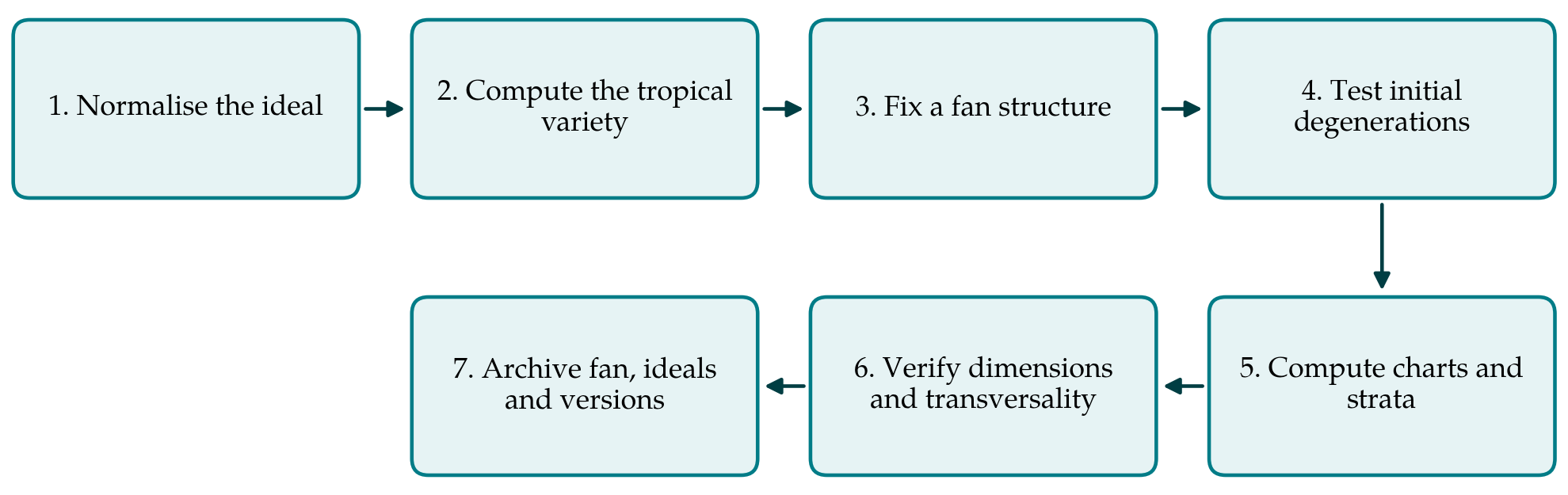
The procedure has seven steps. Table 1 lists them with the tool used and the check to be recorded, and Figure 1 shows their order. When the verification in Step 6 fails, the procedure returns to Step 3 with a finer fan. The description assumes that X is irreducible and defined over the rational numbers.
| Step | Computation | Software | Check recorded |
|---|---|---|---|
| 1. Normalise | Saturate by the product of the variables; test primality | Macaulay2, Singular or OSCAR | Dimension d; ideal is prime |
| 2. Tropicalise | Homogenise; starting cone and traversal | Gfan | Fan is pure of dimension d and balanced |
| 3. Fix a fan | Remove lineality; refine to a simplicial or unimodular fan | polymake | Support unchanged; cones listed up to symmetry |
| 4. Test schön | Initial ideal and Jacobian criterion for one weight per cone | Macaulay2, Singular or OSCAR | Each initial degeneration smooth, or the failing cones |
| 5. Charts and strata | Monomial change of coordinates; saturation | Macaulay2, Singular or OSCAR | Ideal of the closure in each chart |
| 6. Verify | Dimension of each stratum; transversality to the boundary | Any of the above | Strata non-empty of dimension d − dim σ |
| 7. Archive | Export fan, ideals, weights, versions | polymake or OSCAR | Files sufficient to rerun every step |
3.1. Step 1: Normalise the input
The input is a finite set of Laurent polynomials. Denominators are cleared and the resulting polynomial ideal is saturated with respect to the product of the variables, so that it defines the closure of X in affine space and has no component in the coordinate hyperplanes. Primality should be tested, because the traversal in the next step relies on the connectedness in codimension one of the tropical variety of an irreducible variety; a reducible input is decomposed and each component treated separately. The dimension d is recorded. If a torus acts on X by translation, the corresponding sublattice will appear later as the lineality space, and it is useful to know it in advance.
3.2. Step 2: Compute the tropical variety
Gfan works with homogeneous ideals, so the ideal is homogenised with one new variable and saturated again; the tropical variety of X is recovered by intersecting with the hyperplane where the new coordinate vanishes, or equivalently by passing to the quotient by the all-ones vector. The output is a list of rays, a lineality space, the maximal cones and their multiplicities. Three checks cost almost nothing and catch most errors of input: every maximal cone has dimension d plus that of the lineality space, the weighted fan satisfies the balancing condition at each codimension-one cone, and the number of orbits of cones agrees with the symmetry group that was declared.
3.3. Step 3: Fix a fan structure
The fan returned by Gfan is the restriction of the Gröbner fan, on whose cones the initial ideal is constant. A tropical variety has no canonical coarsest fan structure in general, and the Gröbner structure may be finer or coarser than is convenient. After the quotient by the lineality space the fan is passed to polymake. If a smooth compactification is wanted, the fan is refined by stellar subdivisions until every cone is generated by part of a lattice basis (Cox et al., 2011); if only the boundary combinatorics matter, a simplicial refinement is enough. Any refinement of a fan that gives a tropical compactification again gives one, so refining is always safe, whereas coarsening has to be justified by the later steps.
3.4. Step 4: Test the schön condition
For each cone of the Gröbner structure, or one representative per symmetry orbit, a weight vector in the relative interior is chosen and the initial ideal is computed. The initial degeneration is the subscheme of the torus that it defines, so smoothness is tested by the Jacobian criterion after saturating the ideal of minors by the product of the variables. Since the initial degeneration is invariant under the subtorus of the cone, the test can be run on a slice, which lowers the number of variables. If every test succeeds, X is schön and the theorem of Luxton and Qu applies to whatever fan was fixed in Step 3. If some fail, the failing cones are recorded; the variety may still have tropical compactifications, but they must be certified differently.
3.5. Step 5: Compute charts and boundary strata
Let σ be a unimodular cone of dimension k with primitive generators extended to a basis of the cocharacter lattice. The basis defines a monomial change of coordinates under which the affine toric chart of σ becomes the product of affine k-space and a torus of dimension n − k. Substituting into the generators of I and saturating with respect to the first k coordinates gives the ideal of X(Σ) in that chart. Setting a subset of those coordinates to zero gives the strata lying over the faces of σ, and these can be compared with the initial ideals of Step 4 as a consistency check. Only maximal cones need to be processed, one per orbit.
3.6. Step 6: Verify dimension and transversality
In the schön case this step confirms what the theory predicts: each stratum is non-empty and smooth of dimension d − dim σ, and in a unimodular chart the closure is smooth and meets the coordinate hyperplanes transversally. In the general case the same computations serve as necessary conditions for flatness of the multiplication map. A stratum that is empty or of excessive dimension shows that the fan is not tropical for X along that cone, and the procedure returns to Step 3 to subdivide it. Passing these checks does not by itself prove flatness, and for varieties that are not schön the output should be reported as a candidate tropical compactification unless flatness is established by a separate argument.
3.7. Step 7: Archive
The fan with its multiplicities, the weight vectors used, the initial ideals, the chart ideals and the exact software versions are written to files in the native formats of polymake or OSCAR. Because the computations are exact and deterministic once the term orders and weight vectors are fixed, a reader with these files can repeat every step. Intersection numbers on the compactification, when needed, can be computed from the fan through the Minkowski weights of Fulton and Sturmfels (1997).
4. Benchmark Families for Validation
A procedure of this kind should be tested first where the answer is known. The complement of a hyperplane arrangement is schön, its tropical variety is the Bergman fan of the associated matroid (Ardila and Klivans, 2006), and for the nested set fan structures of Feichtner and Sturmfels (2005) the tropical compactification is a wonderful model of De Concini and Procesi (1995). Every output of Steps 2 to 6 can therefore be compared with a combinatorial prediction.
The moduli space of n-pointed rational curves is a second benchmark. It is the quotient of an open stratum of the Grassmannian of planes by a torus, its tropical variety is the space of phylogenetic trees described by Speyer and Sturmfels (2004), and with that fan structure the tropical compactification is the moduli space of stable pointed rational curves (Tevelev, 2007). For five points the fan is the cone over the Petersen graph, small enough to check by hand. Generic hypersurfaces with a prescribed Newton polytope, which are schön and whose tropical variety is the codimension-one skeleton of the normal fan, and the moduli of marked del Pezzo surfaces treated by Hacking et al. (2009) supply further cases of graded difficulty.
5. Limitations and What Remains to Be Shown
The procedure is a proposal and has not been run on these benchmarks here. Its feasibility is bounded by the cost of Gröbner bases: the traversal in Step 2 computes many of them, and the number of variables and the absence of symmetry are the obstacles to be expected. Whether Steps 4 and 5, which repeat saturations over many cones, stay practical for varieties of dimension four or five is something only systematic trials can establish.
Three limits are structural. The output depends on the embedding in the torus, and for a compactification intrinsic to X the intrinsic torus, whose characters are the units of the coordinate ring modulo constants, would have to be computed first. The procedure treats constant coefficients only; ideals over a field with a non-trivial valuation lead to polyhedral complexes and to toric degenerations in place of fans and toric varieties. Finally, outside the schön case the procedure yields evidence and not a certificate. An effective test for flatness of the multiplication map, in a form that current systems can execute, is the main missing component.
6. Conclusion
Tropical compactifications can in principle be computed from start to finish with open software, by passing an ideal through Gfan, a fan through polymake and a family of initial and chart ideals through a general computer algebra system. The seven steps proposed here arrange those computations so that each one is tied to a theorem and leaves a check on file. For schön varieties the checks amount to a proof that the output is a tropical compactification; in general they narrow the search. The benchmarks named above are the place to find out how far the procedure reaches in practice.
Conflict of interest
To be declared by the author(s) before publication.
Funding
To be declared by the author(s) before publication.