1. Introduction
Bacterial antimicrobial resistance is now counted among the leading causes of death worldwide, and the highest estimated death rates fall in sub-Saharan Africa and South Asia (Antimicrobial Resistance Collaborators, 2022). Those estimates are built on sparse data. The Global Action Plan on Antimicrobial Resistance made surveillance one of its five objectives (WHO, 2015), and the Global Antimicrobial Resistance Surveillance System that followed asks countries to report susceptibility results for priority pathogens from routine clinical specimens. Such reporting presupposes that patients are cultured, that laboratories perform quality-assured susceptibility testing, and that results are linked to basic patient information. In many low-income cities few of these conditions hold, and the isolates that are tested come largely from tertiary hospitals and from patients in whom first-line treatment has already failed.
Sewage has been proposed as a way around this bottleneck. It mixes the faecal bacteria of a whole catchment, sick and healthy alike, and can be sampled without consent procedures or clinical infrastructure (Aarestrup and Woolhouse, 2020). Interest grew sharply once wastewater monitoring of SARS-CoV-2 demonstrated that viral signals in sewage tracked reported infection (Medema et al., 2020) and many countries built sampling networks that could, in principle, be turned to other targets.
This article reviews what is known about applying the approach to antimicrobial resistance genes in cities with limited resources. Its particular concern is the distance between the sewered European and North American settings in which most methods were developed and the fragmented sanitation of the cities where the surveillance gap is widest.
2. Scope and Approach
The review is narrative. It draws on published studies of resistance genes and resistant bacteria in urban wastewater, on methodological papers concerning sampling and molecular quantification, on conceptual frameworks for environmental surveillance, and on guidance from the World Health Organization. Sources were selected for their relevance to the questions a public health agency would face in setting up a programme, not through a registered search strategy, and no quantitative synthesis is attempted. Work on the removal of resistance genes by treatment processes, and on the risk that environmental exposure poses to human health, is mentioned only where it affects the interpretation of surveillance data.
3. Why Sewage Carries a Surveillance Signal
The idea rests on three observations. The first is that the bacterial community of raw sewage reflects the gut microbiota of the contributing population closely enough for differences between cities to be detected (Newton et al., 2015). The second is that resistance genes are abundant and measurable in wastewater, a finding established by early quantitative PCR surveys (Pruden et al., 2006) and by a large subsequent literature on treatment plants as meeting points for resistant bacteria, antibiotic residues and mobile genetic elements (Rizzo et al., 2013).
The third observation is that the resistance profile of sewage corresponds to clinical patterns. A survey of treatment plants in seven European countries found that the abundance of resistance genes in influent followed the same north-to-south gradient as resistance in clinical isolates (Pärnänen et al., 2019). A global metagenomic study of untreated sewage from cities in sixty countries reported that samples from Africa, Asia and South America carried a higher abundance of resistance genes than those from Europe, North America and Oceania, and that the differences were better explained by sanitation and general health indicators than by antimicrobial consumption (Hendriksen et al., 2019). The latter result agrees with ecological analyses in which infrastructure and governance predicted national resistance levels more strongly than drug use did (Collignon et al., 2018).
4. Sampling Where Sewers Are Incomplete
A treatment plant inlet is a convenient sampling point because it has a known catchment and a flow meter. Many low-income cities offer no such point for most residents. A comparative analysis of faecal sludge management in twelve cities showed that the majority of excreta in several of them was held in on-site systems and that a large share was never safely collected or treated (Peal et al., 2014). Sampling the sewer in such a city describes the minority with connections, who tend to be wealthier and to have better access to both health care and antibiotics. Figure 1 places site selection at the head of the surveillance sequence for this reason: a programme that begins with the laboratory method and leaves the catchment undefined cannot say whose resistome it has measured.
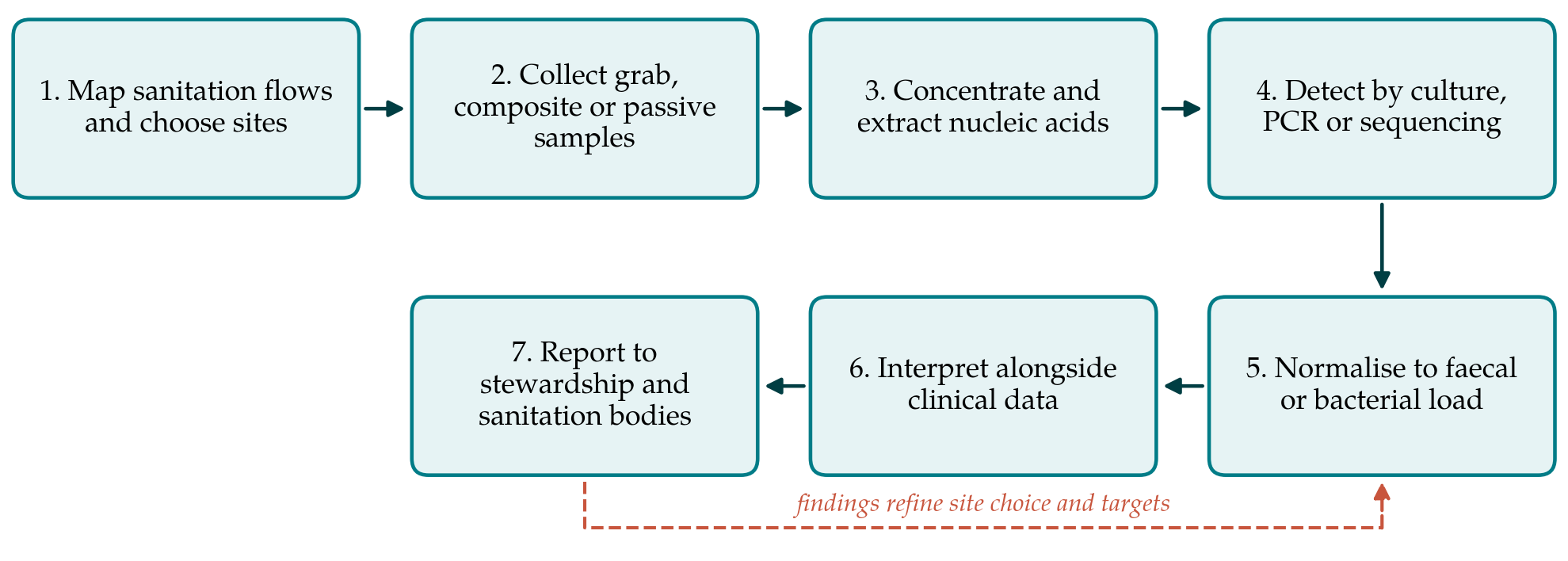
The alternatives are open drains, canals and rivers that receive overflow and illegal discharges, communal toilet blocks, and the tankers or transfer stations that handle faecal sludge. Each has drawbacks. Surface channels are diluted by rain and mixed with animal and industrial waste. Sludge from pits and septic tanks has been stored for months or years, during which bacterial communities change, so it gives a blurred and delayed picture. Informal settlements, where human and animal waste, drinking water and food share the same small space, are precisely the places in which resistance is thought to circulate most intensively (Nadimpalli et al., 2020), and metagenomic work in low-income communities in Latin America has traced resistance genes across human, animal and environmental samples along gradients of sanitation (Pehrsson et al., 2016).
How the sample is taken also matters. Flow-proportional composite samplers are standard in high-income programmes but are expensive, need power and are vulnerable to theft. Grab samples are cheap and capture one moment of a signal that varies through the day. Passive samplers left in the flow offer a middle course. The Moore swab, a gauze pad suspended in sewage for several days, has a long history in typhoid and poliovirus surveillance and has been revived as a low-cost tool (Sikorski and Levine, 2020). Its use for quantitative resistance gene monitoring is less well characterised, since the volume of water that passes through the pad is unknown.
5. Analytical Routes
Three families of methods are in use, and they answer different questions. Table 1 compares them from the standpoint of a laboratory with limited equipment and budget.
| Approach | What it measures | Strengths | Limits in low-resource settings |
|---|---|---|---|
| Culture of indicator bacteria | Proportion of E. coli producing ESBL | Cheap, standardised, yields isolates (WHO, 2021) | One organism and one phenotype; several days to result |
| Quantitative PCR | Copies of chosen genes per volume | Sensitive, fast, quantitative (Bustin et al., 2009) | Targets fixed in advance; inhibition; reagent cold chain |
| High-throughput qPCR arrays | Hundreds of genes in parallel | Broad profile without sequencing | Specialised platform; relative data only |
| Shotgun metagenomics | All genes above a detection depth | Open-ended, comparable across sites (Hendriksen et al., 2019) | Cost, bioinformatics, low sensitivity for rare genes |
| Sequencing of isolates | Genome of cultured resistant strains | Links gene, host and plasmid | Sees only what grows on the chosen medium |
5.1. Culture-based indicators
The simplest approach counts an indicator organism on media with and without an antibiotic. The World Health Organization's Tricycle protocol standardises this for Escherichia coli producing extended-spectrum beta-lactamases, measured in humans, the food chain and the environment so that the three can be compared (WHO, 2021). Culture needs an incubator, selective agar and trained hands, all of which exist in most public health laboratories. Its narrowness is the price: it reports on one phenotype in one species and says nothing about the genes involved unless isolates are characterised further.
5.2. Targeted molecular detection
Quantitative PCR measures the number of copies of a chosen gene in extracted DNA. It is sensitive enough to follow rare genes of clinical concern, such as those encoding carbapenemases, and returns a result within a day. The method is exacting. Wastewater contains humic substances and metals that inhibit amplification, extraction efficiency varies between samples, and standard curves drift. The MIQE guidelines set out the minimum information needed to judge a quantitative PCR result (Bustin et al., 2009), and an adaptation for environmental microbiology adds requirements for process controls, inhibition testing and reporting of detection limits (Borchardt et al., 2021). Programmes that cannot meet these requirements produce numbers that look precise and cannot be compared over time.
Choice of target is a further difficulty. Some authors recommend a small panel that includes the class 1 integron-integrase gene intI1, which is linked to genes for resistance to antibiotics, disinfectants and heavy metals and has been proposed as a general marker of anthropogenic pollution (Gillings et al., 2015). A marker of that kind is useful for ranking sites by overall contamination. It is less informative about the specific resistance mechanisms that matter for treatment guidelines.
5.3. Metagenomic sequencing
Shotgun metagenomics sequences all DNA in a sample and identifies resistance genes by comparison with curated databases such as ResFinder (Zankari et al., 2012) and the Comprehensive Antibiotic Resistance Database (Alcock et al., 2020). No targets need be chosen in advance, and stored sequence data can be searched again when a new gene is described. An extension of the global sewage project to samples from more than one hundred countries used this property to describe regional resistomes and the genetic contexts in which resistance genes travel (Munk et al., 2022). The disadvantages are cost per sample, the need for bioinformatic skill and computing, and a detection limit that is poor for rare genes unless sequencing is deep. A gene's presence in a metagenome also does not reveal which bacterium carries it or whether it is expressed.
6. Normalising and Interpreting Gene Data
Raw gene concentrations rise and fall with the amount of faecal matter in a sample, so some form of normalisation is unavoidable. Common denominators are the 16S rRNA gene, as a measure of total bacteria, and markers of human faecal input. The choice changes the conclusions. Karkman et al. (2019) showed that across many impacted environments the abundance of resistance genes could largely be explained by the level of faecal pollution, without any need to invoke selection by antibiotic residues on site. A drain with more resistance genes may therefore simply be a drain with more faeces, and a programme must decide whether it wishes to measure contamination or the resistance carried per unit of gut bacteria.
Interpretation raises the question of purpose. Huijbers et al. (2019) distinguish several objectives for environmental surveillance, among them tracking resistance in the human population, assessing the risk of transmission from the environment and detecting the emergence of new resistance determinants, and they point out that each calls for different sites, targets and denominators. Wastewater data serve the first objective reasonably well at the level of trends and comparisons. They cannot at present be converted into the number of resistant infections in a catchment, because the relation between carriage in the gut, shedding, survival in the sewer and clinical disease is not known for most organisms (Larsson and Flach, 2022).
Environmental signals also need separating from human ones. Pharmaceutical manufacturing effluent, hospital discharges, abattoir waste and livestock kept within the city all contribute resistance genes that do not reflect community carriage, and antibiotic residues, metals and biocides may select for resistance in the drain itself (Berendonk et al., 2015). Recording these inputs during site mapping is as much a part of the method as the laboratory assay.
7. Institutional and Ethical Conditions
Wastewater surveillance is often described as free of ethical difficulty because no individual is identified. At the scale of a city that is broadly true. At the scale of a single informal settlement, prison or institution, a finding of high resistance can stigmatise a known group of people who were not asked and who may gain nothing from the result. Programmes should set a minimum catchment size for reporting and agree in advance with municipal and community representatives how results will be released.
A second condition is a recipient for the data. Sewage results are of little value unless an antimicrobial stewardship committee, a national coordinating body or a sanitation authority is prepared to act on them. Because consumption of antibiotics has been rising in many low- and middle-income countries, the temptation is to read every upward trend as evidence of overuse, whereas the global sewage data point at least as strongly to sanitation. Results should accordingly go to those responsible for drains and sludge as well as to those responsible for prescribing.
8. Gaps and Future Work
Several questions remain open. Sampling methods for non-sewered catchments have not been compared systematically, and it is unclear which of drains, communal toilets or sludge gives the most representative and stable signal. Few studies have paired wastewater results with clinical isolates from the same population over time, so the lead, lag and strength of any relation are unknown outside Europe. The day-to-day and seasonal variability of gene abundance in tropical open drains has scarcely been described, which makes it difficult to say how often samples must be taken. Agreement on a short core panel of targets and a common normalisation would allow results from different cities to be compared. Cost data from low-income laboratories are also scarce, and without them ministries cannot weigh wastewater monitoring against investment in clinical bacteriology, which it complements and does not replace.
9. Conclusion
Sewage carries a real and interpretable signal of antimicrobial resistance in the population that produces it. Studies in sewered cities have shown that the signal parallels clinical resistance and distinguishes regions of the world. Extending the approach to low-resource cities is justified by the weakness of clinical surveillance there, but it requires prior attention to where the excreta of different groups actually go, modest and well-controlled laboratory methods, and restraint in interpretation. A programme that starts with culture of an indicator organism at a few carefully described sites, adds targeted molecular assays under documented quality control, and reserves metagenomics for periodic reference surveys would match the evidence as it now stands.
Conflict of interest
To be declared by the author(s) before publication.
Funding
To be declared by the author(s) before publication.