1. Introduction
Milk is an emulsion of fat globules and a colloidal suspension of protein particles in a solution of lactose, salts and soluble proteins. Roughly four fifths of its protein is casein, organised in micelles, and the remainder is whey protein, chiefly β-lactoglobulin and α-lactalbumin (Fox et al., 2015). The proposition behind precision fermentation is that these proteins can be made without the cow, by inserting the bovine genes into a microorganism, growing it in a fermenter and recovering the secreted protein for use as a food ingredient (Teng et al., 2021).
The motives are environmental and commercial. Dairy production carries substantial greenhouse gas emissions and land use per unit of protein (Poore and Nemecek, 2018), and advocates argue that microbial production could supply the same molecules at a fraction of the burden (Rischer et al., 2020). Products containing recombinant whey protein have reached the market in some countries. The claim that such proteins will soon displace milk is another matter, and it rests on a chain of technical assumptions that deserve to be examined one at a time.
This review does that. It follows a dairy protein from the choice of host organism to the retail product and asks, at each stage, what the published literature identifies as difficult.
2. Scope and Approach
The article is a narrative review. It draws on reviews and analyses of precision fermentation and cellular agriculture, on the dairy chemistry literature that defines what the target proteins must do, on the recombinant expression literature for yeasts and filamentous fungi, and on published life-cycle and techno-economic work. No systematic search was carried out. Commercial developments are mentioned only in general terms, because the performance data that would allow them to be assessed are mostly unpublished. Cultured mammary cells, which aim to produce whole milk, and biomass fermentation, which produces microbial protein, are different technologies and are not covered.
3. The Precedent of Chymosin
Recombinant dairy ingredients are not new. Chymosin, the enzyme in calf rennet that clots milk by cleaving κ-casein, was the first product of recombinant DNA technology to be cleared for food use in the United States, in 1990 (Flamm, 1991). Fermentation-produced chymosin made in bacterial, yeast and fungal hosts went on to supply much of the cheese industry. The precedent shows that a mammalian protein from a microbial host can be accepted by regulators, manufacturers and consumers.
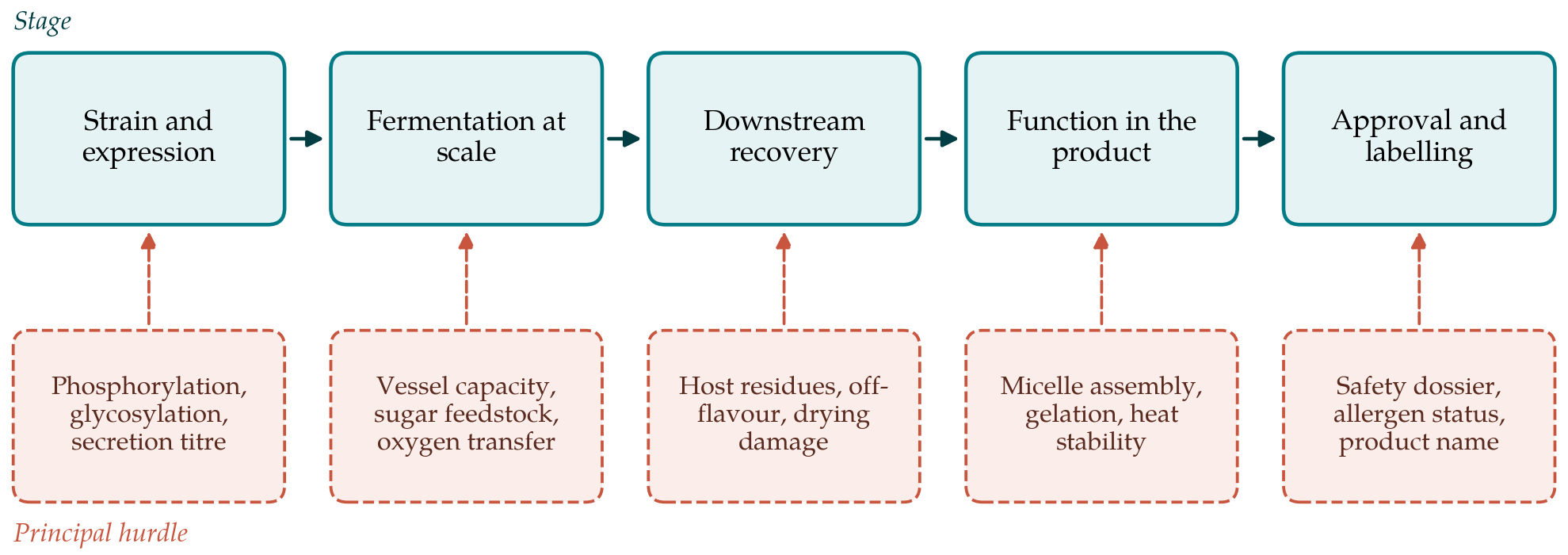
It also shows where the analogy stops. Chymosin is a processing aid added to milk in minute quantities, so its cost per kilogram is of little consequence and its purity requirement concerns activity, not flavour or texture. A structural protein is the food. It must be made by the tonne at a price comparable with that of a commodity, it must taste of nothing objectionable, and it must behave like its bovine counterpart in a gel, a foam or a curd (Hettinga and Bijl, 2022). Figure 1 sets out the stages between fermenter and shelf and the principal hurdle at each, which the following sections take in turn.
4. Making the Right Molecule
The first question is whether a microbial cell can make a protein that is chemically the same as the one in milk. The answer differs sharply between the whey proteins and the caseins, and the two groups are considered separately below.
4.1. Whey proteins
β-Lactoglobulin is a small globular protein of the lipocalin family with a well-characterised fold and no phosphorylation or glycosylation. It was secreted at high level by the methylotrophic yeast then known as Pichia pastoris as early as the 1990s, and the recombinant protein closely resembled the native one in its physical properties (Kim et al., 1997). That yeast, now classified as Komagataella phaffii, and filamentous fungi such as Trichoderma reesei and Aspergillus species are the usual production hosts, chosen because they secrete protein efficiently into the medium and have a long record of industrial use (Cereghino and Cregg, 2000; Nevalainen et al., 2005). For whey proteins the molecular problem is largely solved, and it is no accident that the first commercial products were built on them.
4.2. Caseins and their modifications
Caseins are harder. They have little fixed tertiary structure, which makes them prone to degradation by host proteases, and their function depends on modifications added after translation. The αs- and β-caseins carry clusters of phosphoserine residues that bind calcium phosphate, and κ-casein carries short glycan chains on the portion that projects from the micelle surface (Holt et al., 2013). In the mammary gland the phosphate groups are added in the Golgi apparatus by a dedicated secretory-pathway kinase, identified as Fam20C (Tagliabracci et al., 2012). Microbial hosts lack an equivalent that reproduces the bovine pattern, so a casein secreted by an unmodified yeast or fungus is unphosphorylated or wrongly phosphorylated, and yeasts may add their own mannose-rich glycans at sites the cow leaves bare.
Possible remedies are discussed in the literature: co-expressing a suitable kinase, phosphorylating the purified protein enzymatically or chemically, or accepting an unphosphorylated casein and compensating in the formulation (Hettinga and Bijl, 2022; Augustin et al., 2024). Each adds cost or changes the molecule, and published evidence that any of them yields casein equivalent to the bovine protein in a cheese vat is limited. Table 1 summarises the main target proteins, the features on which their function depends and the difficulty each presents to a microbial host.
| Protein | Features that matter | Main difficulty in a microbial host | Role in products |
|---|---|---|---|
| β-Lactoglobulin | Compact globular fold; disulfide bonds; no phosphate or glycan | Few; titre and cost dominate | Gelling, foaming, emulsifying |
| α-Lactalbumin | Small calcium-binding protein with several disulfide bonds | Correct folding and disulfide pairing | Infant formula, nutrition |
| α - and s1 α -casein s2 | Heavily phosphorylated; open, flexible structure | Phosphorylation pattern; proteolysis | Calcium binding, curd structure |
| β-Casein | Phosphorylated; strongly amphiphilic | Phosphorylation; proteolysis | Micelle formation, emulsification |
| κ-Casein | Glycosylated; stabilises the micelle surface | Bovine-type glycosylation absent | Micelle stability, rennet clotting |
| Lactoferrin | Large iron-binding glycoprotein | Size, glycosylation, yield | Bioactive ingredient |
5. Fermentation at Commodity Scale
A protein that can be made is not yet a protein that can be afforded. Food proteins sell at prices far below those of the enzymes and pharmaceuticals for which recombinant fermentation was developed, and the process must therefore achieve high titres, high productivity and high yield on sugar in very large vessels. Vestergaard et al. (2016), in an early feasibility analysis of microbial production of milk protein, framed the question in exactly these terms: what yields and productivities a microbial process would need in order to compete with the cow.
Aerobic fermentation at that scale is constrained by physics as much as by biology. Oxygen must be dissolved into a dense culture and metabolic heat removed, and both become more difficult and more energy-intensive as vessels grow. The techno-economic analysis of Humbird (2021) addressed animal cell culture, a more demanding case, but its account of how capital cost, sterility requirements and mass-transfer limits accumulate with scale applies in spirit to any aseptic bioprocess aimed at a commodity. Microbial hosts are far more forgiving than animal cells, yet the installed fermentation capacity suitable for food-grade recombinant production is limited, and new capacity is expensive to build (Augustin et al., 2024). Feedstock is a further consideration, since the process converts refined sugar into protein with unavoidable losses to biomass and carbon dioxide.
6. Recovery and Purification
What leaves the fermenter is a dilute protein solution containing cells, residual nutrients, host proteins, polysaccharides, pigments and metabolites. Recovery typically involves removing the biomass by centrifugation or filtration, concentrating and washing the protein by ultrafiltration and diafiltration, further purification where needed, and spray drying. The target specification is unusual. Pharmaceutical processes pursue very high purity at almost any cost, and industrial enzymes tolerate crude preparations. A food protein needs to be free of viable production organisms and of objectionable flavours and colours, at a recovery cost of a small fraction of the selling price (Chai et al., 2022).
Flavour is the under-reported problem. Yeasts and fungi produce volatile compounds, and proteins bind them. Removing them without denaturing the protein or losing yield is a matter of process know-how that seldom reaches the open literature. Drying brings its own risk, because heat denaturation and aggregation change solubility and gelling behaviour, as they do in conventional whey protein manufacture.
7. Rebuilding Dairy Functionality
A purified protein is an ingredient. Turning it into something a shopper recognises as milk, yoghurt or cheese is a separate task. Whey proteins set heat-induced gels, stabilise foams and emulsions, and can be formulated into frozen desserts, beverages and spreads with plant fats and added sugars and minerals. This is conventional product development, and it is where recombinant β-lactoglobulin has found its first uses.
Cheese is different because it depends on the casein micelle. The micelle is a hydrated association colloid in which thousands of casein molecules are held together by calcium phosphate nanoclusters and hydrophobic interactions, with κ-casein forming a stabilising surface layer; rennet coagulation follows when chymosin removes that layer (Dalgleish and Corredig, 2012; Holt et al., 2013). Even for bovine caseins, the structure has been debated for decades (Horne, 2006). To make cheese from recombinant caseins, the proteins must be produced in the right proportions and with adequate phosphorylation, then induced to assemble with calcium and phosphate into particles that clot, drain, melt and stretch as natural micelles do. Published demonstrations of this at more than laboratory scale are few. Milk fat, with its distinctive fatty acid profile and globule membrane, and lactose are not supplied by the process at all.
8. Regulation, Allergens and Naming
A recombinant milk protein reaches the market only after a safety assessment. In the United States the usual route for ingredients from well-characterised production strains has been the Generally Recognized as Safe procedure, long used for microbial enzymes (Sewalt et al., 2016). In the European Union a food with no significant history of consumption before 15 May 1997 falls under the novel food regulation and requires authorisation (European Union, 2015), and the use of a genetically modified production organism brings further scrutiny. Timelines are long and differ between jurisdictions.
Two labelling matters follow from the fact that the proteins are meant to be identical to those of milk. They are milk allergens, with caseins and β-lactoglobulin among the major ones (Wal, 2002), so a product described as animal-free is nonetheless unsafe for people with cow's milk allergy and must say so. And in the European Union the terms milk, cheese and yoghurt are reserved by law for products of mammary secretion (European Union, 2013), which leaves the naming of such foods unsettled.
9. Environmental Claims and Consumer Response
Life-cycle assessments of recombinant food proteins point in a consistent direction with wide margins. Behm et al. (2022), modelling β-lactoglobulin produced by T. reesei, and Järviö et al. (2021), modelling fungal ovalbumin, both found potential reductions in greenhouse gas emissions and land use relative to the animal product, and both found the result sensitive to the electricity supply and the sugar source. These are prospective models of processes not yet operating at scale, and should be read as such.
Consumer studies report considerable stated willingness to try animal-free dairy products (Zollman Thomas and Bryant, 2021), though stated intention is a weak guide to repeat purchase at a premium price. Social scientists have also drawn attention to what the technology might mean for dairy farmers and rural economies, and to the uncertainty about who will own the production capacity (Mendly-Zambo et al., 2021).
10. Gaps and Research Priorities
The most obvious gap is public data. Titres, yields, recovery losses and costs are commercial secrets, so the academic literature reasons from first principles and from analogies. Independent work on casein expression with controlled phosphorylation, and on the assembly of recombinant caseins into functional micelles, would address the central scientific uncertainty. Studies of flavour carry-over and its removal would address a practical one. Life-cycle and cost models need to be checked against operating plants as these come on stream. And the nutritional equivalence of products built from one or two recombinant proteins plus plant fats, as against the whole food they imitate, deserves more attention than it has received.
A further question concerns partial solutions. The first casein-containing products may well combine a recombinant protein with plant proteins, plant fats and conventional stabilisers, without attempting to reproduce milk in full. Such products would sidestep the micelle problem at the price of becoming a new category of food, whose digestibility, nutritional quality and processing behaviour have to be established on their own terms. Work on mixed systems of recombinant caseins and plant proteins, and on the minimum degree of phosphorylation needed for useful calcium binding, would show how far such compromises can go. The same applies to shelf life: whether products built on recombinant proteins keep as well as their dairy counterparts under chilled distribution has scarcely been examined in public.
11. Conclusion
Between the bioreactor and the supermarket shelf lie five kinds of hurdle: making the correct molecule, making it cheaply at scale, recovering it clean, rebuilding a food around it, and gaining permission to sell and name it. For whey proteins the first is essentially cleared and the others are being worked through, which is why whey-based products came first. For caseins, and hence for cheese, the molecular and colloidal problems remain open. Precision fermentation is best regarded for now as a source of specific functional ingredients. Whether it becomes a substitute for milk depends on advances that the published literature does not yet show.
Conflict of interest
To be declared by the author(s) before publication.
Funding
To be declared by the author(s) before publication.