1. Introduction
A tomato grower with a quarter of a hectare harvests every few days for several weeks and must sell each picking almost at once. The buyer is usually a village trader or a commission agent in the nearest wholesale market, who handles the produce of hundreds of such growers, knows the day's prices in more than one town and can decline a lot without much loss. The grower cannot. Fresh produce deteriorates quickly after harvest, and physical losses between farm and consumer are large wherever cooling and careful handling are absent (Kader, 2005). The imbalance between the two sides of this transaction is the starting point for most arguments in favour of organising farmers.
Farmer producer organisations, a term that covers cooperatives, associations and producer companies, are expected to redress the imbalance by pooling the output of many small sellers. Governments and donors have invested heavily in forming them. India amended its company law in 2002 to create the producer company as a legal form, issued national guidelines for promoting farmer producer organisations (SFAC, 2013) and later adopted a central scheme to form and support ten thousand of them. Comparable programmes exist across eastern and southern Africa and Latin America.
The premise that collective selling confers bargaining power is intuitive, but it is a claim about market structure that needs examining, and perishable vegetables are a hard case for it. This review considers what theory predicts and what the published evidence shows.
2. Approach and Scope
The article is a narrative review of the published literature. It combines three bodies of work: the economic theory of bargaining, transaction costs and cooperatives; empirical studies of collective marketing by smallholders in low- and middle-income countries, with preference for those dealing with fruit and vegetables; and writing on producer companies in India. Studies of staples and export crops are used where they establish a mechanism that carries over. The selection is not exhaustive and no formal search protocol was followed. Bargaining power is used here in a specific sense: the capacity of the seller to obtain a larger share of the surplus from a transaction, as distinct from gains that arise because the transaction itself has become cheaper or the product better.
3. Why Perishability Weakens the Seller
In the bargaining model of Nash (1950), the division of the gains from a trade depends on what each party would get if no agreement were reached. For a grower holding ripe vegetables, the alternative to selling today is a product worth less tomorrow and perhaps nothing the day after. The trader's alternative is to buy from the next grower. Perishability thus lowers the seller's fallback position directly, and it does so most at the moment of sale, after the costs of production and often of transport to market have already been sunk.
Transaction cost economics describes the same situation as a hold-up problem. Once produce has been harvested and carried to a particular market, it is committed to that place and time, and the buyer can revise the terms knowing that the seller has little choice (Williamson, 1985). Studies of wholesale markets confirm that the institutional setting compounds the problem. In Indian fruit and vegetable markets, commission agents commonly advance credit to growers and receive their produce in return, which ties the sale to the loan (Minten et al., 2012). Where farmers are far from any alternative market, traders face little competition, and the prices farmers receive rise with the number of markets within reach (Chatterjee, 2023).
Information alone does not correct the imbalance. In an experiment with potato farmers in West Bengal, giving growers daily wholesale prices did not raise the average price they received from traders, a result the authors interpreted as bargaining after harvest in which farmers lacked a credible outside option (Mitra et al., 2018). Growers with small quantities are also the least able to carry a load to a second market, since the cost of the journey is fixed and the lot is small.
4. What Theory Expects of Collective Selling
Three theoretical traditions bear on whether a producer organisation can change this picture, and they do not all point in the same direction.
4.1. Countervailing power and the competitive yardstick
The oldest argument is that a cooperative offsets buyer power by presenting a single large seller, or by entering the buyer's own business. Sexton (1990) formalised the second route for spatially separated markets: a cooperative that handles members' produce at cost forces rival buyers in its area to pay more, so that non-members benefit as well. The yardstick effect requires the cooperative actually to perform the trading or processing function. An organisation that only assembles produce and then sells to the same traders changes the size of the lot but not the number of buyers competing for it.
4.2. Transaction costs
A second line of reasoning holds that the main disadvantage of small farms lies in the cost of transacting, not in production. Small farms supervise labour well but pay more per unit to obtain inputs, credit and information and to find and satisfy buyers (Poulton et al., 2010). Collective organisation spreads these fixed costs over more output. Barrett (2008) makes a related point for market participation in general: households with few assets and high costs of reaching markets sell little, and price incentives do not help those who cannot respond to them. On this view the value of a producer organisation lies in making transactions possible, which is not the same as winning a larger share.
4.3. The costs of acting together
Collective action has costs of its own. Olson (1965) argued that members of a large group have an incentive to enjoy its benefits without contributing, and Ostrom (1990) showed that groups overcome this where they can monitor one another and enforce their own rules. Cook (1995) identified the weaknesses specific to cooperatives: free riding, short investment horizons, and the costs of control and of internal lobbying. For vegetables the practical form of free riding is side-selling. A member who is offered a slightly better price at the farm gate on a given day has every reason to accept, and each such sale reduces the volume on which the group's commitments to buyers depend.
5. What the Empirical Literature Shows
Reviews of smallholder collective action reach a measured conclusion. Introducing a set of studies on the subject, Markelova et al. (2009) found that farmer groups improved market access under identifiable conditions relating to the group, the product and the market, and that the case was stronger for high-value and perishable products than for staples, since the transaction costs to be saved are larger. Shiferaw et al. (2011) reached a similar view for sub-Saharan Africa while stressing that many organisations lack the management capacity and capital to perform marketing functions well.
5.1. Prices, incomes and services
Studies that measure outcomes for members often find income gains, but the source of the gain is seldom a higher price obtained by negotiation. Among banana growers in Kenya, group membership raised income, and the effect operated largely through information and the adoption of improved practices (Fischer and Qaim, 2012). For Meso-America, Hellin et al. (2009) concluded that organisation paid off for vegetable growers supplying demanding buyers and much less for growers of undifferentiated maize, for whom the costs of organising exceeded the benefit.
5.2. Access to demanding buyers
The clearest successes involve buyers who need something that individual smallholders cannot supply: consistent grades, traceability, compliance with safety standards and delivery to a schedule. Supermarket and export chains have tended to exclude small farmers who lack the assets to meet such requirements (Reardon et al., 2009). Collective organisation, usually with public or private partners, has been the means by which smallholders in Kenya's green bean sector and India's grape sector met export standards (Narrod et al., 2009; Roy and Thorat, 2008). In these cases the group's leverage comes from being able to commit to a specification, which makes it a valuable supplier, and the price premium reflects quality and reliability as much as bargaining.
Table 1 draws these findings together by listing the sources from which a vegetable producer organisation might derive leverage, how each works and the condition on which it depends.
| Source | How it is expected to work | Condition for it to hold | Representative sources |
|---|---|---|---|
| Pooled volume | Larger lots attract more and bigger buyers | Members deliver; side-selling is contained | Markelova et al., 2009 |
| Storage and timing | Produce can be held when prices are poor | Cold chain exists and is affordable to run | Kader, 2005 |
| Alternative outlets | A credible threat to sell elsewhere | More than one market within reach | Chatterjee, 2023 |
| Grading and standards | Supply meets specifications of premium buyers | Technical support and internal quality control | Narrod et al., 2009 |
| Own trading or processing | Rival buyers must match the price paid | Capital and management capacity | Sexton, 1990 |
| Shared services | Lower cost of inputs, credit and advice | Enough turnover to cover overheads | Poulton et al., 2010 |
5.3. Who joins and who benefits
Producer organisations do not draw evenly from the farming population. In Ethiopia, marketing cooperatives were found to include few of the poorest households, and decisions tended to rest with better endowed members, although poorer farmers could gain indirectly from the cooperative's presence (Bernard and Spielman, 2009). In the Kenyan banana study the households most likely to join were those with middle-sized holdings (Fischer and Qaim, 2012). Membership requires share capital, time for meetings and enough marketable surplus to make participation worthwhile, and each of these screens out the smallest growers. Any assessment of bargaining gains therefore needs to ask for whom they are obtained.
6. Producer Companies in India
The Indian producer company was conceived as a hybrid, combining cooperative principles of member ownership with the legal framework and managerial freedom of a company (Singh, 2008). Early assessments described a form with promise and a high dependence on promoting agencies. Trebbin and Hassler (2012) documented producer companies that gave small farmers access to inputs, technology and new buyers, and noted that most relied on external funding and expertise. Attempts to connect such companies to organised retail met obstacles on both sides: retailers wanted volumes and consistency that young companies could not guarantee, and companies found the terms offered unattractive (Trebbin, 2014).
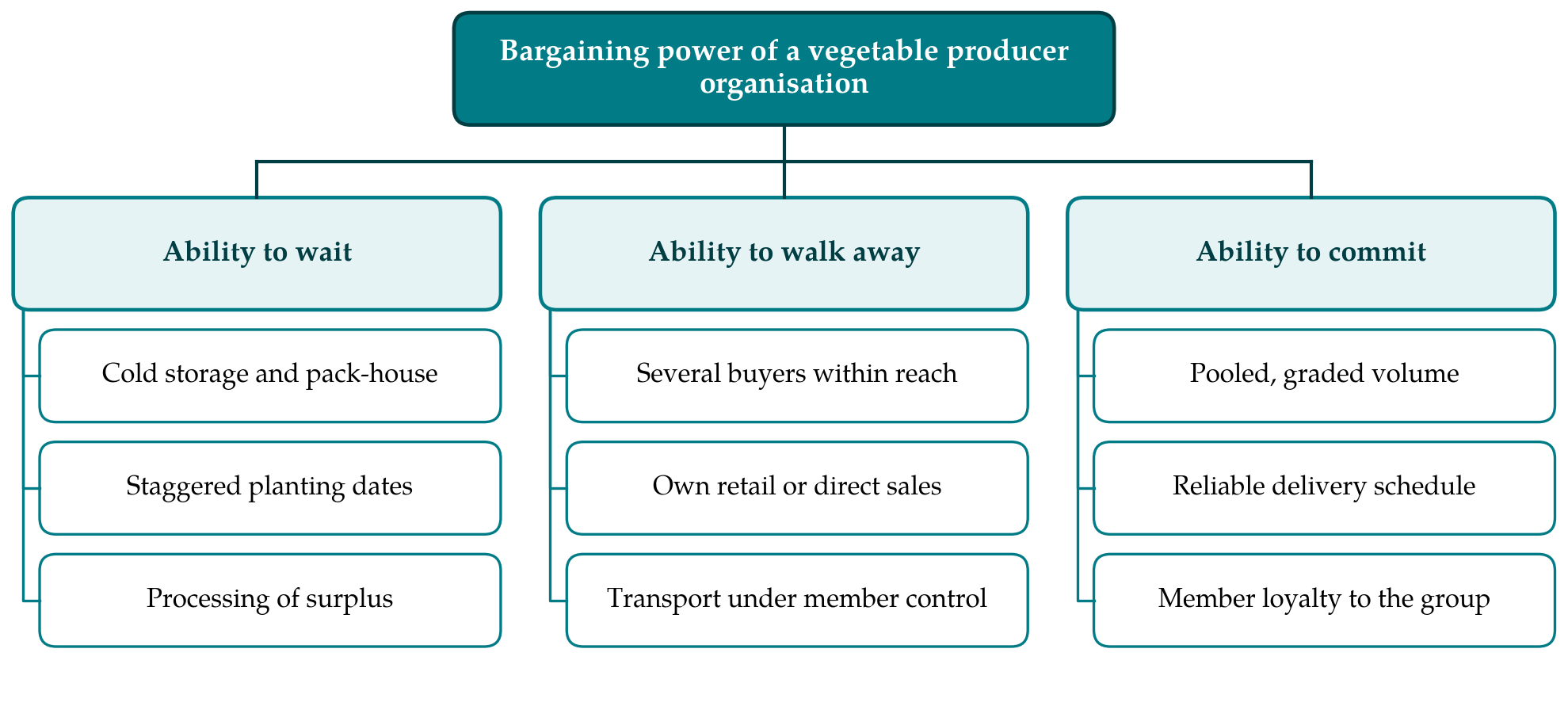
Shah (2016) offered a sharper critique, arguing that many producer companies were formed to meet promotion targets, with too little member capital and too little business with their own members to matter in those members' livelihoods. The comparison he drew was with the dairy cooperatives, whose strength rests on daily transactions with every member and on ownership of processing. Vegetables share the daily rhythm of milk but lack an equivalent processing stage that absorbs the whole supply, which is why Figure 1 treats the capacity to wait, to walk away and to commit as separate requirements.
7. Gaps and Future Work
The literature leaves several questions open. Few studies observe the prices that producer organisations obtain for vegetables against a credible comparison, so that price effects are usually inferred from income. Studies that track the same organisations over several years are rare, although survival and continued member patronage are the outcomes on which any bargaining gain depends. Side-selling is widely reported and seldom measured. Little is known about how the gains within an organisation are divided between larger and smaller members, or between men and women. Finally, the spread of digital trading platforms and direct procurement by retailers and processors changes the set of buyers within reach, and its effect on the position of organised and unorganised growers has yet to be studied carefully.
8. Conclusion
Organising vegetable growers does not by itself alter the fact that their product cannot wait. The reviewed evidence suggests that producer organisations help their members mainly by reducing the cost of transacting and by opening routes to buyers who pay for grade and reliability. Bargaining power in the strict sense appears where the organisation has changed the seller's alternatives, through storage, a choice of outlets or its own trading and processing, and where members sell through it consistently enough for its commitments to be believed. Programmes that count organisations formed, without asking whether these capabilities exist, are measuring the wrong thing. Support directed at cold chains, working capital and management is more likely to shift the terms of trade than registration alone.
Conflict of interest
To be declared by the author(s) before publication.
Funding
To be declared by the author(s) before publication.