1. Introduction
Since Thorsen et al. (2001) showed that a stream of water meeting a cross-flowing oil at a T-shaped junction breaks into regular droplets, the geometry has become a standard component of droplet microfluidics. It serves two purposes. In the cross-flow arrangement the dispersed phase enters from the side arm and is broken up by the carrier liquid. In the bifurcating arrangement a droplet already formed arrives along the stem and is divided between the two arms, as demonstrated by Link et al. (2004). The physics of both has been reviewed thoroughly for Newtonian liquids (Christopher and Anna, 2007; Baroud et al., 2010; Anna, 2016).
Applications have moved faster than that understanding. Droplets now routinely contain polymer solutions, hydrogel precursors, cell suspensions or protein-rich media, and carrier phases are sometimes thickened as well. Most of these liquids are shear-thinning. This note considers what can be said, from established results alone, about how shear thinning alters the breakup regimes of the T-junction, and where published accounts are likely to talk past one another.
2. The Newtonian Regime Picture
For droplet formation in a cross-flow junction the controlling parameter is the capillary number of the carrier phase, the ratio of viscous stress to interfacial tension. At low capillary number the emerging tip fills the main channel, the carrier liquid is blocked, and pressure builds upstream until the neck is squeezed shut. Garstecki et al. (2006) showed that the plug length in this squeezing regime grows linearly with the ratio of dispersed to carrier flow rates and is nearly independent of viscosity and interfacial tension. At higher capillary number the tip no longer blocks the channel and is sheared off before it reaches the far wall, the dripping regime, in which size falls as the capillary number rises. De Menech et al. (2008) located the transition between the two at a capillary number of roughly 0.015 and found that the viscosity ratio matters in dripping although it barely matters in squeezing. At still higher flow rates the dispersed phase forms a thread along the channel and breaks downstream, the jetting regime.
Splitting at a bifurcation has its own map. A droplet arriving at the junction either divides or lodges and leaves by one arm, depending on its length relative to the channel width and on the capillary number (Link et al., 2004). Leshansky and Pismen (2009) gave a lubrication theory for the critical condition, and Jullien et al. (2009) distinguished breakup in which the droplet obstructs both arms from breakup in which gaps, or tunnels, open between the droplet and the wall and carrier liquid leaks past. Table 1 collects these regimes.
| Regime | Controlling balance | Expected influence of shear thinning |
|---|---|---|
| Squeezing | Upstream pressure against interfacial tension Garstecki et al., 2006 | Weak: plug length follows the flow-rate ratio |
| Dripping | Carrier shear against interfacial tension De Menech et al., 2008 | Moderate: local viscosity sets the stress on the tip |
| Jetting | Thread advected faster than it pinches | Strong: thread length depends on thinning in the neck |
| Obstructed splitting | Neck stretched by flow into both arms Leshansky and Pismen, 2009 | Weak to moderate, through the critical droplet length |
| Splitting with tunnels | Leakage past the droplet slows the neck Jullien et al., 2009 | Moderate: gap flow is a high-shear region |
3. What Shear Thinning Changes
A shear-thinning liquid has a viscosity that falls as the rate of deformation rises, commonly represented by a power law over the working range or by a Carreau-type model with Newtonian plateaus at low and high rates (Bird et al., 1987). Inside a T-junction the shear rate is far from uniform. It is high in the thin films between a plug and the walls, in the corners where carrier liquid bypasses the tip, and in the neck as it collapses. It is low in the core of a slowly moving plug. A single viscosity therefore does not exist, and neither does a single capillary number or viscosity ratio.
The Newtonian scalings indicate where this matters. In squeezing, breakup is driven by a pressure that does not depend on viscosity at leading order, so a shear-thinning dispersed phase should produce plugs of nearly the same length as a Newtonian one at the same flow rates. A shear-thinning carrier is a different case, because the leakage through the corners, a region of high shear, becomes easier and the squeezing pressure builds more slowly. In dripping the stress on the tip is viscous and local, so the relevant carrier viscosity is the one at the shear rate in the gap above the tip, which can be well below the zero-shear value. The transition out of squeezing should then appear at a higher nominal capillary number when that number is computed with the zero-shear viscosity. Figure 1 sketches the expected arrangement of regimes as a qualitative guide.
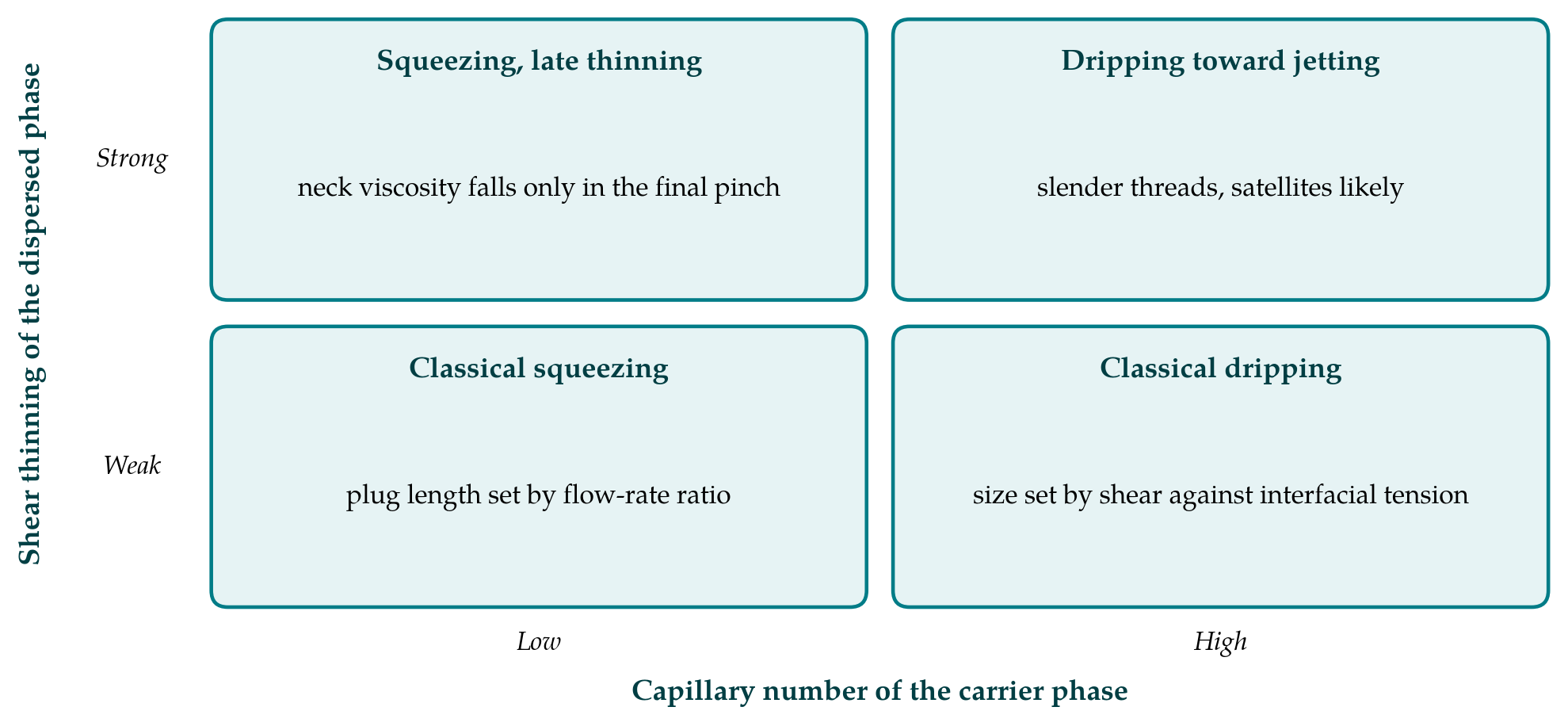
The final stage of pinch-off is where a thinning dispersed phase departs most from Newtonian behaviour. As the neck narrows the local deformation rate climbs, the viscosity resisting collapse drops, and collapse accelerates. Near the dripping-to-jetting boundary, where the outcome depends on whether the thread pinches before it is carried downstream, this feedback should shift the boundary and alter the population of satellite droplets.
4. Separating Thinning From Elasticity
Most shear-thinning liquids used in microfluidics are polymer solutions, and polymer solutions are also elastic. The two properties act in opposite senses during pinch-off. Thinning speeds the collapse of the neck. Elasticity resists the strong extensional flow there, and Arratia et al. (2008) showed that polymeric filaments in microchannels thin exponentially in time and persist far longer than Newtonian ones. Husny and Cooper-White (2006) observed in T-junctions that elastic drops remain attached by long filaments that later break into secondary droplets. A study that changes polymer concentration changes both properties at once, and an effect attributed to shear thinning may be elastic in origin. Inelastic thinning liquids, for example some particle suspensions, and elastic liquids of nearly constant shear viscosity are the natural controls.
5. Implications for Reporting
Three practices would make regime maps for shear-thinning liquids comparable. The first is to state the full flow curve of each liquid over the range of shear rates reached in the device, together with the fitted model, and not a single viscosity. The second is to define the characteristic shear rate used to form the capillary number and viscosity ratio, whether a nominal wall value in the main channel or an estimate for the gap, and to give the dimensional flow rates and channel dimensions so that readers can recompute with another choice. The third is to report a measure of elasticity, such as a relaxation time from filament thinning, so that a Weissenberg or Deborah number can be attached to each condition. Interfacial tension should be measured for the actual liquid pair, since polymers and surfactants both alter it.
6. Conclusion
The Newtonian regimes of the T-junction survive when one phase is shear-thinning, but their boundaries move, and by how much depends on which viscosity is used to draw the map. Reasoning from the accepted scalings suggests little change in squeezing, a shifted transition to dripping, and the largest differences in pinch-off and jetting, where thinning and elasticity compete. These are expectations to be tested and not findings. Clear reporting of rheology and of the chosen characteristic scales is the precondition for testing them.
Conflict of interest
To be declared by the author(s) before publication.
Funding
To be declared by the author(s) before publication.