1. Introduction
Where formal collection of used lead-acid batteries is weak, the batteries are dismantled by hand in yards and household compounds, the plates are smelted in simple furnaces and the electrolyte is poured away. The hazard this creates has been documented chiefly as lead exposure, in workers and in the children who live alongside the work (Gottesfeld and Pokhrel, 2011; Daniell et al., 2015), and such sites appear repeatedly in programmes that catalogue contaminated locations in low and middle income countries. International controls on the movement of hazardous scrap have had limited purchase on the informal sector, which works outside the permitting and record keeping those controls assume.
Cadmium is a secondary consideration in these assessments and is often left out altogether. There are reasons to look at it. Mixed scrap handled by informal operations is not confined to lead-acid chemistry, cadmium occurs as a contaminant in some materials and alloys, and smelting at poorly controlled temperatures volatilises it readily. More importantly, the toxicological consequences of low-level cadmium exposure are slow and cumulative, so an exposure that looks unremarkable against occupational standards may still matter for a population living permanently on the site (Järup and Åkesson, 2009).
This communication sets out the case for including urinary cadmium in the assessment of such communities, and describes what the indicator supports and where it misleads. It reports no new measurements.
The argument is not that cadmium rivals lead as the main hazard at these sites, which it does not, but that the two behave differently enough that a programme built for one will not detect the other. Blood lead responds within weeks to a change in exposure and is the right instrument for finding children who need intervention now. Cadmium accumulates quietly, produces no acute signal, and is detected only by looking for it. A survey team that arrives with a portable blood lead analyser and nothing else will leave with an accurate picture of one hazard and no information at all about the other.
2. Why Urinary Cadmium Is the Right Indicator Here
Absorbed cadmium binds metallothionein and accumulates in the renal cortex with a biological half-life measured in decades. A small and relatively constant fraction of the body burden appears in urine each day, so urinary cadmium approximates the accumulated burden rather than recent intake, and it is the indicator on which most of the dose-response work for kidney effects has been built (Nordberg et al., 2018). Blood cadmium behaves differently: it responds to intake over recent months and is strongly driven by smoking, which makes it useful for occupational surveillance and for detecting a change in conditions, and less useful for characterising what a resident population has accumulated. Figure 1 places the indicator in the sequence from source to early effect.
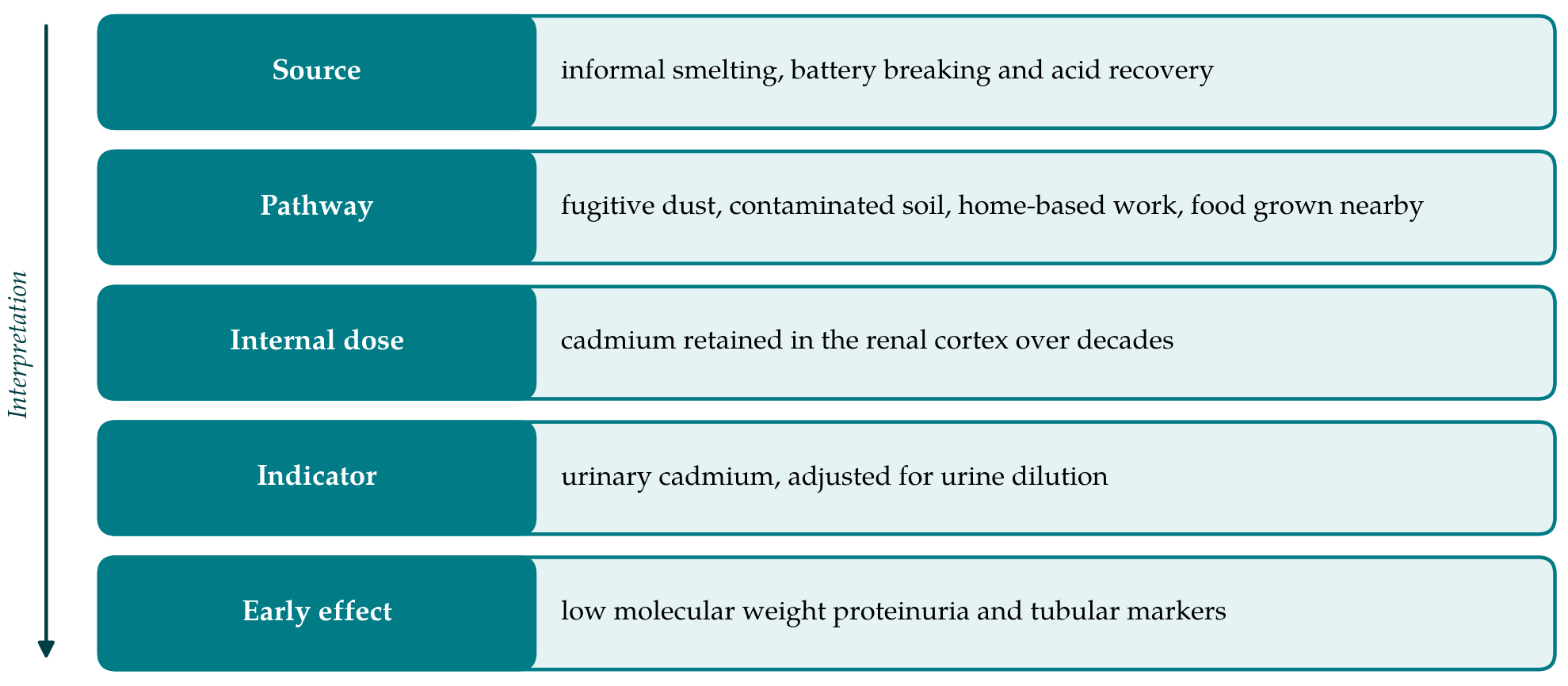
The health concern that gives the measurement meaning is renal tubular damage. Cadmium causes a characteristic low molecular weight proteinuria, detectable as increased urinary beta-2-microglobulin or retinol binding protein before any change in glomerular filtration (Lauwerys et al., 1994), and effects of this kind have been found in general populations at exposure levels once considered unremarkable (Åkesson et al., 2005). Beyond the kidney, associations with bone and with cardiovascular outcomes have been reviewed and remain less settled (Åkesson et al., 2014). Cadmium and cadmium compounds are classified as carcinogenic to humans (IARC, 2012).
3. Practical Requirements of the Measurement
Four requirements determine whether a result means anything. Table 1 summarises them alongside the alternatives that a survey might consider.
| Measurement | What it reflects | Main constraint |
|---|---|---|
| Urinary cadmium | Accumulated body burden, chiefly renal | Needs dilution correction and contamination control |
| Blood cadmium | Intake over recent months | Dominated by smoking (Järup and Åkesson, 2009) |
| Urinary beta-2-microglobulin | Tubular reabsorption function | Unstable in acidic urine; needs prompt handling |
| Urinary retinol binding protein | Tubular reabsorption function | More stable alternative to beta-2-microglobulin |
| Soil and dust cadmium | Environmental loading at the site | Does not establish that people are exposed |
| Creatinine or specific gravity | Degree of urine dilution | Creatinine varies with age, sex and muscle mass (Barr et al., 2005) |
Contamination control comes first. Cadmium is present in the dust of these sites, on hands and on clothing, and a sample collected without attention to that will measure the yard rather than the person. Metal-free containers, washing before collection and field blanks are the minimum. Second, urine concentration must be accounted for, conventionally by expressing the result per gram of creatinine or by correcting for specific gravity; creatinine adjustment has known weaknesses where body composition differs systematically between the groups compared (Barr et al., 2005). Third, smoking is the largest competing source in most populations and has to be recorded rather than assumed away. Fourth, interpretation needs a comparison, either an unexposed group sampled identically or published reference distributions for a general population (CDC, 2019).
One further consideration applies to community surveys. Disposition and toxicity differ by sex, in part because iron status affects intestinal absorption of cadmium, so that women with depleted iron stores absorb more from the same dietary intake (Vahter et al., 2007). A survey that does not record sex and, where feasible, iron status will find differences it cannot explain. Age matters for the same structural reason: because the renal burden accumulates, urinary cadmium rises with age in any population, and a comparison between a young workforce and an older resident group will show a difference that has nothing to do with the site.
How the sample is taken deserves more attention than it usually receives. A first morning void is preferable to a spot sample collected at convenience, because it reduces the variation that dilution correction then has to absorb, and the collection should be timed and recorded rather than left to the household. Where a survey must rely on spot samples, specific gravity is the more robust adjustment. Analysis is straightforward on modern instrumentation, but the limit of quantification and the blank values should be reported, since environmental concentrations in a general population sit low enough that a poorly characterised blank can dominate the result.
4. What the Measurement Will Not Do
Urinary cadmium cannot apportion exposure between the recycling site and other sources. Diet, particularly cereals and leafy vegetables grown on cadmium-bearing soil, contributes substantially in many regions, and where food is grown near the site the distinction between environmental and dietary exposure loses much of its meaning. Nor can a single survey establish a time course, since the indicator integrates decades of intake; a reduction in emissions will not show up quickly in urinary cadmium, and that limitation has to be explained before a community is told what the monitoring will reveal.
There is also a risk of displacing attention. Lead is the dominant hazard at these sites, the effects in children are serious and the case for intervention does not depend on cadmium at all. Adding a cadmium indicator is worthwhile only if it does not consume the resources that blood lead screening requires. The argument here is for inclusion in a panel, not for substitution.
A last caution concerns what follows a result. Unlike lead, where chelation has defined indications and removal from exposure produces a measurable fall, there is no treatment that reduces an accumulated cadmium burden, and the response to an elevated finding is environmental and nutritional rather than clinical. Communities asked to provide samples are entitled to know that in advance, and a survey that cannot say what it will do with a high result should think again before collecting one.
5. Conclusion
Urinary cadmium is inexpensive, well characterised and interpretable against published reference distributions, and it indexes exactly the kind of slow accumulation that a community living beside an informal recycling operation is liable to experience. Its omission from most assessments of these sites appears to be a matter of habit rather than of reasoning. Where cadmium is measured, the requirements set out above, contamination control, dilution correction, recording of smoking and pairing with a tubular marker, determine whether the result is informative. Published guidance on cadmium as a public health problem already recommends biomonitoring of exposed populations (WHO, 2019), and informal battery recycling sites are an obvious place to apply it.
Conflict of interest
To be declared by the author(s) before publication.
Funding
To be declared by the author(s) before publication.