1. Introduction
Ashwagandha holds a settled place in the Ayurvedic materia medica as a rasayana, a drug given to restore strength and resilience, and the dried root is official in the Ayurvedic Pharmacopoeia of India (Government of India, 1990). Modern interest has followed, and the pharmacology of the root and its constituents has been reviewed many times (Mishra et al., 2000; Kulkarni and Dhir, 2008). The same interest has produced a crowded market of powders, extracts and compound formulations whose labels refer to withanolides, often as a single percentage with no statement of how it was measured.
That figure is harder to interpret than it looks. Withanolides are a family of related steroidal lactones and not one substance, their proportions depend on plant part and chemotype, and a gravimetric "total withanolides" value cannot be compared with a chromatographic assay of named compounds. When Sangwan et al. (2004) examined commercial ashwagandha products they reported wide variation in withanolide profile between brands and preparations. A quality control laboratory therefore needs two things from its method: evidence that the material is what it claims to be, and a defensible number for one or more defined markers.
This article proposes a procedure that delivers both from a single thin-layer plate. It is written for the laboratory of an Ayurvedic pharmacy or teaching institution that owns, or can reach, a high-performance thin-layer chromatography (HPTLC) system. The procedure is built from pharmacopoeial conventions and published methods. It does not report an application to samples, and no results are presented.
2. Background
Two questions shape the design: which compounds are worth measuring, and why planar chromatography is a reasonable way to measure them when liquid chromatography is available.
2.1. Withanolides as markers
Withanolides are C28 ergostane-type steroids in which the side chain is oxidised to form a six-membered lactone. Withania somnifera produces several dozen of them, together with their glycosides, the withanosides (Mirjalili et al., 2009). Withaferin A is the best studied and is generally the dominant withanolide of the leaf, while the root, which is the classical drug, carries withanolide A, withanone, withanolide D and related compounds alongside smaller amounts of withaferin A. The existence of distinct chemotypes is well documented.
These facts have practical consequences. A root product adulterated with leaf or aerial parts will tend to show a raised proportion of withaferin A, so the ratio between markers carries information that a single total does not. No one compound can stand for the therapeutic activity of the drug, which is still attributed to the whole root in Ayurvedic practice. Markers are chosen here as analytical handles for identity and consistency. Withaferin A and withanolide A are proposed because reference substances for both are commercially available and both have been quantified in earlier chromatographic work (Ganzera et al., 2003; Chaurasiya et al., 2008).
2.2. Why planar chromatography
Column liquid chromatography gives better resolution and remains the reference technique for withanolide assay. Thin-layer chromatography answers a different need. Many samples and standards run side by side on one plate under identical conditions, and the whole chromatogram stays visible from the application position to the solvent front. The result is an image that an analyst can compare with a reference at a glance, which is why thin-layer atlases have long served as the working tool of herbal drug identification (Wagner and Bladt, 1996) and why fingerprinting is treated as a core strategy for the quality control of herbal medicines (Liang et al., 2004).
HPTLC adds instrumental control to the classical technique: plates with a finer and more uniform sorbent layer, automated band-wise application, development in a conditioned chamber, and slit-scanning densitometry. With these in place the method becomes reproducible enough for quantitative work (Reich and Schibli, 2007; Spangenberg et al., 2011). A validated densitometric method for withaferin A and withanolide A in plant parts of W. somnifera has been published (Sharma et al., 2007), which shows that the approach is feasible for crude drug. Finished formulations, with their fats, sugars and co-ingredients, are the harder case and the one this procedure addresses.
3. The Proposed Procedure
The procedure has seven steps, shown in order in Figure 1. The first five produce the fingerprint and the assay value. The last two establish and then maintain confidence in them. Each step is described below with the decisions it requires.
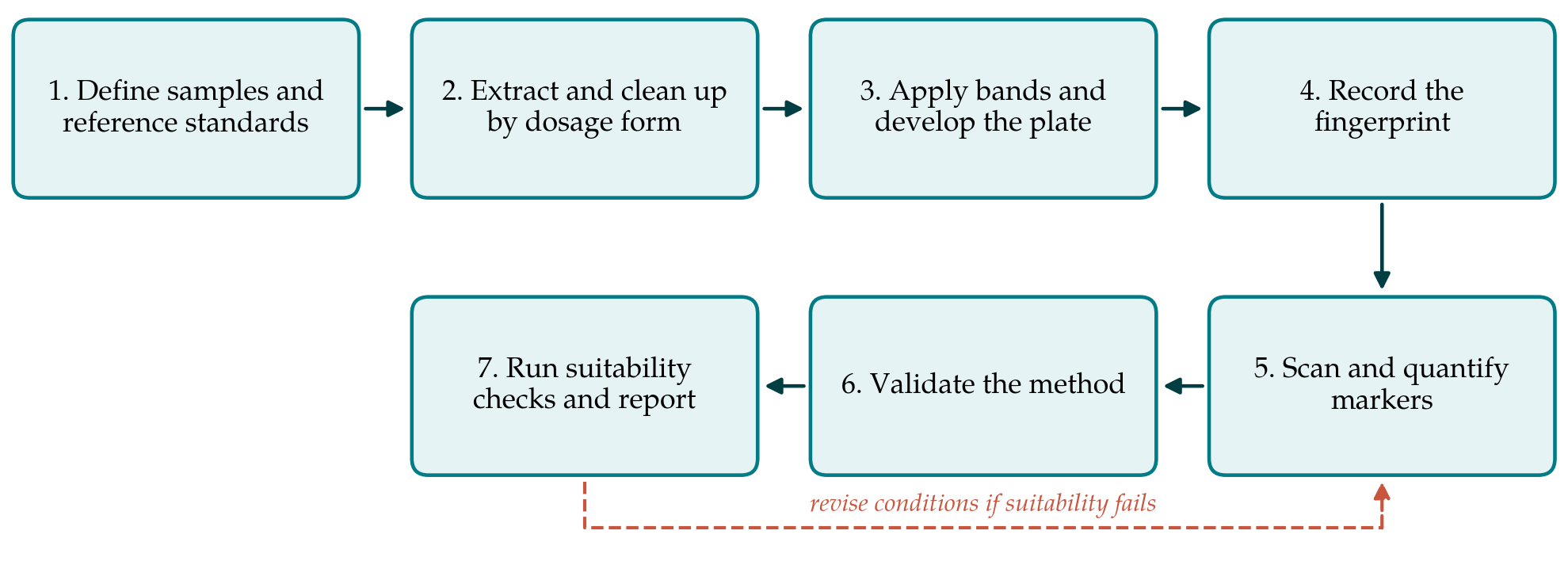
3.1. Step 1: Define samples and reference standards
The laboratory first fixes what will be placed on every plate. Three kinds of track are needed. The first is a botanical reference: authenticated ashwagandha root, identified against the pharmacopoeial description and kept as a retained sample. The second is the chemical reference: solutions of withaferin A and withanolide A of stated purity, prepared at a series of concentrations for calibration. The third is the test material. For compound formulations a fourth track is strongly advised, namely a placebo prepared in-house with every ingredient except ashwagandha, because it is the only direct way to see which zones the other ingredients contribute.
3.2. Step 2: Extract and clean up according to dosage form
Withanolide aglycones dissolve readily in methanol, and methanolic extraction with sonication or reflux is the usual starting point for root powder and dry extracts. Dosage forms differ in what else comes into solution. Tablets and capsules need only grinding and filtration. Medicated ghee and oils must be defatted, for example by partitioning between hexane and aqueous methanol, or the lipids will smear across the plate. Confections such as avaleha carry a heavy load of sugar that is best left behind by partitioning the aqueous dispersion into a moderately polar organic solvent. Fermented liquids such as arishta can be evaporated to remove ethanol and then partitioned in the same way. Whatever scheme is chosen, solvent volumes, times and temperatures are held constant, and recovery is examined during validation.
3.3. Step 3: Apply bands and develop the plate
Silica gel 60 F254 HPTLC plates are proposed as the stationary phase, since nearly all published thin-layer work on withanolides uses them. Samples and standards are applied as narrow bands of fixed length with an automated applicator, at a fixed distance from the lower edge. For the mobile phase, mixtures of toluene, ethyl acetate and formic acid have been widely used for withanolide aglycones and make a sensible first choice; the proportions are adjusted until the two markers sit in the middle third of the plate and are separated from each other and from placebo zones. Development takes place in a twin-trough chamber saturated with mobile phase vapour, over a fixed migration distance, after the plate has been conditioned at controlled relative humidity. Departures from these conventions are the commonest cause of drifting retardation factors (Reich and Schibli, 2007).
3.4. Step 4: Record the fingerprint
The dried plate is photographed under short-wave ultraviolet light, where compounds that absorb appear as dark zones against the fluorescent indicator, and under long-wave ultraviolet light. It is then derivatised. Anisaldehyde-sulphuric acid reagent followed by heating gives coloured zones with steroids and terpenoids and is a standard general reagent for this class (Wagner and Bladt, 1996). The plate is photographed again in white light and under long-wave ultraviolet light. Identity is judged by comparing the position, colour and relative intensity of zones in the test track with those of the botanical reference, and the acceptance description is written in those terms. Images are stored with the batch record.
3.5. Step 5: Scan and quantify the markers
Quantification is carried out on an underivatised plate, or on the same plate before derivatisation, by scanning each track in absorbance mode. The conjugated enone of ring A gives the withanolide markers an absorption maximum in the short-wave ultraviolet, and the working wavelength is selected from spectra recorded on the plate itself. Peak areas of the standards are fitted to a calibration function, linear or polynomial as the data require, and sample content is read from it. Because every plate carries its own standards, calibration is renewed with each run and plate-to-plate variation in layer thickness or development is largely cancelled.
3.6. Step 6: Validate the method
A quantitative method is of no use for release decisions until it has been validated. The characteristics to be examined are those of the ICH guideline on analytical validation (ICH, 2005), and their translation into planar chromatography has been discussed in detail by Shewiyo et al. (2012). Table 1 lists each characteristic with the way it would be assessed in this procedure and the record it should leave. Acceptance criteria are set by the laboratory in advance, in a written protocol, and are not adjusted after the plates have been scanned. Validation is carried out separately for each dosage form, because a clean-up that recovers the markers from a tablet may lose part of them from a ghee.
| Characteristic | Proposed assessment on the plate | Record kept |
|---|---|---|
| Specificity | Sample, standard and placebo tracks; spectral overlay | Plate images, overlays |
| Linearity and range | Standards at five or more levels | Calibration plot, residuals |
| Accuracy | Spiked placebo or sample at three levels | Recovery at each level |
| Repeatability | Replicate preparations on one day | Relative standard deviation |
| Intermediate precision | Different days, analyst and plate lot | Between-run variation |
| Detection, quantitation limits | Signal-to-noise ratio or calibration function | Limits and how estimated |
| Robustness | Small changes in mobile phase, saturation, humidity | Shift in position and area |
3.7. Step 7: Run suitability checks and report
Validation shows that a method can work. System suitability shows that it did work on the day. Each routine plate is accepted only if the botanical reference track shows the expected zones at the expected positions, the two markers are resolved from each other, and the standards return a calibration of the expected quality. If any check fails, the plate is rejected and the conditions are examined before samples are repeated. The report then states the identity conclusion, the content of each named marker with its unit and basis, the plate number and the reference materials used. Results are reported as withaferin A and withanolide A, and are not converted into a "total withanolides" figure, since that would imply a knowledge of the other family members that the method does not provide.
4. Fitting the Procedure to Different Formulations
Ashwagandha is rarely alone in a classical formulation. Other ingredients may contribute zones that sit close to a marker, and some share the steroid and terpenoid colour reactions used for the fingerprint. The placebo track of Step 1 is the main defence. Where a placebo cannot be made, as with a purchased product of undisclosed composition, the laboratory can still report identity with caution but should treat any assay value as provisional.
Processing also changes what there is to find. Aqueous decoction favours the more polar glycosides over the aglycones, and prolonged heating in ghee or fermentation may alter labile compounds. A formulation prepared correctly from good root may therefore show marker levels well below those of the raw drug. Specifications for finished products should be set from batches of known history made by the pharmacy's own process, and not borrowed from the crude drug or from another manufacturer's extract. General guidance on setting such limits for herbal materials is given by the World Health Organization (2011).
5. Limitations and What Remains to Be Shown
The procedure is proposed and has not been validated here. Before it could be used for release testing, a laboratory would have to show three things with its own equipment and materials. The first is specificity in each formulation it intends to test, which depends on the co-ingredients and cannot be assumed from work on the crude drug. The second is recovery through each clean-up scheme, especially from lipid and sugar matrices. The third is agreement with an independent technique: analysing a set of samples by both HPTLC and a validated liquid chromatographic method would reveal any bias from unresolved zones.
Some limits are inherent. Planar chromatography separates fewer compounds than a column, so a zone may hide more than one substance, and densitometry in the short-wave ultraviolet is less selective than mass spectrometric detection. Coupling the plate to a mass spectrometer through an elution interface is now practical and can confirm zone identity (Morlock and Schwack, 2010), but it is beyond the means of most pharmacy laboratories. Two markers also say nothing about the withanosides, which only the fingerprint displays.
6. Conclusion
A single HPTLC plate can carry an authenticated root, chemical standards, a placebo and the test sample, and can yield both a documented fingerprint and a densitometric value for withaferin A and withanolide A. The seven steps proposed here arrange that work so that each decision is recorded and each result can be traced to its plate. The design rests on established pharmacopoeial practice, but its performance with real ashwagandha formulations is an open question that only validation in the user's laboratory, formulation by formulation, can settle.
Conflict of interest
To be declared by the author(s) before publication.
Funding
To be declared by the author(s) before publication.