1. Introduction
A teaching laboratory produces a surprising quantity of records. In a single term a class of undergraduates may run restriction digests, transformations, polymerase chain reactions, protein assays and growth curves, and each exercise leaves behind handwritten notes, gel photographs, spreadsheet files and instrument exports. Most of it is never looked at again. The trouble starts when it is: a student cannot reconstruct which plasmid went into which tube, an instructor cannot tell whether a failed ligation was a pipetting slip or a bad batch of enzyme, and next year's cohort inherits a freezer box with no key.
These are small failures, but they rehearse larger ones. A widely read survey of researchers by Baker (2016) found that most had at some point been unable to reproduce another scientist's experiment, and incomplete description of methods and unavailable raw data were among the causes they named. Record keeping is also a matter of research integrity. Standard texts on responsible conduct treat the notebook as the primary evidence of what was done and by whom (Macrina, 2014). A graduate who has never been asked to date an entry or explain a correction arrives in a research group, or in a quality-controlled company, with something basic still to learn.
This article sets out a framework for planning notebooks and data records in a small biotechnology teaching laboratory, meaning one run by a few staff with shared benches, shared instruments and little money for software. The framework is a proposal. It is built from established guidance and has not been applied or evaluated in a course as part of this work. The aim is to give an instructor a sequence of decisions to make before the first practical, and a short list of documents to have ready.
2. Background
Three bodies of guidance inform the design. They were written for different audiences, and none of them was written for a teaching bench, which is partly why a framework that joins them is useful.
2.1. The bound notebook tradition
The conventions of the paper notebook are old and remarkably stable. Kanare (1985) describes them in full: a permanently bound book with numbered pages, entries in ink made at the time of the work, each page dated and signed, unused space struck through, and errors corrected with a single line so that the original remains readable. A table of contents at the front makes the book searchable. The logic behind every rule is the same. A reader who was not present should be able to tell what happened, in what order, and that nothing was added or removed afterwards.
2.2. Good documentation practice and data integrity
Regulated laboratories formalised these habits. The OECD Principles of Good Laboratory Practice require raw data to be recorded directly, promptly, accurately and legibly by the person entering them, signed or initialled and dated, and require that any change leaves the earlier entry visible and gives a reason (OECD, 1998). Later data integrity guidance condensed the expectation into the acronym ALCOA: records should be attributable, legible, contemporaneous, original and accurate. Guidance from the World Health Organization and from the United Kingdom medicines regulator extends the list with complete, consistent, enduring and available, and stresses that the same attributes apply to paper and electronic records alike (WHO, 2016; MHRA, 2018). For electronic records, the United States rule known as Part 11 adds requirements for audit trails and electronic signatures (FDA, 1997). A teaching laboratory is not bound by any of this, but the vocabulary is the one graduates will meet in industry.
2.3. Research data management
The third strand comes from academic research, where the concern is less with proof and more with reuse. The FAIR principles ask that data be findable, accessible, interoperable and reusable (Wilkinson et al., 2016), and funders increasingly expect a data management plan that says how this will be achieved (Michener, 2015). Alongside these sits a practical literature on everyday habits: keeping raw data untouched, naming files consistently, organising one folder per project and backing up in more than one place (Noble, 2009; Borer et al., 2009; Wilson et al., 2017). Schnell (2015) applies the notebook conventions to computational work, which matters here because even a wet-laboratory course now ends at a spreadsheet or a sequence file.
3. What Makes a Teaching Laboratory Different
A research group can assume continuity. People stay for years, a principal investigator owns the data, and the group has reasons of its own to keep good records. A teaching laboratory has none of these. Its members change every term, often every week. Benches, pipettes and the gel imager are shared between sections, so the person who ran a sample is frequently not the person who photographs it. Students work in pairs or groups, which blurs who did what. The records also serve two purposes at once, since they are the evidence of the experiment and the object that will be marked.
Resources shape the choices as well. A small department is unlikely to pay for a commercial electronic notebook, and its instruments may write files to a local disk that nobody is responsible for clearing. Student records carry names and marks, so privacy rules apply to them even when the scientific content is trivial. A workable plan has to be cheap, quick to teach in the first session, and robust to the fact that its users are beginners who will leave in twelve weeks.
4. The Proposed Framework
The framework consists of six planning steps, taken in order before the course starts. Table 1 lists them with the decision each requires and the document it should leave behind. Together the documents form a record plan of two or three pages that can be handed to students and teaching assistants.
| Step | Decision to be made | Document produced |
|---|---|---|
| 1. Inventory the records | Which records each exercise generates and who creates them | Record inventory, one line per record type |
| 2. Choose the notebook format | Bound paper, electronic, or paper with a shared file store | Format statement with reasons |
| 3. Set the entry standard | What every entry must contain and how it is laid out | One-page entry template and worked example |
| 4. Name and structure files | File naming pattern, folder layout and sample identifiers | Naming convention and folder map |
| 5. Review and correction | Who checks entries, when, and how errors are amended | Review checklist and correction rule |
| 6. Storage and retention | Where records live, how they are backed up and for how long | Storage, backup and retention schedule |
4.1. Step 1: Inventory the records
Planning begins with a list. For each practical exercise the instructor writes down every record it will generate: notebook entries, printed protocols with annotations, gel and plate images, plate-reader and spectrophotometer exports, spreadsheets, sequence files, and the labels on tubes and plates, which are records too. Against each item go its creator, its format and whether it is raw or derived. The exercise is dull and worth doing, because it exposes the records nobody owns, such as the image left on the imager's hard disk.
4.2. Step 2: Choose the notebook format
The choice is between a bound paper notebook, an electronic laboratory notebook, and a hybrid in which the narrative is kept on paper and files are kept in a shared folder. Electronic notebooks offer search, time stamps and easy linking to data files, and published guidance on selecting and introducing them is available (Kwok, 2018; Higgins et al., 2022). They also need accounts, devices at the bench and someone to administer them. For a small teaching laboratory the hybrid is often the realistic option: paper survives spills and needs no login, and it teaches the conventions in their plainest form. Whatever is chosen, the plan should state the reason.
4.3. Step 3: Set the entry standard
An entry standard tells a student what a complete entry looks like. A reasonable minimum is the date, a title, the aim in a sentence, the protocol followed with its version and every deviation from it, the reagents with lot numbers or stock identifiers, the instruments used, the observations as they occur, the names of the files produced, and a short interpretation written afterwards and marked as such. Entries are made during the session and not copied up neatly at home, since a fair copy is by definition neither original nor contemporaneous. Group work needs a rule of its own: each student keeps a notebook, and each entry names the partner who carried out any step the writer did not perform.
4.4. Step 4: Name and structure the files
Digital records fail in predictable ways, and most of them can be designed out. A naming pattern that puts the date first in year-month-day order, followed by the exercise, the group and a brief description, sorts chronologically and can be read without opening the file. Spaces and special characters are avoided. Raw instrument exports are saved once, set to read-only and never edited; analysis is done on a copy (Wilson et al., 2017). Spreadsheets deserve particular care. Broman and Woo (2018) recommend a rectangular layout with one value per cell, consistent codes, no information carried by colour and a separate data dictionary. Their warning about automatic conversion is well founded, since gene symbols altered into dates by spreadsheet software have been found throughout the supplementary files of published papers (Ziemann et al., 2016). Open formats such as comma-separated text and FASTA remain readable when the software that wrote them is gone (Hart et al., 2016).
Sample identifiers tie the two halves of the record together. If the code written on a tube is the code in the notebook and in the file name, an image can be traced to a bench entry in seconds. A simple scheme of course, section, group and a running number is enough.
4.5. Step 5: Arrange review and correction
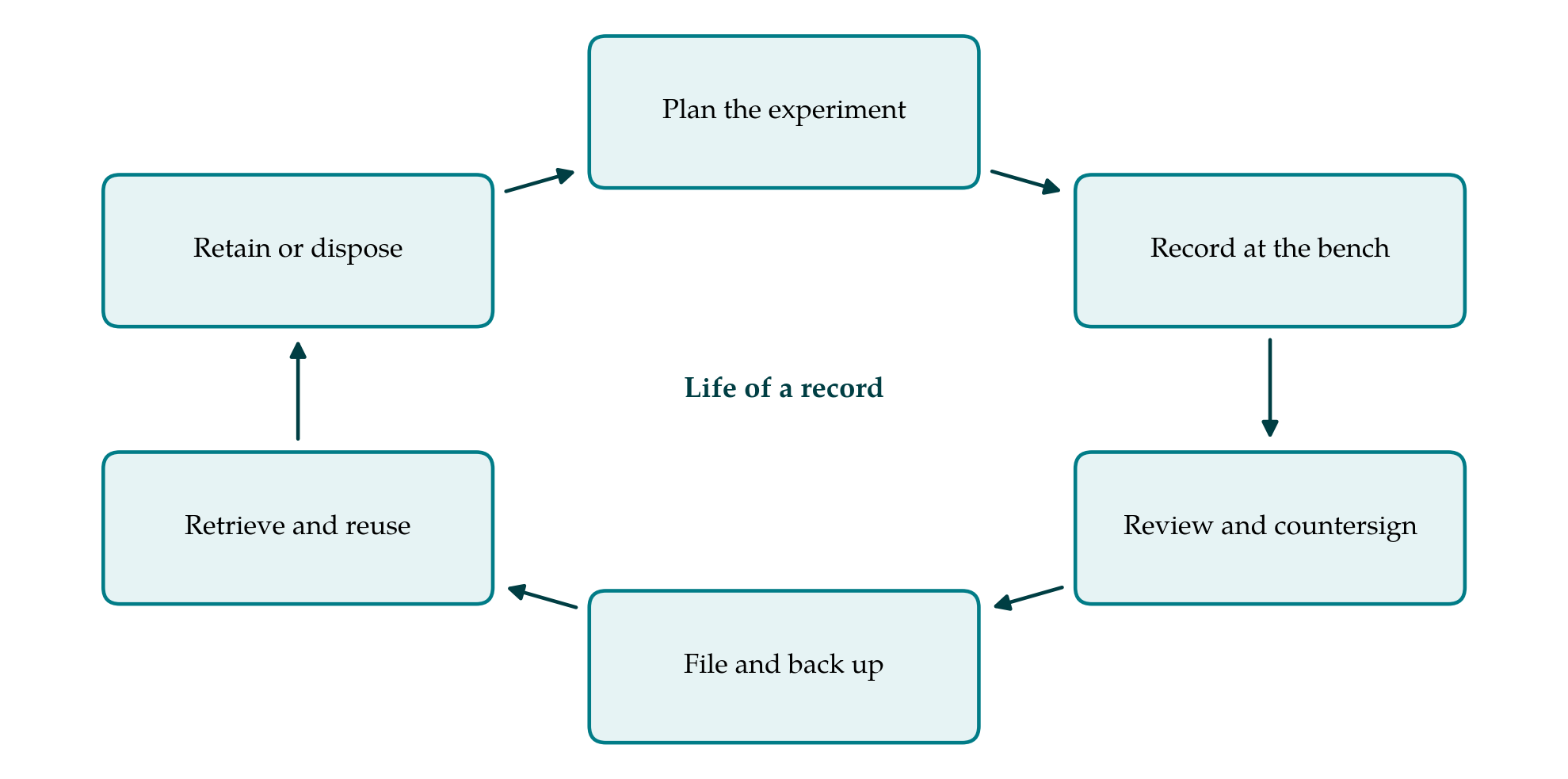
A record nobody reads soon deteriorates. The plan should say who reviews entries and when. In a teaching setting a teaching assistant can initial and date each notebook before the student leaves the bench, checking against a short list: dated, legible, deviations noted, files named, blank space struck through. This takes a minute per student and gives the countersignature of the bound-notebook tradition a teaching purpose. The correction rule is stated just as plainly. A wrong entry is crossed out with one line, the correction is written beside it with the date and initials, and nothing is erased, overwritten or torn out. In electronic files the equivalent is a dated note of what was changed and why. Figure 1 places review within the life of a record, from the planning of an experiment to the point at which its records are retained or destroyed.
4.6. Step 6: Settle storage, backup and retention
The last step answers three questions. Where does each record live? A shared institutional drive with one folder per course, term and group is usually sufficient, with instrument computers emptied into it on a fixed day each week. How is it protected? The familiar rule of three copies, on two kinds of media, with one held elsewhere is a sensible target, and institutional storage often meets it without further effort (Hart et al., 2016). How long is it kept? Student work is normally held until marks are confirmed and any appeal period has passed, under the institution's own records policy, while protocols, strain lists and reagent logs belong to the laboratory and should outlive the cohort. The schedule names a person responsible for disposal, because records that are nobody's job to delete accumulate indefinitely.
5. Fitting the Framework to a Course
A plan on paper changes little unless it is built into how the course runs. Three points of contact are suggested. The first is the opening session, where twenty minutes spent on a worked example of a good entry, and a poor one, sets expectations better than a handout. The second is assessment. If part of the mark for each practical is awarded for the record itself, judged against the same checklist the teaching assistants use, students have a reason to care, and the criteria are transparent. The third is continuity: the record plan, the templates and the folder map are themselves records, kept under version control in the simplest sense of a dated file and a note of what changed.
The framework scales down as well as up. A course with a single exercise may need only the entry template and a naming rule. A final-year project course, where students generate data that may be published, warrants the full plan and perhaps an electronic notebook. Linking the vocabulary to ALCOA is worthwhile in either case, since it gives students terms they will hear again.
6. Limitations and What Remains to Be Shown
The framework is assembled from guidance written for regulated testing and for research, and its transfer to teaching is argued here, not demonstrated. Whether students who follow it keep more complete records, whether the habit persists after the course ends, and whether the time spent on review is repaid in fewer unexplained failures are open questions. Each could be examined by comparing notebooks against a fixed rubric before and after the plan is introduced, or between course sections, and such an evaluation would be a natural next step.
There are also costs that should not be understated. Countersigning takes staff time in sessions that are already crowded. Marking the record may reward neatness over thinking if the checklist is applied mechanically. A hybrid system leaves the link between paper and files dependent on students writing file names down, which is exactly the step beginners forget. Finally, institutional rules on privacy and records retention differ between countries and universities, and the schedule in Step 6 must be fitted to local policy.
7. Conclusion
Good records in a teaching laboratory are mostly the result of decisions taken before students arrive. The six steps proposed here ask an instructor to list the records, choose a format, define an entry, agree names, arrange review and settle storage, and to write each decision down in a short plan. The content is borrowed from the notebook tradition, from data integrity guidance and from research data management, and none of it requires special software. What the framework achieves in practice has yet to be measured, and courses that adopt it are well placed to do so.
Conflict of interest
To be declared by the author(s) before publication.
Funding
To be declared by the author(s) before publication.