1. Introduction
Per- and polyfluoroalkyl substances are a large family of synthetic chemicals that share a fully or partly fluorinated carbon chain. The terminology in general use, which separates perfluoroalkyl acids such as PFOA and PFOS from the polyfluorinated precursors that can degrade to them, was set out by Buck et al. (2011) and later broadened by the OECD to cover several thousand structures (OECD, 2021). Their uses range from fluoropolymer manufacture and firefighting foams to grease-resistant paper and textiles (Glüge et al., 2020). The acids are persistent, mobile in water and, for the longer chains, bioaccumulative, so they reach food through contaminated water and soil, through accumulation in fish and livestock, and to a lesser extent by migration from packaging (Trier et al., 2011).
Reviews of dietary exposure identify fish and seafood, eggs, meat and offal as the foods that contribute most, with fruit, vegetables and drinking water adding to the total where local contamination exists (Domingo and Nadal, 2017). In 2020 the European Food Safety Authority set a group tolerable weekly intake of 4.4 ng per kg of body weight for the sum of PFOA, PFNA, PFHxS and PFOS (EFSA, 2020). Maximum levels for these four substances in eggs, fishery products, meat and offal followed (European Commission, 2022a). The practical consequence for laboratories is a demand for limits of quantification in the low nanogram per kilogram range in matrices that are rich in protein, fat or pigment.
Liquid chromatography with tandem mass spectrometry has the sensitivity that is required. Whether that sensitivity is realised depends on sample preparation, and it was recognised early that the analytical difficulties of this compound class lie largely before the instrument (Martin et al., 2004). This review considers how food samples are prepared for PFAS analysis, what each approach does well and where the methods still fall short.
2. Scope and Approach
This is a narrative review of the published literature and of official documents on the determination of PFAS in food. It draws on the papers that introduced the main extraction and clean-up techniques, on critical reviews of analytical performance and on regulatory texts of the European Union and the United States. It does not attempt an exhaustive catalogue of applications. The emphasis is on ionic PFAS measured by liquid chromatography, because these are the regulated substances; neutral and volatile compounds are discussed more briefly. Studies are cited for the methods and principles they established and not for the concentrations they reported.
3. Why Food Is a Difficult Matrix
Three properties of PFAS and of food combine to make preparation demanding. The first is the range of polarity within one analyte list. A method that covers perfluorobutanoic acid and a fourteen-carbon acid must retain a small, very water-soluble anion and recover a long, surface-active one that sticks to container walls and partitions into fat. The second is binding. Unlike the classical lipophilic pollutants, the perfluoroalkyl acids associate with proteins and phospholipids, so the extraction has to disrupt those interactions and cannot simply follow the fat. The third is the diversity of matrices under a single regulation: egg yolk, fish liver, muscle, milk, leafy vegetables and cereal-based baby food differ in water, fat, protein and pigment content, and no one procedure suits them all (Jahnke and Berger, 2009).
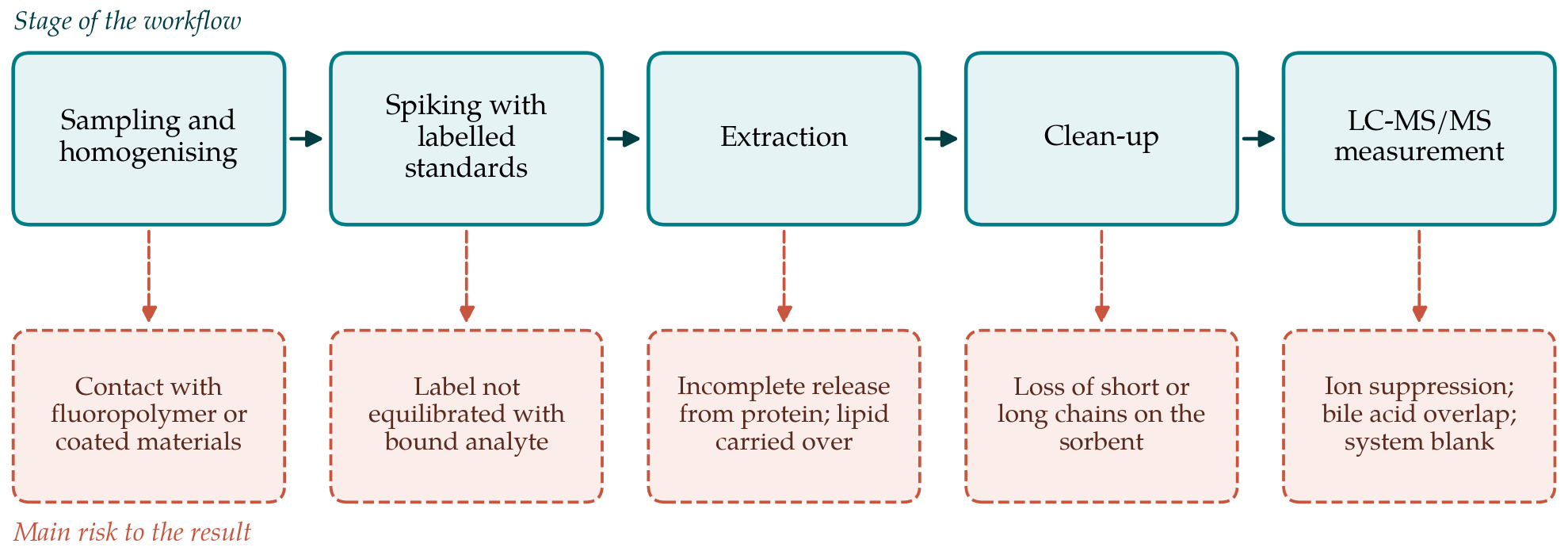
Figure 1 sets the stages of a typical workflow against the principal risk at each. The remainder of this review follows that sequence.
4. Controlling Background Contamination
Fluoropolymers are common in laboratories, and they are a source of the analytes. Yamashita et al. (2004) traced blank signals to polytetrafluoroethylene parts in the chromatograph, in solvent lines and in sample containers, and showed that replacing them was a condition for trace work. The precautions that followed are now routine: polypropylene or polyethylene vessels in place of glass and fluoropolymer, testing of each lot of solvent, sorbent and filter, a delay column between the pump and the injector so that system-derived PFAS elute after those from the sample, and a procedural blank with every batch. Kitchen and sampling equipment deserve the same attention, since non-stick coatings and grease-proof wrappings can contaminate a sample before it reaches the laboratory. At the concentrations now of regulatory interest the blank often sets the limit of quantification, not the detector.
5. Extraction
Four extraction approaches account for most published methods. Table 1 summarises them, and the following subsections discuss each.
| Approach | Principle | Typical matrices | Main limitation |
|---|---|---|---|
| Ion-pair extraction Hansen et al., 2001 | Anions paired with tetrabutylammonium and taken into methyl tert-butyl ether | Liver, blood, fish tissue | Lipids co-extracted; weak for short chains |
| Methanol or acetonitrile extraction Powley et al., 2005 | Solvent denatures protein and dissolves analytes; often followed by carbon clean-up | Muscle, egg, vegetables | Extract may still suppress ionisation |
| Alkaline digestion Taniyasu et al., 2005 | Hydroxide in methanol breaks down tissue and releases bound analytes | Liver, fatty fish, offal | Some precursors may be transformed |
| Salting-out partitioning Lacina et al., 2011 | Acidified acetonitrile separated from water by added salts | Milk, fish, produce | Recovery varies with chain length |
| Tetrahydrofuran- water Ballesteros-Gómez et al., 2010 | Mixed solvent chosen to match analyte polarity range | Varied foods | Less widely adopted and compared |
5.1. Ion-pair extraction
The first method to give compound-specific results for PFAS in biological material paired the anions with tetrabutylammonium and extracted the neutral pair into methyl tert-butyl ether (Hansen et al., 2001). It was the basis of much of the early work on blood and liver and was carried over to fish and other animal foods. Its weaknesses became clear as lower concentrations were sought. The ether takes lipids with the analytes, there is no clean-up step in the original form, and recovery of the shorter carboxylic acids is poor. Critical reviews of extraction and clean-up accordingly describe a gradual move away from ion pairing toward solvent extraction followed by a selective sorbent (van Leeuwen and de Boer, 2007).
5.2. Extraction with methanol or acetonitrile
Methanol and acetonitrile precipitate protein and dissolve the ionic PFAS well, and extraction with one of them, assisted by shaking or sonication, is the commonest first step in current food methods. Methanol gives a more complete extraction of the long chains but also brings more matrix. Acetonitrile is more selective against lipids. Powley et al. (2005) combined methanol extraction with a dispersive treatment using graphitised carbon and acetic acid, and showed that this removed much of the material responsible for matrix effects while leaving the perfluorocarboxylic acids in solution. Although developed for soils and sediments, the approach was soon applied to biota and remains part of many food procedures. A solvent mixture of tetrahydrofuran and water has been proposed as an alternative with a polarity range matched to the analytes (Ballesteros-Gómez et al., 2010).
5.3. Alkaline digestion
For tissues in which PFAS are strongly bound, digestion with sodium or potassium hydroxide in methanol before extraction breaks down the matrix and frees the analytes. Taniyasu et al. (2005) described the approach for biota in combination with solid-phase extraction on a weak anion exchanger. The digest is diluted with water so that the analytes can be loaded onto the cartridge. Alkaline conditions suit liver and other offal, which are among the regulated foods. They carry a risk where precursors are present, because some polyfluorinated esters and amides hydrolyse in base and may be converted to the acids being measured.
5.4. Salting-out partitioning
The acetonitrile extraction and salt-induced phase separation introduced for pesticide residues by Anastassiades et al. (2003) has been adapted to PFAS, attracting laboratories that already run it for other contaminants. Lacina et al. (2011) described a method of this type for milk and fish. Acidification is needed to keep the carboxylic acids in the organic phase, and recovery tends to fall at both ends of the chain-length range, the shortest acids staying in the aqueous layer and the longest adsorbing to precipitated matrix. The dispersive sorbents used in pesticide work also need care: primary-secondary amine is an anion exchanger and will remove the analytes along with the fatty acids it is meant to capture.
6. Clean-Up
Weak anion exchange is the clean-up most closely matched to the chemistry of the target compounds. On a mixed-mode polymeric sorbent the anionic PFAS are held by both ionic and hydrophobic interaction. Neutral lipids and many pigments can be washed off with methanol, which also provides a fraction containing neutral PFAS, and the acids are then eluted with ammoniated methanol (Taniyasu et al., 2005). The United States Environmental Protection Agency method for PFAS in water, solids and tissue pairs this cartridge with graphitised carbon (US EPA, 2024). Carbon removes planar and pigmented interferences, among them bile acids, but it can also retain the longer-chain sulfonates if too much is used or contact is prolonged, so the amount has to be fixed during method development.
Fatty foods need additional lipid removal. Freezing out of the extract, hexane washing and dedicated lipid-retaining sorbents are all in use. Each additional step is another opportunity for loss and for contamination, and the gain in cleanliness has to be weighed against both. Evaporation of the final extract is a further point of risk: long-chain compounds adsorb to the dry vessel wall, and volatile precursors are lost altogether.
7. Quantification, Matrix Effects and Interferences
Electrospray ionisation is susceptible to suppression or enhancement by co-eluting matrix, and the standard way of measuring that effect compares the response of an analyte added after extraction with its response in pure solvent (Matuszewski et al., 2003). PFAS methods rely on isotope dilution to correct for it. A carbon-13 or oxygen-18 labelled analogue of each analyte is added to the sample before extraction and is assumed to behave as the native compound does through every later step. The assumption is weakest at the start, since a label added to a homogenate has not had time to bind to protein as the incurred analyte has. Where no labelled analogue exists the compound is quantified against a neighbour, and the correction is correspondingly less reliable.
Two interferences are specific to this field. Bile acids of the taurodeoxycholate group have nearly the same mass as the PFOS anion and share its most intense product ion, which leads to overestimation in eggs, liver and fish unless the compounds are separated chromatographically or a different transition is monitored (Benskin et al., 2007). The same work showed that branched and linear isomers of PFOS respond differently in the mass spectrometer, so the choice of standard and of integration window affects the reported sum. Perfluorobutanoic acid presents a different problem: it gives a single useful transition, and its identification rests on retention time to an unusual degree.
8. Performance Criteria Attached to Regulation
European Union law now specifies how PFAS methods for official control must perform. The implementing regulation on sampling and analysis sets requirements for the limit of quantification relative to the maximum level, for the recovery of the labelled standards, for precision and for identification, and it obliges laboratories to report the sum of linear and branched isomers (European Commission, 2022b). A parallel recommendation asks Member States to monitor a wider range of foods and compounds and names target limits of quantification lower than those needed for enforcement (European Commission, 2022c). These texts do not prescribe a preparation procedure. They do, in effect, exclude procedures that cannot deliver clean blanks and stable internal-standard recovery in fatty and protein-rich matrices, and they have pushed laboratories toward the combination of solvent extraction, weak anion exchange and carbon.
9. Beyond the Target List
A target method sees only the compounds for which standards exist. Two complementary measures have been developed to estimate what it misses, and both make their own demands on sample preparation. The total oxidisable precursor assay converts precursors to perfluoroalkyl acids with heat-activated persulfate under alkaline conditions, the increase in acids after oxidation indicating the precursor content (Houtz and Sedlak, 2012). It was designed for water, and in food extracts the organic matter consumes the oxidant, so the extract must be cleaned thoroughly or the oxidant dose raised. Extractable organic fluorine, determined by combustion ion chromatography, gives a mass balance against the sum of target compounds (Miyake et al., 2007). Here the difficulty is inorganic fluoride, which is abundant in some foods and has to be removed completely from the extract before combustion.
10. Gaps and Future Work
Several weaknesses recur in the literature. Ultrashort-chain acids, including trifluoroacetic acid, are poorly retained by the reversed-phase and anion-exchange materials that serve the rest of the class and generally need a separate method. Plant-based foods have received far less method development than animal tissues, although pigments, sugars and organic acids in fruit, vegetables and cereals create matrix effects of their own. Certified reference materials for food at relevant concentrations are few, which makes trueness hard to demonstrate and leaves proficiency tests as the main external check. Finally, the equilibration of labelled standards with incurred residues is usually assumed and seldom examined. Comparative studies on naturally contaminated material, and not only on spiked samples, would show how much the choice of extraction really matters.
11. Conclusion
Sample preparation for PFAS in food has converged on a recognisable pattern: plastic labware and monitored blanks, isotope-labelled standards added at the outset, extraction with methanol or acetonitrile with alkaline digestion where binding is strong, and clean-up on a weak anion exchanger with graphitised carbon. The pattern works well for the regulated acids in animal foods. It is less secure for the shortest and longest chains, for plant matrices and for precursors, and these are the areas in which further method development and comparative testing would add most to confidence in dietary exposure data.
Conflict of interest
To be declared by the author(s) before publication.
Funding
To be declared by the author(s) before publication.