1. Introduction
Few critical categories have been dismissed as memorably as this one. In an essay first published in 1983 Salman Rushdie reported on a conference devoted to Commonwealth literature and concluded that the thing did not exist. The label, he argued, was a ghetto: it herded together writers who had little in common beyond a colonial past, and it did so in order to keep them outside English literature proper (Rushdie, 1991). Six years later the most influential textbook in the field proposed post-colonial as the better term and treated the older one as a stage that criticism had passed through (Ashcroft et al., 1989).
The institutions followed. Courses were renamed, and prizes changed their rules or closed. Yet the word has not disappeared. Associations, a short story prize and a number of journals still carry it, and scholars continue to need some way of referring to the particular set of literary relations that British imperial rule and its aftermath produced. This article asks what, if anything, the category is still good for. Its answer is that the term fails as a name for a literature and succeeds, within limits, as a name for an institutional field.
2. How the Category Was Made
The term came into academic use as the empire was being dismantled. An early American anthology of essays surveyed the writing of the member countries one by one (McLeod, 1961). In 1964 the University of Leeds hosted a conference whose proceedings appeared under a subtitle that stated the founding assumption, unity and diversity in a common culture (Press, 1965). An association for the study of these literatures and a dedicated journal were established in the same years. A decade on, Walsh (1973) could write a survey of the field for a general readership, moving region by region through India, Africa, the West Indies, Canada, New Zealand and Australia.
Three features of this founding moment matter for the present argument. The category was defined by membership of a political association and not by any quality of the texts. It was confined to writing in English. And it was comparative from the start in a way that national literary histories were not: a critic trained in it was expected to read a Nigerian novel next to a Caribbean one and an Australian poem next to a Canadian. The first two features explain why the category was attacked. The third explains why something was lost when it went.
3. The Case Against
The objections are well known and largely sound. Rushdie's point about segregation is the first. A second concerns language. Ngũgĩ (1986) argued that literature in the languages of the colonisers could not be the national literature of African peoples, and a category restricted to English made the writing in Gikuyu, Hindi, Yoruba or Māori of the same countries invisible. A third concerns politics. Commonwealth criticism in its early form praised universal themes and local colour and had little to say about conquest, race or economic dependence; the postcolonial vocabulary that displaced it put those matters at the centre. A fourth is simple incoherence. The settler dominions and the colonies of occupation had different histories, and the United States, a former British colony with a comparable literary history, was left out because it was not a member.
If the question were whether to restore Commonwealth literature as the main heading under which this writing is taught and discussed, these objections would settle it. The question worth asking is narrower: whether the terms that replaced it can do everything it did.
4. What the Successor Terms Leave Out
Postcolonial criticism brought gains that need no defence here, and it attracted criticism of its own almost at once. McClintock (1992) observed that the prefix arranged the world's cultures along a single line of time defined by European rule. Mukherjee (1990) objected that the model of writing back to the centre turned every text into a reply to the coloniser and ignored the arguments that writers were having with their own societies. Ahmad (1992) made a related case against grand categories that sort literatures by their relation to the West, and Lazarus (2011) later showed how small a canon the field had come to rely on. A general theory of colonial discourse, in short, tends to abstract from the specific arrangements of any one empire.
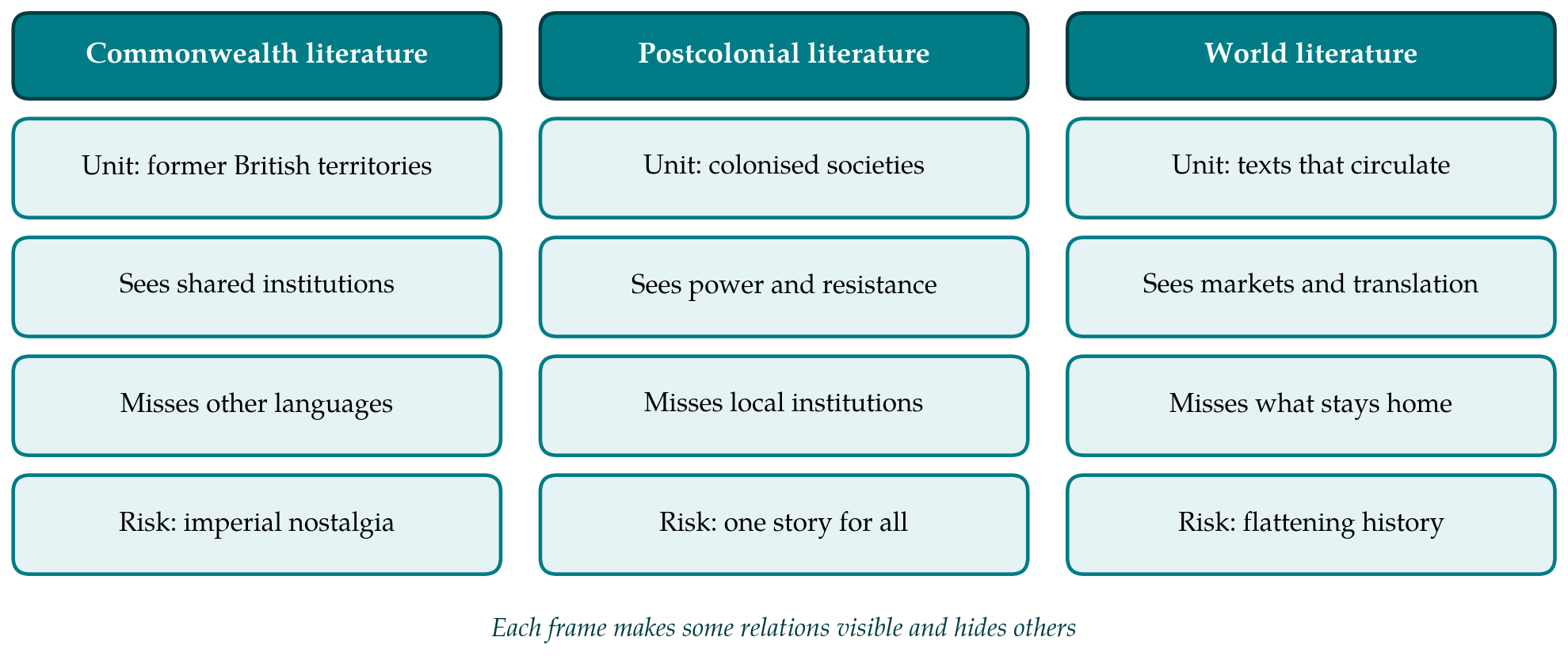
World literature abstracts in a different direction. Damrosch (2003) defined it as writing that circulates beyond its culture of origin, and Casanova (2004) described a world literary space with its own capitals and its own unequal exchange. The Warwick Research Collective reframed the object as the literature of a single, uneven capitalist world-system (WReC, 2015). These models are powerful at the scale of the globe. Mufti (2016) has pointed out that they often take the dominance of English for granted when it ought to be the thing explained. They also have least to say about the middle scale, the level at which a particular empire's schools, laws and publishers shaped a particular set of writers. Figure 1 compares the three frames by what each makes visible and what each tends to hide.
5. A Restricted Use: The Commonwealth as an Institutional Field
The middle scale is where the old term remains accurate. A writer who grew up in a British colony in the middle of the twentieth century was likely to have studied a syllabus set or examined from England, read the same school anthologies as a contemporary on another continent, and looked to London for publication. Educational publishers built lists that carried African and Caribbean authors to readers in other colonies. After independence, scholarships, cultural agencies and university links continued along the same routes. The literary result was a set of shared reference points, and shared quarrels, that cannot be deduced from colonialism in general.
Prizes and journals extended the field. Table 1 lists the main institutions that carried the category and notes where each stands now. Their history is itself evidence. Huggan (2001) showed how a prize limited for decades to Commonwealth and Irish citizens helped create a market for a certain kind of fiction from the former colonies, and Brouillette (2007) traced how authors positioned themselves within that market. Amitav Ghosh's withdrawal of a novel from the Commonwealth Writers' Prize in 2001, on the grounds that the label tied his work to an imperial grouping and excluded writing in other languages, was an act that only makes sense inside such a field.
| Institution | Role in forming the category | Position today |
|---|---|---|
| Leeds conference of 1964 and the association founded there | Gave the field a programme and a scholarly network (Press, 1965) | Association continues with regional branches |
| Dedicated journals from 1965 | Supplied bibliography, reviews and a common critical forum | Several have renamed or broadened their remit |
| Commonwealth Writers' Prize, from 1987 | Rewarded fiction by region and overall across member states | Closed in 2011; a short story prize followed |
| Booker Prize | Long restricted to Commonwealth and Irish citizens (Huggan, 2001) | Open since 2014 to any novel in English published in Britain |
| University courses | Taught the literatures comparatively under one title | Mostly renamed postcolonial or world literature |
| London educational publishers | Circulated authors between colonies and to the metropolis | Lists sold, closed or absorbed into larger groups |
Used in this restricted sense, Commonwealth names a historical formation with a beginning, a period of strength and a decline. It is an object of study and not a banner. A critic can analyse the field without endorsing the idea of a common culture that its founders announced, much as a historian of the book can study a censor's office without approving of censorship.
6. Objections Considered
The most serious objection is that any continued use lends dignity to an imperial fiction. The Commonwealth presents itself as a voluntary family of equals, and to organise criticism around it may seem to accept that self-description. The reply is that the restricted use does the opposite. To treat the Commonwealth as a set of institutions is to ask who funded them, whom they served and whom they left out, which is the kind of question the family image discourages.
A second objection is that the modern Commonwealth no longer fits. Its membership now includes Mozambique, Rwanda, Gabon and Togo, none of which was ruled by Britain, and its cultural programmes have widened accordingly. A category tied to present membership would be arbitrary. That is true, and it is a reason to define the field historically, by the institutions of the period from the 1940s to the early 2000s, and not by a current list of states.
A third objection is that the field so defined still privileges English. It does, because the institutions did. The remedy is to say so plainly and to set the study of the anglophone field beside work on writing in other languages of the same countries, a task for which Walkowitz (2015) and others working on translation have supplied useful tools. A fourth objection, that Ireland and the United States belong in any honest account of English beyond England, can be granted without difficulty: the institutional field had borders, and describing those borders is part of the analysis.
7. Implications for Criticism and Teaching
Three consequences follow. Comparative work across former British territories has a rationale that does not depend on similarity of theme. Two authors may be compared because the same editor published them, the same examination set them or the same prize ranked them, and such comparison is open to evidence in a way that claims about a shared sensibility are not. Literary history of the kind that Boehmer (2005) has written gains from this attention to mechanism.
Archival and book-historical research becomes central. Publishers' files, prize committee records and the back runs of journals are the primary sources of the field, and much of that material is still little used. In teaching, the category is best introduced as a problem. Students who read Rushdie's essay next to the Leeds proceedings, and then examine the rules of a prize, learn how categories are built and what they cost, which is more valuable than learning any one label as the correct one.
8. Conclusion
Commonwealth literature does not exist as a kind of writing, and criticism was right to stop pretending that it did. The Commonwealth literary field did exist, as a network of schools, publishers, prizes, journals and associations that shaped several generations of writers in English, and it has left marks that broader terms do not register. Twenty-first century criticism can keep the word for that historical object and for the comparative habit that grew up around it, provided it gives up the claim to a common culture. Used with that restriction the category remains a working tool, though no longer a home.
Conflict of interest
To be declared by the author(s) before publication.
Funding
To be declared by the author(s) before publication.