1. Introduction
The idea that a mobile device might extend its battery life by sending work elsewhere is older than edge computing. Kumar and Lu (2010) stated the condition in its simplest form: offloading saves energy when the computation is heavy and the data to be transferred are light, relative to the bandwidth available. The MAUI system showed that the decision could be taken per method call at run time on a real handset (Cuervo et al., 2010), and the cloudlet proposal moved the server from a distant data centre to within one wireless hop so that delay would stop dominating (Satyanarayanan et al., 2009). Multi-access edge computing, standardised by ETSI, places such servers inside the radio access network (ETSI, 2019).
A large research literature has since treated offloading as an optimisation problem, and two surveys organise it well (Mach and Becvar, 2017; Mao et al., 2017). Reading across that literature, however, one finds that the word energy covers different things. Some papers minimise the battery drain of one user, some the sum over users, some a weighted mix of energy and delay, and few include the base station or the server. The dense urban setting, in which the radio and computing resources of many small cells are shared among many users, makes these differences matter, because a decision that is frugal for one handset can be costly for its neighbours or for the network.
This article proposes a framework for setting up and evaluating an energy-aware offloading study in dense urban cells so that its assumptions are explicit and its results can be compared with others. It is a methodological proposal built from published models. It reports no simulation or measurement, and the framework has not been validated here.
2. Background
Three bodies of work supply the building blocks: models of the energy a device spends computing locally, models of the energy it spends transmitting, and formulations that couple many users through shared resources.
2.1. Local computing and transmission energy
For a processor built in complementary metal-oxide-semiconductor technology, dynamic power grows roughly with the cube of clock frequency when supply voltage is scaled with frequency, so the energy per cycle grows with the square (Burd and Brodersen, 1996). Offloading studies use this in the form E = κCf2, where C is the number of cycles the task needs, f the frequency and κ a chip-dependent coefficient. The consequence is that a device able to scale its frequency should run a task as slowly as the deadline allows. On the radio side, the energy to upload a task is the transmit power, plus circuit power, multiplied by the time taken, and the time is the task size divided by the achievable rate. Rate is commonly modelled with the Shannon formula over the signal-to-interference-plus-noise ratio. You et al. (2017) derive from these two models an offloading priority for each user that depends on its channel gain and its local computing energy.
2.2. Coupling between users in dense cells
When cells are small and close together, the uplink transmission of an offloading user raises the interference seen by others on the same channel, in its own cell and in adjacent ones. Their rates fall, their uploads take longer, and their transmission energy rises. Chen et al. (2016) modelled this as a game among users choosing channels and showed that it admits a potential function and hence an equilibrium reachable by distributed updates. Sardellitti et al. (2015) optimised transmit precoders and server allocation jointly across several cells. Zhang et al. (2016) addressed heterogeneous networks with macro and small cells. Where each user may reach several servers, association becomes a further variable (Tran and Pompili, 2019).
2.3. Decisions over time
Tasks arrive continually and channels fade, so a one-shot optimum is only part of the picture. Lyapunov drift-plus-penalty methods turn long-term average objectives and constraints into a sequence of per-slot problems without requiring knowledge of the underlying statistics (Neely, 2010), and were applied to offloading with energy-harvesting devices by Mao et al. (2016). Deep reinforcement learning has been used to produce binary offloading decisions quickly enough to follow fading (Huang et al., 2020). Each family of methods rests on different information and runs at a different timescale, which the framework below asks the analyst to state.
3. The Proposed Framework
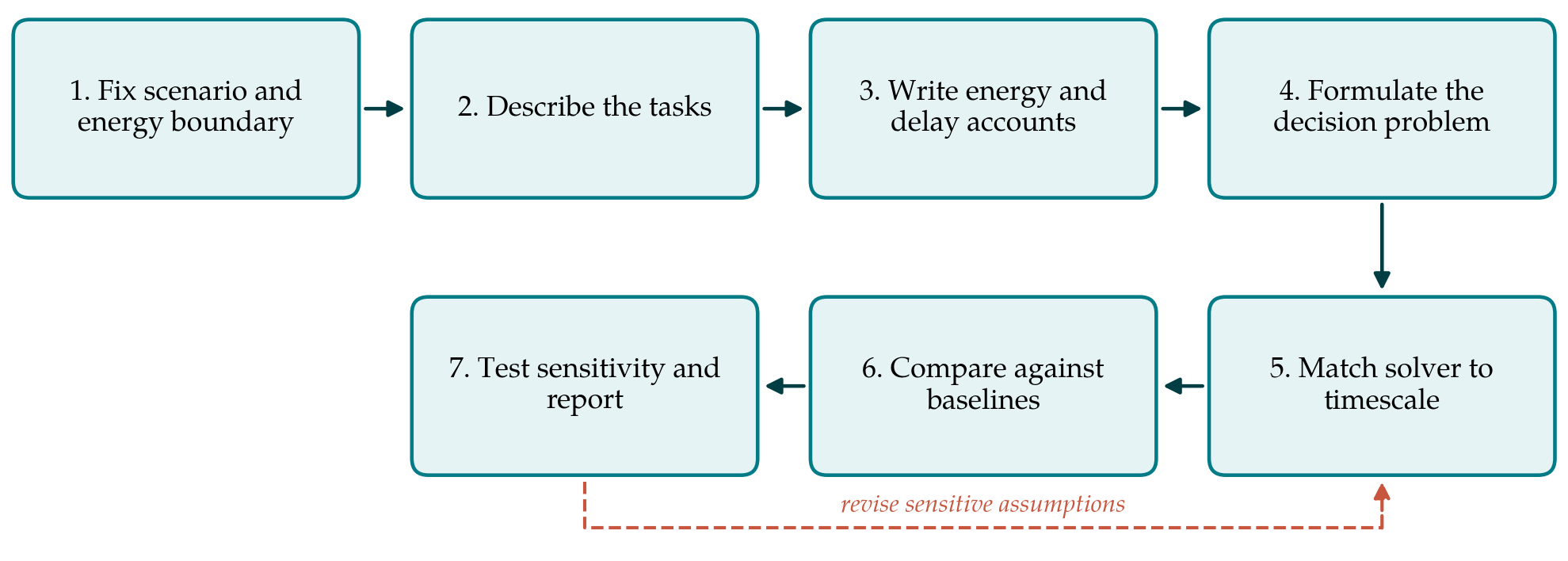
The framework consists of seven steps, shown in sequence in Figure 1. They are ordered so that each fixes something the next one needs. Nothing in them is new taken singly. The contribution lies in requiring all of them and in the record each should leave.
3.1. Step 1: Fix the scenario and the energy boundary
The analyst first describes the deployment: the layout and density of small cells, whether a macro layer is present, the carrier frequency and bandwidth, the frequency reuse pattern, and which sites host servers. A recognised channel model for urban micro cells should be named instead of an ad hoc path-loss exponent (3GPP, 2020). The same step draws the boundary of the energy account. Three choices are defensible: the device alone, the devices plus the edge servers, or the whole access network. The choice must be declared, because offloading by construction moves consumption from batteries to mains-powered equipment, and a study that counts only one side of the transfer will always favour it.
3.2. Step 2: Describe the tasks
Each task is characterised by its input size in bits, its workload in processor cycles, its deadline and the size of the result to be returned. The study should say whether tasks are atomic, so that the choice is binary, or divisible, so that a fraction can be offloaded, and how they arrive: one per user per slot, or as a random stream with queues. The ratio of cycles to bits deserves particular care, since it is the quantity on which the condition of Kumar and Lu (2010) turns, and the values assumed in published studies differ widely. Where no measured workload is available, the framework asks for results across a range of ratios and not at a single convenient value.
3.3. Step 3: Write the energy and delay accounts
Every term inside the boundary chosen in Step 1 is now written down. Table 1 lists the terms, the model usually adopted for each, and the omission most often encountered. Two deserve comment. A device that has offloaded a task does not switch off: it idles, with its radio in a connected state, until the result returns, and the energy of that wait can be comparable to the upload energy for long-running tasks. On the network side, measurements summarised in the widely used base-station power model show that small cells draw a large share of their peak power even when idle (Auer et al., 2011), so the marginal network energy of one more offloaded task is small while the fixed cost of keeping an edge site awake is not.
| Term | Usual model | Frequently omitted |
|---|---|---|
| Local computing energy | 2 κCf with frequency scaling (Burd and Brodersen, 1996) | Limits on the range of frequency scaling |
| Uplink transmission energy | Transmit plus circuit power times task size over rate | Circuit power; interference from other cells |
| Device waiting energy | Idle power times remote execution and return time | Usually the whole term |
| Edge server energy | Idle power plus a load-dependent part | Idle power of servers kept on for few tasks |
| Radio access energy | Load-dependent base-station model (Auer et al., 2011) | Backhaul and cooling |
| Delay | Upload, queueing, execution and download times | Queueing at the server; handover during a task |
3.4. Step 4: Formulate the decision problem
With the accounts in place, the decision variables are listed: for each user, whether or how much to offload, to which cell and server, on which sub-channel, at what transmit power, and with what share of server capacity. The objective is stated as a formula, and if it is a weighted sum of device and network energy or of energy and delay, the weights are given with a reason. Constraints cover deadlines, maximum transmit power, server capacity and, where relevant, backhaul. The analyst should also record the structure of the resulting problem. Joint binary offloading and resource allocation is in general a mixed-integer non-linear programme, and the literature handles it by decomposition into an allocation sub-problem that is convex for fixed decisions and a combinatorial assignment solved heuristically (Tran and Pompili, 2019; Sardellitti et al., 2015). Stating which part is solved exactly and which approximately is part of the formulation.
3.5. Step 5: Match the solution method to the timescale
Dense urban channels change within milliseconds, user positions within seconds and traffic patterns within minutes to hours. A method must be matched to the timescale at which its inputs are known. Convex optimisation with full channel knowledge suits slow, centralised decisions such as server placement or cell association. Game-theoretic updates suit distributed channel selection where users observe only their own interference (Chen et al., 2016). Lyapunov methods suit per-slot control under long-term energy budgets (Mao et al., 2016), and learned policies suit cases where the decision must be produced faster than an iterative solver allows (Huang et al., 2020). The framework asks the analyst to state, for the chosen method, what information it assumes, who holds that information, how much signalling is needed to gather it, and how long a decision takes to compute. The energy of signalling and computation spent on the decision itself belongs in the account when it is not negligible.
3.6. Step 6: Compare against stated baselines
A proposed scheme means little without reference points. Four are required. Executing every task locally and offloading every task to the nearest cell bound the range of interest. A simple greedy rule, such as the priority ordering of You et al. (2017) applied per cell without coordination, shows what coordination adds. An exhaustive or branch-and-bound solution on instances small enough to solve shows how far the heuristic lies from the optimum. Evaluation is by simulation, preferably in a tool that models both radio and computing resources, of which EdgeCloudSim is one openly available example (Sonmez et al., 2018). Results are reported as energy per completed task, broken down by the terms of Table 1, together with the share of tasks that miss their deadline and a measure of how unevenly energy savings are spread among users.
3.7. Step 7: Test sensitivity and report
The last step varies the assumptions that Steps 1 to 3 fixed: cell density, the cycles-to-bits ratio, circuit and idle power, server capacity and the energy boundary itself. A conclusion that reverses when the boundary moves from device to network is still a valid conclusion, but it must be reported as conditional. Where the outcome proves sensitive to an assumption that was chosen for convenience, the analyst returns to the relevant step, as the feedback path in Figure 1 indicates. The final report lists all parameter values, the random seeds and the number of independent runs, and makes the simulation code available where possible.
4. Fitting the Framework to Practice
The framework is meant to be usable by a research student planning a simulation study and by an engineer comparing vendor claims. For the first, Steps 1 to 4 amount to a checklist for the system-model section of a paper, and Steps 6 and 7 for its evaluation section. For the second, the energy boundary and the baseline set are the most useful parts, since a claimed saving can usually be traced to a narrow boundary or a weak baseline. Operators have a further interest. In a dense deployment the practical question is often not which tasks to offload but which edge sites to keep powered at a given hour, and the accounts of Step 3 make that trade visible.
Some simplification is unavoidable. Where a study cannot model the whole access network, the framework accepts a narrower boundary provided it is declared and the excluded terms are discussed qualitatively. Where task workloads are unknown, a parametric sweep is acceptable. What the framework does not accept is silence on these points.
5. Limitations and What Remains to Be Shown
The framework has not been exercised here on any scenario, so its usefulness is argued and not demonstrated. The obvious test is to re-express several published schemes within it, using a common scenario and a common energy boundary, and to see whether their relative merits change. A second test is whether the additional terms it insists on, particularly device waiting energy and idle infrastructure power, alter conclusions often enough to justify the extra modelling effort.
The component models carry their own limits. The quadratic energy-per-cycle law describes dynamic power in a single core and ignores leakage, heterogeneous cores and thermal throttling. The Shannon rate is an upper bound that real modulation and coding approach only within a margin. The base-station power model predates current hardware. Mobility is treated only through the delay account, although a user who changes cell during a task raises questions of service migration that the framework notes without resolving (Mach and Becvar, 2017). Privacy and security of offloaded data lie outside its scope altogether.
6. Conclusion
Energy-aware offloading in dense urban cells is a problem of shared resources, and its answer depends on whose energy is counted. The seven steps proposed here ask a study to declare its scenario and energy boundary, describe its tasks, write out every energy and delay term, formulate the problem openly, justify the solver by the timescale of the decision, compare against fixed baselines and probe its own assumptions. Adopted consistently, these steps would make results from different groups comparable. Whether they also change the conclusions that the field has reached is a question for the applications that should follow.
Conflict of interest
To be declared by the author(s) before publication.
Funding
To be declared by the author(s) before publication.