1. Introduction
Natural gas has long been attractive as a spark ignition engine fuel. Methane has the highest hydrogen-to-carbon ratio of any hydrocarbon, so it produces less carbon dioxide per unit of energy than petrol or diesel, and its high knock resistance allows compression ratios well above those of petrol engines (Korakianitis et al., 2011). Heavy-duty gas engines for buses, trucks and stationary power have often been run lean, with considerable excess air, because dilution lowers flame temperature and with it both heat loss and the formation of nitrogen oxides (Heywood, 1988).
The difficulty is that methane burns slowly. Its laminar burning velocity is low among common fuels and falls steeply as the mixture is leaned. A lean natural gas charge therefore takes longer to develop a self-sustaining flame after the spark, burns later in the expansion stroke, and is more easily disturbed by the random motion of the charge near the plug. The visible result is cycle-to-cycle variation in cylinder pressure, then occasional partial burns, and finally misfire, which sends unburned methane, itself a strong greenhouse gas, into the exhaust.
Hydrogen has the opposite character: a very high burning velocity, a wide flammability range and a low ignition energy (White et al., 2006; Verhelst and Wallner, 2009). The idea of adding a limited amount of hydrogen to natural gas, so as to borrow some of these properties without the storage and abnormal combustion problems of neat hydrogen, goes back at least to the engine tests of Nagalingam et al. (1983). The blend is now generally called hydrogen-enriched compressed natural gas, or HCNG. This article reviews what the literature says about its effect on combustion stability in lean-burn engines.
2. Scope and Approach
This is a narrative review of the published literature. It draws on standard texts on engine combustion, on flame studies of methane-hydrogen-air mixtures, on engine experiments reported in the archival journals and technical paper series of the field, and on earlier reviews (Akansu et al., 2004; Mehra et al., 2017). It is selective, not exhaustive, and it makes no attempt at pooled quantitative analysis, since the engines and test conditions differ too widely for that. Hydrogen fractions are quoted by volume throughout, which is the usual convention, and the reader should keep in mind that a given volume fraction corresponds to a much smaller share of the fuel energy.
3. Why Lean Natural Gas Combustion Becomes Unstable
Stability in this context means repeatability from one engine cycle to the next. No two consecutive cycles in a spark ignition engine are identical, and the surveys of Young (1981) and Ozdor et al. (1994) trace the scatter to a small set of causes: variation in the motion of the charge near the spark plug at the moment of ignition, variation in the local mixture strength and residual gas content, and variation in the spark discharge itself.
3.1. How stability is measured
The usual measure is the coefficient of variation of indicated mean effective pressure, computed over a few hundred consecutive cycles from the cylinder pressure record. Matekunas (1983) showed that other pressure-derived quantities, such as the peak pressure and the crank angle at which it occurs, respond differently to fast and slow cycles and can be used to separate the modes of variability. A coefficient of variation of about ten per cent is the level at which Heywood (1988) notes that drivability suffers, and many laboratories adopt a stricter working threshold to define the lean operating limit. Because the threshold is a convention, lean limits reported by different groups are not directly comparable unless the criterion is the same.
3.2. The role of early flame development
The decisive period is the first few millimetres of flame travel. A flame kernel that is small compared with the turbulent eddies around it is moved about and distorted by them, and its growth rate depends strongly on the laminar burning velocity of the mixture. Quader (1976) distinguished two ways in which a lean engine can fail: the spark may not establish a flame at all, or a flame may be established and then propagate too slowly to finish before the exhaust valve opens. Both failure modes become more likely as the burning velocity falls. Near the limit the process also acquires memory, since a poor cycle leaves residual gas rich in unburned fuel that strengthens the next, and Daw et al. (1996) showed that a simple model of this feedback reproduces the alternating patterns seen in lean engines.
4. How Hydrogen Changes the Flame
The case for hydrogen enrichment rests on flame properties that have been measured outside the engine. Measurements with spherically expanding flames show that the laminar burning velocity of natural gas and methane mixtures rises as hydrogen is added, slowly at first and then much more steeply once hydrogen dominates the blend (Huang et al., 2006; Halter et al., 2005). Di Sarli and Di Benedetto (2007) describe the same behaviour from detailed kinetic calculations and identify a methane-dominated regime, at the modest hydrogen fractions of interest for engines, in which the gain is roughly linear and comparatively small. The implication is that the benefit of practical blends cannot be explained by unstretched burning velocity alone.
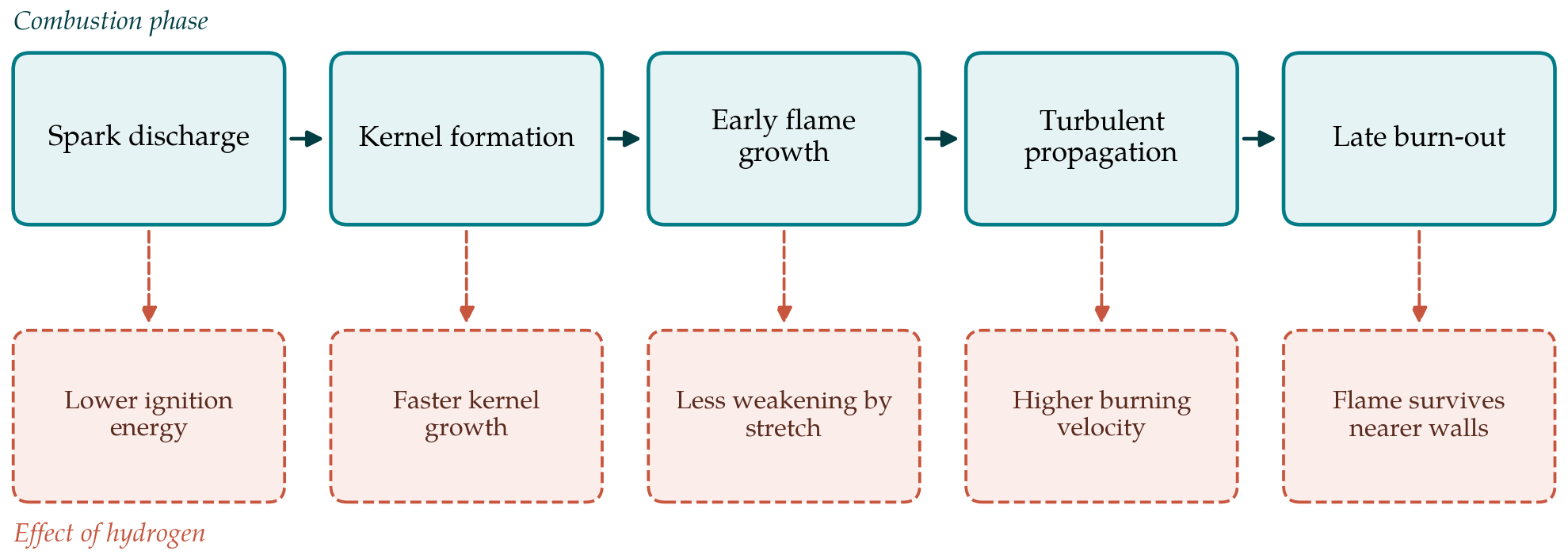
Two further effects matter. The first is chemical: hydrogen raises the concentration of the hydrogen, oxygen and hydroxyl radicals that drive chain branching, which widens the lean flammability limit and reduces the energy needed for ignition. The second concerns flame stretch. A small, strongly curved kernel is stretched, and its response depends on the balance between heat conduction and the diffusion of the deficient reactant, expressed by the Lewis number (Law, 2006). Hydrogen diffuses far faster than methane, so lean hydrogen-containing flames are less weakened, and may be strengthened, by positive stretch. A kernel that would be slowed or extinguished in lean methane is therefore more likely to survive. Hydrogen also has a shorter quenching distance than methane, so the flame persists closer to cold walls in the final stage of the burn. Figure 1 relates these effects to the successive phases of combustion in the engine.
5. Evidence From Engine Experiments
The engine literature can be grouped by the question each study asked. Table 1 sets out the main themes with representative sources, and the paragraphs that follow take the two themes closest to stability in turn.
| Theme | Consistent finding | Representative sources |
|---|---|---|
| Lean operating limit | Limit moves to leaner mixtures as hydrogen fraction rises | Bauer and Forest, 2001; Ma and Wang, 2008 |
| Cyclic variability | Variation in indicated pressure falls at a given lean mixture | Ma et al., 2008; Wang et al., 2008 |
| Burn duration | Flame development period shortens more than the main burn | Ma et al., 2007; Dimopoulos et al., 2008 |
| Spark timing | Less advance is needed for best torque | Nagalingam et al., 1983; Sierens and Rosseel, 2000 |
| Nitrogen oxides | Rise at fixed mixture and timing; offset by leaning or dilution | Akansu et al., 2004; Hu et al., 2009 |
| Knock and power | Knock margin and volumetric energy fall at high hydrogen fractions | Karim et al., 1996; Mehra et al., 2017 |
5.1. Extension of the lean limit
Every study that has looked for it reports that the lean operating limit moves to weaker mixtures as hydrogen is added. Bauer and Forest (2001) found this in a single-cylinder research engine across a range of methane-hydrogen blends, and Ma and Wang (2008) found it in a multi-cylinder natural gas engine, where they also examined how load, speed and spark timing shift the limit. The analytical work of Karim et al. (1996) anticipated the result from the shortening of the combustion period. Engine speed and turbulence matter here: conditions that already produce fast burning leave less for hydrogen to add, which is one reason the size of the extension differs between engines. Sierens and Rosseel (2000) concluded from this dependence on operating point that no single blend is best everywhere and proposed varying the hydrogen fraction with load.
5.2. Cycle-to-cycle variation
Studies that recorded cylinder pressure over many consecutive cycles give the most direct evidence. Ma et al. (2008) and Wang et al. (2008) both report that, at a fixed lean mixture, the coefficient of variation of indicated mean effective pressure falls as the hydrogen fraction rises, and that the improvement is largest close to the lean limit of the base fuel and small near stoichiometric conditions, where natural gas alone already burns stably. Both attribute the effect mainly to the shortening and steadying of the flame development period, in line with the flame physics outlined above, with a smaller contribution from the main burn.
Dimopoulos et al. (2008) reached a compatible conclusion for a passenger car engine and pointed to a further use of the added stability: it increases tolerance to exhaust gas recirculation. A stoichiometric engine with a three-way catalyst can then be run with more recirculated gas for efficiency without the instability that natural gas alone would show. Hu et al. (2009) likewise found that hydrogen restores much of the stability lost when recirculated exhaust is introduced. Lean air dilution and exhaust dilution stress the flame in a similar way, and hydrogen helps with both.
6. Trade-Offs That Accompany the Stability Gain
The stability gain is not free. At a fixed air-fuel ratio and spark timing, faster burning raises peak temperature and with it the formation of nitrogen oxides, a point on which the reviews agree (Akansu et al., 2004; Mehra et al., 2017). The benefit appears only when the extra stability is spent on leaner operation or more dilution, with spark timing retarded to suit the faster burn, as Ma et al. (2007) showed in their study of efficiency and emissions. An engine calibrated for natural gas and simply refuelled with HCNG may therefore emit more nitrogen oxides, not less.
Hydrogen also lowers the knock resistance of the blend, which matters in engines whose compression ratio was chosen for methane, and at high fractions it brings the backfire and pre-ignition risks documented for hydrogen engines (Verhelst and Wallner, 2009). Because hydrogen carries little energy per unit volume, the energy content of the cylinder charge and of a storage tank at a given pressure both fall as the fraction rises (Karim et al., 1996). These considerations explain why most demonstration work has settled on modest blends, in which hydrogen makes up a minor share of the fuel volume and a far smaller share of its energy.
7. Gaps and Directions for Further Work
Several limits of the evidence deserve to be stated. Most published results come from engines converted from diesel or petrol designs, at steady speed and load, with certified gas compositions. Pipeline natural gas varies in its ethane, propane and inert content, and how that variation interacts with hydrogen addition near the lean limit has received little systematic attention. Transient operation, in which mixture excursions push individual cycles past the limit, is seldom reported, although it is the condition that decides whether a lean calibration is usable on the road.
Comparability is a second weakness. Stability criteria, the number of cycles recorded, the definition of the lean limit and even the basis on which hydrogen fraction is expressed differ between papers, so that the literature supports firm statements about direction and only loose ones about size. Agreement on a reporting convention would allow the existing body of work to be combined. A third gap lies in ignition systems. Prechamber, high-energy and corona ignition also strengthen early flame development, and whether their benefit adds to that of hydrogen or merely duplicates it has not been settled.
8. Conclusion
The published evidence gives a coherent account. Lean natural gas combustion becomes unstable because the early flame grows slowly and is vulnerable to stretch and to the random flow at the spark plug. Hydrogen addresses exactly that stage: it eases ignition, speeds kernel growth and makes the young flame more robust. Engine experiments from several laboratories agree that this extends the lean limit and reduces cycle-to-cycle variation, most strongly where the base fuel is closest to failure. The size of the effect depends on the engine and on the criterion used, and the gain must be traded against nitrogen oxides, knock margin and energy density. Standardised reporting, transient testing and work on realistic gas compositions would do most to turn a well-established tendency into design guidance.
Conflict of interest
To be declared by the author(s) before publication.
Funding
To be declared by the author(s) before publication.