1. Introduction
Threshing separates the grain from the panicle, and in rice it must be done within days of cutting if quality is to be kept. By hand, by beating sheaves on a board or treading them under animals, it is among the heaviest tasks of the season. It is also among the easiest to mechanise. The machine stands still, the crop is brought to it, and the power it needs is small but well beyond what a person can sustain. Economists of mechanisation have long observed that power-intensive stationary operations such as threshing, milling and pumping are mechanised early, even where wages are low and field operations are still done by hand (Binswanger, 1986; Pingali, 2007).
In the hills the case is sharper. Terraces are narrow, holdings are scattered over steep ground, and the out-migration of working-age men has left harvest labour short in many mountain districts of South and Southeast Asia. Small engines have spread widely through rural Asia by way of local markets and workshops, with little help from formal programmes (Biggs and Justice, 2015), and the engine-driven thresher carried from terrace to terrace is one of their common uses. The tractors and combine harvesters that have spread across the plains of Nepal, to take one documented example, remain concentrated there and are largely absent from the hills (Takeshima, 2017).
Electricity changes the options. A thresher is driven through a belt from a single shaft, and an electric motor can take the place of the engine with a new pulley and a mounting plate. Whether it should is a different question, and one that turns on matters beyond the machine. This review sets out what is known that bears on the decision.
2. Scope and Approach
The article is a narrative review. Published accounts that follow an electric retrofit of a paddy thresher in a hill community from installation through several harvests are few, and none is treated here as representative. The review instead brings together established knowledge from four adjoining literatures: the design of threshing machinery, electric motors and drives, machinery safety, and the economics and sociology of small-scale mechanisation. Standards and textbooks are used where they state settled practice. No systematic search was made, no results are pooled, and no case is reported.
3. What the Thresher Asks of Its Drive
A drive must be matched to a load, and the load presented by a threshing drum has three features that matter for a retrofit.
3.1. Drum types and speed
Small paddy threshers are of two kinds. In the hold-on type the operator holds the sheaf and presents the panicles to a drum fitted with wire loops, so that the straw stays whole; the pedal thresher is the manual form of this machine. In the throw-in type the whole cut crop passes through a drum with spike teeth or rasp bars, usually along its axis, and straw and grain are separated afterwards (Chakraverty et al., 2003). In both, the quantity that governs threshing is the peripheral speed of the drum. Too slow, and grain is left on the straw. Too fast, and grain is cracked or hulled, with the damage rising as the grain dries (Kepner et al., 1978; Srivastava et al., 2006). The acceptable band is fairly narrow, and a drive that holds speed steady under load is worth more than one that is merely powerful.
3.2. Torque, inertia and uneven feeding
Feeding by hand is irregular. Each sheaf or forkful is a brief overload, and between them the drum runs nearly free. The drum's own inertia smooths these pulses, and the drive must supply the average power together with enough reserve torque to recover speed after a heavy feed. A small diesel engine copes through its governor and flywheel, but an engine sized for the peaks spends most of its hours at light load, where the fuel used per unit of work is high (Heywood, 1988). Starting is the third feature. A drum is heavy, and a belt-driven machine started with crop already in the concave demands high torque from rest.
4. Electric Drive Options
Table 1 sets the drive options side by side. The choice among the electric ones is constrained less by the motor than by the supply that reaches the threshing floor.
| Drive | Supply needed | Strengths | Limits |
|---|---|---|---|
| Small diesel or petrol engine | Liquid fuel carried to the site | Independent of any network; familiar to local mechanics | Fuel cost, noise and exhaust; poor efficiency at light load |
| Single-phase induction motor | Household-type connection | Simple and cheap; the commonest rural supply | Limited power; weak starting torque; sensitive to low voltage |
| Three-phase induction motor | Three-phase line or mini-grid | Robust, efficient, good starting torque | Three-phase supply is rare on hill farms |
| Three-phase motor with inverter drive | Single-phase or direct-current input | Soft start; adjustable drum speed | Cost; electronics exposed to dust and moisture |
| Permanent-magnet motor with battery | Solar array or periodic charging | Portable; usable away from any line | Battery cost and life; limited hours per charge |
4.1. Motors
The squirrel-cage induction motor is the default for stationary farm machines. It has no brushes, it tolerates dust if suitably enclosed, and it runs within a few per cent of its synchronous speed from no load to full load, which suits the threshing drum well. On a 50 Hz supply a four-pole machine has a synchronous speed of 1500 revolutions per minute, so the belt ratio that served an engine running at a different speed has to be recalculated. Single-phase versions need a capacitor or auxiliary winding to start, deliver less starting torque than three-phase motors of the same rating, and are made only in small sizes (Hughes and Drury, 2013). International efficiency classes now allow motors to be compared on a common scale (IEC, 2014), although small single-phase motors sold in rural markets often carry no class at all.
Electronic drives widen the choice. A variable-frequency inverter can run a three-phase motor from a single-phase line, bring the drum up to speed gently, and let the operator set drum speed to suit variety and moisture, something no fixed pulley can do. Permanent-magnet and other electronically commutated motors offer higher efficiency in small sizes than induction machines (de Almeida et al., 2014) and are the natural partner of a battery. Against these gains stand cost and fragility. Chaff, awns and monsoon damp are a severe environment for power electronics, and a failed inverter cannot be mended in a village workshop in the way a belt or a bearing can.
4.2. The supply in the hills
Rural electrification in mountain areas usually arrives as a long single-phase line with small conductors, or as an isolated mini-grid fed by a micro-hydro set, a technology well suited to steep streams and widely used in remote hill regions (Paish, 2002). Both are weak supplies in the engineer's sense: voltage sags when a large load is connected. An induction motor draws several times its rated current at the moment of starting, and its torque varies with the square of the voltage, so a motor that starts readily in a workshop may stall at the end of a village feeder, and its starting may dim the lights of every neighbour on the line (Hughes and Drury, 2013). On a small hydro mini-grid the generator itself may be no larger than a few threshers. Harvest also concentrates demand, since every household wants to thresh in the same weeks.
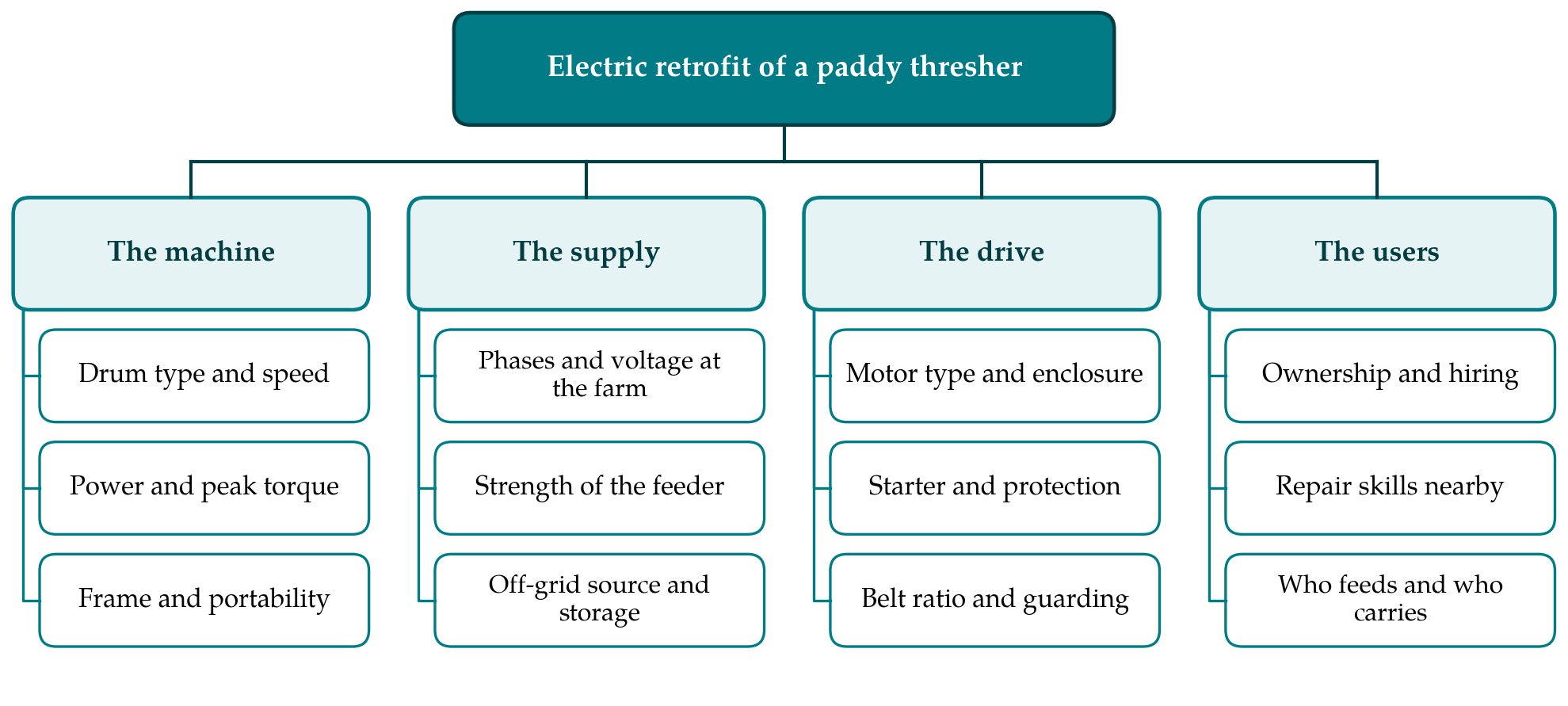
These constraints favour modest motor sizes, soft starting, and agreement among users about when threshing loads may be run. Where there is no line at all, a photovoltaic array with a battery can drive a small thresher, but the battery then becomes the dominant cost and the component most likely to fail first. Figure 1 groups the considerations that a retrofit has to settle, of which the supply is one branch.
5. Mechanical Conversion
The mechanical work is the least uncertain part. The motor is mounted on an adjustable base where the engine sat, or lower in the frame to improve stability, and drives the drum shaft through V-belts. Pulley diameters are chosen to give the drum the same peripheral speed as before, and belt section and number are selected for the motor power with a service factor appropriate to a shock load, as set out in standard machine design texts (Budynas and Nisbett, 2015). Removing the engine removes its mass and its vibration, which usually lightens the machine but may also change how it sits on uneven ground. For a hold-on thresher of the pedal type, the conversion is simpler still, since a small motor replaces the treadle and frees the operator's leg and attention for feeding.
6. Safety
Power threshers have a poor safety record. Work in India combined injury epidemiology with ergonomics to show that serious hand and arm injuries arise at the feeding chute of throw-in machines, and proposed chutes shaped so that the hand cannot reach the drum (Mohan and Patel, 1992; Kumar et al., 2002). A broader review of accidents in Indian agriculture places threshers among the machines most often involved (Nag and Nag, 2004). Unguarded belts and pulleys are the other long-recognised hazard. India legislated on the matter, and the statute names power threshers among the machines it regulates (Government of India, 1983).
A retrofit is an opportunity to correct these faults and a risk of adding new ones. The general method is that of machinery safety standards: identify the hazards, remove them by design where possible, guard what remains, and only then rely on instructions (ISO, 2010). The belt drive needs a fixed guard that cannot be left off (ISO, 2015a). An electric machine can be given what an engine-driven one seldom has, an emergency stop within reach of the person feeding (ISO, 2015b). Electric motors are also quiet, and a quiet drum does not announce that it is turning. The new hazards are electrical. A thresher works outdoors, among dust and damp straw, at the end of a trailing cable, and is handled by people standing on wet ground. The motor and switchgear need an enclosure rated against dust and splashing water under the international code (IEC, 2013), and the installation needs sound earthing, overload protection and a residual current device. These are inexpensive, and they are the items most often left out.
7. Ownership, Hiring and Repair
A thresher works for a few weeks a year, and on a single hill farm for a few days. Machines of this kind are seldom owned for one household's use. Across Asia the usual arrangement is the hire service, in which an owner threshes for neighbours for a fee or a share of the grain, and the growth of such services explains how very small farms came to use machines at all (Diao et al., 2020). The same model is now urged for smallholders in Africa (Sims and Kienzle, 2016). An engine-driven thresher suits this trade because it can be carried anywhere. A mains motor ties the machine to a socket and a length of cable. In a compact village with a shared threshing floor that is no hardship. Where fields are far from houses, the sheaves must be carried to the machine, and the labour saved in threshing may be spent again on the path.
Repair is the other practical question. The spread of small engines created a dense network of mechanics who can strip and rebuild them (Biggs and Justice, 2015). Skills in motor rewinding and electrical fault-finding are thinner on the ground in hill districts, and a burnt-out motor in harvest week is a serious loss. Low supply voltage is a common cause of such failures, which brings the argument back to the feeder.
8. Gaps and Future Work
The principal gap is evidence from the field. Energy use per tonne threshed, grain damage, output per hour, breakdowns and the cost of the service have not been compared for engine and electric drive on the same machine, through whole harvests, with the supply voltage logged. Until such comparisons exist, claims of savings rest on calculation. Little is known about how mini-grid operators manage threshing loads, or about tariffs that would encourage daytime threshing when lighting demand is low. The safety of retrofitted machines in use has not been audited. Battery-electric portable threshers are too recent for their service life in hill conditions to be known. Finally, the effect of a quieter, cleaner and lighter machine on who operates it, including whether more women take up the work and on what terms, is an open and practical question.
9. Conclusion
Fitting an electric motor to a small paddy thresher is mechanically simple, and the induction motor suits the steady-speed, pulsed load of the drum. The difficulties lie around the machine. Hill supplies are weak and single-phase, so motor size and starting method must be chosen for the feeder as much as for the thresher. Electrical protection and guarding must be designed in, since the conversion is the one moment at which they can be added cheaply. Portability and repair, which engines provide by default, have to be arranged. The literature supports the retrofit in principle and cannot yet say how it performs in practice.
Conflict of interest
To be declared by the author(s) before publication.
Funding
To be declared by the author(s) before publication.