1. Introduction
Work at manual stations, whether assembly, packing, inspection or machine tending, exposes the body to awkward postures, repeated movements and exerted forces. The epidemiological evidence that these exposures are associated with disorders of the back, neck and upper limbs is substantial, although the shape of the exposure-response relationships remains debated (Punnett and Wegman, 2004). Industrial engineers therefore need a way to rate workstations, to decide which to redesign first and to check whether a redesign helped.
The instruments in common use are observational. David (2005) groups exposure assessment methods into self-reports, observational methods and direct measurement, and notes that practitioners favour observation because it is cheap and fits the working day, while direct measurement gives more exact data at greater cost in equipment and analysis. That trade has shifted. Inertial measurement units are now small, wireless and affordable, and a narrative review by Lim and D'Souza (2020) documents their growing use in occupational ergonomics.
This article proposes a protocol for using such sensors to produce posture-based risk scores at manual workstations. It is a methodological proposal. No measurements are reported, and the protocol has not been validated in this article. Its purpose is to set out a complete and checkable sequence that a plant or a research group could adopt and then test.
2. Background
The protocol joins two traditions, and the strengths and weaknesses of each shape its design.
2.1. Observational scoring methods
The Rapid Upper Limb Assessment of McAtamney and Corlett (1993) assigns scores to the posture of the upper arm, lower arm, wrist, neck, trunk and legs from angle bands, adjusts them for muscle use and for force or load, and combines them through tables into a grand score from 1 to 7 with four action levels. The Rapid Entire Body Assessment of Hignett and McAtamney (2000) follows the same logic for whole-body tasks and adds terms for coupling and activity. For static postures the standard ISO 11226 gives acceptable angle ranges with holding times (ISO, 2000), and for lifting the revised NIOSH equation computes a recommended weight limit from the geometry and frequency of the lift (Waters et al., 1993).
These methods were designed for the eye. An observer selects a posture judged to be the worst or the most frequent and classifies it. Reviews have pointed out the consequences: the result depends on which moment is chosen, angles near a band boundary are classified inconsistently, and duration and repetition are captured crudely (Li and Buckle, 1999). A systematic evaluation of observational methods by Takala et al. (2010) found that evidence on their validity and repeatability was uneven and that no single method suited all purposes.
2.2. Inertial motion capture
An inertial measurement unit contains a three-axis gyroscope and accelerometer, usually with a magnetometer. A fusion algorithm combines the three signals into an estimate of the unit's orientation in space: the gyroscope follows fast movement, gravity corrects inclination, and the magnetic field corrects heading. The principles and error sources are reviewed by Sabatini (2011), and a widely used computationally light filter is that of Madgwick et al. (2011). With a unit on each body segment and a calibration that relates unit axes to anatomical axes, joint angles follow from the relative orientation of adjacent segments. Comparison with optoelectronic systems has shown close agreement for whole-body movement in the laboratory, with larger differences in some axes and in long or complex tasks (Robert-Lachaine et al., 2017).
The step from joint angles to risk scores has also been demonstrated. Vignais et al. (2013) computed RULA scores continuously from inertial sensors and goniometers and returned them to the worker in real time. The idea is therefore established. The contribution attempted here is a protocol that makes the many small decisions explicit.
3. Design Principles
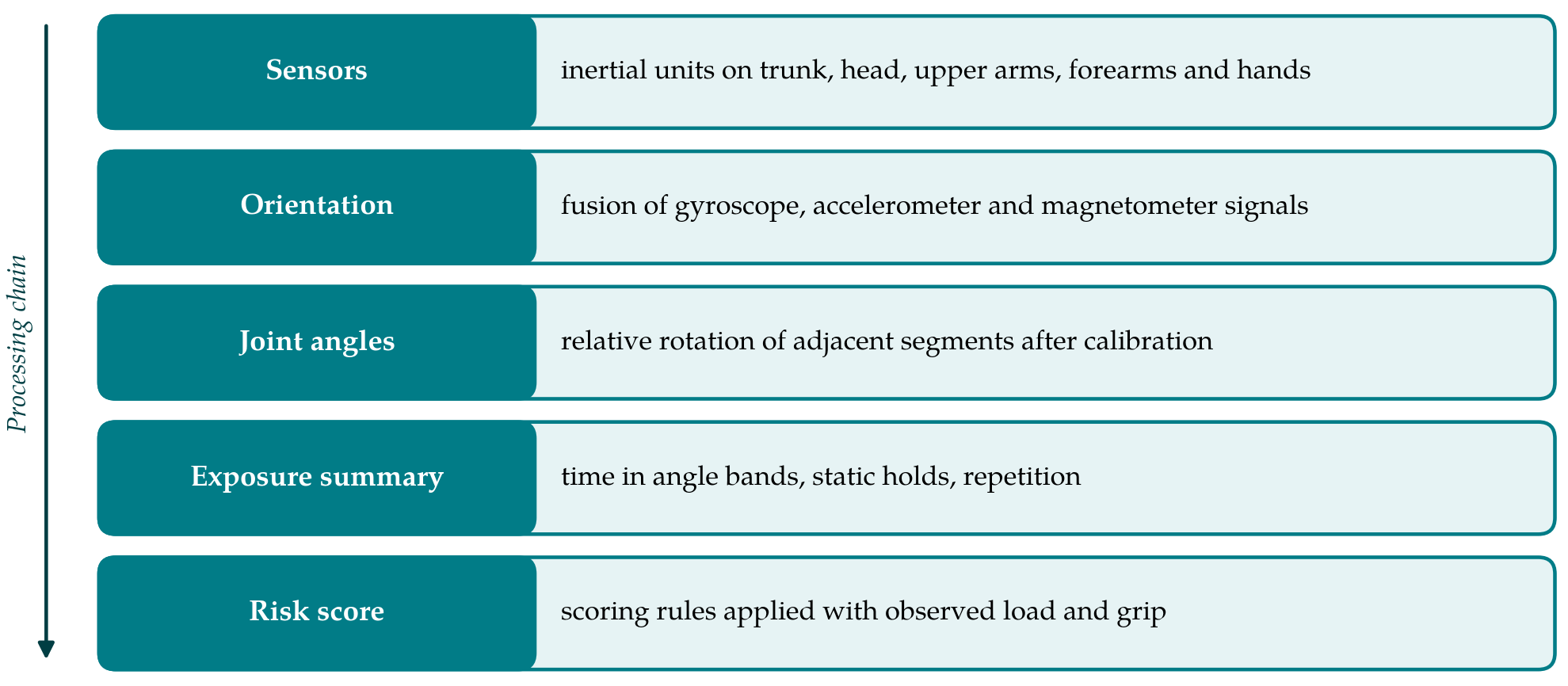
Four principles govern the protocol. The scoring rules of the published methods are applied unchanged, so that results remain comparable with those of trained observers. Every input a method requires is traced to a stated source, sensor or observer, and nothing is filled in silently. Scores are reported as distributions over the work cycle and not as a single number alone. And the record is assembled so that another analyst could repeat the processing from the stored data. Figure 1 shows the processing chain from sensors to score.
4. The Protocol
The protocol has six parts, described in the order in which they are carried out.
4.1. Preparation and consent
The analyst defines the workstation, the task and its cycle, the product variants to be covered, and the scoring method: RULA for seated or standing work dominated by the upper limbs, REBA where the whole body moves or loads are handled. Workers are told what will be recorded, why, and who will see the results, and they take part only with written consent, which they may withdraw. Where the work forms part of research, the principles of the Declaration of Helsinki apply (World Medical Association, 2013). Movement recordings are personal data. In the European Union their processing falls under the General Data Protection Regulation (European Union, 2016), and comparable rules exist elsewhere. The protocol requires that data be stored under a code, that results be reported for the workstation and not for the individual, and that the recordings not be used to appraise performance. Worker representatives should be consulted before the first recording.
4.2. Instrumentation and calibration
For upper-body scoring, units are placed on the pelvis, the sternum, the head, both upper arms, both forearms and both hands; for whole-body scoring, the thighs and shanks are added. Units are fixed with straps over or under work clothing so that they neither slip nor hinder the task, and protective equipment is worn as usual. Calibration follows the manufacturer's procedure, typically a neutral standing pose held for a few seconds and sometimes a set of prescribed movements. Joint angles are defined according to the recommendations of the International Society of Biomechanics for the upper limb (Wu et al., 2005). Because steel structures, motors and tools distort the local magnetic field, the analyst checks the field at the workstation before recording and, if it is disturbed, uses a fusion mode that does not rely on the magnetometer and shortens the recording blocks.
4.3. Recording
The worker performs the normal job at the normal pace. Enough consecutive cycles are recorded to cover the variants and the natural variation between cycles, after a settling period in which the worker becomes used to the sensors. A video is recorded in synchrony, with consent, to identify task elements and to supply what sensors cannot. The neutral pose is repeated at the end of each block, so that drift can be detected by comparing the first and last poses. Loads handled, forces exerted, the quality of grip, and any support of the arms or body are noted by the analyst, using a scale or force gauge where practicable.
4.4. From orientation to joint angles
Processing produces, for each sample, the angles that the scoring method needs: trunk flexion, side bending and twist; neck flexion, side bending and twist; upper-arm elevation and abduction; elbow flexion; forearm rotation; wrist flexion and deviation; and for REBA, knee flexion. Samples in which a unit lost its signal are marked and excluded, not interpolated across long gaps. Inclination angles, which depend on gravity, are more trustworthy than rotations about the vertical, which depend on the magnetometer or on integration of the gyroscope (Sabatini, 2011). The record states which angles are of the less reliable kind.
4.5. From joint angles to scores
The angle bands and tables of the chosen method are applied to every sample, with the observed load, coupling and muscle-use terms held constant within each task element. Table 1 lists the inputs of the two methods and the source the protocol assigns to each. Three summaries are then computed for the cycle: the proportion of time spent at each action level, the highest score sustained for a stated minimum duration, and the time-weighted mean. The first is the primary result. To prevent flicker between adjacent bands from inflating the count of posture changes, a small tolerance is applied at each boundary before a change of band is registered. The muscle-use term, which in the original methods depends on whether a posture is held or repeated, is derived from the angle signals themselves by rule and reported with the rule used.
| Input | Used in | Source in the protocol | Remark |
|---|---|---|---|
| Trunk flexion, side bending, twist | Both | Pelvis and sternum units | Twist depends on heading; flag if field disturbed |
| Neck flexion, side bending, twist | Both | Head and sternum units | Helmet or visor may dictate placement |
| Upper-arm elevation, abduction | Both | Upper-arm and sternum units | Shoulder raising not sensed; observed from video |
| Elbow flexion, forearm rotation | Both | Upper-arm and forearm units | Soft-tissue movement affects rotation |
| Wrist flexion, deviation | Both | Forearm and hand units | Gloves and tools limit hand placement |
| Leg posture and support | Both | Leg units for REBA; observation for RULA | Seated or standing noted by analyst |
| Load or force | Both | Analyst: scale or force gauge | Not measurable by inertial units |
| Coupling (grip quality) | REBA | Analyst: observation | Recorded per task element |
4.6. Quality checks and reporting
A report under the protocol contains the task description, the sensor set and placement, the calibration procedure, the fusion mode, the result of the magnetic check, the share of excluded samples per segment, the drift between first and last neutral poses, the observed inputs with their sources, and the three summaries. Results are presented beside the task elements identified from the video, so that the reader can see which part of the job produces the high scores. That link, more than the score itself, is what a redesign needs.
5. Checking the Protocol Before Routine Use
Before the protocol is relied on, its scores should be compared with a reference. Two comparisons are proposed. In the laboratory, joint angles from the sensors are compared with those from an optoelectronic system during simulated workstation tasks, and agreement is expressed by the limits of agreement of Bland and Altman (1986) and not by correlation alone. At the workplace, sensor-derived scores are compared with scores given independently by several trained observers to the same recorded cycles, and reliability among observers and between the two approaches is expressed by an intraclass correlation coefficient chosen and reported as recommended by Koo and Li (2016). Disagreement should be examined band by band, since it is expected to concentrate where angles lie close to a boundary and where the observer and the algorithm weight duration differently.
6. Limitations and What Remains to Be Shown
The protocol is a proposal and has not been tested in this article. Its limitations are of three kinds. Inertial sensing has known weaknesses: heading drift, magnetic disturbance, and movement of the units relative to the bone. Scoring has inherited weaknesses: RULA and REBA are screening tools whose thresholds rest largely on expert judgement, and a continuous record does not make them more valid. A sensor-derived score is not interchangeable with an observer's score, because the methods were defined for selected postures, so results from the two should not be mixed in one comparison without the agreement study described above.
The third kind concerns interpretation. What is established is that posture, force and repetition contribute to musculoskeletal load. What is uncertain is how well any posture-based score predicts disorder in the individual worker or even in a group, and the protocol does nothing to settle that. Its scores rank workstations and task elements for attention. They are not a diagnosis, and decisions about an individual's health or fitness for work belong to occupational health professionals.
7. Conclusion
Body-worn inertial sensors can supply most of the postural inputs that RULA and REBA require, and they supply them for every moment of the cycle. The protocol proposed here specifies the sensor set, calibration, recording, processing, scoring and reporting needed to turn that capability into a repeatable assessment, keeps the published scoring rules intact, and names the inputs that still depend on an observer. It treats consent and data protection as parts of the method. Whether its scores agree well enough with expert observation to be used alongside it is the first question for those who take it up.
Conflict of interest
To be declared by the author(s) before publication.
Funding
To be declared by the author(s) before publication.