1. Introduction
Colonoscopy prevents colorectal cancer only to the extent that it finds and removes precursor lesions, and endoscopists differ widely in how many they find. The adenoma detection rate, the proportion of screening examinations in which at least one adenoma is identified, has become the main measure of that difference. Patients examined by endoscopists with low rates have more cancers diagnosed in the years after a clear colonoscopy (Kaminski et al., 2010), and in a large American cohort each one per cent increase in the rate was associated with a three per cent fall in the risk of interval cancer (Corley et al., 2014). Studies in which patients undergo two examinations in succession show that a meaningful share of adenomas is missed the first time.
Computer-aided detection, usually abbreviated CADe, was developed to narrow this gap. A neural network trained on annotated endoscopic images analyses the video stream and places a box or other marker around any region it classifies as a possible polyp. The endoscopist decides what to do with each alert. Within a few years the technology has moved from research prototypes to a standard option on commercial processors, and managers of ordinary units now have to decide whether to buy it and how to use it. This Perspective offers a view on that decision.
2. What the Randomised Trials Established
The early trials were consistent. A single-centre study in China reported a clear rise in adenoma and polyp detection with a real-time system (Wang et al., 2019), and a multicentre Italian trial confirmed the effect among experienced endoscopists without a lengthening of withdrawal time (Repici et al., 2020). A tandem trial, in which each patient had two examinations in random order, found that the miss rate for neoplasia was roughly halved when CADe was used first (Wallace et al., 2022). Meta-analyses of the randomised evidence have repeatedly shown a higher detection rate with assistance (Hassan et al., 2021).
The same body of evidence has limits that are often left out of summaries. The additional lesions are mostly small. A later meta-analysis found that CADe increased the detection of adenomas but not of advanced adenomas, and increased the removal of polyps that proved not to be neoplastic (Hassan et al., 2023). The trials could not blind the endoscopist, and none was large or long enough to measure interval cancer, which is the outcome that matters to patients. The link between detection and cancer is well supported for conventional colonoscopy (Corley et al., 2014). Whether detection gained through software carries the same benefit is an inference.
3. What Happened in Routine Practice
When units began to use CADe outside trials, the results were mixed. A pragmatic implementation study at an American academic centre found no improvement in detection after the system was switched on for all endoscopists (Ladabaum et al., 2023). A report from an Israeli centre likewise saw no increase in routine use (Levy et al., 2022), and a randomised trial in community practices in the United States did not show a significant difference in adenoma detection (Wei et al., 2023).
Several explanations have been offered. Endoscopists in a pragmatic study are not selected for enthusiasm and may ignore alerts or leave the system off. Baseline detection in some of these units was already high, leaving little room for improvement. And an endoscopist who knows that an examination is part of a trial may withdraw more carefully in both arms, which makes a trial an imperfect guide to an ordinary Tuesday list. None of these explanations implies that the trials were wrong. They suggest that the effect of CADe depends on the conditions in which it is used.
4. The Argument: An Aid Within a Quality Programme
A lesion can be missed for two different reasons. It may never appear on the screen, because it lies behind a fold, under residual stool or in a segment passed too quickly. Or it may appear and go unrecognised, because it is flat, pale or briefly in view and the endoscopist's attention is elsewhere. CADe can help only with the second. Software cannot analyse mucosa that the camera has not seen. Exposure depends on bowel preparation, on a deliberate withdrawal technique and on adequate time, and longer withdrawal was associated with higher detection long before artificial intelligence arrived (Barclay et al., 2006).
Seen this way, the trial and real-world results fit together. In a trial centre with good preparation and disciplined technique, most of the mucosa is exposed, recognition is the remaining weakness, and CADe corrects part of it. In a unit where exposure is the main problem, the software has less to work with. The place of CADe in everyday practice follows directly. It is an adjunct to a functioning quality programme of the kind set out in professional standards (Rex et al., 2015), and its benefit should be expected in proportion to how well the rest of that programme works. Table 1 sets out what the technology can reasonably be expected to do and what remains the responsibility of the unit.
| Cause of missed lesions | Effect of CADe | What the unit must still do |
|---|---|---|
| Polyp on screen but not recognised | Direct: an alert draws the eye | Train staff to assess every alert and not dismiss by habit |
| Mucosa hidden by folds or flexures | None | Teach and monitor withdrawal technique |
| Poor bowel preparation | None; debris may trigger false alerts | Audit preparation quality and split-dose regimens |
| Hurried withdrawal | None | Protect list time; record withdrawal time |
| Subtle serrated or flat lesions | Uncertain; less trial evidence | Report serrated lesion detection separately |
| Fatigue late in a list | Plausible support for attention | Sensible scheduling; do not rely on software alone |
5. Objections and Counter-Arguments
The first objection is that this position is too cautious. If randomised trials show a benefit and the device is safe, units should simply adopt it. The difficulty is that professional bodies reading the same evidence have not agreed. The European Society of Gastrointestinal Endoscopy has set out the performance that artificial intelligence would need to deliver to be of value in endoscopy (Messmann et al., 2022), while the living guideline of the American Gastroenterological Association made no recommendation for or against CADe, citing uncertainty about long-term outcomes and burdens (Sultan et al., 2025). Reasonable readers of the same trials differ.
The second objection concerns cost. A modelling study concluded that CADe in screening colonoscopy could reduce cancer incidence and save money over the long term (Areia et al., 2022). That conclusion rests on the assumption that the detection gains seen in trials are achieved in practice and translate into prevented cancers. The costs, by contrast, are immediate and certain: licences, more polypectomies, more pathology, and more patients placed in intensive surveillance because a small additional adenoma moved them into a higher risk group (Mori et al., 2023).
A third concern is what the technology does to the endoscopist. Research on automation in other fields describes complacency, in which operators monitor less closely once a reliable aid is present (Parasuraman and Manzey, 2010). An observational study in Polish centres reported that detection during unassisted colonoscopy fell after endoscopists had become used to working with CADe (Budzyń et al., 2025). The finding needs replication and has alternative explanations, but it is a reminder that an aid may change the skill it supports. False alerts, which are frequent, add a further cost in distraction, although trials have not shown that they prolong the procedure to an important degree.
6. Implications for Everyday Units
If the argument is accepted, the practical question changes from whether to buy CADe to what must be in place before and after it is switched on. Figure 1 pairs each stage of adoption with the safeguard that should accompany it. Procurement should rest on published evidence for the specific system, since algorithms differ and results for one do not transfer automatically to another. Before use, the team should revisit withdrawal technique, so that the software is added to good practice and not substituted for it.
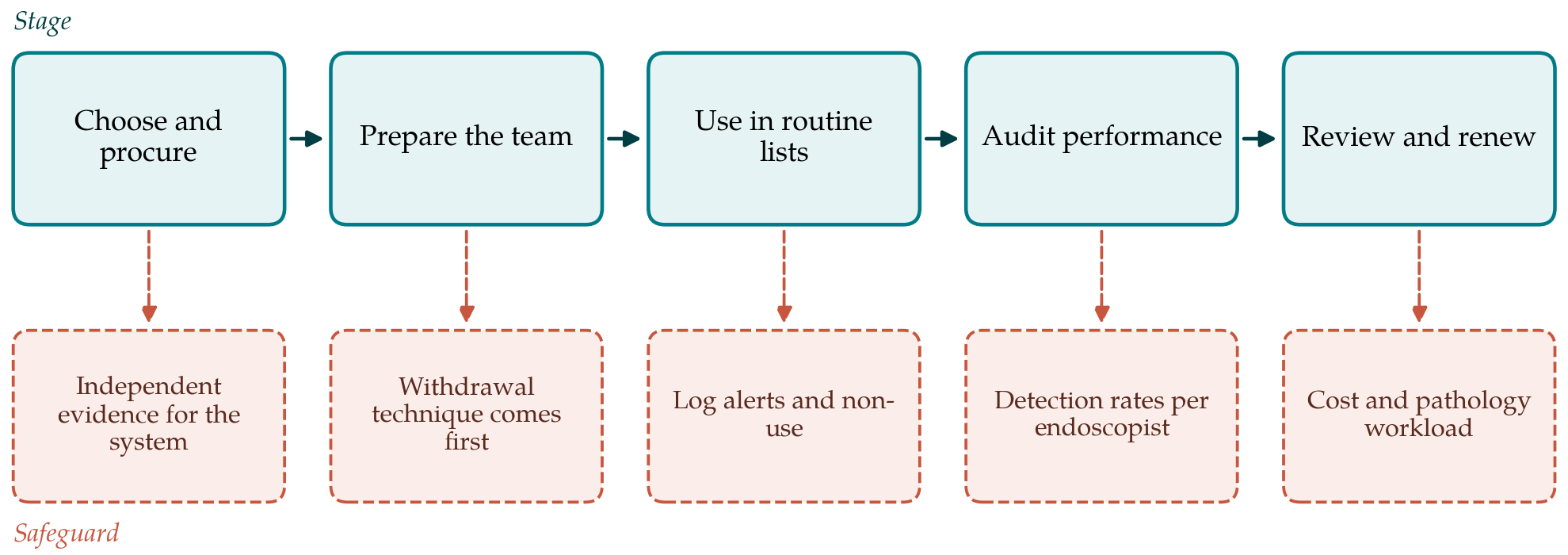
During routine use, the unit should record when the system was on, and it should measure adenoma and serrated lesion detection for each endoscopist before and after introduction, with unassisted lists included where they still occur. A unit that cannot produce these figures cannot know whether its purchase has helped. The audit also identifies the endoscopists with low baseline rates, who stand to gain most and who may need training more than software. Finally, the decision should be revisited when the licence is renewed, with the local data, the pathology workload and the surveillance consequences on the table.
For patients, honesty about the evidence is appropriate. It is fair to say that the system helps the endoscopist notice small polyps. It is not yet possible to say that a colonoscopy with CADe protects against cancer better than a careful one without it.
7. Conclusion
Computer-aided detection is a real advance in one part of the task of colonoscopy, the recognition of lesions that are in view. It leaves untouched the part that depends on preparation, technique and time. Everyday endoscopy units should treat it as a component of quality improvement whose local effect has to be measured, and should resist the idea, convenient as it is, that a software licence can discharge the obligation to examine the colon well.
Conflict of interest
To be declared by the author(s) before publication.
Funding
To be declared by the author(s) before publication.