1. Introduction
For most of the twentieth century, hunger and obesity were mapped onto different parts of the world. Nutrition programmes in poor countries dealt with underweight, stunting and micronutrient deficiency; obesity was a concern of rich ones. That division no longer holds. The World Health Organization defines the double burden of malnutrition as the coexistence of undernutrition with overweight, obesity or diet-related noncommunicable disease, within individuals, households and populations, and across the life course (WHO, 2017a). A 2020 series in The Lancet argued that this coexistence has become the ordinary condition of low- and middle-income countries and that it is now moving toward the poorest of them (Popkin et al., 2020).
The household is where the double burden is most striking. A family eats from one budget and often from one pot, yet a child in it may be short for age while an adult is overweight. The first multi-country analyses found such households in every country examined and noted that they were most frequent in middle-income countries passing through the nutrition transition (Doak et al., 2005). This review asks what is known about these households: how they are defined and counted, why they arise where diets are changing fast, and what follows for policy.
2. Scope and Approach
This is a narrative review of the published literature. It draws on the main conceptual papers on the nutrition transition, on cross-national analyses of household surveys, on the developmental origins literature, and on recent policy syntheses from the World Health Organization and The Lancet. Sources were selected for their influence on the field and their relevance to the household level; no systematic search was conducted and no pooled estimates are offered. Prevalence figures vary greatly with the definitions used, for reasons explained below, and are therefore described in words.
3. Defining and Counting Dual Burden Households
A dual burden household contains at least one undernourished and at least one overnourished member. Beyond that sentence the definitions diverge. The commonest pairs a stunted child under five, meaning a height-for-age more than two standard deviations below the median of the WHO Child Growth Standards (WHO, 2006), with a mother whose body mass index is 25 or above. Others pair any underweight member with any overweight member, add anaemia as the undernutrition indicator, or use the lower body mass index action points suggested for Asian populations (WHO Expert Consultation, 2004). Each choice changes the count, and comparisons across studies that use different definitions are unreliable (Tzioumis and Adair, 2014).
A more fundamental objection concerns whether the pair is a meaningful entity at all. Where many children are stunted and many women are overweight, some stunted children will have overweight mothers by coincidence. Dieffenbach and Stein (2012) compared the observed frequency of stunted child and overweight mother pairs in national surveys with the frequency expected if the two conditions were independent, and found them close, concluding that the pair was largely a statistical artefact. Earlier work had linked the pairs to economic development and urbanisation, with higher frequencies in Latin America than in Africa (Garrett and Ruel, 2005), and others have described the combination as paradoxical (Jehn and Brewis, 2009).
The two positions are less opposed than they seem. Independence at the population level means that the household pairing needs no special mechanism; it does not make the household less real for the family or for the programme that serves it. A health worker weighing a short child held by an overweight mother still has to decide what to say about food. Table 1 summarises the forms the double burden takes at each level and the indicators commonly used.
| Level | Typical form | Indicators used | Key source |
|---|---|---|---|
| Individual, same time | Overweight with micronutrient deficiency | Body mass index with anaemia or other deficiency | Wells et al., 2020 |
| Individual, over time | Stunted in childhood, overweight as adult | Early height-for-age, adult body mass index | Victora et al., 2008 |
| Mother and child pair | Stunted child with overweight mother | Child height-for-age, maternal body mass index | Garrett and Ruel, 2005 |
| Household | Any underweight with any overweight member | Anthropometry of all members | Doak et al., 2005 |
| Population | High stunting or wasting with high adult overweight | National survey prevalences | Popkin et al., 2020 |
4. The Nutrition Transition as Setting
The concept of the nutrition transition describes a shift in the structure of diet and activity that accompanies economic and demographic change: away from diets based on coarse staples and toward diets higher in fat, sugar, animal products and refined grains, alongside less physically demanding work (Popkin, 1993). An early and influential observation was that this shift no longer waits for wealth. Cheap vegetable oils and sweeteners allowed high-fat diets to appear at much lower levels of national income than in the past (Drewnowski and Popkin, 1997). The transition has since accelerated across Asia, Latin America, the Middle East and urban Africa (Popkin et al., 2012).
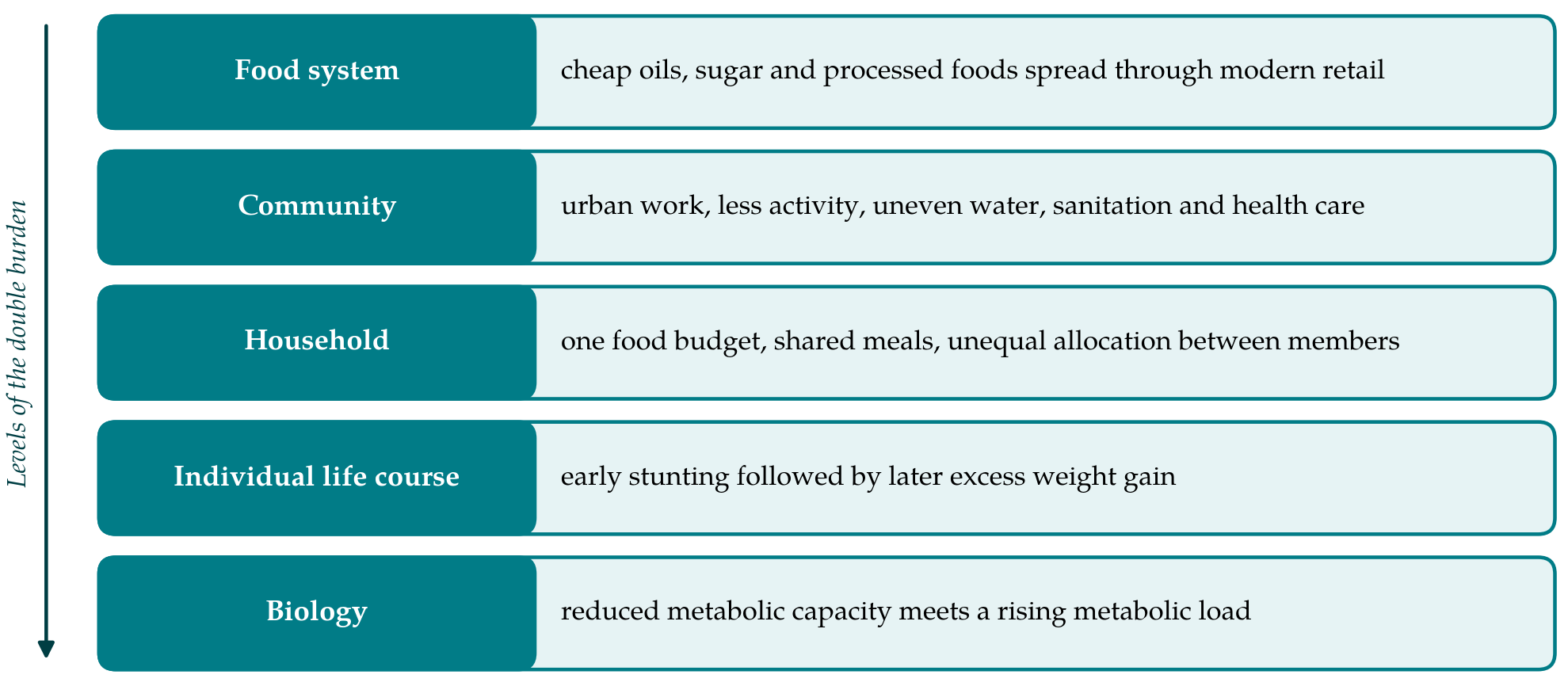
Changes in how food is sold have carried it along. Supermarkets and the supply chains behind them spread through Latin America, Asia and parts of Africa within a few decades (Reardon et al., 2003), and packaged, ready-to-consume products of the kind termed ultra-processed have taken a growing share of purchases in middle-income countries (Monteiro et al., 2013). These foods are energy-dense, convenient and heavily marketed, and they tend to be poor in the micronutrients and protein quality that growing children need. A diet can therefore supply too much energy for an adult and too little of what a child requires for linear growth. Figure 1 places this food system change above the community, household and individual levels through which it acts.
5. Inside the Household
Why should members of one household fare so differently? Part of the answer is timing. Stunting is largely fixed in the first thousand days from conception, and reflects the mother's nutrition in pregnancy, infant feeding, and repeated infection in an unsanitary environment (Black et al., 2013). A five-year-old's height records conditions several years in the past, while an adult's weight reflects the present food environment. A family whose circumstances have improved, or whose diet has shifted toward cheap energy, can carry both records at once.
Part of the answer lies in what the shared diet contains. Rising income in a transitional setting often buys oil, sugar, refined cereals and snacks before it buys eggs, milk, fruit or vegetables. Such a diet meets and exceeds adult energy needs while leaving a toddler, whose small stomach demands nutrient-dense food, short of iron, zinc and good-quality protein. Poor complementary feeding and sweetened drinks given to young children compound the problem.
The household is also not a single decision maker. Economists have shown that food, care and money are divided within families according to bargaining power, custom and perceived need, and that the result can depart far from equal shares (Haddad et al., 1997). Who eats first, who eats away from home, and whose paid work leaves little time for preparing children's food all shape the outcome. These processes are hard to observe in surveys that record household purchases and not individual intake, which is one reason the intra-household pathway remains more often asserted than demonstrated.
6. Developmental Links Between the Two Burdens
Undernutrition and overweight are connected biologically as well as socially. Barker's observation that low birth weight predicted adult cardiovascular disease (Barker, 1990) and the thrifty phenotype hypothesis that followed (Hales and Barker, 1992) proposed that a fetus or infant deprived of nutrients adapts in ways that become harmful when food is later plentiful. Cohort studies from low- and middle-income countries support the outline: undernutrition in early life is associated with shorter adult height, less schooling and lower earnings, and rapid weight gain after infancy in those who were small is associated with higher blood pressure, glucose and adiposity (Victora et al., 2008).
Wells et al. (2020) frame this as a relation between metabolic capacity, built during early growth, and metabolic load, imposed later by diet, inactivity and excess weight. Stunting lowers capacity; the transitional food environment raises load. On this view the populations most exposed to the double burden are precisely those in which early undernutrition is still common and obesogenic diets are newly available, and the short mother who gains weight is herself an instance of the double burden and not only one half of a pair. Maternal short stature and obesity each raise risks in pregnancy, so the conditions can pass to the next generation.
7. Implications for Policy and Programmes
If the two burdens share causes, they can share remedies. The World Health Organization has promoted double-duty actions, interventions that reduce the risk of both undernutrition and overweight (WHO, 2017b). Hawkes et al. (2020) identified candidates that already exist within health and social systems, among them protection and promotion of breastfeeding, better complementary feeding, redesigned school meals, and regulation of food marketing. The same authors warned that programmes built to treat undernutrition can do unintended harm where diets have changed, for example when food or cash transfers raise energy intake in households that are already consuming enough.
The economic case rests on the costs of both conditions falling on the same economies, in lost productivity from stunting and in the treatment of chronic disease (Nugent et al., 2020). The Lancet Commission on the global syndemic went further, arguing that obesity and undernutrition have common drivers in food, transport and land-use systems, and that piecemeal action is unlikely to succeed (Swinburn et al., 2019). For front-line services the practical consequence is that the household, and not the individual patient, becomes the unit of counselling: growth monitoring of the child and weight screening of adults can be joined, and dietary advice framed around food quality for everyone instead of more food for one member and less for another.
8. Gaps and Future Work
Most of what is known about dual burden households comes from cross-sectional surveys of women and young children. Longitudinal data that follow the same households through a period of dietary change are rare, so the sequence in which burdens appear is inferred, not observed. Definitions remain inconsistent, and few studies report whether the observed frequency of pairs exceeds what chance would produce, a check that should be routine after the critique by Dieffenbach and Stein (2012).
Men, adolescents and older adults are largely absent from the household picture because surveys do not measure them. Micronutrient deficiency, sometimes called hidden hunger, is seldom included in definitions although it may be the commonest form of undernutrition in overweight people. Individual dietary intake within households is almost never recorded. And double-duty actions, however well reasoned, have rarely been evaluated for their effect on both outcomes in the same households. Trials and natural experiments that measure child growth and adult weight together would show whether the promise holds.
9. Conclusion
Households in which a stunted child lives with an overweight adult are a visible product of rapid dietary change. Whether or not the pairing exceeds what chance predicts, it shows that a single food environment can fail a family in two directions, through too little of what supports growth and too much cheap energy. Its roots run from food systems through the household economy to developmental biology. The policy response now favoured, action designed to serve both ends at once, is coherent with that account. The evidence that it works at household level is still to be gathered.
Conflict of interest
To be declared by the author(s) before publication.
Funding
To be declared by the author(s) before publication.