1. Introduction
Influenza vaccination programmes in most countries give priority to older adults, and with reason: hospital admission and death from influenza are concentrated in the later decades of life. The inactivated vaccines used in these programmes are reformulated each year and given in the autumn, weeks or months before the virus begins to circulate. Protection therefore has to last. In temperate regions the season may run from late autumn into spring, and a person vaccinated at the first opportunity may need the response to hold for half a year or more.
The idea that it does not hold in the elderly is old and has been repeated often. It rests on a reasonable chain of inference. Ageing changes the B cell and T cell compartments in ways that blunt responses to new antigens (Goronzy and Weyand, 2013), and older adults reach lower antibody titres after influenza vaccination than younger adults do (Goodwin et al., 2006). A lower peak that then declines will cross any protective threshold sooner. What is less clear is whether the decline itself is faster in old age, whether it matters clinically, and how much of the evidence concerns people over seventy as distinct from the wider group aged sixty-five and over that most studies report.
This review examines that evidence. It asks what is known about the persistence of vaccine-induced antibody in adults over seventy, how far serological decline is matched by loss of protection against illness, and what the answers imply for practice.
2. Scope and Approach
The article is a narrative review of the published literature. It draws on serological follow-up studies, on earlier systematic reviews and meta-analyses, on observational studies of vaccine effectiveness by time since vaccination, and on immunological studies of the cells that produce antibody. No formal search protocol was applied and no new analysis is reported. Because few studies restrict enrolment to people over seventy, the review relies in many places on findings for adults aged sixty or sixty-five and over, and says so where the distinction affects the conclusion.
3. Measuring Antibody and Defining Protection
Almost all of the persistence literature uses the haemagglutination inhibition (HI) assay, which measures the highest serum dilution that prevents the viral haemagglutinin from agglutinating red cells. The assay owes its standing to challenge studies in healthy adult volunteers, in which a titre of about 1:40 was associated with a halving of the risk of infection (Hobson et al., 1972). That figure became the working definition of seroprotection, and it has been carried into the immunogenicity criteria used in vaccine licensing ever since, with the qualification that the studies behind it were done in young volunteers.
Two cautions follow. First, the relationship between titre and protection is a continuous curve and not a step: modelling of pooled data shows protection rising steadily with titre, with no point at which it becomes complete (Coudeville et al., 2010). The proportion of a group above 1:40 is a convenient summary and a crude one. Second, the correlate was established in young adults. In a vaccine trial that examined it directly, HI titre predicted protection after inactivated vaccine but left a good deal of risk unexplained (Ohmit et al., 2011), and in older adults measures of T cell function have tracked protection more closely than serum antibody has (McElhaney et al., 2006). Persistence of an HI titre is therefore evidence about one arm of immunity, and the arm that is easiest to measure.
4. The Peak Response in Older Adults
Durability cannot be judged apart from the height of the peak. A quantitative review of several decades of immunogenicity studies found that adults aged sixty-five and over were considerably less likely than younger adults to seroconvert or to reach seroprotective titres, for all three vaccine components, and that responses were lower still in those aged seventy-five and over (Goodwin et al., 2006). The same review pointed out that many older adults enter the season with measurable antibody from earlier vaccinations and infections, which depresses fold-rise statistics without necessarily meaning a poor final titre.
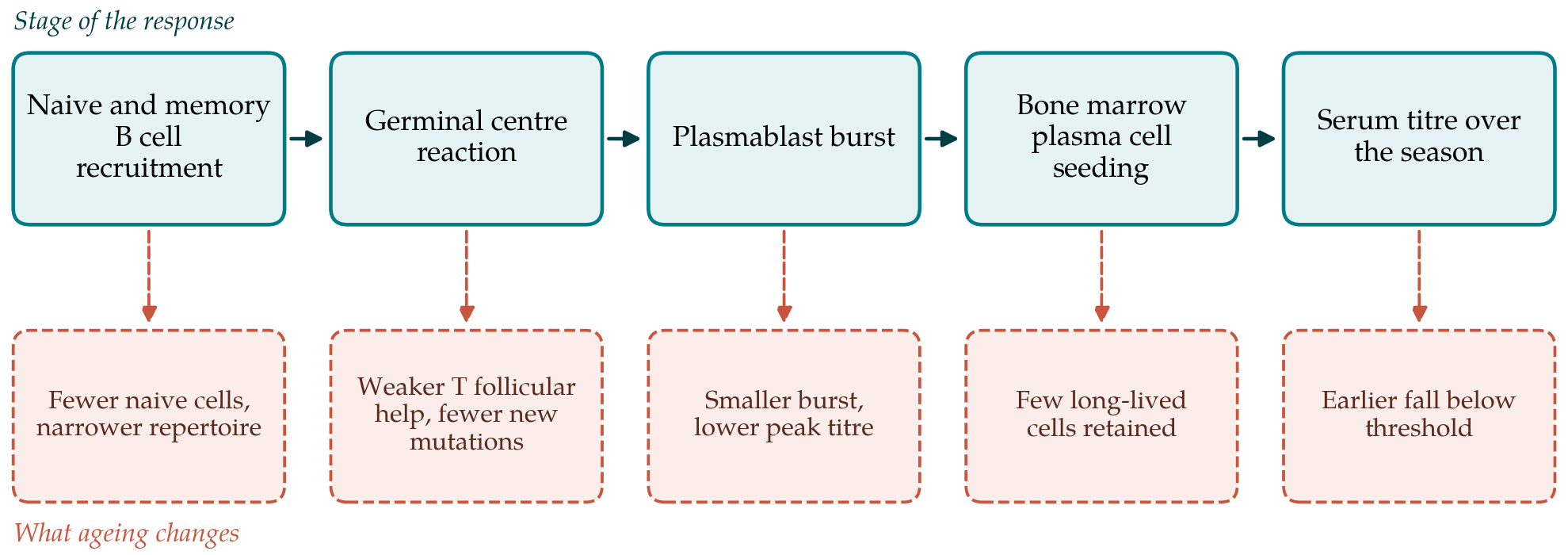
Cellular studies explain the lower peak. Older vaccinees generate fewer vaccine-specific plasmablasts in the week after immunisation, and the smaller burst accounts for the lower serum titre; the antibodies that individual cells produce are not of obviously lower avidity (Sasaki et al., 2011). The B cells that older adults recruit after vaccination carry fewer newly acquired mutations and are directed at conserved epitopes remembered from earlier exposures, which leaves them poorly adapted to drifted strains (Henry et al., 2019). The lifelong layering of responses to successive influenza strains, reviewed by Krammer (2019), means that an older adult's response is to a large extent a recall of the past. Figure 1 sets the stages of the response beside the changes that ageing brings to each.
5. Serological Evidence on Persistence
The claim that vaccine-induced antibody declines rapidly in the elderly was tested against the literature by Skowronski et al. (2008). They found that the statement had been passed from one guidance document to the next with little primary support, and that in the studies which followed older vaccinees serologically, seroprotection rates, where they had been reached after vaccination, were generally maintained for at least four months and often for six or longer, particularly for the A(H3N2) and A(H1N1) components. Their conclusion was that the published record did not show a decline steep enough to justify delaying vaccination.
A later systematic review and meta-analysis asked a slightly different question: whether responses in the elderly last the whole year. Pooling studies with follow-up to about twelve months, Young et al. (2017) found that titres and seroprotection rates fell progressively after the first month, with the size of the fall varying by subtype and lineage. The two reviews are less opposed than they appear. One shows that antibody mostly lasts a season; the other shows that it does not last until the next. Individual follow-up studies of older vaccinees fit that reading, reporting a clear decline by six months and identifying low pre-vaccination titre and advanced age among the predictors of an inadequate or short-lived response (Song et al., 2010).
Whether the rate of decline is greater in the old than in the young is harder to establish, because few studies follow both age groups with the same assay over the same interval. In healthy adults enrolled in a placebo-controlled trial, antibody to haemagglutinin and to neuraminidase fell only modestly over a season (Petrie et al., 2016). The serological studies in older adults do not show a markedly steeper slope. The weight of the evidence is that older adults lose seroprotection earlier chiefly because they begin closer to the threshold. Table 1 summarises the main kinds of evidence and what each can and cannot show.
| Evidence | What it measures | Main finding | Main limitation |
|---|---|---|---|
| Serological follow-up | HI titre and seroprotection over months | Titres mostly held for a season, not a year (Skowronski et al., 2008) | Correlate derived in young adults |
| Pooled serology | Seroprotection at fixed intervals | Progressive fall to twelve months (Young et al., 2017) | Heterogeneous assays and age bands |
| Test-negative studies | Effectiveness by time since vaccination | Within-season decline (Ferdinands et al., 2017) | Bias and drift can mimic waning |
| Cohort studies | Risk by weeks since vaccination | Risk rises with time (Ray et al., 2019) | Timing of vaccination is not random |
| Cellular studies | Plasmablasts and marrow plasma cells | New plasma cells largely lost by one year (Davis et al., 2020) | Small groups, few very old donors |
| T cell studies | Cytokine and granzyme B responses | Better correlate than HI in old age (McElhaney et al., 2006) | No agreed protective threshold |
6. Evidence From Vaccine Effectiveness Studies
A second line of evidence does not measure antibody at all. Since about 2010, observational studies using the test-negative design have compared vaccine effectiveness among people vaccinated shortly before they fell ill with effectiveness among those vaccinated long before. In Europe, analyses of the 2011 to 2012 season, in which A(H3N2) circulated late, found that effectiveness was lower in those vaccinated more than about three months earlier, with the pattern most evident in older adults and other target groups (Castilla et al., 2013; Kissling et al., 2013). A study in the United States reported a similar decline against A(H3N2) within one season in young children and in older adults (Belongia et al., 2015).
Larger analyses followed. Data pooled over four seasons from the United States Influenza Vaccine Effectiveness Network showed effectiveness falling by several percentage points for each month since vaccination, for A(H3N2), for A(H1N1)pdm09 and for influenza B (Ferdinands et al., 2017). A cohort analysis within a large health system found that the odds of testing positive for influenza rose steadily with each additional four weeks since vaccination (Ray et al., 2019). A meta-analysis of test-negative studies concluded that effectiveness declined between the first three months and the second three months after vaccination, significantly so for A(H3N2) and for influenza B (Young et al., 2018).
These findings should be read with care. Lipsitch (2019) has set out why studies of this kind can show waning that is not there. If a vaccine protects some recipients well and others hardly at all, the unprotected among the vaccinated become infected early, as do the unvaccinated, and the two groups come to resemble each other as the season goes on. People who are vaccinated early also differ from those vaccinated late, and late-season viruses may have drifted from the vaccine strain. None of this disproves waning, and the consistency of the signal across designs and countries is hard to dismiss, but the estimates of its speed are uncertain. Few of the studies report adults over seventy as a separate stratum.
7. Why the Response May Be Short-Lived at Any Age
Serum antibody to some antigens lasts a lifetime. Longitudinal measurement in adults has shown antibody to measles, mumps and rubella declining so slowly that the estimated half-lives run to many decades, while antibody to tetanus and diphtheria toxoids declines much faster (Amanna et al., 2007). The difference is thought to lie in how many long-lived plasma cells a given exposure deposits in the bone marrow. Direct sampling of marrow before and after influenza vaccination has shown that vaccine-specific plasma cells increase in the weeks after immunisation and then fall back towards their starting level within a year, with newly generated cells lost preferentially (Davis et al., 2020).
This suggests that a transient response is a property of the current inactivated vaccines in adults generally, and not only a defect of old age. What ageing adds is a smaller initial burst and, plausibly, a marrow environment less able to retain new cells, although the second point has been studied mainly in animals and remains uncertain in humans.
8. Implications for Practice
Two practical responses have been pursued. The first is to raise the peak. A vaccine containing four times the standard quantity of haemagglutinin proved more efficacious than the standard-dose vaccine in a large randomised trial in adults aged sixty-five and over (DiazGranados et al., 2014), and a meta-analysis of observational studies found the MF59-adjuvanted vaccine effective against influenza-related hospital admission in the elderly (Domnich et al., 2017). A higher starting titre should, other things being equal, stay above a protective level for longer, but whether these vaccines slow the decline itself has not been settled.
The second response concerns timing. Guidance in the United States now expresses a preference for high-dose, recombinant or adjuvanted vaccines in people aged sixty-five and over, and advises against vaccinating older adults in the height of summer because protection may wane before the season ends (Grohskopf et al., 2022). The same guidance is clear that vaccination should not be put off so long that it is missed. That balance reflects the state of the evidence: the cost of a missed dose is certain, and the benefit of fine-tuning the date is not.
9. Gaps and Directions for Research
Several gaps stand out. Adults over seventy, and especially those over eighty or living in care homes, are underrepresented in serological follow-up, and where they are included the results are seldom reported separately. Frailty, which may matter more than chronological age, is rarely measured. Persistence has been studied almost entirely through HI titres, with little longitudinal information on neuraminidase antibody, on antibody to the haemagglutinin stalk or on T cell memory. Head-to-head comparison of the decline after standard and enhanced vaccines over a full season is sparse. Finally, the effect of repeated annual vaccination on the durability of each year's response, as opposed to its peak, is not well described. Studies that sample the same older adults at intervals across a season, with several immune measures and with clinical outcomes, would address most of these questions.
10. Conclusion
The published evidence does not support the old claim that influenza vaccine antibody disappears within weeks in the elderly, and it does not support complacency either. Older adults reach lower titres, those titres decline over the months that follow, and protection against illness appears to fall within a season, most clearly against A(H3N2). The vaccine-induced plasma cell response is short-lived in adults of any age. For people over seventy the data are thinner than their share of the disease burden warrants. Vaccinating with an enhanced product, at a date neither far ahead of the season nor so late as to risk missing it, is the course best supported by what is known.
Conflict of interest
To be declared by the author(s) before publication.
Funding
To be declared by the author(s) before publication.