1. Introduction
In 2016 Chile began requiring black octagonal warnings on the front of packaged foods and drinks that exceeded set limits for sugar, sodium, saturated fat or energy. The law also restricted the marketing of those products to children and banned their sale in schools (Corvalán et al., 2019). Peru, Uruguay, Mexico and Israel, among others, have since adopted warning labels of their own, and the approach has the backing of the Pan American Health Organization, whose nutrient profile model supplies the thresholds several countries use (PAHO, 2016). The World Health Organization has issued guiding principles for governments designing front-of-pack schemes (WHO, 2019).
Interest has now reached countries with much lower incomes, in sub-Saharan Africa and South and Southeast Asia, where sales of packaged foods and sugary drinks are rising quickly from a low base. For a health ministry with few resources, a warning label looks like an ideal measure: it costs the government little, it puts the burden on manufacturers, and it comes with a recent record of apparent success.
This Perspective takes the view that warning labels are a reasonable policy and that the case for them in low-income markets is nonetheless weaker than it is usually presented. The evidence was gathered elsewhere, under different conditions, and much of it measures steps on the way to dietary change and not the change itself. The argument is not that low-income countries should refrain. It is that they should adopt labels in a way that produces the evidence now missing.
2. What the Evidence Shows
Evidence on front-of-pack labels falls into two groups. The first consists of experiments, online or in laboratory shops, in which people are shown products with different labels and asked to choose. A scoping review of such studies found that nutrient warnings consistently improved identification of unhealthy products and reduced stated intentions to buy them (Taillie et al., 2020a), and a meta-analysis of experiments on sugary drink warnings reached a similar conclusion (Grummon and Hall, 2020). A synthesis of studies with objectively measured purchasing suggests that labels of various kinds shift some choices toward healthier options, while noting how few such studies there are (Croker et al., 2020).
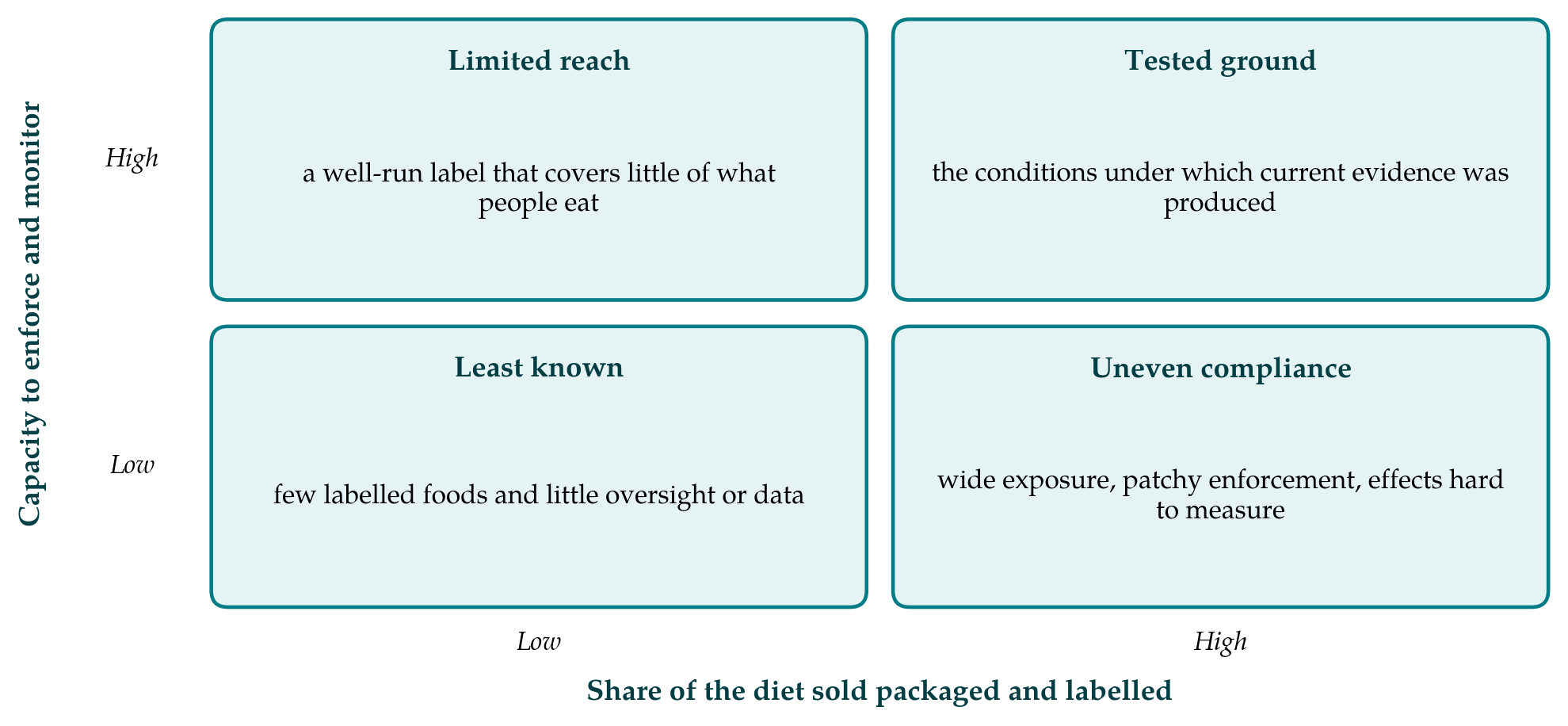
The second group consists of evaluations of real policies. Here Chile dominates. Household purchases of beverages carrying warnings fell markedly after the first phase of the law (Taillie et al., 2020b), later analyses found reductions in purchased sugar, sodium and energy from labelled foods (Taillie et al., 2021), and manufacturers reformulated products so that fewer exceeded the thresholds (Reyes et al., 2020). A wider meta-analysis of labelling in general found modest effects on consumer intake and some on industry formulation (Shangguan et al., 2019). Table 1 sets these findings against the chain of outcomes a label is supposed to move, and Figure 1 locates the settings in which they were obtained.
| Outcome | Present evidence | Missing for low-income markets |
|---|---|---|
| Noticing and understanding | Consistent in experiments Taillie et al., 2020a | Tests with low-literacy and multilingual shoppers in real shops |
| Purchase intention | Reduced in experiments Grummon and Hall, 2020 | Whether intention holds when budgets are very tight |
| Actual purchases | Declines in Chile Taillie et al., 2021 | Purchase data from informal and small-shop retail |
| Reformulation | Observed in Chile Reyes et al., 2020 | Response of small local producers and importers |
| Total dietary intake | Little direct evidence anywhere | Substitution toward unlabelled loose and street foods |
| Health outcomes | Not yet demonstrated | Effects on both overweight and undernutrition |
3. Why the Evidence May Not Travel
Three features of the Chilean evidence limit how far it can be carried. The first is that labels were one part of a package. Marketing restrictions and the school ban came into force at the same time, and the evaluations, as their authors state, estimate the effect of the law as a whole. A country that adopts the label alone is implementing a different intervention.
The second is the structure of the food supply. A label acts only on food that carries one. In Chile and comparable economies, packaged and processed products make up a large share of what households buy, a pattern that has spread through middle-income countries (Monteiro et al., 2013). In many low-income markets a large part of the diet is still bought loose: grain from a sack, oil decanted into the buyer's bottle, snacks fried at a roadside stall, sugar added at home. Packaged goods are often sold from kiosks in single units or repacked without their original wrapper. A warning cannot reach what has no pack, and a shopper who turns away from a labelled biscuit may turn to an unlabelled fried snack that is no better.
The third is the capacity of the state. A warning scheme needs a nutrient profile model, a means of verifying declared composition, inspection of shops and ports, and sanctions that are applied. Reviews of labelling regulation note wide variation in how schemes are specified and enforced (Kanter et al., 2018; Jones et al., 2019). Where laboratories are few and inspectors are stretched, compliance among small domestic producers and informal importers may be poor, and large firms may comply while smaller competitors do not. Labelling rules have also been challenged as barriers to trade at the World Trade Organization, which adds legal cost for governments with little capacity to defend them (Thow et al., 2018).
There is, in addition, the matter of who is being warned. In countries where undernutrition and overweight coexist, energy-dense packaged foods are sometimes a cheap source of calories for households that are short of them, and some carry mandatory fortification. Thresholds drawn up for populations with excess intake may send a confusing message in such settings. Research on how consumers use labels has long distinguished liking and understanding a label from acting on it (Grunert and Wills, 2007), and that gap is likely to be wider where price, not information, decides most purchases. None of these points shows that warning labels would fail in low-income markets. Rising sales of sugary drinks and packaged snacks there are real, they are concentrated among the young and the urban, and these are the products on which labels act most directly. The points show only that the size and even the direction of some effects cannot be read off from experience elsewhere.
4. The Case for Proceeding Regardless, and a Reply
There are serious objections to this caution. The first is that demands for more evidence are a familiar tactic of delay. Food and beverage companies have opposed warning labels in every country that proposed them, and a public health article asking for stronger evaluation can be quoted in that cause. The objection is fair as a description of how such arguments are used. It is not a reason to overstate what is known. The reply is to be specific: evaluation should accompany adoption and be written into the regulation, not stand as a condition that postpones it.
The second objection is that labels are cheap and harmless, so that even a small benefit justifies them. They are cheap for the treasury. They are not free of opportunity cost in a ministry where a handful of officials handle all of nutrition policy, and where the political effort spent on a labelling law is not spent on, for example, a tax on sugary drinks or standards for school food. Nor is harmlessness established where substitution to unlabelled foods and effects on undernourished households have not been studied.
The third objection is that people have a right to know what is in their food whatever the effect on behaviour. That is a sound argument for clear labelling. It is an argument about transparency, and it should be made as such. When a government justifies a label by promising lower rates of obesity and diabetes, it makes an empirical claim, and reviews of the field are careful to say that effects on diet and health remain to be shown (Roberto et al., 2021).
5. What Stronger Evaluation Would Involve
A national labelling law is a natural experiment, and guidance exists on how to evaluate such policies when randomisation is impossible (Craig et al., 2012). The essential requirement is measurement before the policy starts. Chile's evaluations were possible because purchase panels and dietary cohorts were already in place. Few low-income countries have commercial household panels, so baseline data must be planned: repeated shop audits of product composition and labelling, sales records from a sample of retailers including kiosks and market stalls, and dietary surveys that record whether foods were packaged.
Design matters as much as data. Phased introduction, by product category or region, creates comparison groups. Interrupted time series analysis, which compares the trend after a policy with the trend projected from before, is well suited to regulations that begin on a known date (Bernal et al., 2017). Outcomes and analyses should be specified in advance and should follow the whole chain in Table 1, including substitution toward unlabelled foods and effects in poorer households. Before any of this, the label itself should be tested with local shoppers for comprehension across languages and levels of literacy, as WHO guidance recommends (WHO, 2019).
Independence is the last element. Evaluation should be commissioned from researchers with no financial ties to the food industry, funded through public or philanthropic sources, and published whatever the result. Regional bodies could pool resources so that several small countries share one evaluation framework and learn from one another's results. Shared protocols would also make findings comparable, which single-country studies using different outcome measures seldom are.
6. Implications
For governments, the practical message is to treat a warning label as one instrument to be tried under observation and not as a finished solution imported whole. A law can include a baseline period, a phased start, a named evaluating institution and a date for review. For international agencies and funders that promote labelling, it means paying for evaluation alongside technical assistance. For researchers, it means resisting the pull to generalise from the best-studied country and reporting null or adverse findings with the same prominence as favourable ones. For civil society groups that campaign for labels, it means asking not only whether a law was passed but whether anyone is measuring what it does. A label that is adopted, poorly enforced and never evaluated can be cited as action on diet for years while purchasing patterns continue unchanged.
7. Conclusion
Warning labels are among the better supported food policies of the past decade, and the support comes mainly from one kind of setting. Low-income markets differ in how food is sold, how rules are enforced and what nutritional problems households face, and those differences bear directly on whether a label on a packet changes what people eat. Adopting labels with evaluation built in would serve these countries better than either waiting for certainty or assuming it, and it would give the next group of governments something firmer to rely on than evidence borrowed from elsewhere.
Conflict of interest
To be declared by the author(s) before publication.
Funding
To be declared by the author(s) before publication.