1. Introduction
Graves' disease is the usual cause of overt hyperthyroidism in women of childbearing age, and most women who have it are treated with a thionamide: methimazole, its prodrug carbimazole, or propylthiouracil (Cooper, 2005). Pregnancy complicates that treatment. Both drugs cross the placenta, both have been linked to congenital anomalies after first-trimester exposure, and the information leaflets say so. A woman who discovers an unplanned pregnancy may reasonably conclude that the safest course is to stop. If her disease is active, the consequence can be a rapid return of thyrotoxicosis at a time when the physiological demands of pregnancy are rising.
Severe uncontrolled thyrotoxicosis in pregnancy is associated with miscarriage, preeclampsia, preterm birth, heart failure and, at the extreme, thyroid storm (Davis et al., 1989; Sheffield and Cunningham, 2004). Storm is a clinical diagnosis of decompensated thyrotoxicosis with multiorgan dysfunction, and it carries substantial mortality even with modern intensive care (Akamizu et al., 2012). Nonadherence to or discontinuation of antithyroid medication is among its recognized precipitants.
The guidance needed to prevent and manage this sequence exists, but it is spread across documents written for endocrinologists, obstetricians and intensivists. This article assembles it into a single pathway. The pathway is proposed, not tested: no patients or outcomes are reported here.
2. Background
Three bodies of published work underlie the pathway: the advice on antithyroid drugs in early pregnancy, the diagnostic criteria for thyroid storm, and the physiology that makes thyroid assessment in pregnancy difficult.
2.1. Antithyroid drugs in early pregnancy
Methimazole exposure in the first trimester is associated with a characteristic pattern of anomalies that includes aplasia cutis and choanal and esophageal atresia. Propylthiouracil was long considered free of such effects, but a Danish national study found it too was associated with birth defects, which were less severe (Andersen et al., 2013). Propylthiouracil in turn carries a risk of severe liver injury, which led to advice that its use be limited largely to the first trimester (Bahn et al., 2009). The period of greatest teratogenic sensitivity appears to be gestational weeks six to ten (Laurberg and Andersen, 2014).
Guidelines therefore recommend that women with Graves' disease be counseled before conception, that those taking methimazole who become pregnant be reviewed urgently, and that propylthiouracil be preferred when treatment is needed in early pregnancy. They also allow that a woman who is euthyroid on a low dose, with features suggesting remission, may have the drug withdrawn under close supervision with frequent thyroid function tests (Alexander et al., 2017; Kahaly et al., 2018). The distinction between supervised withdrawal in a selected patient and unsupervised cessation in any patient is the point on which the present pathway turns.
2.2. Diagnostic criteria for thyroid storm
No laboratory test separates storm from uncomplicated thyrotoxicosis, since hormone concentrations overlap. Two clinical systems are in use. The Burch-Wartofsky Point Scale assigns points for temperature, central nervous system effects, gastrointestinal and hepatic dysfunction, heart rate, heart failure, atrial fibrillation and the presence of a precipitant; a total of 45 or more is highly suggestive of storm, 25 to 44 suggests impending storm and a total below 25 makes it unlikely (Burch and Wartofsky, 1993). The Japan Thyroid Association criteria require biochemical thyrotoxicosis and define storm by combinations of the same organ-system features (Akamizu et al., 2012). The American Thyroid Association recommends that the diagnosis rest on clinical judgment supported by one of these tools (Ross et al., 2016). Neither system was derived or validated in pregnant women.
2.3. Why pregnancy obscures the picture
Normal pregnancy raises heart rate and cardiac output, produces heat intolerance and, in the first trimester, nausea and vomiting. Chorionic gonadotropin stimulates the thyroid, suppressing thyrotropin and sometimes raising free thyroxine, and estrogen increases thyroxine-binding globulin and with it total hormone concentrations (Glinoer, 1997). Gestational transient thyrotoxicosis, often accompanying hyperemesis, must be told apart from Graves' disease. Later in pregnancy, preeclampsia, sepsis and peripartum cardiomyopathy can each mimic or precipitate decompensation. A scoring system that counts tachycardia and vomiting will therefore read higher in a pregnant woman for reasons unrelated to the thyroid, and the pathway has to allow for that.
3. The Proposed Pathway
The pathway has seven steps, shown in sequence in Figure 1. Table 1 lists each step with the action proposed and the published guidance on which it rests. The steps are described in order below. Doses are deliberately not reproduced; the guidelines cited are the authority for them and should be consulted directly.
| Step | Proposed action | Source guidance |
|---|---|---|
| 1. Counsel | Explain before conception that tablets must not be stopped without review | Alexander et al., 2017 |
| 2. Flag cessation | Treat any report of self-stopped tablets as needing same-week review | De Groot et al., 2012 |
| 3. Assess and score | Examine, test thyroid function, apply a storm score, seek precipitants | Burch and Wartofsky, 1993; Akamizu et al., 2012 |
| 4. Escalate | Involve endocrine, obstetric and critical care teams together | Satoh et al., 2016 |
| 5. Treat | Give multimodal treatment in the order guidelines specify | Ross et al., 2016; Satoh et al., 2016 |
| 6. Monitor | Observe mother and fetus; avoid delivery during storm unless indicated | ACOG, 2020 |
| 7. Plan onward care | Agree treatment for the rest of pregnancy and after birth | Alexander et al., 2017 |
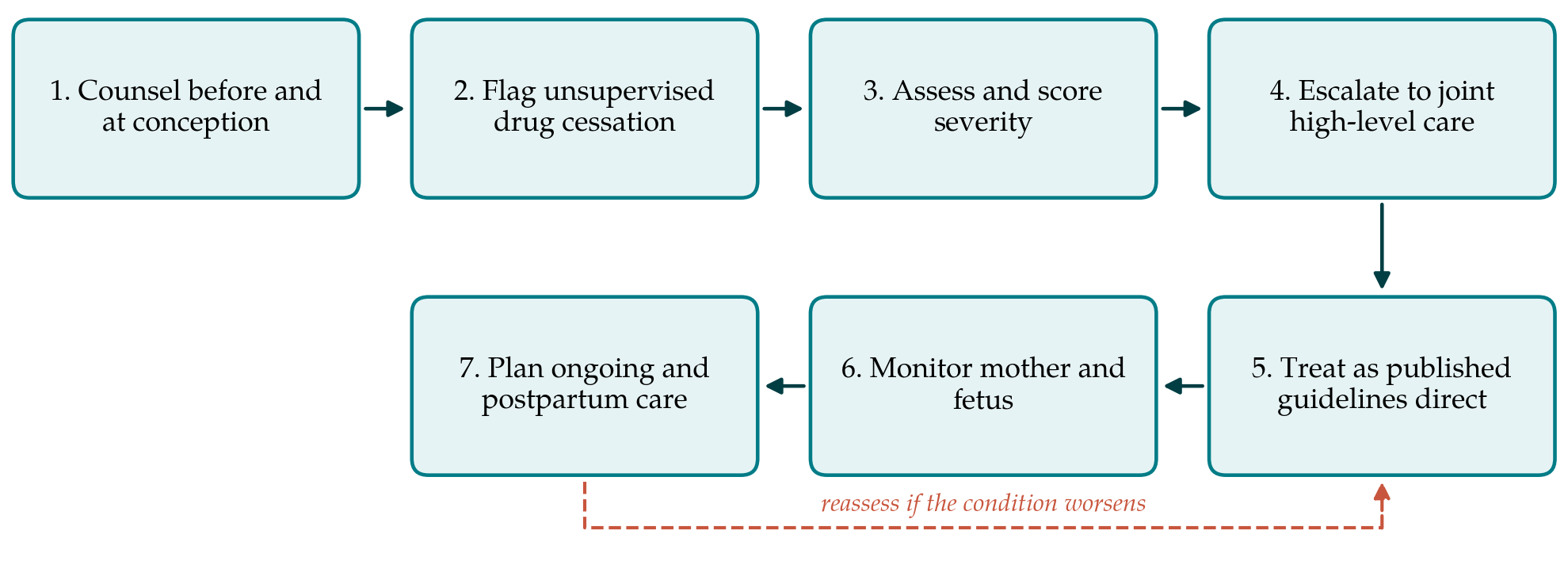
3.1. Step 1: Counsel before and at conception
Prevention begins well before pregnancy. Every woman of reproductive age prescribed a thionamide should be told, and have it recorded, that pregnancy should be planned where possible, that the drugs carry a small risk to the embryo, that untreated hyperthyroidism carries risks too, and that on a positive pregnancy test she should contact her clinician at once and not stop treatment on her own. The option of definitive treatment before conception is part of the same conversation (Alexander et al., 2017).
3.2. Step 2: Flag unsupervised cessation
The pathway proposes that a statement by a pregnant woman with Graves' disease that she has stopped her antithyroid drug be treated as a trigger, whoever hears it: midwife, pharmacist, general practitioner or booking clerk. The trigger leads to thyroid function testing and specialist review within days. Endocrine guidance already calls for close monitoring when treatment is changed in early pregnancy (De Groot et al., 2012); the proposal here is only that the same urgency apply when the change was the patient's own.
3.3. Step 3: Assess and score
A woman who presents unwell is assessed for temperature, pulse and rhythm, mental state, signs of heart failure, vomiting, diarrhea and jaundice. Free thyroxine, triiodothyronine and thyrotropin are measured and read against pregnancy-specific expectations. A Burch-Wartofsky score is calculated and recorded with its components, so that later readers can see which features drove it. Because pregnancy inflates some items, the score informs the decision and does not make it. A search for a second precipitant, particularly infection and preeclampsia, proceeds in parallel (Chiha et al., 2015).
3.4. Step 4: Escalate to joint care
Suspected or impending storm is managed in a high-dependency or intensive care setting, as the Japanese guideline advises for storm in general (Satoh et al., 2016). The pathway asks that a senior endocrinologist, obstetrician and intensivist be informed together at the point of suspicion, with an anesthetist and neonatologist added once the fetus is viable. A single named clinician coordinates.
3.5. Step 5: Treat as published guidelines direct
Treatment of storm is multimodal and its components are the same in pregnancy as outside it: a thionamide to block hormone synthesis, iodine to block release, given only after the thionamide has been started, a beta-adrenergic blocker to control heart rate, a glucocorticoid, cooling, fluids and treatment of the precipitant (Ross et al., 2016; Nayak and Burman, 2006). The pathway adds nothing to these recommendations. It asks only that the order of administration and the monitoring required for each agent be written into the local protocol in advance, so that they are not worked out at the bedside.
3.6. Step 6: Monitor mother and fetus
Maternal observation follows critical care practice. Fetal heart rate is monitored at a gestation where intervention would be considered; fetal tachycardia is expected while the mother is thyrotoxic and febrile and generally improves as she does. Obstetric guidance is that delivery during storm should be avoided unless there is an obstetric indication, because labor and surgery are themselves precipitants (ACOG, 2020).
3.7. Step 7: Plan onward care
Once the acute illness is controlled, the team agrees which antithyroid drug will be continued and at what gestation it might be changed, how often thyroid function will be checked, when thyrotropin receptor antibodies will be measured to assess fetal and neonatal risk, and how the newborn will be followed (Alexander et al., 2017; Cooper and Laurberg, 2013). The postpartum period, when Graves' disease commonly relapses, and the question of definitive treatment are addressed before discharge. The conversation in Step 1 is repeated, this time with the benefit of experience.
4. Fitting the Pathway to Local Services
A pathway of this kind has to be adapted. A tertiary center with a joint endocrine antenatal clinic can implement every step internally. A district hospital may need a telephone arrangement with a regional endocrinologist for Step 4 and an agreed transfer policy. In primary care and community midwifery, where Step 2 will most often be triggered, what matters is a short written prompt and a direct referral route. Laboratories should be asked whether trimester-specific reference intervals are reported. Each service that adopts the pathway should write down who is responsible for each step, since the failure it is designed to prevent is one in which every professional assumed another had acted.
5. Limitations and What Remains to Be Shown
The pathway is a synthesis of guidance and has not been validated. Its evidence base is that of the guidelines themselves, which for thyroid storm consists largely of observational series and expert consensus, because the condition is too rare and too acute for randomized trials. For storm in pregnancy the base is thinner still. The scoring systems in Step 3 have not been calibrated for pregnant women, and their false positive rate in that setting is unknown.
Several things would need to be established before the pathway could be recommended. One is feasibility: whether the trigger in Step 2 can be made to work across the many points at which a pregnant woman meets the health service. Another is yield: how many women flagged turn out to have active disease needing treatment, which determines the burden on clinics. A third is whether structured assessment shortens the interval between presentation and treatment. These can be addressed by audit and by prospective registry studies. Whether the pathway reduces maternal or fetal harm is the question that matters most and, given the rarity of the outcome, the one least likely to be answered by any single institution.
6. Conclusion
Thyroid storm after unsupervised withdrawal of antithyroid drugs in pregnancy is a preventable emergency. The knowledge needed to prevent it, recognize it and treat it is already in the guidelines of thyroid and obstetric societies. What this article contributes is an ordering of that knowledge into seven steps that cross specialty boundaries, with an explicit trigger at the moment a woman reports having stopped her tablets. The pathway remains a proposal until it has been tested in practice.
Conflict of interest
To be declared by the author(s) before publication.
Funding
To be declared by the author(s) before publication.