1. Introduction
A hospital ward at three in the morning is staffed by people whose bodies are prepared for sleep. Rotating rosters ask the same nurse or junior doctor to work days one week and nights the next, and the costs of that arrangement to sleep are well documented. Sleep taken in the daytime after a night shift is usually shorter than night sleep by a matter of hours, and it is lighter and more often interrupted (Åkerstedt, 2003). Over years, shift work is associated with higher rates of cardiometabolic disease, gastrointestinal complaints and accidents (Knutsson, 2003; Kecklund and Axelsson, 2016), and the International Agency for Research on Cancer has classified night shift work as probably carcinogenic to humans (IARC, 2020).
Eating is displaced along with sleeping. A night worker may take the main meal before leaving home in the evening, snack at a workstation after midnight, and eat again on returning at dawn, just before trying to sleep. For a long time nutrition research on shift workers asked what and how much they ate. The newer question is when. The field sometimes called chrononutrition holds that the same food has different metabolic consequences at different points of the circadian cycle, and that the timing of meals is itself a signal to the body's clocks (St-Onge et al., 2017).
If meal timing can move internal clocks and load the gut at the wrong hour, it is plausible that it also affects how well a shift worker sleeps afterwards. That link is the subject of this review. Urban hospitals are a useful setting in which to examine it, because they employ large numbers of rotating staff, offer limited food at night, and sit in cities where commuting eats further into the time available for sleep and for meals.
2. Scope and Approach
This is a narrative review of the published literature. It draws on laboratory studies of circadian misalignment and simulated night work, on field studies and reviews of eating behaviour in shift workers, and on the wider literature relating diet to sleep. No formal search protocol was followed and no quantitative synthesis is attempted. The aim is to set out the mechanisms that have been proposed, to weigh how well each is supported, and to be clear about where findings from the laboratory or from day-working volunteers are being extended, by inference, to hospital staff on rotating rosters.
3. Clocks, Light and Food
The mammalian circadian system has a hierarchy. A central pacemaker in the suprachiasmatic nucleus of the hypothalamus is synchronised to the solar day chiefly by light reaching the retina. Clocks built from the same genes run in nearly every other tissue, and for many of these the dominant time cue is feeding. Two rodent experiments established the point. Restricting food to the animals' normal rest phase shifted clock gene rhythms in liver and other peripheral organs by many hours while leaving the central pacemaker locked to the light cycle (Damiola et al., 2000), and the liver clock began to move within a couple of days of the change in feeding time (Stokkan et al., 2001). Mice fed only in their rest phase also gained more weight than mice given the same diet in their active phase (Arble et al., 2009).
Human evidence followed. When healthy men ate three meals on a schedule delayed by five hours, the rhythm of plasma glucose and of a clock gene in adipose tissue shifted later, while melatonin and cortisol, markers of the central clock, did not move (Wehrens et al., 2017). Meal timing can therefore pull peripheral rhythms away from the central one in people as it does in rodents. Laboratory protocols that deliberately misalign the behavioural cycle from the central clock produce higher post-meal glucose, lower leptin and a reversed cortisol rhythm (Scheer et al., 2009), and glucose tolerance is poorer in the biological evening independently of misalignment (Morris et al., 2015).
4. How Rotating Shifts Redistribute Eating
Reviews of dietary studies in shift workers reach a consistent conclusion: total daily energy intake differs little between shift and day workers, but its distribution across the day changes (Lowden et al., 2010; Bonham et al., 2016). Night workers tend to replace meals with repeated small snacks, eat more often, and take a larger share of intake during the biological night. Even among people who do not work shifts, eating is commonly spread over most of the waking day with little regularity (Gill and Panda, 2015), and rotation adds a weekly change of pattern on top of that.
The reasons are practical as much as physiological. Night workers have described eating according to habit and the time available, not appetite (Waterhouse et al., 2003). In hospitals, breaks depend on patient load and may be missed altogether; canteens are often closed at night, leaving vending machines and food brought from home; and eating with colleagues is one of the few social moments of the shift. A detailed review of these influences groups them under what is eaten, when, where and why, and stresses that the workplace shapes all four (Gupta et al., 2019). Table 1 summarises the features of meal timing that studies of shift workers most often record and the way each is thought to bear on sleep.
| Feature | How it is usually measured | Proposed link to sleep |
|---|---|---|
| Eating during the biological night | Food diary or recall with clock times | Shifts peripheral clocks away from the central clock Wehrens et al., 2017 |
| Interval between last meal and bedtime | Diary times set against sleep log | A meal close to sleep may delay onset or fragment sleep Crispim et al., 2011 |
| Meal frequency and snacking | Number of eating occasions per day | Marker of irregular routine; raises exposure to night-time intake Lowden et al., 2010 |
| Regularity across the roster | Variation in meal times between shift types | Repeated re-timing of food-entrained rhythms |
| Size and composition of the pre-sleep meal | Weighed or estimated record | Carbohydrate type and meal size may alter sleep onset Afaghi et al., 2007 |
| Caffeine timing | Beverage log | Late-shift caffeine carries over into the sleep period |
5. Routes From Meal Timing to Sleep
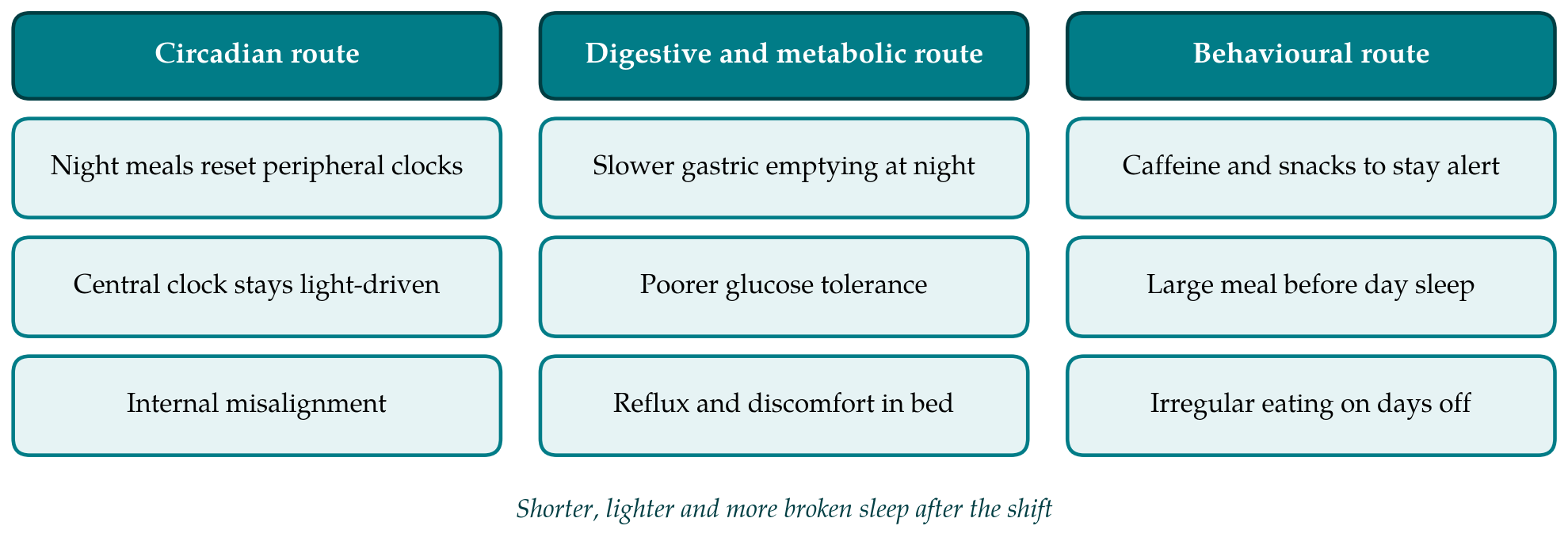
Three routes can be distinguished by which meal timing might impair sleep in a rotating worker. Figure 1 sets them side by side. They are not exclusive, and in a real roster they act together. Separating them matters all the same, because each points to a different remedy: the first to when food is eaten in relation to the body's clocks, the second to how much is eaten and how close to bed, and the third to the habits and substances that surround eating on a night shift. A study that records only whether staff eat at night cannot tell which of the three is at work.
5.1. Circadian misalignment
The first route runs through the clocks themselves. A worker who eats at night but is exposed to ordinary daylight on the way home keeps a central clock near its usual phase while liver, gut and adipose rhythms drift toward the new meal times. The result is internal misalignment, a state in which tissues disagree about the time of day. The clearest human test comes from a simulated night-work trial in which one group ate during both day and night and another ate only in the daytime. Daytime-only eating prevented the misalignment between central and glucose rhythms and the loss of glucose tolerance that night work otherwise produced (Chellappa et al., 2021). An earlier simulated-shift study reached a similar conclusion for glucose metabolism (Grant et al., 2017). These trials were designed around metabolic outcomes, and whether keeping the clocks aligned also improves sleep is suggested by the physiology but has not been shown as directly.
5.2. Digestive and metabolic load
The second route is more immediate. Gastric emptying, gut motility and glucose handling are all slower or less efficient in the biological night, so a meal eaten then stays longer in the stomach and produces a larger glycaemic excursion. Gastrointestinal complaints are among the most frequently reported health problems of shift workers (Knutsson, 2003), and discomfort or reflux on lying down is an obvious obstacle to falling asleep. In day-living volunteers studied with polysomnography, greater food intake close to the sleep period was associated with poorer sleep, more clearly in women (Crispim et al., 2011). A small crossover trial found that a high glycaemic index meal shortened the time taken to fall asleep when eaten four hours before bed but less so one hour before (Afaghi et al., 2007). The broader literature on diet and sleep is suggestive but uneven, and most of it concerns night sleep in people on conventional schedules (St-Onge et al., 2016).
5.3. Behaviours that keep workers awake
The third route is behavioural. Food and drink are used on night duty as tools against sleepiness: caffeine in the small hours, sweet snacks during the circadian trough, a substantial breakfast as a reward at the end of the shift. Each makes sense in the moment and each can carry into the sleep period that follows. Chronotype matters here. People who score as evening types on the Horne and Östberg questionnaire (Horne and Östberg, 1976) tend to eat later in any case and may tolerate night work differently from morning types, which means that meal timing and sleep quality could both reflect an underlying trait and not act on each other.
6. What Field Studies in Hospital Staff Can Show
Most field studies of hospital workers share a design. Staff complete a sleep questionnaire, most often the Pittsburgh Sleep Quality Index, together with a dietary recall or a set of questions about usual meal times, and the two are correlated. The Index summarises the previous month in seven components and a global score, with scores above five conventionally taken to indicate poor sleep (Buysse et al., 1989). It was built for people with a single habitual sleep period. A nurse who has worked days, nights and rest days within the reference month has no single habitual bedtime to report, and the instrument cannot separate sleep after night duty from sleep on days off. Daytime sleepiness scales such as the Epworth (Johns, 1991) have the same difficulty.
Dietary measurement has a parallel weakness. Recalls and frequency questionnaires are organised around breakfast, lunch and dinner, labels that lose their meaning on a night roster. Unless clock times are recorded for every eating occasion and matched to the shift worked that day, the exposure of interest is not really measured. Time-stamped food photographs or app-based logging, as used in studies of daily eating patterns (Gill and Panda, 2015), and wrist actigraphy for sleep would allow meal timing and sleep to be aligned shift by shift, but they have been used far less often than questionnaires.
Cross-sectional designs also leave the direction of effect open. Poor sleep changes eating: short sleep increases appetite and the pull of energy-dense food, and a worker who cannot sleep may get up and eat. An association between late eating and poor sleep is as compatible with sleep driving food timing as with the reverse. Workload, seniority, caring duties at home and commuting distance influence both. The observational literature therefore supports the statement that irregular, night-weighted eating and poor sleep cluster together in shift workers. It does not by itself show that changing meal times would improve sleep.
7. Implications for Hospitals and Staff
Existing guidance for shift workers already leans toward the daytime. A widely cited review recommends keeping to a normal day-oriented meal pattern as far as possible, avoiding or limiting intake between midnight and early morning, eating the main meal before the night shift, and taking a light breakfast before day sleep instead of a heavy one (Lowden et al., 2010). The simulated night-work trials give this advice a firmer mechanistic footing for metabolic health (Chellappa et al., 2021). Its benefit for sleep is plausible and unlikely to do harm, but it should be presented to staff as reasonable practice, not as a proven remedy for poor sleep. Nor should it be applied rigidly. Some workers find that a small snack during the night keeps them alert and safe, and fasting through a long shift is not appropriate for everyone, including staff with diabetes or those who are pregnant, who should follow individual clinical advice.
Advice directed at individuals has limits when the environment works against it. A nurse cannot eat a balanced meal at ten in the evening if the break comes at two and the only food on site is in a vending machine. Protected breaks early in the night shift, access to a place to store and heat food brought from home, and rosters that rotate forward with adequate recovery time are organisational measures, and they fall to employers and not to the individual worker (Gupta et al., 2019). Occupational health services are well placed to link the two levels, by raising meal timing in routine consultations with night staff and by reporting to management when the conditions for following the advice are absent. Staff who commute long distances across a city deserve particular attention, since the journey home delays both the last meal and the start of sleep.
8. Gaps and Future Work
The first gap is one of outcome. The best controlled trials of meal timing under night work measured glucose and hormones; sleep was controlled by protocol and not studied as a result. Trials that randomise night-shift eating schedules and record sleep by actigraphy or polysomnography on the following days are needed. The second gap is one of setting. Laboratory participants are usually young, healthy and new to night work, whereas hospital staff are older on average, predominantly women in nursing, and have rotated for years. Whether findings transfer is unknown.
A third gap concerns rotation as distinct from permanent night work. A rotating roster changes meal times every few days, and how quickly human peripheral clocks follow, and whether repeated re-timing is worse than a stable shifted pattern, has scarcely been examined outside animals. Finally, studies need to record chronotype, caffeine and the sequence of shifts, and to analyse sleep episode by episode. A within-person design, comparing the same worker's sleep after nights with early and late eating, would remove much of the confounding that weakens present evidence.
Measurement itself needs development. A sleep questionnaire written for rotating rosters, asking separately about sleep after night duty, after day duty and on rest days, would be more informative than a single monthly summary. Dietary instruments should abandon meal names in favour of clock times anchored to the shift worked. Reporting would also benefit from agreed definitions of terms such as night eating, eating window and meal regularity, which are at present used differently from one study to the next and make results hard to compare or to pool.
9. Conclusion
Rotating shift work moves eating into the biological night, and there are sound physiological reasons to expect that this affects sleep: food resets peripheral clocks, the gut handles meals poorly at night, and the stimulants and snacks used to stay awake outlast the shift. Controlled studies confirm the metabolic part of this account. For sleep itself the evidence in hospital staff is associative, drawn from questionnaires poorly suited to changing rosters. Day-weighted eating is sensible advice on present knowledge. Showing that it improves sleep will take trials and time-stamped field studies that have yet to be carried out.
Conflict of interest
To be declared by the author(s) before publication.
Funding
To be declared by the author(s) before publication.