1. Introduction
The benzimidazole ring is present in drugs as varied as the antiparasitic albendazole, the proton-pump inhibitor omeprazole and the antihypertensive candesartan, and in many agrochemicals, so routes to substituted benzimidazoles are of standing interest. The classical synthesis condenses an ortho-phenylenediamine with a one-carbon partner. A carboxylic acid gives the 2-substituted benzimidazole directly but needs forcing acidic conditions; an aldehyde gives an intermediate that is oxidised to the same product; and orthoesters, imidates and related reagents offer milder alternatives. These reactions are usually run by refluxing in hydrochloric acid, polyphosphoric acid or a high-boiling solvent, and the classical variants are collected in the review of Bansal and Silakari (2012).
Mechanochemistry proposes a different source of activation. Instead of heat carried in by a solvent, the reagents are ground together in a mill, and the energy released when grinding balls collide drives the reaction, frequently with no solvent at all (James et al., 2012). The approach has spread across synthetic chemistry, as the surveys of Do and Friscic (2017) and Howard et al. (2018) show, and benzimidazole formation is among the condensations to which it has been applied. This note summarises that specific literature. It presents no new results; it is a reading of published work intended to orient a chemist considering the method.
2. Two Condensation Routes in the Mill
The acid route and the aldehyde route both translate to the mill, and the choice between them in mechanochemistry follows much the same logic as in solution. Table 1 sets the two side by side. In the acid route the diamine and a carboxylic acid, or a derivative such as an anhydride, are milled together, sometimes with a solid acid or dehydrating additive to assist the double condensation and loss of water that closes the ring. In the aldehyde route the diamine and an aldehyde are milled to the dihydrobenzimidazole, which is then oxidised; the oxidant may be a mild solid reagent added to the jar or, in some reports, air. The general scope of solvent-free and mechanochemical heterocycle synthesis, benzimidazoles included, is reviewed by Leonardi et al. (2018) and, for green heterocyclic chemistry more broadly, by Martins et al. (2009).
| Route | One-carbon partner | Extra reagent in the jar | Note |
|---|---|---|---|
| Acid route | Carboxylic acid or anhydride | Solid acid or dehydrating additive, often | Direct to the 2-substituted product (Bansal and Silakari, 2012) |
| Aldehyde route | Aldehyde | Mild solid oxidant, or air | Via the dihydro intermediate, then oxidation |
| Either, assisted | As above | Catalytic grinding liquid | Liquid-assisted grinding raises conversion (Friscic et al., 2009) |
| Either, with care | As above | None beyond reagents | Jar heating means it is not truly cold (Stolle et al., 2011) |
A frequent and useful modification is liquid-assisted grinding, in which a catalytic quantity of a liquid is added to the otherwise dry mixture. The liquid is far below the amount that would dissolve the reagents, but it lubricates contact between particles and can steer the outcome; its role was defined and quantified by Friscic et al. (2009) through the ratio of liquid volume to reagent mass. For a condensation that expels water, a small amount of a protic or polar additive often raises conversion without turning the process into a solution reaction.
3. The Variables That Matter
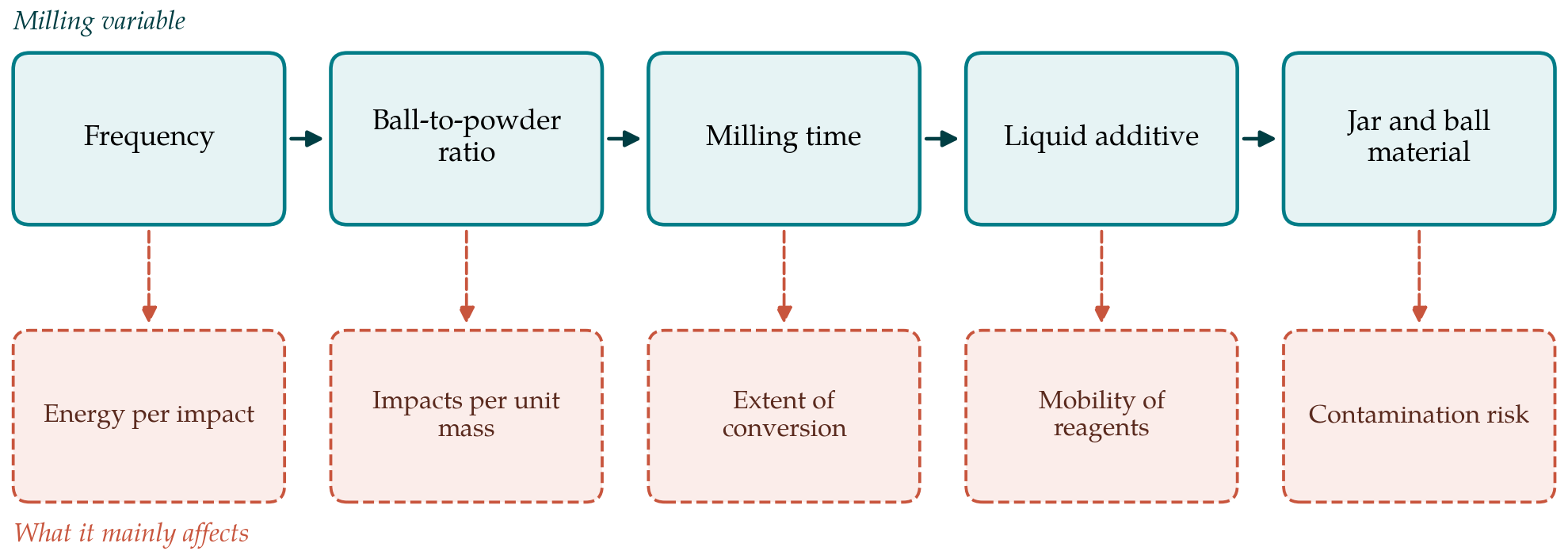
A planetary ball mill spins jars on a rotating carrier, so each ball experiences both the jar's motion and the carrier's, and the collisions are frequent and energetic. The outcome depends on how that energy is delivered. Figure 1 pairs the main operating variables with the quantity each chiefly governs. Milling frequency sets the energy of each impact; the ball-to-powder mass ratio sets how many impacts a given mass of reagent receives; and time sets the total dose and hence, up to a plateau, the conversion. The amount and nature of any grinding liquid tune reagent mobility, and the material of the jar and balls, commonly stainless steel, agate or zirconia, matters both for the energy transferred and for the risk of abrasion contaminating the product. A practical account of these parameters and of good reporting practice is given by Stolle et al. (2011).
Temperature is the awkward variable. The bulk charge warms as milling proceeds, and the transient temperature at a point of impact is higher still and short-lived, so a benzimidazole condensation in the mill is not strictly a room-temperature reaction even when no bath is used. Because this heating is hard to measure in a sealed jar, reports differ in how they treat it, and a reader comparing procedures should note whether and how temperature was monitored.
4. Advantages and Open Difficulties
The attractions are plain. Removing or greatly reducing the solvent cuts waste and avoids the strongly acidic media of the classical route, which fits the aims of green chemistry set out by Anastas and Warner (1998), and reactions in the mill are often quick. Against these sit real difficulties. Scale-up is the largest: a planetary mill is a batch device of limited jar volume, and moving to larger throughput means twin-screw extrusion or other continuous mechanochemical equipment rather than a bigger planetary jar (Do and Friscic, 2017). Reproducibility is a second concern, because outcomes depend on equipment details, the number and size of balls and the degree of jar filling that older reports did not always state. Reaction monitoring is a third, since taking the reaction apart to sample it disturbs it, although in situ methods that follow milling by diffraction or spectroscopy are maturing (Friscic et al., 2013). None of these is a reason to avoid the method; they are the matters on which careful practice and full reporting are needed.
5. Conclusion
The mechanochemical synthesis of substituted benzimidazoles in a planetary ball mill is now a well-populated corner of the literature rather than a curiosity. Both the acid and the aldehyde condensations have been carried out with little or no solvent, liquid-assisted grinding is a dependable way to raise conversion, and the behaviour is governed by a small set of operating variables that are by now reasonably well understood. The outstanding problems are scale, reproducible reporting and the measurement of temperature and progress, and these are shared with mechanochemistry generally. A chemist weighing the approach for a particular benzimidazole will find representative procedures and fuller discussion in the reviews cited here.
Conflict of interest
To be declared by the author(s) before publication.
Funding
To be declared by the author(s) before publication.