1. Introduction
The production of carbon fibre from polyacrylonitrile precursor is slow and energy intensive, and life cycle studies consistently find that the fibre accounts for most of the embodied energy of a carbon fibre reinforced polymer (Das, 2011; Duflou et al., 2009). That burden is repaid in aircraft, where mass saved translates into fuel saved over decades of service. In road vehicles the repayment is slower and less certain. Waste compounds the problem. Ply cutting, trimming and expired prepreg divert a substantial fraction of purchased fibre from the product, and the first generation of composite-intensive aircraft and wind turbine blades is approaching retirement (Pimenta and Pinho, 2011).
Landfill and incineration are the least attractive outlets, both environmentally and under European waste law, which sets reuse and recovery targets for end-of-life vehicles (European Parliament and Council, 2000). A set of recovery processes has therefore been developed, and several operate commercially. They return a fibre whose stiffness is close to that of the virgin material but whose form is very different: short, fluffy, of mixed length and stripped of its sizing (Pickering, 2006; Oliveux et al., 2015). The supply of such fibre has for some years been ahead of the demand for it.
This review considers one candidate market, the interior of the passenger car. It asks which processing routes can turn recovered fibre into interior components, what properties result, and where the material still falls short of what interior engineers require.
2. Scope and Approach
The article is a narrative review of published research, earlier reviews and standards known to the field. It does not report a systematic search and offers no new measurements. Interior parts are taken to mean semi-structural and trim components inside the cabin and luggage space: seat back shells and pans, instrument panel carriers, door inner modules, centre console structures, parcel shelves and load floors. Exterior body panels and crash structures are outside the scope, since they raise questions of surface class and energy absorption that deserve separate treatment. Thermoplastic matrices receive most attention because they dominate interior parts and suit short cycle times.
3. Why Interiors Suit a Discontinuous Fibre
Interior carriers are designed mainly for stiffness, dimensional stability across the cabin temperature range and acceptable behaviour in head and knee impact. Peak stresses are modest. The incumbent materials are long glass fibre polypropylene, glass mat thermoplastics and natural fibre mats pressed with polypropylene, all of them discontinuous and more or less random in fibre orientation. A recycled carbon fibre product therefore competes on familiar ground: it need not match a woven laminate, only offer higher specific stiffness than glass at a tolerable price.
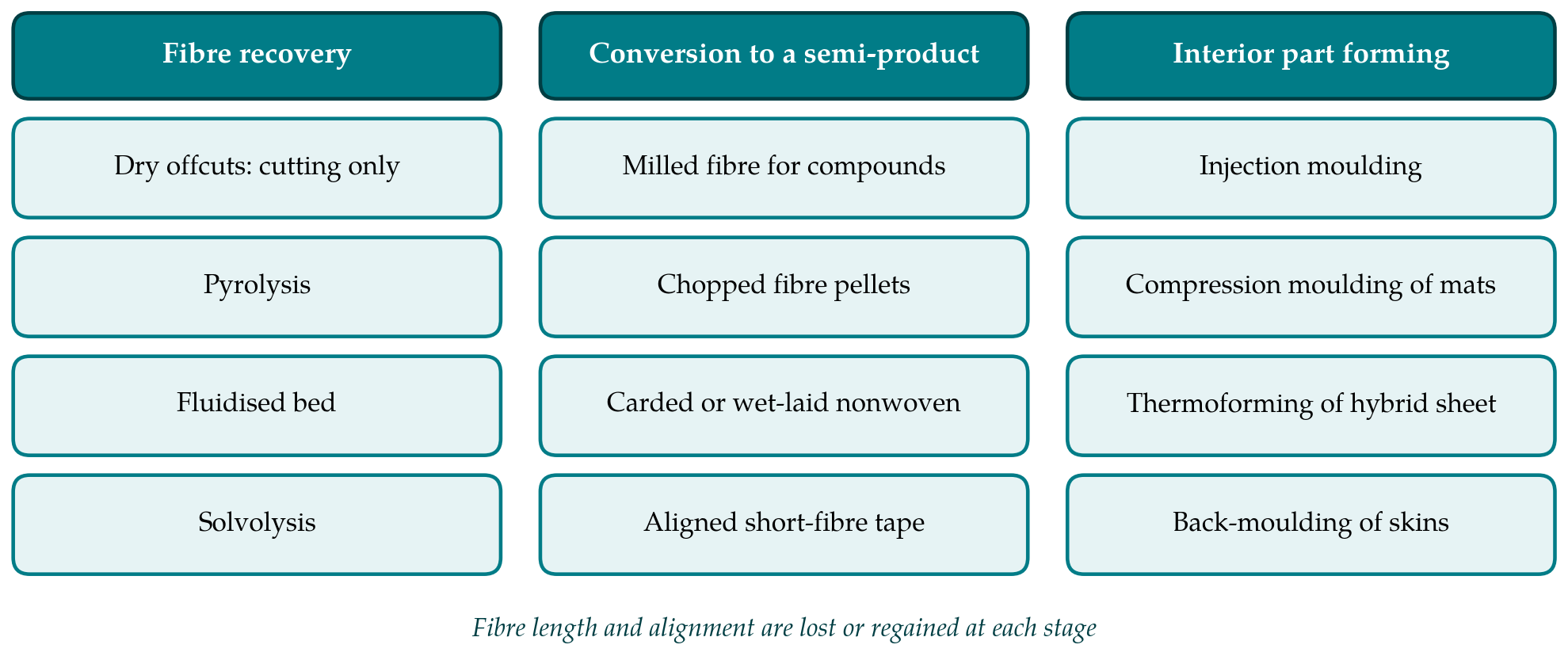
Composite theory indicates what is at stake. A short fibre carries load through shear at the interface, and it reaches its full strength only if it is longer than a critical length that depends on fibre strength, diameter and interfacial shear strength (Kelly and Tyson, 1965). Stiffness is far less sensitive to length than strength is, and both fall as orientation becomes random (Fu and Lauke, 1996; Hull and Clyne, 1996). A stiffness-driven part with fibres a few millimetres long is thus a reasonable target, whereas a strength-driven one is not. The remainder of this review follows the fibre through the three stages shown in Figure 1.
4. Recovering the Fibre
Dry offcuts from weaving and preforming need no chemical treatment and are simply cut or opened. Cured laminate and prepreg require removal of the matrix, and four families of process are described in the literature. Table 1 compares them.
| Route | How the matrix is removed | Condition of recovered fibre | Main limitation |
|---|---|---|---|
| Mechanical grinding | Not removed; laminate is shredded and milled | Short fibre bundles with adhering resin | Low-value filler only (Pickering, 2006) |
| Pyrolysis | Thermal decomposition in an oxygen-poor atmosphere | Stiffness retained; some strength loss; possible char | Narrow window between char residue and fibre oxidation |
| Fluidised bed | Oxidation in a hot sand bed with air | Clean, short, fluffy fibre; reduced strength | Attrition shortens fibre (Pickering et al., 2016) |
| Solvolysis | Dissolution in sub- or supercritical fluids | Clean surface; properties close to virgin | Pressure, corrosion and scale-up (Piñero-Hernanz et al., 2008) |
| Direct reuse of dry waste | No matrix present | Virgin properties; sizing intact | Limited, variable supply |
Pyrolysis is the most widely industrialised of these. The resin is driven off as gas and oil, leaving fibre that may carry a layer of char if conditions are too mild and that loses strength through surface oxidation if they are too severe. Published comparisons agree that well-controlled pyrolysis preserves fibre modulus almost completely and tensile strength to a large degree (Pimenta and Pinho, 2012; Oliveux et al., 2015). The fluidised bed process developed at the University of Nottingham tolerates contaminated and mixed waste, including painted parts and metal inserts, at the price of shorter fibre (Pickering et al., 2016). Solvolysis in water or alcohols under near-critical conditions gives the cleanest fibre and can recover useful chemicals from the resin, but it remains closer to pilot scale (Yang et al., 2012).
For interior use two aspects of recovery deserve emphasis. Residual char or resin fragments on the fibre are a potential source of odour and volatile emissions, so cleanliness matters for reasons beyond adhesion. And every process removes the original sizing, which leaves a fibre surface that bonds reasonably to epoxy (Jiang et al., 2008) but poorly to non-polar polyolefins.
5. Converting Fibre into a Usable Form
Recovered fibre has very low bulk density and will not feed through standard equipment. It must be converted into a semi-product, and the choice made here fixes the fibre length and orientation of the final part.
5.1. Compounds for injection moulding
The simplest route is to compound milled or chopped fibre with a thermoplastic and pelletise it. Fibre length falls to a fraction of a millimetre during extrusion and moulding, which caps strength, but stiffness, conductivity and dimensional stability improve markedly at low loadings. Work on polypropylene has shown that the reinforcing effect depends strongly on a coupling agent, typically a maleic anhydride grafted polypropylene, to compensate for the missing sizing (Wong et al., 2012). In engineering polymers such as polyphenylene sulphide, compounds made with recovered fibre have been reported to perform comparably to those made with virgin chopped fibre (Stoeffler et al., 2013). Brackets, housings and console structures are natural applications.
5.2. Nonwoven mats
Carding, air-laying and wet-laying, borrowed from the textile and paper industries, turn fibre tens of millimetres long into a mat. Blending thermoplastic staple fibre into the web gives a hybrid mat that can be heated and pressed in one step, much as natural fibre polypropylene mats already are in door panels and parcel shelves. Akonda et al. (2012) took a related approach, spinning recovered carbon fibre with polypropylene fibre into a hybrid yarn and consolidating it into a thermoplastic composite with a useful degree of alignment. The weakness of random mats is packing. A random, crimped web resists compaction, so fibre volume fraction stays low unless moulding pressure is high, and high pressure breaks fibre (Pimenta and Pinho, 2011).
5.3. Aligned discontinuous products
Alignment addresses the packing limit directly, since parallel fibres nest far more closely than random ones. Hydrodynamic methods, in which a dilute fibre suspension is accelerated through a converging nozzle or directed between plates, have produced tapes of short fibre with a high degree of orientation. The HiPerDiF process developed at the University of Bristol is the best documented example (Yu et al., 2014), and the same group has shown that aligned material can be reclaimed and remanufactured through more than one loop (Longana et al., 2016). Such tapes approach the stiffness of continuous fibre laminates. Their productivity and cost at automotive volumes are not yet established in the open literature.
6. Remaining Property Gaps
The mechanical gap is clearest in strength and toughness. Random mats and compounds deliver attractive stiffness per unit mass, yet their tensile and impact strengths are limited by short fibre length, low volume fraction and the weak polyolefin interface. Carbon fibre has a lower strain to failure than glass, so a part that must deform without splintering in a head impact may need hybridisation with glass or polymer fibre, or a ductile skin. Fatigue and creep data at cabin temperatures, which carrier designers need for long-term sag predictions, are sparse for recycled grades.
Variability is the second gap. A recycler's feedstock mixes fibre types of different modulus, resin systems and laminate forms, and the output reflects the mix. Virgin fibre is sold against a specification with guaranteed minima. Recovered fibre is only beginning to be classified in a comparable way, and without grades and design allowables an engineer cannot sign off a safety-relevant interior part (Zhang et al., 2020).
Interior-specific requirements form a third group that the composites literature has largely ignored. Cabin materials must pass a horizontal burning-rate test (ISO, 1989) and manufacturer limits on volatile organic compounds, fogging and odour. Residual pyrolysis char, coupling agents and recycled matrix polymers all bear on these tests, and very little has been published. Carbon fibre is also electrically conductive: this helps electromagnetic shielding but can promote galvanic corrosion of metal inserts and fasteners. Finally the material is black, which restricts visible applications to covered or painted parts.
7. Environmental and Cost Evidence
The environmental case rests on avoiding virgin fibre production. Assessments of recycling against landfill and energy recovery find a clear benefit when the recovered fibre displaces virgin carbon fibre, and a much smaller or doubtful one when it displaces glass (Witik et al., 2013). For automotive parts specifically, Meng et al. (2017) modelled components made from fibre recovered in a fluidised bed and concluded that they could lower life cycle energy and emissions relative to steel and to virgin composites, with the outcome depending on the fibre content achieved and the mass saved in use. A companion financial analysis reached a cautiously positive view of cost, again conditional on conversion efficiency (Meng et al., 2018).
Both findings return the discussion to processing. A low-density random mat that needs thick walls to reach its stiffness target saves little mass, and with it little fuel or battery energy. The environmental and commercial arguments are strongest for exactly those aligned, high-fibre-content products whose manufacture is least mature.
8. Priorities for Further Work
Four needs stand out. The first is open data on emissions, odour and flammability of recycled fibre thermoplastics, measured by the methods interior suppliers actually use. The second is a grading system for recovered fibre that reports length distribution, modulus class and surface cleanliness in a form that purchasers can specify. The third is sizing or surface treatment designed for recovered fibre in polypropylene, applied economically to a low-density fluffy feed. The fourth is evidence at part level: published studies of complete carriers or seat shells, with cycle times, scrap rates and second-life recyclability, would do more to establish the market than further coupon tests.
9. Conclusion
Recovering carbon fibre from waste is a solved problem in the laboratory and a working business at industrial scale. Using it well is the unfinished part. Automotive interiors offer stiffness-driven, discontinuous-fibre applications in which recovered fibre can compete, and the processing routes exist to make compounds, mats and aligned tapes from it. What remains is to close the gaps in strength and impact behaviour, in consistency of supply, and in the cabin-specific properties that decide whether a material is approved at all. Progress on alignment and on interface chemistry will determine how much of the environmental promise is realised.
Conflict of interest
To be declared by the author(s) before publication.
Funding
To be declared by the author(s) before publication.